You've probably heard this one before. "Keep your rest periods short. Sixty seconds max. Chase the pump. That burning feeling means it's working."
It's one of the most repeated pieces of gym advice out there. And for decades, it wasn't questioned much. The logic seemed airtight: shorter rest = more metabolic stress = bigger hormone spike = more muscle. Bodybuilders swore by it. Fitness magazines printed it as gospel. Personal trainers set their stopwatches to 60 seconds and never looked back.
Then researchers actually tested it. And the results surprised almost everyone.
What Did the Schoenfeld 2016 Rest Period Study Find?
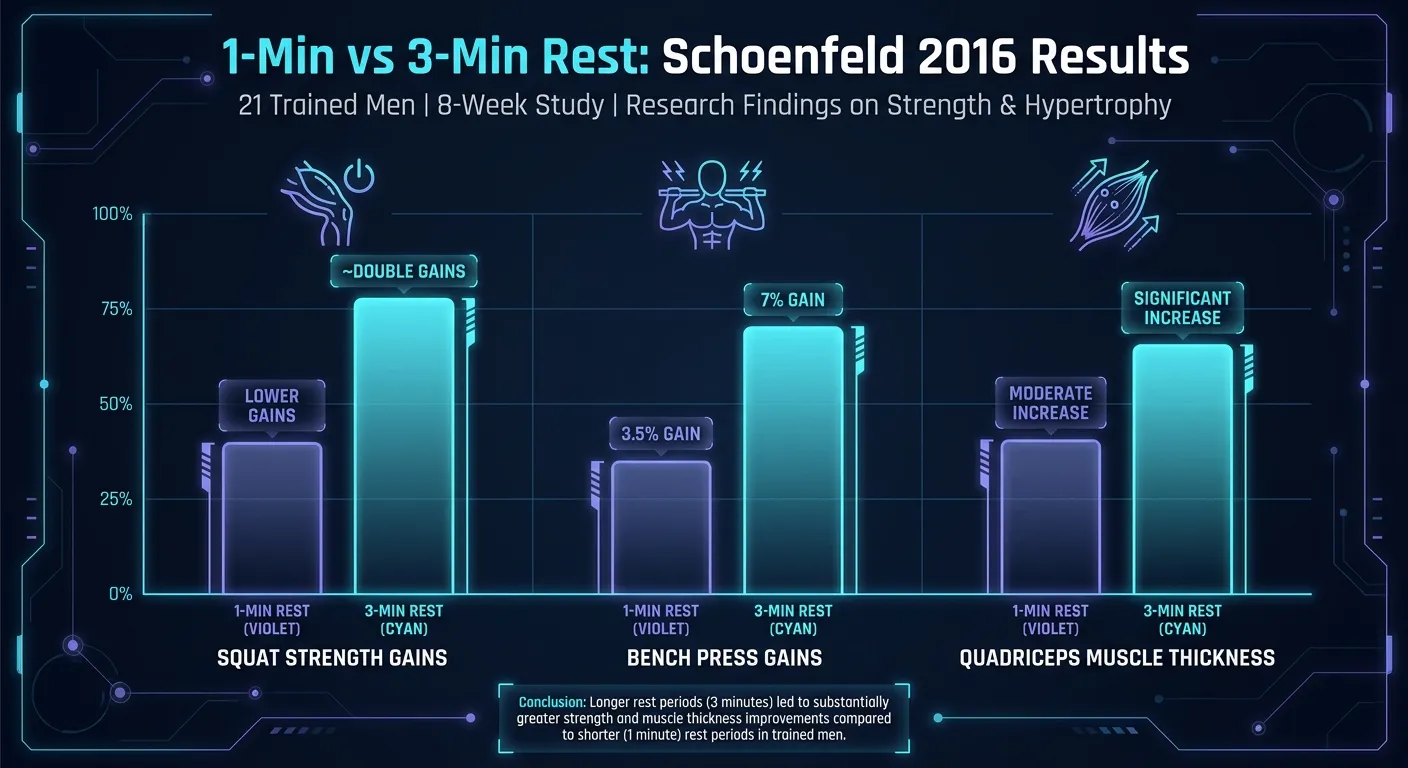
The study found that 3-minute rest periods produced significantly greater strength gains and greater quadriceps growth than 1-minute rests over 8 weeks in trained men. In 2016, Brad Schoenfeld (one of the most cited hypertrophy researchers in the world) published a study that directly pitted short rest periods against long ones. Not in untrained beginners. In guys who already knew their way around a squat rack.
Study Design: Schoenfeld et al. (2016)
Twenty-one resistance-trained men were randomly assigned to two groups. Both groups followed the exact same program: 3 full-body workouts per week, 7 exercises per session, 3 sets of 8-12 reps to failure. Same exercises. Same volume. Same intensity. The only variable that changed was rest between sets.
- SHORT group: 1 minute between sets
- LONG group: 3 minutes between sets
They trained for 8 weeks. Researchers measured 1RM strength on squat and bench press, muscular endurance, and muscle thickness via ultrasound at three sites: elbow flexors (biceps), triceps, and anterior thigh (quads).
The Results: Longer Rest Won on Almost Every Measure
Here's where the "short rest for hypertrophy" crowd took a hit.
Strength: The 3-minute group increased their back squat 1RM significantly more than the 1-minute group. Same story for bench press. The longer-rest group saw roughly double the strength gains (about 7% vs 3.5% for bench press).
Muscle growth: The 3-minute group showed significantly greater increases in quadriceps muscle thickness. There was also a trend toward greater triceps growth (p = 0.06) that didn't quite reach statistical significance but pointed in the same direction. Biceps growth was similar between groups.
The takeaway was clear: resting 3 minutes between sets produced superior strength gains and at least equal (likely greater) muscle growth compared to 1-minute rest periods, even when everything else was identical (Schoenfeld et al., 2016).
Muscle growth is only one of the jobs a rest interval does, and the number moves when the goal moves. Our blog post on how long to rest between sets lays the strength, hypertrophy and endurance ranges side by side.
This wasn't a fringe finding from an obscure lab. It was published in the Journal of Strength and Conditioning Research, the flagship journal of the National Strength and Conditioning Association, and it fundamentally shifted how evidence-based coaches think about rest intervals.
Do Short Rest Periods Build More Muscle?
No. The evidence says short rests don't build more muscle, and the hormone-spike logic behind them hasn't held up. So how did the fitness world get this wrong for so long? Two words: hormonal hypothesis.
The Growth Hormone Myth
The old reasoning went like this: short rest periods create more metabolic stress. More metabolic stress triggers a bigger acute spike in growth hormone and testosterone. More hormones = more muscle. Simple, right?
Except it doesn't actually work that way.
In 2014, Henselmans and Schoenfeld reviewed the evidence on rest intervals and hypertrophy in Sports Medicine. Their conclusion was blunt: the transient hormonal spikes caused by short rest intervals have a "weak" relationship with actual long-term muscle growth. None of the studies measuring real hypertrophy outcomes found that shorter rest intervals produced more muscle than longer ones. One study found the opposite (Henselmans & Schoenfeld, 2014).
The acute hormone spike after a tough set? It's real. But it's also transient and localized, and based on the evidence, it's not the driver of long-term muscle protein synthesis that people assumed it was. The pump feels like it's doing something. The science says the actual growth signal comes from somewhere else.
What Actually Drives Muscle Growth
The primary driver of hypertrophy is mechanical tension. The force your muscles generate against resistance over time. And here's the thing about mechanical tension: it requires you to actually lift heavy enough, for enough reps, with good technique.
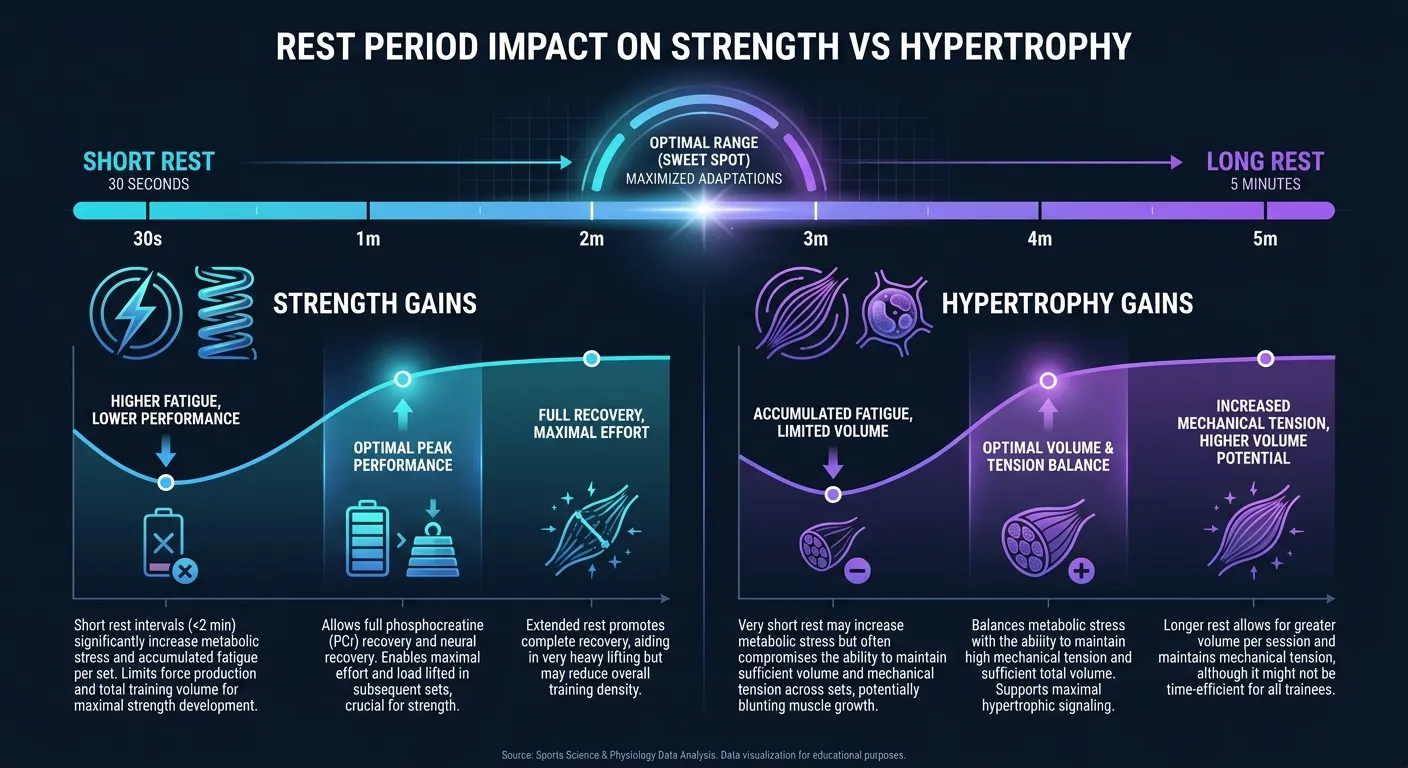
When you rest only 60 seconds between sets, something predictable happens. Your performance drops. Set 1 might be 10 reps at a challenging weight. Set 2 drops to 7. Set 3, maybe 5. You're accumulating fatigue faster than you're recovering, so each set delivers less mechanical tension than it could. There is a way to buy the time back without cutting the rest interval itself, and our review of what a superset is and what the research shows covers the evidence on filling that rest with work for a muscle group that is not recovering.
Rest 3 minutes, and you can hit 10, 9, 8. More total reps. More weight maintained across sets. More mechanical tension accumulated over the session. That's the mechanism behind Schoenfeld's findings. Not some magic property of waiting longer, but the simple reality that recovered muscles do more productive work.
What the Broader Research Says
The broader evidence points the same direction: systematic reviews and a 2024 Bayesian meta-analysis favor rest intervals longer than 60 seconds for trained lifters, with diminishing returns past about 90 seconds. Schoenfeld's 2016 study was the catalyst, but it wasn't the last word. Several other research groups have weighed in since then.
Grgic et al. (2017): Systematic Review
A year after Schoenfeld's study, Grgic and colleagues published a systematic review in the European Journal of Sport Science examining all available evidence on short vs. long rest intervals for hypertrophy. They reviewed six studies that met their inclusion criteria. Their conclusion: both short and long rest intervals can produce hypertrophy, but "novel findings involving trained participants using measures sensitive to detect changes in muscle hypertrophy suggest a possible advantage for the use of long rest intervals" (Grgic et al., 2017).
Translation: if you're already trained and we measure carefully, longer rest probably wins.
de Salles et al. (2009): The Foundation
Even before Schoenfeld's study, the writing was on the wall. A comprehensive review by de Salles and colleagues in Sports Medicine examined 35 studies on rest intervals. For maximal strength, the evidence was already clear: 3-5 minutes between sets produced greater increases in absolute strength due to higher training intensities and volumes. For hypertrophy, they noted that 1-2 minutes was commonly recommended but acknowledged the evidence was far from settled (de Salles et al., 2009).
Singer et al. (2024): The Meta-Analytic Verdict
The most comprehensive look at the question came in 2024. Singer and colleagues published a Bayesian meta-analysis in Frontiers in Sports and Active Living that pooled all available evidence on rest interval duration and hypertrophy. Their finding: a small hypertrophic benefit exists for rest intervals longer than 60 seconds, but no appreciable difference was detected once rest exceeded 90 seconds (Singer et al., 2024).
This is an important nuance. The research doesn't say "more rest is always better." It says: don't cut your rest short. Getting from 60 seconds to 2 minutes matters a lot. Getting from 2 minutes to 5 minutes? Probably not worth the extra gym time for hypertrophy, though it may still benefit maximal strength.
Enjoying the article?
Start a new fitness routine today, written by me and coached by the AI I designed.
Take the Free Assessment Free · 2 minutes · No credit cardCommon Misconceptions About Rest Periods
This is one of those topics where gym culture and exercise science have been talking past each other for decades. Let's clear up the biggest misunderstandings.
Misconception 1: "Short rest keeps your heart rate up, so it burns more fat"
This one's technically true but practically misleading. Yes, shorter rest periods elevate heart rate and increase caloric expenditure during the session. But the difference is modest, maybe 50-100 extra calories over an hour. Meanwhile, the reduced training volume from inadequate rest means less mechanical tension, less muscle stimulus, and potentially less muscle built over time. Since muscle tissue is metabolically active (it burns calories at rest), the long-term fat loss math actually favors building more muscle, which means resting enough to train effectively.
If conditioning is your primary goal, train for conditioning. If muscle is your goal, rest enough to actually build it.
Misconception 2: "The pump means the muscle is growing"
The pump (that tight, swollen feeling in the muscle during and after training) is caused by cellular swelling and metabolite accumulation. It feels great. It looks impressive in the mirror. But it's primarily a temporary fluid shift, not a reliable indicator of hypertrophic stimulus.
Henselmans and Schoenfeld (2014) made this point directly: the metabolic byproducts associated with "the pump" don't correlate well with actual long-term muscle growth. You can get an incredible pump from doing 100 reps with an empty bar. Nobody's building significant muscle that way.
Misconception 3: "If you need 3 minutes of rest, you're being lazy"
This is gym culture at its worst: confusing suffering with productivity. Sitting on a bench for 3 minutes between heavy squats isn't laziness. It's allowing your phosphocreatine stores to replenish so your next set actually challenges your muscles meaningfully. Rushing back under the bar while still gassed doesn't make you tougher. It makes your next set worse.
The research is clear: those "wasted" minutes of rest are what allow you to maintain the training quality that drives adaptation.
How Long Should You Rest Between Sets for Muscle Growth?
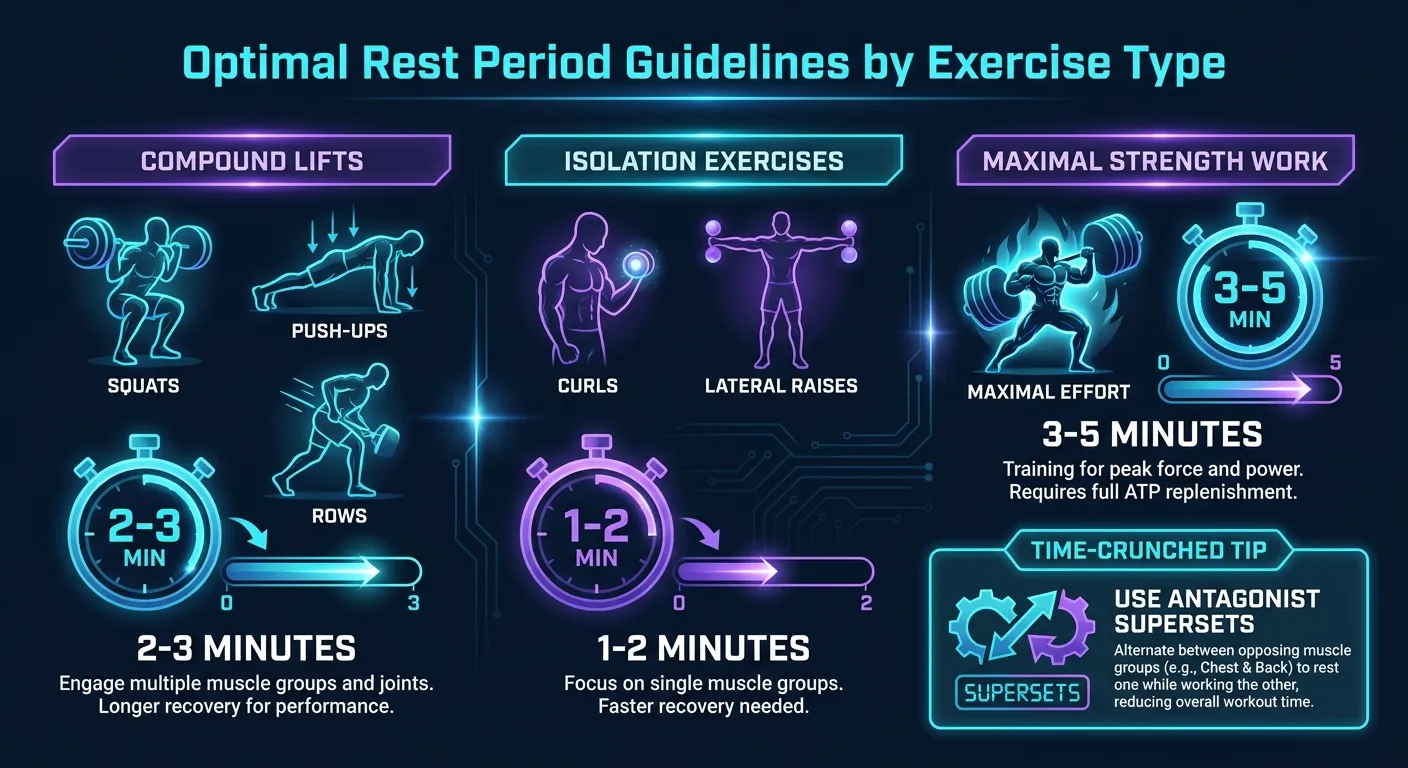
The short answer: rest 2-3 minutes on compound lifts, 1-2 minutes on isolation exercises, and 3-5 minutes for maximal strength work. Here's what the research suggests if you want to apply this to your own training.
| Exercise Type / Goal | Recommended Rest | Why |
|---|---|---|
| Compound lifts (squat, deadlift, bench, rows) | 2-3 minutes | Large muscle groups and heavy loads need more recovery to maintain volume and mechanical tension |
| Maximal strength work (1-3 reps from failure) | 3-5 minutes | Phosphocreatine replenishment supports higher training intensities (de Salles et al., 2009) |
| Isolation exercises (curls, lateral raises) | 1-2 minutes | Smaller muscles, lighter loads, and lower neural demand recover faster |
| Muscular endurance / conditioning | 30-60 seconds | Short rest raises cardiovascular demand, which is the goal here |
| Time-crunched sessions | Antagonist supersets | Pairing push and pull movements preserves per-muscle recovery without stretching session length |
For Compound Movements (Squats, Deadlifts, Bench Press, Rows)
Rest 2-3 minutes between sets. These exercises involve large muscle groups, heavy loads, and high neural demand. They need more recovery between sets to maintain performance. If you're going truly heavy (within 1-3 reps of failure), 3-5 minutes may be warranted for strength-focused blocks.
For Isolation Movements (Curls, Lateral Raises, Tricep Extensions)
Rest 1-2 minutes between sets. Smaller muscle groups recover faster. The load is lighter. The neural demand is lower. You don't need 3 minutes between sets of bicep curls, but you also don't need to rush. Let your breathing normalize and your target muscle feel ready.
For Time-Crunched Workouts
If you only have 30-40 minutes, shorter rest periods may be a practical necessity. That's fine. Some training with shorter rest is better than no training because you didn't have 90 minutes. The research shows the difference between rest durations is real but modest for hypertrophy. It's not the difference between gaining muscle and not gaining muscle. It's an optimization, not a requirement.
A smart approach: use antagonist supersets. Pair a push with a pull (bench press + rows, for example). You rest the pushing muscles while the pulling muscles work, and vice versa. Total session time stays reasonable, but each muscle group gets adequate recovery between its own sets.
Why This Matters If You've Been Quitting Workouts
Here's something the research papers don't address but we see constantly: people abandon training programs partly because they feel terrible during workouts. And rushing through sets with minimal rest is a reliable way to feel terrible.
When every set feels like you're drowning (gasping for air, muscles burning, nausea creeping in), that's not a sustainable experience. You might white-knuckle through it for a few weeks. But if you've tried fitness programs before and quit, ask yourself: was the program demanding recovery you never got? Research on deload weeks reinforces the same principle: planned recovery periods, whether between sets or between training blocks, are what reveal the fitness you've been building.
Adequate rest periods don't just build more muscle. They make the workout experience less miserable. You catch your breath. Your muscles feel ready for the next set. You can actually focus on technique instead of just surviving. That matters for long-term adherence, which is the variable that determines whether any program works or doesn't.
If you've ever felt guilty about "resting too long," let this be your permission slip. The science backs you up.
How FitCraft Programs Rest Periods
FitCraft's AI coach Ty doesn't use a one-size-fits-all rest timer. Rest intervals are programmed based on the specific exercise, your training goal, and how you're progressing, because the research makes clear that context matters.
- Compound movements get longer rest. When Ty programs squats, rows, or push-ups, rest periods reflect the higher recovery demands of multi-joint exercises. No rushing you back into the next set before you're ready.
- Isolation work gets shorter rest. Bicep curls and lateral raises don't need 3 minutes. Ty adjusts accordingly, keeping your session efficient without sacrificing stimulus.
- Rest adapts as you progress. As you get stronger and your work sets become more demanding, rest intervals adjust. What worked in week 2 may not be enough by week 8. The AI tracks this so you don't have to.
- The free version includes this. Evidence-based programming isn't locked behind a paywall. Ty's rest period recommendations are part of the core experience, because getting this wrong undermines everything else in the program.
Programs designed by Domenic Angelino, FitCraft's Chief Exercise Scientist (MS Kinesiology, MPH from Brown University, NSCA-CSCS), who has published in the Journal of Strength and Conditioning Research, Medicine & Science in Sports & Exercise, and Frontiers in Physiology.
What the Research Suggests Going Forward
The rest interval question isn't fully settled. No scientific question ever is. A few honest caveats:
- Most studies use trained young men. The 2016 Schoenfeld study included 21 resistance-trained males. We need more data on women, older adults, and true beginners to know if the effects generalize.
- The hypertrophy differences are modest. The 2024 Bayesian meta-analysis found a small effect. We're not talking about the difference between gaining 5 pounds of muscle and gaining 20. For most people, training consistency matters far more than rest period optimization. And on the topic of recovery, the active recovery research shows the same pattern: rest between sessions is as important as rest between sets.
- Practical constraints are real. If resting 3 minutes between every set means your workout takes 2 hours, that's a problem. Time efficiency matters for adherence, and adherence is the biggest predictor of results.
- Individual variation exists. Some people recover faster between sets than others. Heart rate recovery, training age, sleep quality, nutrition: all of these affect how much rest you actually need.
The current consensus: don't rush your rest periods on compound lifts. Two to three minutes is a solid default. If you've been doing 60 seconds because someone told you it was better for hypertrophy, the evidence says otherwise. But don't obsess over it either. Consistent training with adequate rest will outperform any rest period protocol done sporadically. The same logic applies to progressive overload: the injury prevention research shows that adequate strength volume beats any single training variable for long-term resilience.
References
- Schoenfeld BJ, Pope ZK, Benik FM, et al. "Longer Interset Rest Periods Enhance Muscle Strength and Hypertrophy in Resistance-Trained Men." Journal of Strength and Conditioning Research. 2016;30(7):1805-1812. doi:10.1519/JSC.0000000000001272
- Henselmans M, Schoenfeld BJ. "The Effect of Inter-Set Rest Intervals on Resistance Exercise-Induced Muscle Hypertrophy." Sports Medicine. 2014;44(12):1635-1643. doi:10.1007/s40279-014-0228-0
- Grgic J, Lazinica B, Mikulic P, Krieger JW, Schoenfeld BJ. "The effects of short versus long inter-set rest intervals in resistance training on measures of muscle hypertrophy: A systematic review." European Journal of Sport Science. 2017;17(8):983-993. doi:10.1080/17461391.2017.1340524
- de Salles BF, Simao R, Miranda F, et al. "Rest Interval between Sets in Strength Training." Sports Medicine. 2009;39(9):765-777. doi:10.2165/11315230-000000000-00000
- Singer A, Wolf M, Generoso L, et al. "Give it a rest: a systematic review with Bayesian meta-analysis on the effect of inter-set rest interval duration on muscle hypertrophy." Frontiers in Sports and Active Living. 2024;6:1429789. doi:10.3389/fspor.2024.1429789
Frequently Asked Questions
How long should you rest between sets for muscle growth?
Research suggests resting 2-3 minutes between sets optimizes muscle growth. The Schoenfeld et al. (2016) study found that 3-minute rest periods produced significantly greater hypertrophy in the quadriceps compared to 1-minute rest periods over 8 weeks of training. A 2024 Bayesian meta-analysis confirmed a small benefit to longer rest intervals, though differences above 90 seconds appear modest for hypertrophy specifically.
Do short rest periods build more muscle because of the pump?
No. The idea that short rest periods build more muscle through greater metabolic stress and hormone release has been largely debunked. Henselmans and Schoenfeld (2014) showed that acute hormonal spikes from short rest intervals do not translate to greater long-term muscle growth. The "pump" feels productive but the actual growth signal comes from mechanical tension, which requires adequate recovery between sets to maintain training volume and intensity.
Are short rest periods ever better than long rest periods?
Short rest periods (30-60 seconds) can be useful for muscular endurance training and time-efficient workouts. They also produce greater cardiovascular demand, which matters if conditioning is a goal. However, for maximizing strength and muscle size, the research consistently favors rest periods of 2-3 minutes. The trade-off is real: shorter rests save time but reduce the weight and reps you can handle on subsequent sets.
Does FitCraft program rest periods based on this research?
Yes. FitCraft's AI coach Ty programs rest intervals based on exercise type, training goal, and individual progress. For compound strength movements, Ty prescribes longer rest periods (2-3 minutes) to maximize mechanical tension and volume. For isolation or endurance-focused work, rest periods are adjusted shorter. The app's timer adapts as your fitness level changes, so your rest periods evolve with you.
What did the Schoenfeld 2016 rest period study find?
The Schoenfeld et al. (2016) study published in the Journal of Strength and Conditioning Research compared 1-minute vs 3-minute rest periods in 21 resistance-trained men over 8 weeks. The 3-minute group gained significantly more strength on both squat and bench press, and showed significantly greater muscle thickness in the quadriceps. These findings challenged the long-held belief that shorter rest periods were superior for hypertrophy.