You've probably heard it a thousand times: stretch before you work out or you'll get hurt. Maybe you've sat on a gym floor pulling your hamstrings for 30 seconds per side, hoping that ritual would keep your knees and back safe. Turns out, the largest body of evidence we have says that advice is wrong, or at least deeply incomplete.
The real injury shield? Picking up heavy things. Repeatedly. With progressive overload. That holds for small muscles too, and the neck is the one almost nobody loads: our guide to neck strengthening exercises covers the six moves and the resistance the trials used.
Two landmark meta-analyses by Lauersen and colleagues, published in the British Journal of Sports Medicine in 2014 and 2018, analyzed tens of thousands of participants across dozens of randomized controlled trials. Their conclusion was blunt: strength training is the single most effective exercise intervention for preventing sports injuries. Stretching alone? Statistically, it does almost nothing.
Let's break down exactly what they found, what it means for your training, and why this should change how you think about injury prevention, whether you're a weekend runner, a gym regular, or someone just starting out.
The Research: Two Meta-Analyses That Changed the Conversation
Before we get into the numbers, a quick note on why these studies carry so much weight. Meta-analyses pool data from multiple randomized controlled trials, the highest level of evidence in sports science. A single study can be a fluke. When you combine dozens of studies and thousands of participants, the signal gets very hard to dismiss.
Lauersen et al. (2014): The Original Bombshell
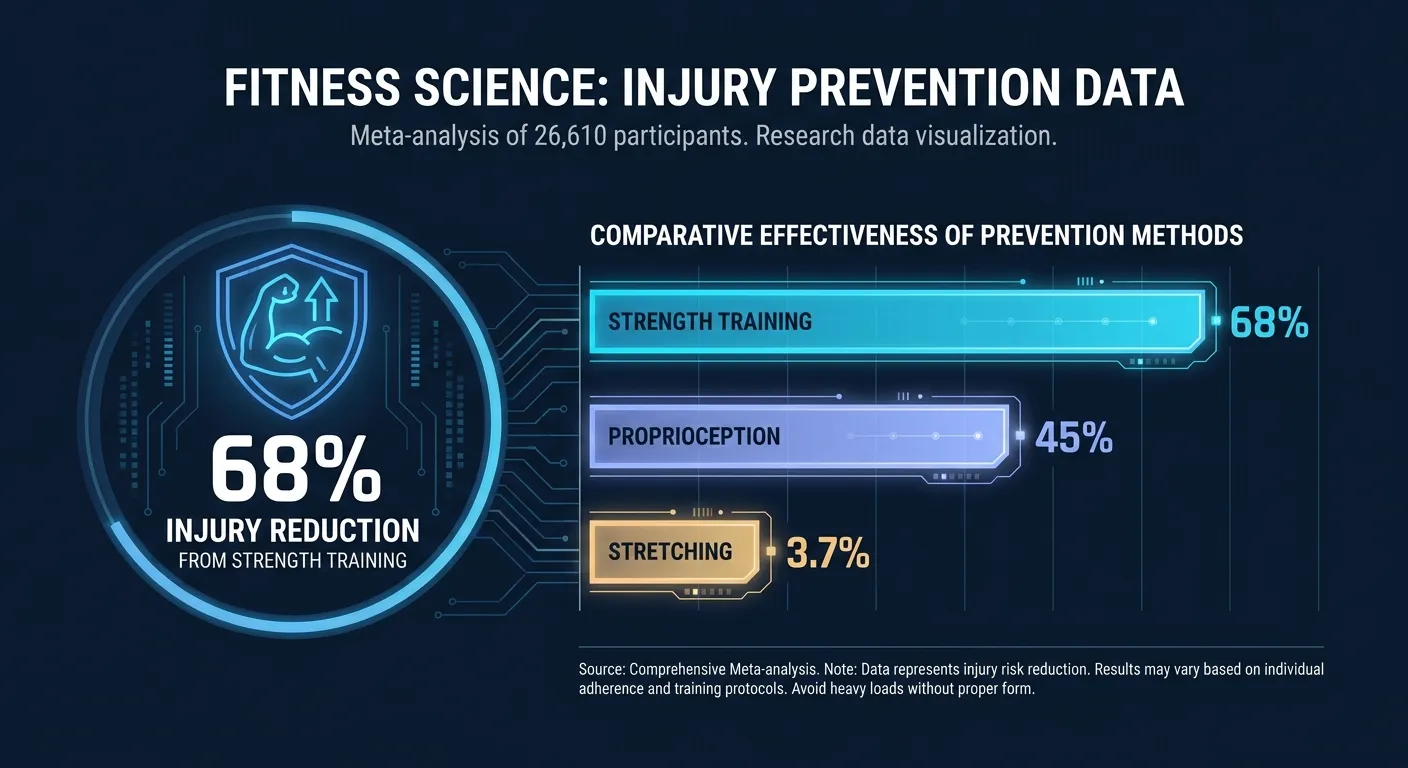
The first study, published in British Journal of Sports Medicine (2014;48:871-877), analyzed 25 trials with a combined 26,610 participants and 3,464 documented injuries. The researchers compared four types of exercise interventions: strength training, stretching, proprioception training, and multi-component programs.
The results weren't even close:
- Strength training: Reduced injury risk by approximately 68% (RR 0.315). That means strength-trained participants sustained roughly one-third the injuries of control groups.
- Proprioception training: Reduced injuries by about 45%. Solid, but not in the same league.
- Stretching: Relative risk of 0.963, essentially no effect. A 3.7% reduction that wasn't statistically significant.
- Multi-component programs: Mixed results depending on what was included.
Here's the part that really stands out: across the four strength training studies analyzed, there was zero statistical heterogeneity (I² = 0%). That's rare in exercise science. It means every single strength training program tested produced a similar protective effect, regardless of the specific protocol. The signal was consistent and strong.
Lauersen et al. (2018): Confirming and Expanding
Four years later, the same research group published a focused follow-up in BJSM (2018;52:1557-1563), this time zeroing in exclusively on strength training-based prevention trials. They analyzed data from 7,738 participants aged 12 to 40 who sustained a total of 177 acute or overuse injuries.
The cluster-adjusted intention-to-treat analysis produced a relative risk of 0.338 (95% CI: 0.238-0.480), consistent with the 2014 findings and holding up across multiple robustness tests. The strength of evidence was rated high.
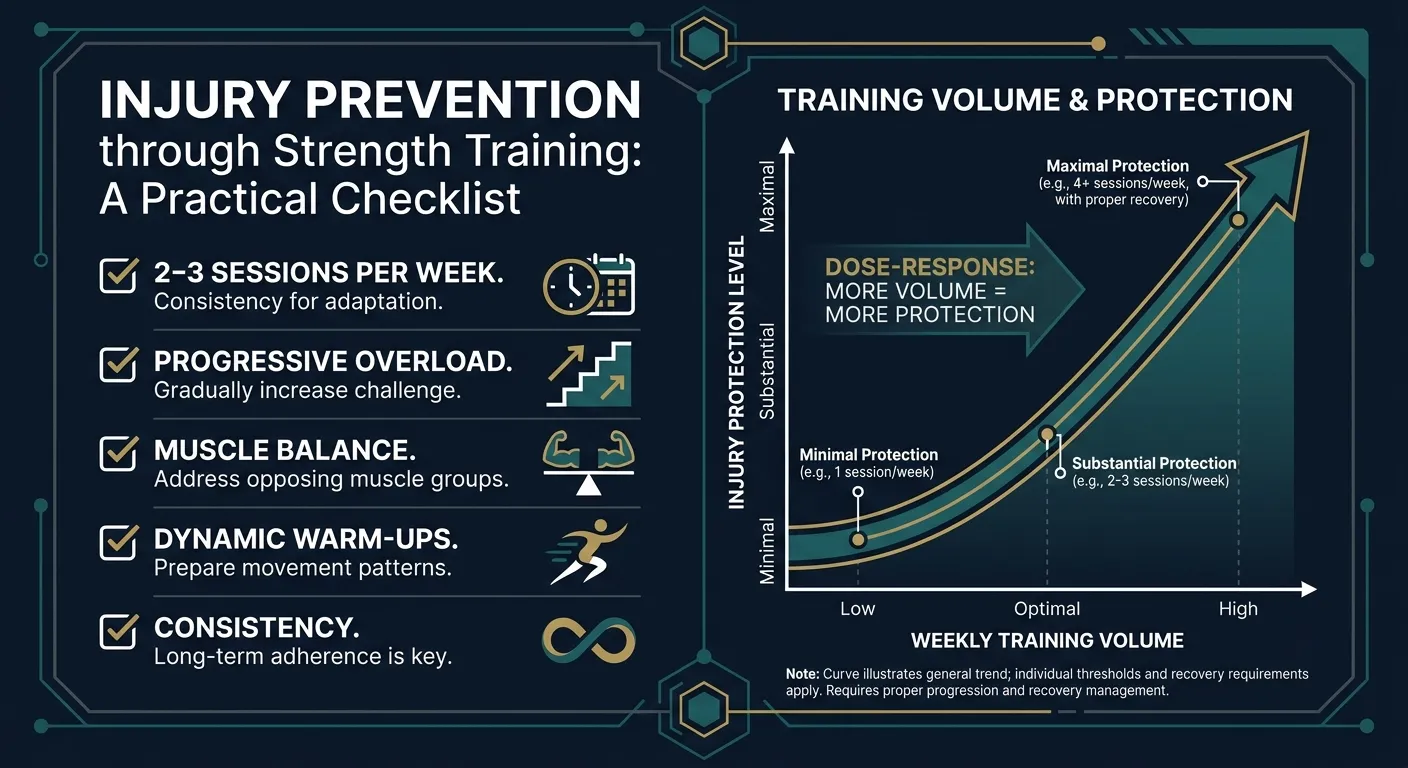
But the 2018 study added something crucial: a clear dose-response relationship. Every 10% increase in strength training volume reduced injury risk by more than four percentage points. More training volume meant more protection, and the researchers found no upper threshold where additional training became counterproductive or unsafe.
In plain language: the more you strength train (within reason), the more protected you are. And nobody in these studies got injured from the strength training itself.
What About Warm-Ups?
If stretching doesn't prevent injuries, what about warming up? Fradkin et al. (2006) conducted a systematic review of RCTs examining warm-up protocols and injury risk. Of five high-quality studies reviewed, three found significant injury prevention benefits from warming up, but only when warm-ups included active movement patterns, not just static stretching.
The takeaway: a warm-up that includes light movement and dynamic preparation likely helps. But sitting on the floor touching your toes for two minutes is not the protective ritual most people think it is.
Why Stretching Doesn't Prevent Injuries (And Why That's Okay)
This is the part that surprises people the most. We've been told since middle school PE that stretching prevents injuries. So what happened?
The short answer: the claim was never well-supported. It was repeated so often it became assumed truth. When researchers actually tested it in controlled trials, the effect simply wasn't there.
Behm et al. (2016) published a comprehensive systematic review of 125 studies in Applied Physiology, Nutrition, and Metabolism examining the acute effects of different stretching types on performance, range of motion, and injury incidence. Their findings added nuance to the stretching conversation:
- Static stretching before exercise produced a mean performance impairment of 3.7%. It actually made people slightly weaker and slower immediately afterward.
- Dynamic stretching showed a small performance improvement of about 1.3%.
- Neither type showed reliable injury prevention benefits in isolation.
Now, here's what's important: this doesn't mean you should never stretch. Stretching improves range of motion. It may aid recovery. It feels good. Some people need it for specific mobility limitations. But if you're stretching instead of strength training because you think it's keeping you injury-free, the evidence says you're protecting yourself with a placebo.

Why Strength Training Works: The Mechanisms
Understanding why strength training prevents injuries makes the research results feel less surprising and more inevitable.
Stronger Tissues Handle More Stress
This is the most straightforward mechanism. Progressive resistance training doesn't just make muscles bigger. It strengthens tendons, ligaments, and bones. Tendons adapt to loading by increasing collagen cross-linking and stiffness. Bones respond to mechanical stress by increasing density. When these tissues are stronger, the forces that would normally cause a sprain, strain, or stress fracture are absorbed without damage.
Think of it like upgrading from a wooden bridge to a steel one. The river hasn't changed. The bridge just handles it better.
Better Neuromuscular Control
Strength training improves your nervous system's ability to coordinate muscle firing patterns. When you stumble on a trail run or land awkwardly during a pickup basketball game, it's your neuromuscular control that determines whether your ankle rolls or your muscles fire fast enough to stabilize the joint. Trained muscles react faster and more precisely.
Correcting Muscle Imbalances
Many injuries, especially overuse injuries like runner's knee, IT band syndrome, and shoulder impingement, stem from muscle imbalances. One muscle group is too strong relative to its antagonist, or stabilizers are too weak relative to prime movers. Strength training addresses these imbalances directly, which is something stretching fundamentally cannot do.
Fatigue Resistance
Here's one that doesn't get enough attention: injuries spike when you're tired. Late in a run, late in a game, late in a long hike — that's when form breaks down and vulnerable tissues take hits they shouldn't. Stronger muscles resist fatigue longer, and your form holds up longer, which means the dangerous compensations that cause injuries happen less often.
Enjoying the article?
Start a new fitness routine today, written by me and coached by the AI I designed.
Take the Free Assessment Free · 2 minutes · No credit cardWhat This Means If You're Not a Pro Athlete
Most of the studies in these meta-analyses focused on athletes — soccer players, runners, military recruits. So does the research even apply to regular people who just want to stay healthy and avoid tweaking their back?
Yes. Here's why.
The mechanisms don't change based on your skill level. Stronger tendons protect against strains whether you're a sprinter or someone who jogs three times a week. Better neuromuscular control helps you recover from a stumble whether you're on a soccer pitch or walking your dog on an icy sidewalk. Muscle imbalance correction matters whether you're an overhead athlete or someone who sits at a desk for eight hours and then tries to do yard work on Saturday.
In fact, recreational exercisers may benefit even more than trained athletes. Athletes already have a baseline of strength and tissue resilience from years of training. If you've been mostly sedentary, your muscles, tendons, and connective tissue are starting from a more vulnerable place, which means the protective effect of even basic strength training could be proportionally larger.
A 2025 systematic review by Chen et al. in the Orthopaedic Journal of Sports Medicine confirmed that adherence to strength training was directly associated with lower injury rates in contact sports, and noted that multicomponent strength training improves neuromuscular control, proprioception, muscle strength balance, and core stability, all benefits that transfer directly to everyday activities.
Common Misconceptions About Injury Prevention
Misconception: "Stretching before exercise prevents injuries"
The Lauersen 2014 meta-analysis found stretching had a relative risk of 0.963 for injury prevention, statistically indistinguishable from doing nothing. Meanwhile, Behm et al. (2016) found that static stretching before exercise actually impaired strength and power output by 3.7%. The evidence supports using dynamic movement to warm up, not prolonged static stretching.
Misconception: "Strength training causes injuries"
This is the opposite of what the research shows. Across the Lauersen 2018 meta-analysis of 7,738 participants, the researchers specifically noted that strength training was safe. No increase in injury rates was observed from the training itself. When performed with appropriate form and progressive overload, strength training is one of the safest physical activities you can do. The injury rate in resistance training is actually lower than in most recreational sports.
Misconception: "You need heavy weights to get the protective effect"
The research doesn't specify a minimum load. What it shows is a dose-response relationship with volume, not necessarily intensity. Bodyweight exercises, resistance bands, and light dumbbells all count, especially for beginners. The key is progressive overload: gradually doing more over time, whether that's more reps, more sets, more resistance, or more challenging variations. Your body adapts to the demands you place on it.
Practical Recommendations
Based on the research, here's what an evidence-based approach to injury prevention actually looks like:
- Prioritize strength training 2-3 times per week. Target all major muscle groups. The dose-response data from Lauersen 2018 suggests more volume provides more protection.
- Use progressive overload. Gradually increase the challenge over time. This is what drives the tissue adaptations that prevent injuries.
- Don't skip the warm-up, but make it active. Dynamic movements that mimic your workout are more effective than static stretching. Save the stretching for afterward if it helps your flexibility.
- Pay attention to muscle balance. Don't just train the muscles you can see in the mirror. Posterior chain (glutes, hamstrings, back), rotator cuff, and core stability work are where a lot of the injury prevention happens.
- Be consistent. The protective effect requires regular training. Sporadic strength sessions don't build the tissue resilience that prevents injuries. This is where most people fail: not in the exercises themselves, but in sticking with the program.
That last point is the hardest one, and it's where the gap between "knowing the science" and "actually applying it" shows up. You can read every meta-analysis ever published on strength training and injury prevention. It doesn't help if you do three sessions and then stop. Research on the minimum effective exercise dose shows that even two sessions a week produces meaningful benefits — the bar to start is lower than most people think.
How FitCraft Applies This Research
This is where we're upfront about our perspective: we built FitCraft around research like this. Not as a marketing angle, but as actual product design decisions made by Domenic Angelino, an Ivy League-trained exercise scientist, NSCA-certified strength coach, and the person who designed every program in the app.
- Progressive strength programming: FitCraft's 3D personal trainer Ty builds strength workouts using bodyweight exercises, dumbbells, and resistance bands that automatically progress as you get stronger. The dose-response principle from the Lauersen research is built directly into the programming logic.
- Muscle balance by design: Ty doesn't let you skip posterior chain work or core stability. Programs are designed to address the imbalances that the research links to overuse injuries.
- The consistency problem: Here's the honest truth. The biggest barrier to getting the protective benefits of strength training isn't knowing the exercises. It's doing them regularly. FitCraft's gamification system, including XP, streaks, collectible cards, and leveling up, exists specifically to solve the consistency problem that makes most injury prevention programs fail in practice.
- No equipment required to start: Because the research shows bodyweight training provides meaningful protection, you can start with zero equipment. Ty adapts to whatever you have available. FitCraft offers a free version with no credit card required.
We're not claiming FitCraft has been tested in a clinical trial for injury prevention. It hasn't. What we are claiming is that the programming applies the principles that have been tested in clinical trials, and that the consistency problem those trials can't solve is exactly the problem gamification was designed to address.
What the Research Suggests Going Forward
The evidence for strength training as injury prevention is strong, but it's not perfect. A few honest caveats:
- Most studies focus on athletes. We have strong mechanistic reasons to believe the findings generalize to recreational exercisers, but direct RCT evidence in sedentary populations is limited.
- Long-term data is sparse. Most trials run 8-36 weeks. We don't have 5-year RCTs on strength training and injury prevention. The dose-response data suggests the benefit is ongoing, but lifetime studies don't exist yet.
- Stretching research has nuance. The meta-analysis shows stretching doesn't prevent injuries, but that doesn't mean it's worthless. Flexibility has value for movement quality, comfort, and specific athletic demands. The evidence simply doesn't support stretching as a standalone injury prevention strategy.
- Individual variation matters. Some people have structural factors, including joint hypermobility, previous injuries, or genetic connective tissue differences, that change their risk profile. Research averages don't perfectly predict individual outcomes.
What's not in doubt: if you do one thing to protect yourself from injury, the evidence overwhelmingly says that thing should be strength training. Not stretching. Not just warming up. Building the structural resilience that comes from progressive resistance training.
Your muscles, tendons, and joints don't lie. They get stronger when you load them. And stronger tissues break less often. The research confirms what should be intuitive: you build a more resilient body by building a stronger one. For older adults especially, the connection between strength training and long-term independence is one of the most compelling arguments in all of exercise science. And the injury-prevention data on static stretching versus strength work shows the two aren't even close: stretching provides no statistically significant protection, while strength training reduces risk by 68%.
References
- Lauersen JB, Bertelsen DM, Andersen LB. "The effectiveness of exercise interventions to prevent sports injuries: a systematic review and meta-analysis of randomised controlled trials." British Journal of Sports Medicine 48.11 (2014): 871-877. doi:10.1136/bjsports-2013-092538
- Lauersen JB, Andersen TE, Andersen LB. "Strength training as superior, dose-dependent and safe prevention of acute and overuse sports injuries: a systematic review, qualitative analysis and meta-analysis." British Journal of Sports Medicine 52.24 (2018): 1557-1563. doi:10.1136/bjsports-2018-099078
- Behm DG, Blazevich AJ, Kay AD, McHugh M. "Acute effects of muscle stretching on physical performance, range of motion, and injury incidence in healthy active individuals: a systematic review." Applied Physiology, Nutrition, and Metabolism 41.1 (2016): 1-11. doi:10.1139/apnm-2015-0235
- Fradkin AJ, Gabbe BJ, Cameron PA. "Does warming up prevent injury in sport? The evidence from randomised controlled trials?" Journal of Science and Medicine in Sport 9.3 (2006): 214-220. doi:10.1016/j.jsams.2006.03.026
- Chen Z, Wang J, Zhao K, He G. "Adherence to Strength Training and Lower Rates of Sports Injury in Contact Sports: A Systematic Review and Meta-analysis." Orthopaedic Journal of Sports Medicine 13.5 (2025). doi:10.1177/23259671251331134
Frequently Asked Questions
Does strength training really reduce injury risk?
Yes. A landmark meta-analysis by Lauersen et al. (2014) analyzing 26,610 participants found that strength training reduced sports injuries by approximately 68% (RR 0.315). A follow-up 2018 analysis confirmed these findings with a relative risk of 0.338, showing strength training is a dose-dependent and safe method of injury prevention for both acute and overuse injuries.
Does stretching before exercise prevent injuries?
According to the Lauersen et al. 2014 meta-analysis, stretching showed no statistically significant effect on injury prevention (RR 0.963). This doesn't mean stretching is useless. It improves range of motion and may aid recovery. But the evidence does not support stretching as an injury prevention strategy on its own.
How much strength training do you need to prevent injuries?
The Lauersen et al. 2018 meta-analysis found a dose-response relationship: every 10% increase in strength training volume reduced injury risk by more than four percentage points. Even two sessions per week of progressive resistance training targeting major muscle groups provides meaningful protection against both acute and overuse injuries.
Does FitCraft include strength training for injury prevention?
Yes. FitCraft's AI coach Ty builds personalized strength training programs using bodyweight exercises, dumbbells, and resistance bands, adapted to your fitness level, available equipment, and goals. The progressive overload system automatically scales difficulty as you get stronger, applying the dose-dependent principle shown in the research. FitCraft offers a free version to get started.
Can beginners benefit from strength training for injury prevention?
Absolutely. The research on strength training and injury prevention applies across fitness levels. In fact, beginners may benefit the most because untrained muscles, tendons, and connective tissues are more vulnerable to injury. Starting with bodyweight movements and progressively adding resistance builds the structural resilience that protects against both acute injuries and overuse problems.