The best fitness app for yoga and mobility at home is one that programs yoga, mobility, and strength inside a single adaptive plan, shows every pose from more than one angle, and has a consistency system you will still be using in month three. Two 15 to 20 minute sessions per week produce measurable flexibility gains within 6 to 10 weeks. Yoga-only apps leave you juggling a second app for strength; a multi-modality app such as FitCraft removes that coordination problem entirely.
Updated September 2026: every study on this page now links to its source, the evidence section adds a 2025 meta-analysis on resistance training and flexibility, and a weekly protocol table shows how to fit yoga and mobility around strength days.
You started looking for a yoga app because something feels off. Maybe your shoulders are tight from desk work. Maybe your hips lock up when you try to squat. Maybe you finished a strength program and realized you can bench press your bodyweight but can't touch your toes. Whatever brought you here, the underlying need is the same: you want to move better, feel less stiff, and build a body that's strong and flexible, not one or the other. And you want to do it at home, on your schedule, without driving to a studio or coordinating class times.
Here's where most people get stuck: they download a yoga app for flexibility, a separate app for strength training, and maybe a third for guided mobility routines. Within two weeks, they're overwhelmed by three different programs with three different schedules and zero coordination between them. That's not a discipline problem. That's a design problem. Before we get to the fix, it helps to understand why combining these modalities matters so much.
Why Do Yoga and Mobility Belong in a Strength Routine?
The fitness industry has a fragmentation problem. Yoga studios talk about flexibility and mindfulness. Gyms talk about sets, reps, and progressive overload. Mobility coaches talk about joint health and movement quality. They all act like their piece is the whole puzzle.
The science says otherwise. Your body doesn't care about category labels. It cares about range of motion, load tolerance, recovery, and coordination, and the best results come from training all of them. Here is what the strongest recent evidence says each modality contributes.
| Modality | What the evidence says it improves | Key source |
|---|---|---|
| Yoga | Flexibility and single-leg balance after 10 weeks of twice-weekly practice; balance is the quality strength training develops most slowly | Polsgrove et al., 2016 (26 college athletes) |
| Mobility training | Improved or maintained strength, speed, change of direction, jumping and balance in 20 of 22 studies | Skopal et al., 2024 (systematic review, 22 studies) |
| Stretching | Range of motion, to a similar degree as strength training done through a full range | Afonso et al., 2021 (meta-analysis, 11 studies) |
| Strength training | Joint flexibility with a medium-to-large effect (g = 0.63) plus the muscle and strength stretching cannot build | Favro et al., 2025 (meta-analysis, 36 studies, 1,469 adults) |
Flexibility Feeds Strength
A systematic review and meta-analysis published in Healthcare (Afonso et al., 2021) examined whether stretching or strength training was more effective for improving range of motion. The finding: both approaches improved flexibility to a similar degree. Strength training through a full range of motion builds "usable" flexibility, the kind your body can actually control under load. Yoga and dedicated mobility work push that range further and help maintain it between sessions.
Newer work strengthens the case. A 2025 meta-analysis of 36 trials and 1,469 healthy adults in the Journal of Strength and Conditioning Research (Favro et al.) found that resistance training improves joint flexibility with a medium-to-large effect, and that higher-intensity protocols produced larger gains than light ones. A small 2024 randomized trial (Rosenfeldt et al., 18 adults, 8 weeks) found full-range resistance training matched static stretching for sit-and-reach flexibility while adding strength that stretching alone did not.
In practical terms, this means the person who does yoga and strength training ends up with better squat depth, healthier shoulders, and fewer movement compensations than someone who only does one or the other.
Mobility Protects Against Injury
A 2024 systematic review in the Journal of Sports Sciences (Skopal, Drinkwater and Behm) analyzed 22 studies on mobility training in athletic populations and found that in 20 of 22 studies, mobility training either improved sports performance or helped maintain it compared to control conditions. The researchers noted improvements in strength, speed, change of direction, jumping, and balance.
Limited mobility doesn't just hold back performance. It forces your body to compensate. Tight hips make your lower back do extra work during squats, a common issue for people dealing with joint pain. Restricted thoracic mobility makes your shoulders take excessive strain during pressing. These compensations compound over weeks and months until something hurts. Dedicated mobility work breaks that cycle.
Yoga Builds What Strength Training Misses
Polsgrove, Eggleston, and Lockyer (2016) studied 26 college athletes, 14 of whom added two one-hour yoga sessions per week for 10 weeks. The yoga group improved sit-and-reach flexibility by 1.8 inches and single-leg balance by 4 seconds, while the non-yoga group declined on both. These are qualities that strength training alone develops slowly, if at all, yet they directly impact how well you move, recover, and perform in every other type of exercise.
Yoga also trains isometric strength (holding poses under tension), proprioception (body awareness in space), and breathing control, all of which carry over to better performance in strength and cardio workouts.
Why Do Most Home Yoga Routines Fall Apart?
You've probably seen the advice: "Just add 10 minutes of stretching after your workout." Or: "Download a yoga app and do it on your rest days." It sounds simple. In practice, it almost never works, and here's why.
The Multi-App Problem
Using one app for yoga and another for strength means two separate programs that don't talk to each other. Your yoga app doesn't know you did heavy deadlifts yesterday and need a recovery-focused flow today. Your strength app doesn't know your hip mobility has improved enough to unlock deeper squat variations. You end up manually coordinating everything, and that coordination overhead is one more reason to skip a session.
The "I'll Do Yoga Tomorrow" Trap
When yoga and mobility are treated as optional add-ons rather than built into your plan, they're the first things to get cut when life gets busy. You tell yourself you'll stretch later. You don't. A week passes. Your hips tighten back up. You feel stiff during your next workout. You push through anyway. This is how minor tightness becomes chronic limitation.
The YouTube Rabbit Hole
Free yoga content on YouTube is abundant but chaotic. There's no progression. No adaptation to your level. No tracking. You do a random 20-minute flow, feel good for an hour, and have no idea whether you're making progress or just going through the motions. Feeling good in the moment is nice. Measurable improvement over months is what actually changes your body.
What Makes a Good Yoga and Mobility App?
Not all fitness apps that claim to offer "yoga" deliver anything useful. Some tack on a few generic flows as an afterthought. Others offer yoga but nothing else, forcing you back to the multi-app problem. Here's what to look for if you want an app that genuinely serves yoga, mobility, and strength in one place.
Multiple Workout Types in One Program
The app should offer yoga, mobility, strength training (with options for bodyweight, dumbbells, and resistance bands), cardio, and ideally dynamic movement sessions. All of these should be coordinated within a single weekly plan, not siloed into separate programs you have to manage yourself. Because yoga and mobility need no gear at all, it is worth checking that the strength side also works without equipment; our roundup of the best no-equipment workout apps covers which apps hold up when all you have is floor space.
Proper Form Guidance
Yoga and mobility exercises demand precise alignment. A downward dog with incorrect hand placement loads your wrists wrong. A pigeon pose with a twisted pelvis compresses your hip joint instead of opening it. The app needs to show you exactly how each movement should look, ideally from multiple angles, not just a single flat demonstration.
Adaptive Programming
Your flexibility and mobility improve over time. The app should recognize that and adjust accordingly, introducing deeper stretches, longer holds, or more challenging pose variations as you progress. Static programs that never change leave you plateaued within weeks.
Consistency Mechanisms
Research consistently shows that adherence is the single biggest predictor of results. A 2023 meta-analysis of 57 studies in Frontiers in Sports and Active Living (Ricke et al.) found that self-efficacy and prior exercise history were the strongest predictors of sticking with home exercise programs. Features that build habits, such as calendar tracking, streak rewards and progress visualization, matter more than having the "perfect" workout library. The app that keeps you showing up four times a week for six months will always beat the app with superior content that you abandon after three weeks.
Find out what's really holding you back
FitCraft, our mobile fitness app, pairs you with an AI coach who builds you a personalized plan around your goals, schedule, and fitness level. Every FitCraft program is designed by Domenic Angelino, MPH (Brown University) and NSCA-CSCS, with research published in the Journal of Strength and Conditioning Research and Medicine & Science in Sports & Exercise.
Take the Free Assessment Free • 2 minutes • No credit cardHow Does FitCraft Handle Yoga, Mobility, and Strength in One App?
FitCraft was built on a simple premise: your body doesn't train in silos, so your app shouldn't either. Here's how it works in practice.
Five Workout Types, One Coordinated Plan
FitCraft offers yoga, mobility, strength (dumbbells, resistance bands, bodyweight), cardio, and dynamic movement as distinct workout types, all programmed into a single adaptive plan. Your AI coach schedules these based on your goals, available equipment, and recovery needs. If you did heavy strength work on Monday, Tuesday might feature a mobility session or a yoga flow. You don't have to think about balance. It's built into the system.
Interactive 3D Exercise Demos
Every exercise in FitCraft, from warrior II to a resistance band pull-apart, features an interactive 3D demo with pinch-and-zoom camera control. You can rotate the model to see a yoga pose from the front, side, back, or overhead. This is especially valuable for yoga and mobility exercises where alignment nuances are invisible from a single camera angle. It's not a video you passively watch. It's a model you actively explore until you understand the movement from every perspective.
Adaptive Workouts Based on Progress
FitCraft's programming adapts as you improve. When your flexibility allows deeper ranges of motion, the app progresses your yoga and mobility work accordingly. When your strength increases, your resistance training scales up. This happens automatically based on your logged progress. No manual program switches, no guessing when to level up.
Gamification That Drives Consistency
Here's where FitCraft diverges from most yoga and fitness apps. The app uses XP, leveling up, collectible cards, and calendar tracking with rewards to tap into the same psychology that makes games compelling. Every workout earns XP. Consistent training unlocks new cards and levels. Your calendar fills with completed sessions, and maintaining streaks triggers rewards.
This isn't a gimmick layered on top of fitness. It's a deliberate application of behavioral science. A 2022 meta-analysis of 16 randomized trials and 2,407 participants in the Journal of Medical Internet Research (Mazeas et al.) found that gamified interventions increased physical activity with a small-to-medium effect, and outperformed non-gamified activity programs, not just waiting lists. When your yoga session earns you XP toward your next level, skipping it feels like leaving progress on the table. That's by design.
AI Coaching That Meets You Where You Are
Your FitCraft AI coach provides personalized, adaptive encouragement throughout your workouts. Whether you're holding your first plank or flowing through an advanced vinyasa, the coaching adjusts to your current level. It is personalized, not generic motivational quotes, but context-aware guidance that reflects your actual training history and goals.
Every FitCraft program is designed by an Ivy League-trained exercise scientist and NSCA-certified strength coach, so the underlying exercise science is sound whether you're doing a gentle mobility routine or an intense strength session.
How Do You Start a Home Yoga and Mobility Routine?
Whether you use FitCraft or not, these steps will help you integrate yoga and mobility into your fitness routine starting this week.
Step 1: Audit Your Current Movement
Stand up and try these three tests: Can you touch your toes without bending your knees? Can you raise both arms straight overhead without arching your back? Can you sit in a deep squat with your heels on the ground for 30 seconds? Wherever you struggle, that's where your mobility work should focus first. If the first of those tests is the one that catches you out, our guide to touching your toes covers what actually limits the fold and how to train it over four weeks.
Step 2: Start With Two Sessions Per Week
Add two 15 to 20 minute yoga or mobility sessions to your existing routine. Schedule them on days between your hardest workouts. Don't try to overhaul everything at once. Two focused sessions per week is enough to start seeing genuine flexibility improvements within 4 to 6 weeks. A week that balances all three modalities looks like this:
| Day | Session | Time | Focus |
|---|---|---|---|
| Monday | Strength | 30 to 40 min | Full body; squat, hinge, push, pull through a full range of motion |
| Tuesday | Mobility | 15 to 20 min | Hips and thoracic spine: 90/90, deep lunge, thoracic rotations |
| Wednesday | Strength | 30 to 40 min | Full body, different movement variations from Monday |
| Thursday | Yoga flow | 20 min | Standing poses, forward folds, balance holds |
| Friday | Strength or cardio | 30 min | Third strength day, or a brisk walk, bike or run |
| Saturday | Optional mobility | 10 to 15 min | Shoulders and ankles, or repeat the weakest test from Step 1 |
| Sunday | Rest | 0 | Full recovery day |
Step 3: Prioritize the Hips and Thoracic Spine
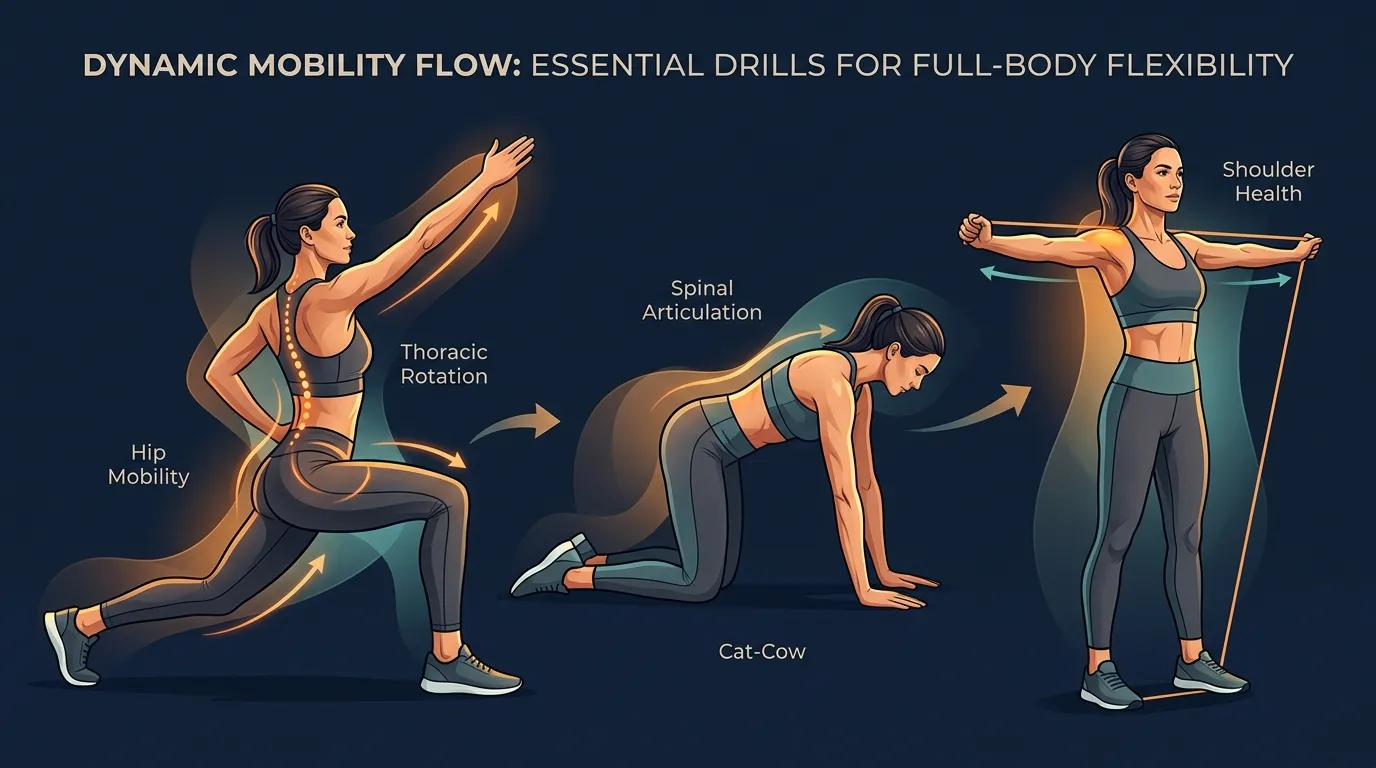
For most people who sit at a desk, these two areas are the biggest bottlenecks. Hip openers (pigeon pose, 90/90 stretch, deep lunges) and thoracic spine rotations address the tightness patterns that affect virtually everything else: squat depth, shoulder health, lower back comfort, and even breathing quality.
Step 4: Track Your Progress
Flexibility improvements are gradual and easy to miss without tracking. Take note of your starting points (sit-and-reach distance, squat depth, overhead reach) and reassess every 4 weeks. Visible progress is one of the strongest motivators for continued practice.
Step 5: Let an App Handle the Programming
If coordinating yoga, mobility, and strength sessions feels overwhelming, let a comprehensive app handle it. FitCraft's free 2-minute assessment builds a plan that balances all your workout types based on your goals, equipment, and schedule. You just show up and follow the plan.
What Results Should You Expect, and When?
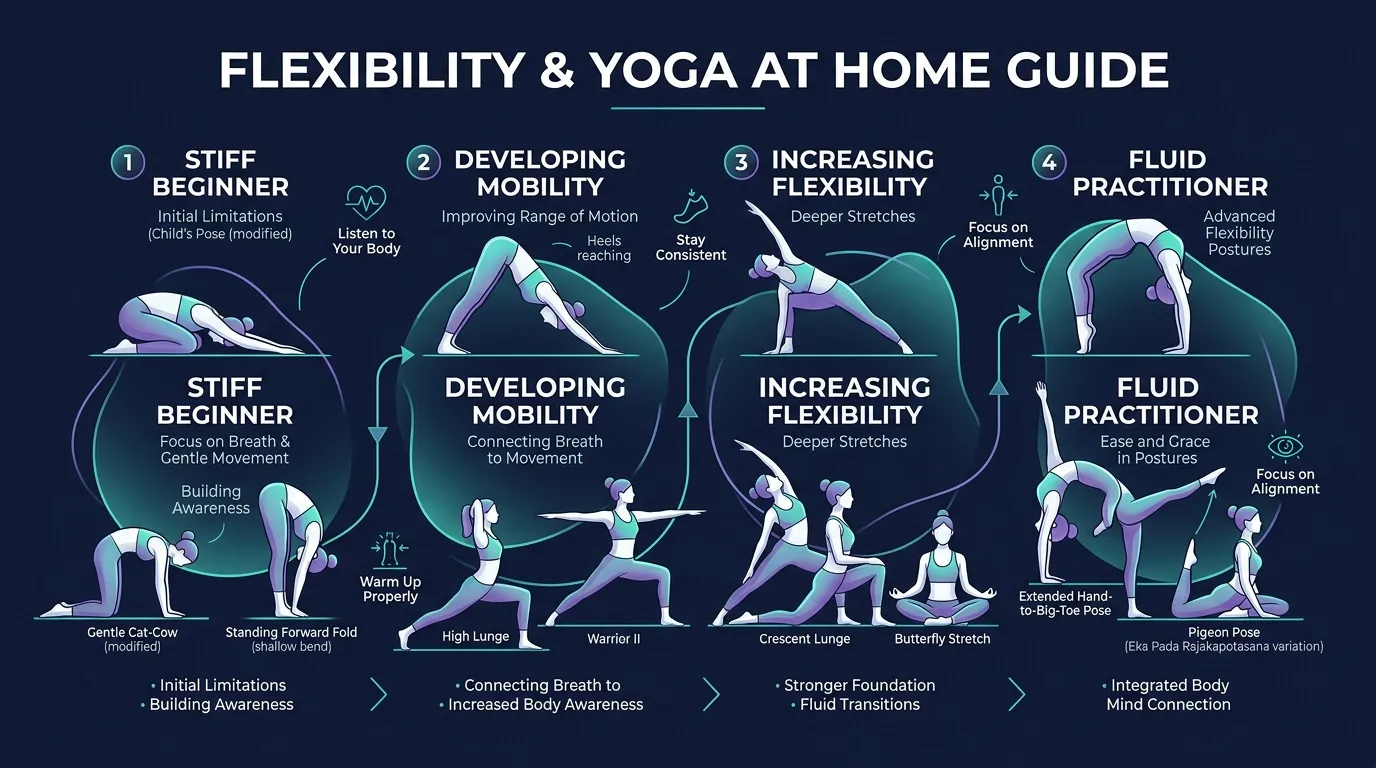
Weeks 1-2: You'll feel the difference after individual sessions: looser hips, less shoulder tension, better breathing. These are temporary effects that fade within hours. Don't mistake them for permanent change yet.
Weeks 3-4: This is the consistency cliff. The novelty wears off. Your body is adapting, which means the dramatic "I feel so much better" effect after each session diminishes. This is where most people quit yoga apps. It's also exactly when structural changes are starting to happen beneath the surface: your connective tissue is remodeling, your joint capsules are gaining range. Don't stop now.
Weeks 6-10: Real, lasting flexibility gains start showing up. Polsgrove et al. (2016) found significant improvements in flexibility and balance after 10 weeks of twice-weekly yoga practice. You'll notice your squat feels deeper, your shoulders move more freely, and movements that used to feel restricted now feel natural. This is the payoff, and it's only accessible to people who pushed through weeks 3-4.
Month 3 and beyond: Yoga and mobility become maintenance rather than catch-up. You're no longer trying to fix tightness. You're sustaining the range of motion you've built while continuing to progress in strength and cardio. This is where the combined approach really shines: you're stronger, more flexible, and more resilient than you'd be with any single modality alone.
What Do Real Users Say?
Sarah, 27: "-18 lbs, 3 months. First app that made exercise feel like something I chose, not forced."
Katie: "I've tried everything. This is the first time I've stuck with something past two weeks."
Matt: "The real win is I actually want to work out now. That's never happened before."
The Bottom Line: Which App Should You Use?
The best fitness app for yoga and mobility at home isn't a yoga-only app. It's an app that treats yoga and mobility as essential parts of a complete training program, alongside strength, cardio, and dynamic movement, and keeps you consistent enough to see real results.
Flexibility without strength is fragile. Strength without mobility is limited. The combination builds a body that performs well, feels good, and lasts. FitCraft offers yoga, mobility, strength, cardio, and dynamic movement workout types in one adaptive plan, guided by an AI coach and powered by gamification that makes consistency feel like progress in a game you actually want to play.
You're not broken for struggling to stick with a yoga routine. You just need a system that integrates it into your training instead of treating it as an afterthought.
Frequently Asked Questions
Can yoga replace strength training?
Yoga builds functional strength, balance, and flexibility, but it does not replace progressive resistance training for building significant muscle mass or maximal strength. The best approach is combining both: yoga and mobility sessions improve range of motion and recovery, while strength sessions with dumbbells, resistance bands, or bodyweight exercises drive muscle and bone density gains.
How many days a week should I do yoga and mobility work?
Two to three dedicated yoga or mobility sessions per week is enough for most people to see meaningful improvements in flexibility and joint health. You can also add 10-15 minutes of mobility work before or after strength sessions. The key is consistency over weeks and months, not marathon sessions once in a while.
What features should I look for in a yoga and mobility app?
Look for an app that offers multiple workout types (yoga, mobility, strength, cardio) so you can train everything in one place. Proper form guidance through 3D demos or video is essential for yoga poses. Adaptive programming that adjusts to your progress, calendar tracking for consistency, and some form of motivation system like gamification all contribute to long-term adherence.
Does FitCraft have yoga and mobility workouts?
Yes. FitCraft includes yoga, mobility, strength (dumbbells, resistance bands, bodyweight), cardio, and dynamic movement workout types all within one app. Each exercise features interactive 3D demos with pinch-and-zoom camera control so you can study proper form from any angle. Your AI coach adapts your program as you progress, and gamification features like XP, leveling up, and collectible cards keep you consistent.
Is it safe to do yoga at home without an instructor?
Yes, home yoga is safe for most people when you follow proper form cues and start at an appropriate difficulty level. An app with detailed exercise demonstrations helps you learn correct alignment. FitCraft's interactive 3D exercise demos let you rotate the camera around each pose so you can check your form from every angle, something even a crowded yoga class cannot always offer.