Medical disclaimer: This article is for informational purposes only and does not constitute medical advice. Joint pain can have many different causes, and the appropriate exercise approach varies significantly depending on your specific condition. Some types of exercise can worsen certain joint conditions. Always consult a physician, physical therapist, or other qualified healthcare provider before starting any exercise program if you have joint pain. Your healthcare team can assess your specific situation and recommend appropriate activities.
You used to be active. Maybe you played sports, hit the gym regularly, or at least kept up with your kids without thinking twice. Then your knee started talking to you. Or your hip. Or that shoulder that hasn't been right since — well, you're not even sure when it started.
Now every fitness app, every YouTube workout, every "30-day challenge" feels like it was designed for someone whose joints don't have opinions. You click on a workout and immediately see jump squats, burpees, mountain climbers — and you close the app before you even start. Not because you don't want to move. Because you're afraid of making things worse.
Here's what nobody in the fitness industry wants to admit: most workout apps aren't built for bodies with limitations. They hand you a generic program and assume your knees, hips, and shoulders will cooperate. When they don't, you quit. And then you feel guilty about quitting. That's not a willpower problem — it's a design problem.
Why Joint Pain Gets Worse When You Stop Moving
For many types of joint pain, reduced activity can lead to a cycle that makes things worse over time. Most people with knee, hip, or shoulder pain gradually stop moving because it's uncomfortable. But in many cases, carefully chosen movement can be part of the solution — though this depends heavily on the underlying cause of the pain.
The Deconditioning Spiral
When you stop exercising because of joint pain, the muscles that support and protect those joints begin to weaken. A systematic umbrella review published in Medicine & Science in Sports & Exercise (Physical Activity Guidelines Advisory Committee, 2019) found that physical inactivity accelerates joint degeneration in people with knee and hip osteoarthritis, while regular exercise slows or reverses it.
Here's the cycle:
- Joint hurts → you move less
- Move less → muscles weaken
- Muscles weaken → less joint support
- Less support → more pain
- More pain → you move even less
Breaking this cycle doesn't require pushing through pain. It requires the right kind of movement — carefully chosen, properly dosed, and progressed at the pace your body can handle.
When Exercise Can Help
For specific conditions like knee osteoarthritis, the evidence for exercise is strong. A 2015 Cochrane systematic review (Fransen et al., 2015) — one of the most rigorous analyses in evidence-based medicine — found that exercise therapy can reduce knee osteoarthritis pain by 30-40% and improve physical function significantly. The CDC also notes that physical activity can be one of the most effective ways to manage arthritis.
However, it's important to recognize that joint pain is not uniform. The relationship between exercise and joint pain varies significantly depending on the cause. What helps osteoarthritis may not help — and could potentially worsen — other joint conditions. A physical therapist or physician can help determine whether and what type of exercise is appropriate for your specific situation.
That said, the relationship between exercise and joint pain is complex. Not all exercise helps all types of joint pain — and in some cases, certain movements can make things worse. The key is working with a qualified professional to identify what's appropriate for your specific situation.
Low-Impact Exercise Options That Protect Your Joints
Low-impact doesn't mean low-effectiveness. It means you're choosing exercises that strengthen your body without hammering your joints. Here are the approaches backed by the best evidence.
Yoga: Strength, Flexibility, and Pain Relief in One Practice
Yoga is one of the most studied interventions for joint pain — and the results are consistently positive. A 2024 systematic review and meta-analysis published in Medicine (Zhu et al., 2024) found that yoga significantly reduces pain and improves physical function in people with knee osteoarthritis. An earlier meta-analysis of nine trials in Current Rheumatology Reports (Lauche et al., 2019) reached similar conclusions for knee osteoarthritis, reporting improvements in pain, function and stiffness, though the authors graded the evidence very low quality and found no effect for hand osteoarthritis.
Why yoga works so well for joint pain:
- Strengthens muscles around the joint — providing more support and stability
- Improves range of motion — gently restoring movement that stiffness has stolen
- Reduces inflammation-related stress — the breathing and relaxation components lower cortisol and reduce pain perception
- Easily modified — chair yoga, wall-supported poses, and props make it accessible at any level
If you haven't tried yoga because you picture pretzel-like poses and Instagram flexibility, that's not what therapeutic yoga looks like. It starts where you are — even if that means sitting in a chair.
Mobility Work: The Missing Piece Most People Skip
Mobility training is different from stretching. While stretching focuses on muscle length, mobility work targets the joints themselves — improving how smoothly they move through their range of motion. For people with joint pain, this is foundational.
Mobility training is consistently associated with better physical function in older adults, with improvements measurable on standardized performance tests. A Harvard Health report linked greater flexibility and mobility in older adults to reduced pain, better functional capacity, and even longer lifespans.
Effective mobility exercises for common problem areas:
- Knees: Gentle knee circles, seated leg extensions, wall slides
- Hips: Hip circles, figure-four stretches, controlled hip hinges
- Shoulders: Arm circles, wall angels, band pull-aparts
Five to ten minutes of mobility work before a workout — or even on its own — can make the difference between a joint that cooperates and one that locks you out of your day.
Low-Impact Strength Training: Build the Armor Around Your Joints
Stronger muscles mean better-supported joints. The ACSM recommends at least 2-3 resistance training sessions per week for adults with joint conditions, starting at approximately 50-60% of maximal capacity and progressing gradually.
The best tools for joint-friendly strength training:
- Resistance bands: Provide variable resistance that naturally reduces load at the endpoints of movement — exactly where joints are most vulnerable
- Bodyweight exercises: Easily scaled to your ability (wall push-ups instead of floor push-ups, chair-assisted squats instead of deep squats)
- Light dumbbells: Allow controlled, joint-specific strengthening with precise load management
The key principle: strengthen around the joint, not through the pain. If a movement causes sharp or escalating pain, modify or replace it. Mild discomfort during exercise is normal for joints that haven't moved in a while. Sharp pain is a signal to change course.
Dynamic Movement and Cardio Without the Impact
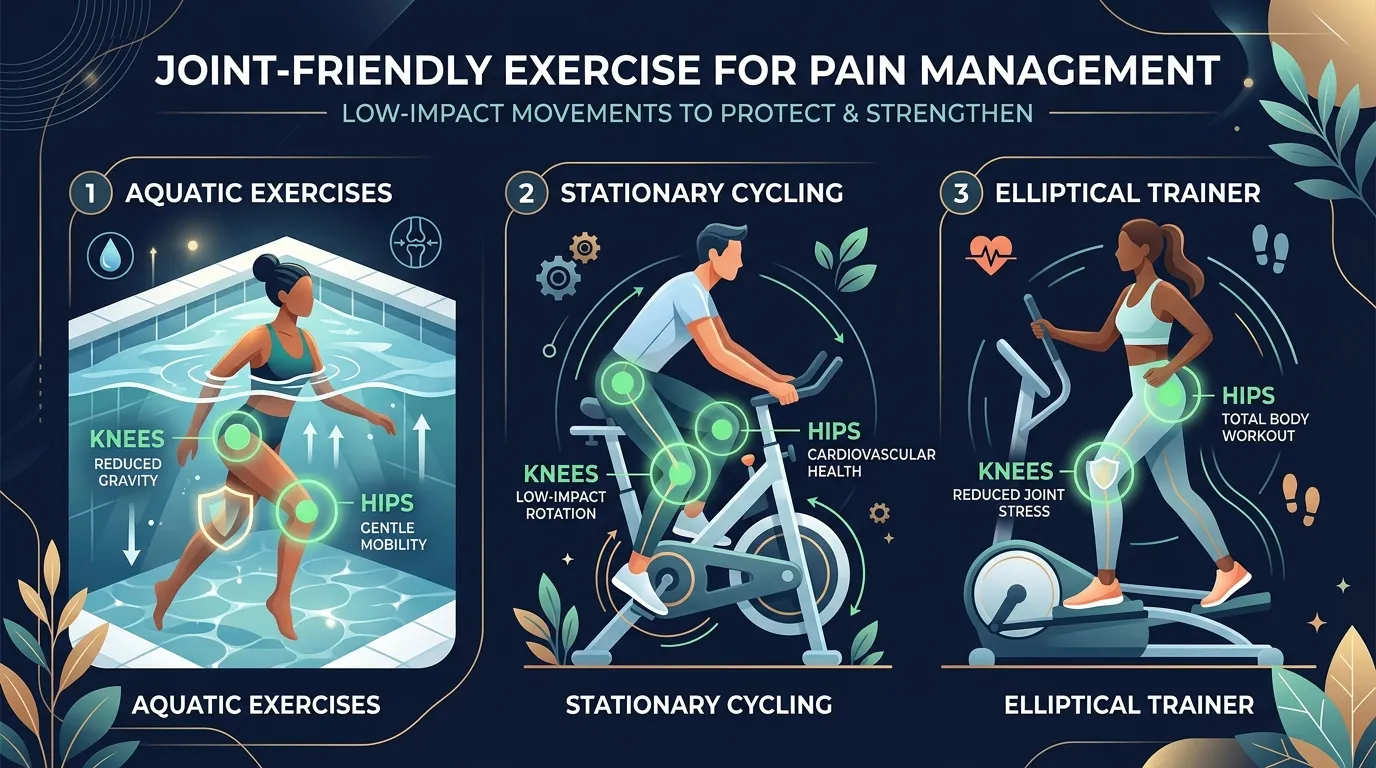
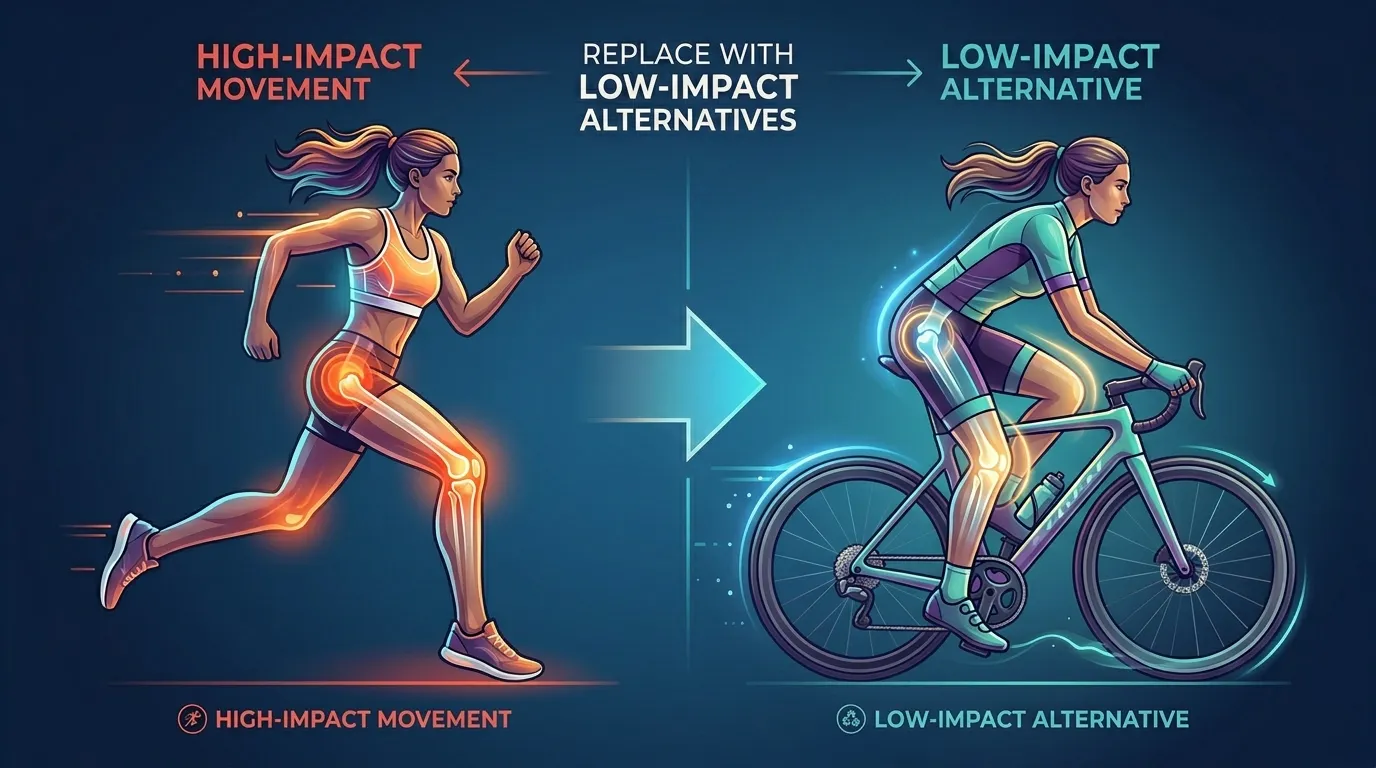
Your cardiovascular health matters just as much as your joint health — and the two are connected. But high-impact cardio (running, jumping) is off the table for many people with joint pain. Low-impact alternatives that get your heart rate up without punishing your joints include:
- Walking: The most accessible exercise on earth, and still one of the most effective
- Dynamic movement sequences: Controlled, flowing movements that combine mobility and light cardio
- Seated or standing cardio circuits: Using resistance bands or light weights with higher rep ranges
How to Exercise Safely with Specific Joint Pain
General advice only goes so far. The following are some general considerations for common joint areas, but keep in mind that joint pain can come from many different causes — and what's helpful for one cause may not be appropriate for another. Always consult a healthcare professional before starting exercises targeting a painful joint.
Exercising with Knee Pain
Knee pain is the most common joint complaint in adults over 40, affecting roughly 25% of the adult population. For conditions like osteoarthritis, research suggests that targeted exercise can be beneficial. However, knee pain can stem from many different causes, and some exercises may worsen certain conditions. A healthcare provider can help determine the right approach for you. For a deeper list of knee-friendly movements, see our guide to the best low-impact exercises for bad knees.
- Do: Straight-leg raises, wall sits (partial range), resistance band exercises, yoga poses like Warrior II (modified), gentle cycling motions
- Modify: Squats (use a chair for support, limit depth), lunges (reduce range, use wall for balance)
- Avoid initially: Deep squats, jumping exercises, running on hard surfaces
- Focus on: Quadriceps and hamstring strengthening — these muscles are the primary stabilizers of the knee joint
Exercising with Hip Pain
Hip pain often limits mobility in ways that affect your entire body — your gait changes, your back compensates, and eventually other joints start hurting too. Hip pain can come from many different causes, so targeted exercise should be guided by a healthcare professional who can identify the underlying issue.
- Do: Glute bridges, clamshells, standing hip abduction with bands, gentle hip circles, seated figure-four stretches
- Modify: Reduce range of motion on any exercise that causes pinching in the hip crease
- Avoid initially: Deep lunges, wide-stance squats, high-step movements
- Focus on: Glute and hip abductor strengthening — weak glutes are the number one driver of hip pain in the over-40 population
Exercising with Shoulder Pain
Shoulder joints have the greatest range of motion of any joint in the body — which also makes them the most vulnerable to injury and wear. After 40, rotator cuff issues, impingement, and general stiffness are extremely common.
- Do: Band pull-aparts, wall slides, external rotation with light bands, scapular squeezes, gentle yoga stretches
- Modify: Reduce overhead movements — keep arms below shoulder height until pain-free range improves
- Avoid initially: Overhead pressing, behind-the-neck movements, heavy pushing exercises
- Focus on: Rotator cuff and scapular stabilizer strengthening — these small muscles control shoulder mechanics and prevent impingement
Find out what's really holding you back
FitCraft's diagnostic assessment maps your joint concerns, fitness level, and goals — then builds a low-impact program your body can actually handle.
Take the Free Assessment Free · 2 minutes · No credit cardWhy Most Fitness Apps Fail People with Joint Pain
Here's the core problem: most fitness apps are built for healthy 25-year-olds and then marketed to everyone. They don't ask about your knee that swells after stairs. They don't know about the shoulder surgery you had five years ago. They hand you a cookie-cutter program and assume your body will comply.
When it doesn't — and it won't — you're left with two options: push through the pain (bad idea) or quit (familiar feeling). Neither one is your fault. It's a design problem, not a discipline problem.
What people with joint pain actually need from a fitness app:
- A real assessment that captures injury history, current limitations, and pain points — not just "what's your goal?"
- Adaptive programming that adjusts as your body changes, not a static 8-week template
- Multiple workout types — yoga, mobility, strength, cardio — so you can match the modality to how your body feels today
- Visual exercise instruction that shows exactly how to perform movements safely — because form matters even more when your joints are at stake
- A reason to keep showing up beyond willpower, because willpower is already spent on managing pain
How Adaptive Apps Like FitCraft Work Around Joint Pain
FitCraft was designed by an Ivy League-trained exercise scientist, NSCA-certified strength coach who built programs around one principle: the best workout is the one you can actually do. For people with joint pain, that means a fundamentally different approach than what most apps offer.
Workout Types Built for Joint-Sensitive Bodies
FitCraft offers the full range of workout types that the research supports for joint pain: yoga, mobility, strength training (bodyweight, resistance bands, and dumbbells), cardio, and dynamic movement. You're not locked into one modality. On days when your knees are flaring, you can do a yoga or mobility session. On good days, you can push your strength work. The variety isn't just convenience — it's how you maintain consistency when your body's needs change day to day.
Interactive 3D Exercise Demos — Not Videos
This is where form matters most. When you're working around joint pain, the difference between a safe squat and a damaging one might be two inches of depth or a slight angle change. FitCraft uses interactive 3D exercise demonstrations with pinch-and-zoom camera control, so you can examine proper form from every angle. You can rotate the model, zoom into the knee position, see exactly where your feet should be. That's information a flat video can't give you.
Progressive Programming
Your body with joint pain isn't the same every week. Some weeks you're feeling strong and mobile. Other weeks, inflammation flares and everything tightens up. FitCraft's programming offers a range of workout types and intensities, so you can choose sessions that match how your body feels on any given day. However, FitCraft is a general fitness app — it is not a substitute for the condition-specific guidance that a physical therapist or physician can provide for your particular joint issue.
Gamification That Makes Showing Up Easier
Here's the hidden challenge for people with joint pain: consistency is even harder when exercise sometimes hurts. You need a stronger reason to show up than "I should." FitCraft uses gamification — XP, leveling up, collectible cards, and calendar-based tracking rewards — to create a motivation system that doesn't rely on willpower alone.
A 2022 systematic review in JMIR found that gamification features in health apps significantly increase exercise participation and sustained engagement. For people managing joint pain, this is especially important. The days when your joints ache are exactly the days you're most tempted to skip — and exactly the days when a gentle mobility session would help the most. Gamification gives you a reason to show up for that session even when motivation is low.
Getting Started: A Practical Plan for Exercising with Joint Pain
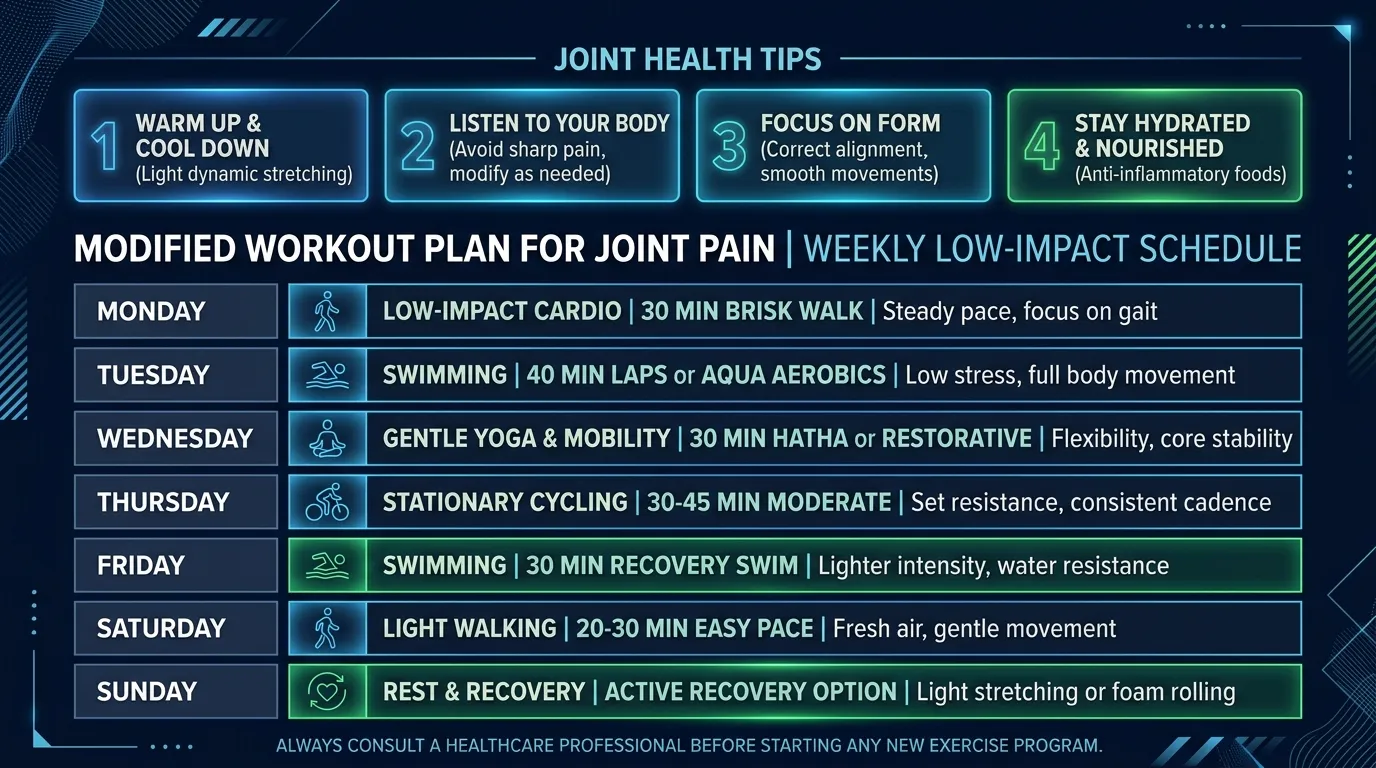
You don't need to overhaul your life. You need a starting point that's small enough to not intimidate your joints — and consistent enough to start the healing process.
Week 1-2: Foundation
- Start with 10-15 minutes per session, 3 days per week
- Focus on mobility work and gentle yoga — no strength training yet
- Pay attention to how your joints respond in the 24 hours after exercise
- Mild soreness is normal. Sharp pain or swelling that worsens is a signal to scale back
Week 3-4: Build
- Add light resistance training (bodyweight or bands) on 1-2 days
- Keep yoga or mobility on the other days
- Extend sessions to 20-25 minutes as tolerated
- Focus on form over intensity — every repetition should be controlled
Week 5+: Progress
- Gradually increase resistance or add complexity to movements
- Aim for 3-4 sessions per week, 25-35 minutes each
- Continue daily mobility work (even 5 minutes makes a difference)
- Notice how your joints feel compared to Week 1 — most people report meaningful improvement within 6-8 weeks of consistent, appropriate exercise
The ACSM emphasizes that pain and functional benefits are more closely linked to the number of sessions and overall time in the program rather than intensity. Translation: showing up consistently at a comfortable level beats pushing hard and quitting.
What to Expect (The Honest Version)
Let's set realistic expectations, because the fitness industry has been terrible at this for people with joint pain.
Week 1: You might feel more discomfort than usual as your body adjusts to moving again. This is normal and temporary. Joints that haven't been worked tend to protest at first — then settle down.
Week 2-3: The initial discomfort fades. You start noticing slightly better range of motion. Getting up from a chair or climbing stairs feels a little easier. These are small changes, but they're real.
Week 4-6: This is where the research says measurable improvements begin. Pain decreases, function improves, and muscles around your joints are noticeably stronger. You start trusting your body again.
Month 2-3: If you've been consistent, this is when people around you notice. You're moving differently. You're doing things you'd been avoiding. The cycle has reversed: movement creates less pain, which creates more movement.
Barry, 42: "-28 lbs, 4 months — Lost weight during breakfast while kids ate — worked around my life."
Katie: "I've tried everything. This is the first time I've stuck with something past two weeks."
The Bottom Line
Joint pain is a reason to move smarter — with professional guidance
For certain joint conditions like osteoarthritis, the evidence supports that intentional, targeted exercise can reduce pain and improve function. However, joint pain has many causes, and what helps one condition may not help another. Some types of exercise can make certain joint conditions worse.
The most important step is working with a qualified healthcare provider — such as a physical therapist or physician — to identify the cause of your joint pain and determine what types of movement are appropriate for you. When exercise is appropriate, finding the right approach and maintaining consistency can make a meaningful difference.
If you're dealing with joint pain, don't assume that any exercise program will help — but also don't assume you have to stop moving entirely. The right guidance can help you find a path forward.
Frequently Asked Questions
What is the best exercise for people with joint pain?
It depends on the cause of your joint pain. For conditions like osteoarthritis, low-impact exercises such as yoga, mobility work, and bodyweight strength training may be beneficial — a 2019 Cochrane review found that consistent exercise can reduce knee osteoarthritis pain by 30-40%. However, joint pain has many causes, and some exercises can worsen certain conditions. Always consult a healthcare provider to determine what's appropriate for your specific situation.
Is it safe to exercise with knee or hip pain?
For many joint conditions, appropriate exercise can be safe and beneficial when done under professional guidance. The CDC and ACSM recommend regular physical activity for people with arthritis. However, the safety and appropriateness of exercise depends on the specific cause of your pain. Some exercises can make certain conditions worse. Always consult a physician or physical therapist before starting an exercise program with joint pain.
Does yoga help with joint pain?
Yes. A 2024 systematic review in Medicine found that yoga significantly reduces pain and improves physical function in people with knee osteoarthritis. Yoga strengthens muscles around the joints, improves range of motion, and its breathing components can reduce the stress and tension that amplify pain perception. Gentle styles like chair yoga or restorative yoga are good starting points.
Can a fitness app adapt workouts for joint pain?
Some apps offer a variety of workout types that may be helpful for people with joint concerns. FitCraft offers yoga, mobility, strength, and dynamic movement workouts with interactive 3D exercise demonstrations. However, a fitness app is not a substitute for the condition-specific guidance that a physical therapist or physician can provide. Always consult a healthcare provider about what types of exercise are appropriate for your specific joint condition.
How often should I exercise if I have joint pain?
The ACSM recommends at least 2-3 sessions per week for people with joint conditions, combining flexibility work, strength training, and low-impact cardio. Consistency matters more than intensity — three moderate sessions per week produce better long-term pain reduction than sporadic intense workouts. Start with shorter sessions (15-20 minutes) and build from there.