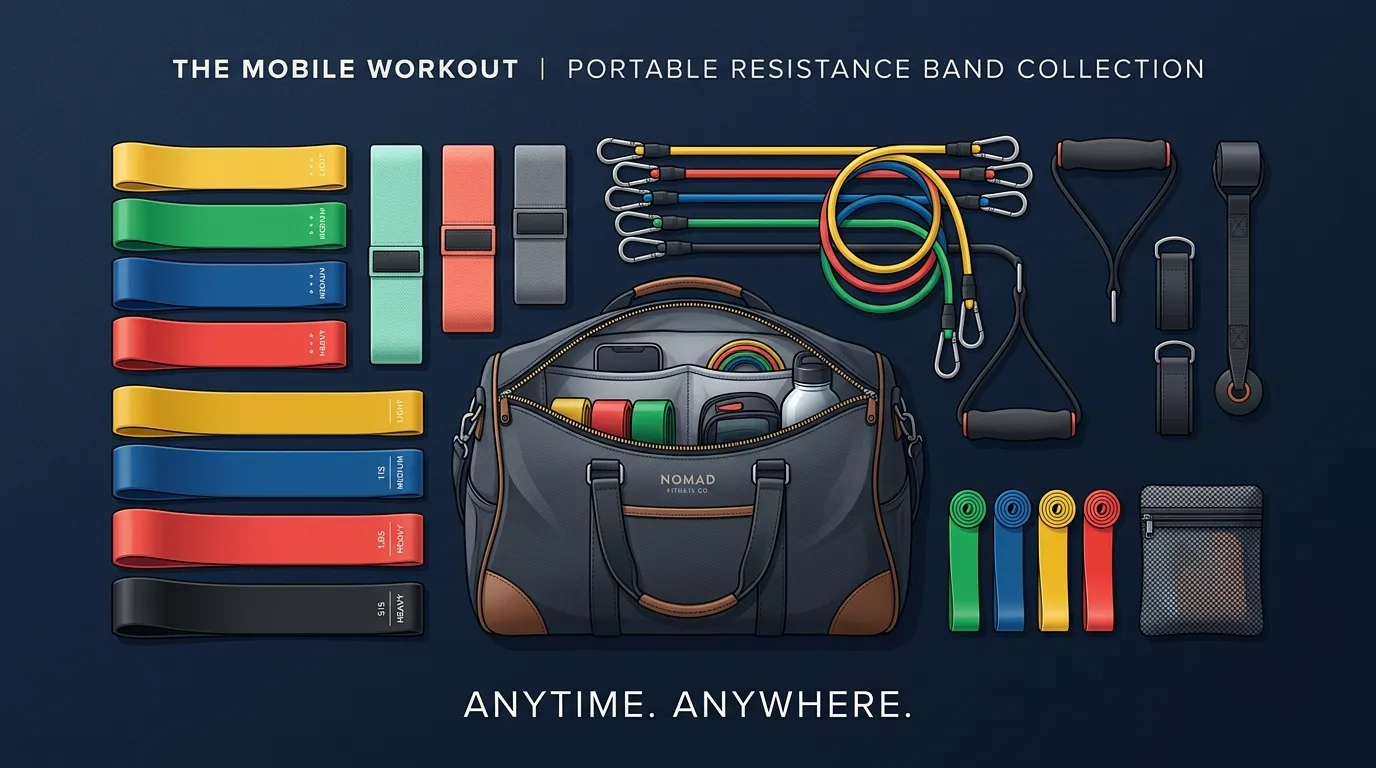
Resistance bands have a perception problem. They look like oversized rubber bands. They fit in a drawer. They cost less than a single month at most gyms. And because of all that, people assume they can't possibly deliver real results.
That assumption is wrong — and it's costing people who train at home, travel frequently, or simply prefer low-impact exercise a genuinely effective training tool.
The bigger problem? Even people who buy resistance bands often struggle to use them well. Not because the exercises are complicated, but because most fitness apps — the thing people turn to for guidance — treat bands like a second-class citizen. They're listed as a substitute for "real" equipment, not as a training modality in their own right.
This guide covers three things: why resistance bands actually work (with the research to back it up), what to look for in a fitness app that genuinely supports band training, and how FitCraft approaches resistance bands as a core part of its workout system.
Why Resistance Bands Work (the Science)
Let's start with the research, because the science on resistance bands is clearer than most people realize.
A 2019 meta-analysis published in SAGE Open Medicine (Lopes et al., 2019) examined the effects of elastic resistance training across multiple studies and populations. The conclusion: resistance band training produces strength gains comparable to conventional resistance training with weights. Not "almost as good." Comparable.
A separate study in the Journal of Human Kinetics (Bergquist et al., 2018) measured muscle activation directly, comparing bands against dumbbells in flyes and reverse flyes at matched 10-repetition-maximum loads. Surface electromyography showed slightly lower activation with the bands in the muscles those exercises target, though the difference was small.
But here's where bands have a unique advantage that weights don't: variable resistance.
The Variable Resistance Advantage
When you curl a dumbbell, the weight is the same at the bottom of the movement as it is at the top. But your muscles aren't equally strong throughout the range of motion — you're weakest at the stretched position and strongest at the contracted position.
Bands flip this in your favor. As the band stretches, resistance increases. That means the load is lightest where you're weakest and heaviest where you're strongest. This ascending resistance curve matches your muscles' natural strength profile, which means more effective loading throughout the entire rep.
For practical purposes, this means two things:
- Less joint stress. The reduced load at the bottom of each movement — where joints are in their most vulnerable position — makes bands inherently more joint-friendly than fixed-weight exercises. A 2021 study in the Journal of Sports Science & Medicine found that elastic resistance training was associated with lower rates of exercise-related discomfort compared to free weights, particularly in older adults and those returning from injury.
- More time under meaningful tension. Because the resistance increases through the range of motion, your muscles spend more of each rep under significant load. With a dumbbell, there are "dead zones" where gravity does the work. Bands eliminate most of those dead zones.
Portability Changes the Equation
A full set of resistance bands weighs about 2 pounds and fits in a backpack. A set covering light to heavy resistance costs a fraction of what adjustable dumbbells run, with no gym membership required.
This isn't just a cost argument. It's an adherence argument. A 2020 systematic review in the International Journal of Environmental Research and Public Health found that home-based exercise programs had significantly higher adherence rates than gym-based programs, largely because of reduced logistical barriers. Bands take the lowest-barrier form of exercise (home workouts) and make it even lower. No clearing floor space for a rack. No adjusting weights between sets. No excuses when you're traveling.
When the barrier to training drops, the frequency of training rises. And frequency — showing up three or four times a week for months — is what actually produces results.
What Most Fitness Apps Get Wrong About Bands
Here's the frustrating part: resistance bands are effective, affordable, and portable. They should be a perfect fit for app-based fitness. But most apps handle them poorly. Here's how.
Problem 1: Bands as Substitutes, Not a Primary Modality
Most fitness apps are designed around dumbbells and barbells. When they include bands, it's as a swap — "don't have dumbbells? Use a band instead." The problem is that band exercises aren't just dumbbell exercises with different equipment. The movement mechanics, anchor points, grip positions, and resistance profiles are different. A banded pallof press is not a cable pallof press with cheaper equipment — it's a distinct exercise with distinct form cues.
Apps that treat bands as substitutes produce awkward, poorly programmed workouts that don't leverage what bands actually do well.
Problem 2: No Way to See Form from Multiple Angles
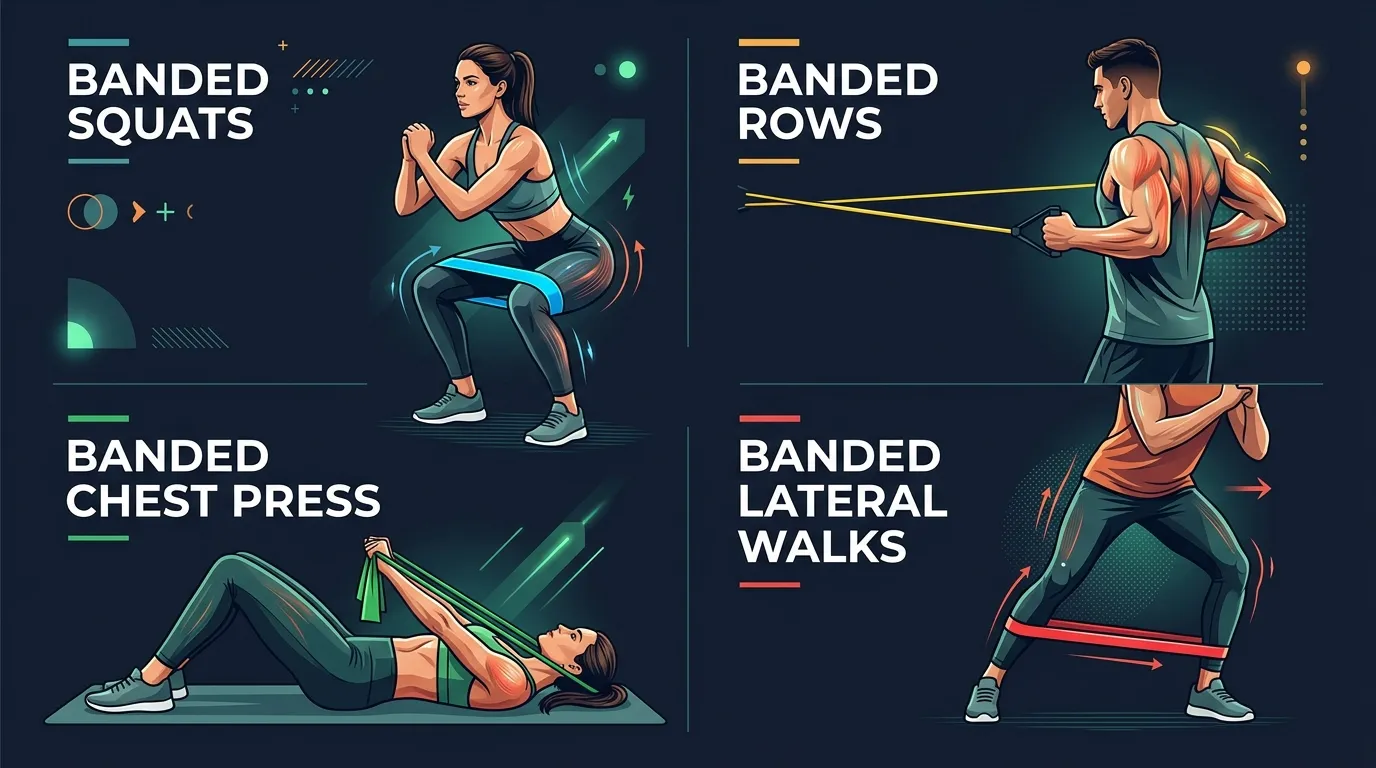
Band exercises require precision in anchor placement, grip, and body positioning. A banded pull-apart looks simple until you realize your elbow angle, shoulder position, and band height all affect which muscles are actually working. A flat 2D video from one camera angle isn't enough to learn these nuances — especially for exercises where the band path matters as much as the body position.
Problem 3: No Progression Logic for Bands
With dumbbells, progression is straightforward: add 5 pounds. With bands, progression is more nuanced. You can move to a heavier band, combine bands, change your grip position to increase tension, slow the tempo, or add volume. Most apps don't have the logic to manage this progression automatically — they either leave it entirely to you or ignore it altogether.
What to Look for in a Resistance Band Fitness App
If you train with bands — or want to start — here's the checklist that separates a good app from one that wastes your time.
1. Bands as a First-Class Equipment Type
The app should let you select resistance bands as your primary equipment during setup — not as a fallback. Your entire program should be built around band-specific exercises, with movements chosen because they work well with elastic resistance, not because they're a workaround for not having weights.
2. Visual Form Guidance You Can Actually Learn From
Static images don't cut it. Single-angle videos are better but still limited. What you need is the ability to see an exercise from multiple perspectives — front, side, overhead — so you can understand exactly where the band anchors, how your body positions relative to it, and what the movement path looks like through the full range of motion.
3. Adaptive Programming That Progresses You Automatically
The app should track your workouts and adjust difficulty over time. As you get stronger, it should introduce harder band variations, suggest heavier resistance levels, increase volume, or modify tempo — without you having to figure out the next step yourself. If the app gives you the same workout in week 8 that it gave you in week 1, it's not adapting.
4. Workout Variety Beyond Strength
Bands aren't just for strength training. They're excellent for mobility work, yoga-style stretching, warm-ups, and dynamic movement patterns. A good app should incorporate bands across multiple workout types — not just in a "strength" category.
Find out what's really holding you back
Take the free 2-minute diagnostic. Your AI coach Ty will build a resistance band program matched to your fitness level — no gym required.
Take the Free Assessment Free · 2 minutes · No credit cardHow FitCraft Handles Resistance Band Training
FitCraft was built with resistance bands as a core equipment type — not a bolt-on. Here's what that means in practice.
Bands Are a First-Class Option
During FitCraft's initial assessment, you select your available equipment. Resistance bands are listed alongside dumbbells, bodyweight, and other options. When you choose bands, your AI coach Ty builds your entire program around band-specific exercises — movements designed for elastic resistance, not repurposed dumbbell exercises.
You can also combine bands with other equipment types. If you have bands and a set of dumbbells, Ty programs workouts that use both, leveraging each tool for the exercises where it works best.
Interactive 3D Exercise Demos
This is where FitCraft is genuinely different from most fitness apps. Every exercise — including every band exercise — comes with an interactive 3D demo. You can pinch and zoom, rotate the camera, and examine the movement from any angle. Want to check the anchor point position? Rotate to a side view. Need to see hand placement? Zoom in.
This matters more for bands than almost any other equipment type. Band exercises are sensitive to anchor position, grip width, and body angle. A flat video from one camera angle can't show you all of that. A 3D model you can move around can.
Adaptive Workouts That Progress With You
FitCraft's AI coach Ty tracks your training history and adapts your workouts based on your progress. As you get stronger with a particular band, Ty adjusts your programming — introducing harder variations, increasing volume, modifying tempo, or recommending you move to a heavier band. You don't have to guess when it's time to progress. The system handles it.
This is critical for band training specifically because band progression isn't as intuitive as adding plates to a bar. Ty handles the decision-making so you can focus on showing up and doing the work.
Multiple Workout Types That Use Bands
FitCraft doesn't restrict bands to strength workouts. Your program can include band-based exercises across strength training, mobility work, yoga, dynamic movement, and cardio sessions. Bands are woven into the full training system — warm-ups, main sets, cooldowns, and active recovery days all benefit from elastic resistance when it's the right tool for the job.
Gamification That Keeps You Consistent
The hardest part of any training program isn't the exercises — it's showing up consistently for months. FitCraft uses gamification to turn consistency into something you look forward to. You earn XP for completing workouts, level up your profile, collect cards for hitting milestones, and track streaks on your calendar. These aren't gimmicks — they're the same reward systems that keep people engaged in the games they love, applied to your training.
When your Tuesday evening band workout earns you the XP to level up and unlocks a new collectible card, skipping it feels like leaving progress on the table. That's by design.
Sample Resistance Band Workout
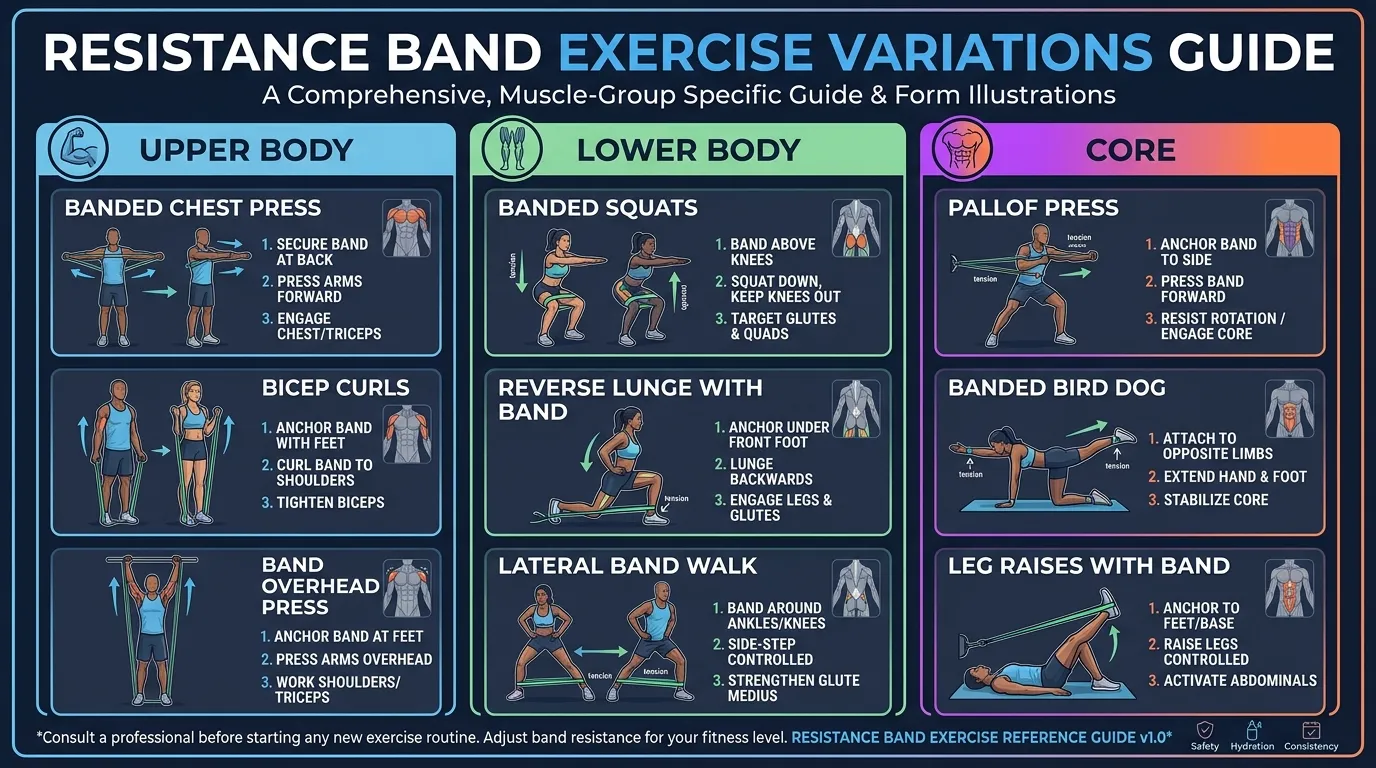
Here's an example of what a full-body resistance band session might look like. This is an intermediate template — your actual program should match your current fitness level.
Warm-Up (5 minutes)
- Banded pull-aparts: 2 sets of 15
- Banded dislocates: 2 sets of 10
- Banded monster walks: 2 sets of 10 steps per direction
Upper Body
- Banded push-ups (band across back, anchored in hands): 3 sets of 10-12
- Banded rows (anchored at waist height): 3 sets of 12
- Banded overhead press: 3 sets of 10
- Banded face pulls: 3 sets of 15
Lower Body
- Banded squats (band under feet, held at shoulders): 3 sets of 12
- Banded Romanian deadlifts: 3 sets of 10
- Banded lateral walks: 3 sets of 12 steps per side
- Banded glute bridges: 3 sets of 15
Core + Cooldown
- Banded pallof press: 3 sets of 10 per side
- Banded anti-rotation hold: 2 sets of 20 seconds per side
- Banded shoulder stretches: 2 minutes
Total time: 30-40 minutes. Total equipment: one or two resistance bands. Total excuses: zero.
The Bottom Line
Resistance bands are not beginner equipment. They're not a substitute for "real" weights. They're a distinct, research-backed training modality that produces comparable strength gains to traditional resistance training — with less joint stress, near-zero cost, and the portability to train anywhere.
The challenge has never been the bands themselves. It's finding an app that treats them as a serious training tool instead of a fallback option. Most fitness apps are designed around gym equipment and add bands as an afterthought. That leads to poorly programmed workouts, inadequate form guidance, and no progression logic.
FitCraft takes a different approach. Resistance bands are a first-class equipment type. Your AI coach Ty builds a complete, adaptive program around them. Interactive 3D demos let you examine every exercise from any angle — critical for band movements where anchor position and body angle determine whether the exercise works or wastes your time. And gamification features like XP, leveling, collectible cards, and calendar streaks make consistency feel rewarding instead of like a chore.
Your bands are already in the drawer. The question is whether your app is actually built to use them.
Frequently Asked Questions
Can you build muscle with resistance bands?
Yes. A 2019 meta-analysis in SAGE Open Medicine found that resistance band training produces strength gains comparable to conventional resistance training with weights. Bands provide variable resistance — the tension increases as the band stretches — which keeps muscles under load through the full range of motion. Combined with progressive overload (heavier bands, slower tempos, more volume), bands can drive meaningful muscle growth.
What resistance band weight should a beginner start with?
Most beginners should start with a light to medium band (roughly 10-25 lbs of resistance). The right starting point depends on the exercise — you might use a lighter band for lateral raises and a heavier one for squats. A good rule of thumb: choose a band where you can complete 10-12 reps with good form but the last 2-3 reps feel genuinely challenging.
Are resistance bands as effective as dumbbells?
For most people's goals, yes. A meta-analysis in SAGE Open Medicine (Lopes et al., 2019) found that elastic resistance training produces strength gains comparable to conventional weights. Bands actually have an advantage in certain movements because the ascending resistance curve matches your muscles' natural strength curve — you're weakest at the bottom of a movement and strongest at the top, which is exactly how band tension works.
What should I look for in a fitness app for resistance band workouts?
Look for three things: (1) the app must include resistance bands as a selectable equipment type with dedicated exercises, not just bolt-on alternatives; (2) it should show you proper form through visual demos you can examine from multiple angles; and (3) it should adjust your programming over time as you get stronger — progressing you to heavier bands, harder variations, or higher volume automatically.
How does FitCraft handle resistance band training?
FitCraft includes resistance bands as a core equipment option. When you select bands during the initial assessment, your AI coach Ty builds a complete program using band-specific exercises. Every exercise includes an interactive 3D demo you can pinch, zoom, and rotate to see form from any angle. As you progress, Ty adapts your workouts — increasing difficulty, introducing new band exercises, and adjusting volume based on your training history.