- Willpower is unreliable fuel for exercise. Research shows motivation naturally fluctuates, and habits built on willpower collapse when life gets hard. Systems beat discipline every time.
- It takes about 66 days to automate a habit (Lally et al., 2010), but exercise habits take longer than simple ones, and missing a single day doesn't reset your progress.
- Environment design is the highest-leverage change you can make. Laying out workout clothes, removing friction, and anchoring exercise to existing routines dramatically increases follow-through.
- Identity shifts outlast motivation. "I'm someone who moves every day" is more durable than "I should really work out more." When exercise becomes who you are, skipping feels wrong instead of tempting.
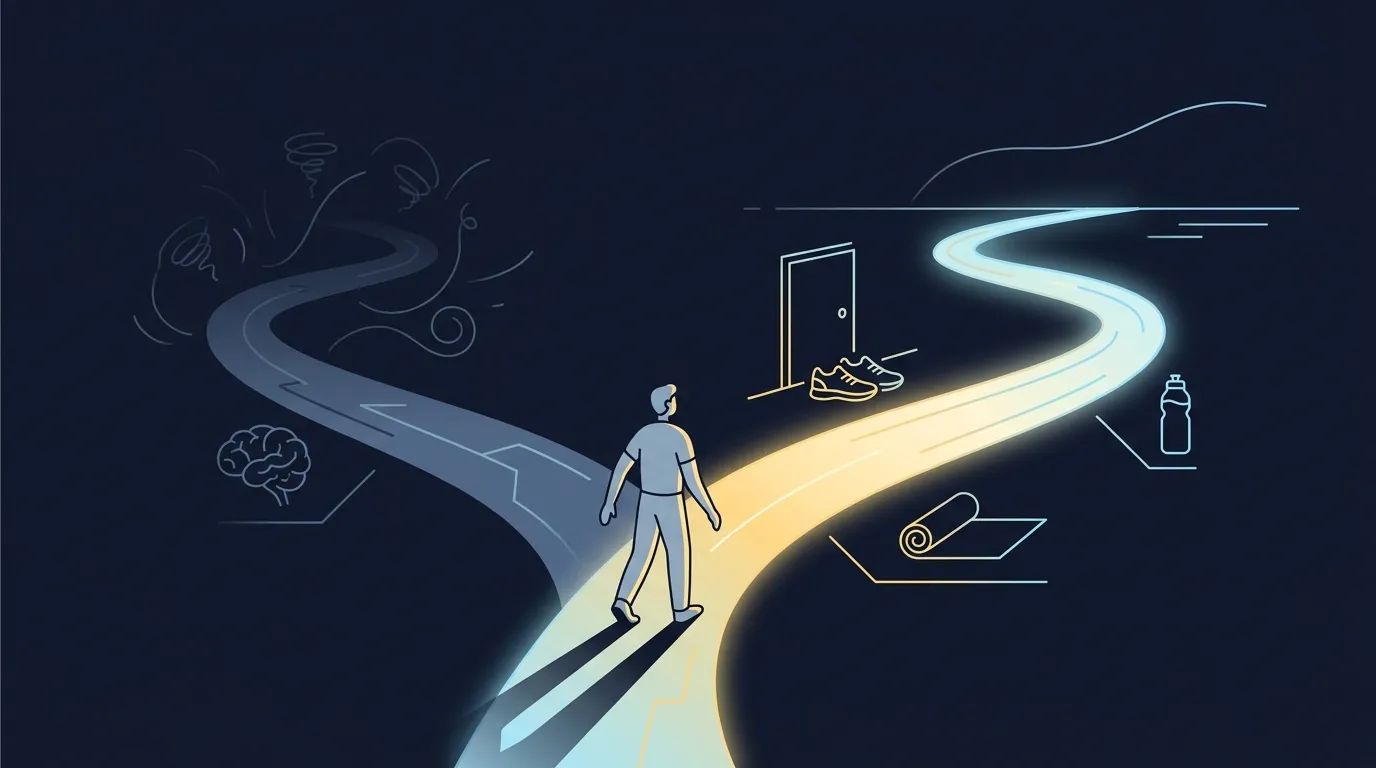
Here's a pattern you probably recognize. You decide on Sunday night that this is the week you finally get consistent with exercise. Monday morning, you crush it. Tuesday, you're sore but you push through. Wednesday, work runs late. Thursday, you're tired. By Friday, the guilt has already started. By the following Monday, you're back to zero, telling yourself you'll try again next week.
Sound familiar? You're not alone, and more importantly, you're not broken. That cycle isn't a discipline problem. It's a design problem. You've been trying to build a habit using the one resource that's guaranteed to run out: willpower.
The research is clear on this. Willpower is a limited, depletable resource that fluctuates with stress, sleep, hunger, and mood. Building your entire exercise routine on willpower is like building a house on sand. It's not a question of if it collapses, but when.
This article is about what to build on instead. Not motivation. Not discipline. Systems. The kind that make exercise feel automatic, like brushing your teeth or putting on your seatbelt. Things you do without debating them first.
Why Willpower Fails (and What Actually Works)
Let's get the uncomfortable truth out of the way: the people you see at the gym at 6 a.m. every single day aren't more disciplined than you. They've just been doing it long enough that it stopped requiring discipline.
That's the real secret. Consistency isn't about having more willpower. It's about needing less of it.
A landmark 2010 study by Phillippa Lally and colleagues at University College London tracked 96 people as they tried to form new daily habits. They found that on average, it took 66 days for a behavior to become automatic, meaning the person did it without thinking or debating (Lally et al., 2010). But here's the nuance most articles leave out: the range was 18 to 254 days, and exercise habits took about 1.5 times longer than simpler habits like drinking a glass of water at lunch.
The encouraging part? Missing a single day didn't significantly affect the habit formation process. One skipped day didn't reset the clock. The all-or-nothing mindset ("I missed Monday so the whole week is ruined") is the real enemy, not the missed workout.
The Three Pillars That Replace Willpower
If willpower isn't the answer, what is? Behavioral science points to three strategies that consistently outperform raw discipline:
- Environment design: making the right behavior the easiest behavior
- Identity alignment: shifting who you see yourself as, not just what you do
- Systems and cues: removing decisions from the process entirely
Let's break each one down into things you can actually do today.
Environment Design: Make Exercise the Path of Least Resistance
Your environment is quietly making decisions for you all day long. The snacks on your counter, the apps on your home screen, the shoes by your door: none of these are neutral. They're nudges. And right now, most of your environment is probably nudging you toward the couch.
James Clear's Atomic Habits framework calls this "making the good behavior obvious and easy, and the bad behavior invisible and hard." It sounds simple because it is. But simple doesn't mean ineffective. Environment design is arguably the single highest-leverage change you can make.
Practical Environment Changes (Start Tonight)
- Lay out workout clothes the night before. Put them on your bedroom floor so you literally step on them when you wake up. This removes the first friction point: deciding what to wear.
- Create a dedicated workout spot. Even if it's just a yoga mat in the corner of your living room. A visible, designated space serves as a constant cue.
- Pre-load your workout. Open your workout app, queue up the playlist, and charge your earbuds the night before. The fewer steps between "I should exercise" and actually exercising, the more likely it happens.
- Remove friction from the path. If you work out in the morning, sleep in your workout clothes. If you exercise after work, bring your gym bag so you don't have to stop at home first (where the couch is waiting).
- Add friction to competing behaviors. Put your phone in another room during workout time. Log out of streaming apps. Make it slightly harder to do the thing that competes with exercise.
These changes feel almost too small to matter. But that's the point. You're not trying to manufacture motivation. You're trying to remove the tiny barriers that kill momentum before it starts.
Identity Shifts: Become Someone Who Exercises
This one sounds abstract, but it might be the most powerful lever of all.
Most people set outcome goals: "I want to lose 20 pounds" or "I want to run a 5K." These goals are fine, but they have a fatal flaw. They're about a future state that doesn't feel real yet. And when the gap between where you are and where you want to be feels too wide, motivation evaporates.
Identity-based habits work differently. Instead of "I want to exercise more," you shift to "I'm someone who moves every day." The difference is subtle but profound. With an outcome goal, every workout is a transaction: suffering now for a payoff later. With an identity goal, every workout is a vote for the person you're becoming.
A 2025 study published in Applied Psychology: Health and Well-Being by Rhodes et al. found that identity changes during the first three months of physical activity participation were a significant predictor of long-term habit formation. People who started seeing themselves as "active" or "athletic" within the first few months were far more likely to maintain their exercise habits than those who still viewed exercise as something they were forcing themselves to do.
How to Start the Identity Shift
- Use identity language with yourself. Instead of "I have to work out," try "I don't miss my daily movement." Instead of "I should go to the gym," try "This is just what I do now."
- Cast small votes. Every 5-minute walk, every single push-up, every time you choose stairs over the elevator: it's a vote for your new identity. You don't need to win by a landslide. You just need a majority.
- Let the streak reinforce it. There's a reason streak mechanics are so psychologically powerful. A 14-day streak isn't just 14 workouts. It's 14 pieces of evidence that you're the kind of person who shows up. That evidence accumulates into belief.
Systems and Cues: Remove the Decision Entirely
Every decision costs energy. "Should I work out today?" is a decision. "What workout should I do?" is another. "When should I fit it in?" is a third. By the time you've answered all three, you've burned through willpower before touching a dumbbell.
The solution: make as many of those decisions in advance as possible, then automate the rest.
Implementation Intentions: The If-Then Trick
Psychologist Peter Gollwitzer's research on implementation intentions shows that creating specific if-then plans ("When [situation X occurs], I will [perform behavior Y]") increases follow-through by two to three times compared to simple goal-setting (Gollwitzer, 1999). That's not a marginal improvement. That's a game-changer.
Here's what this looks like for exercise:
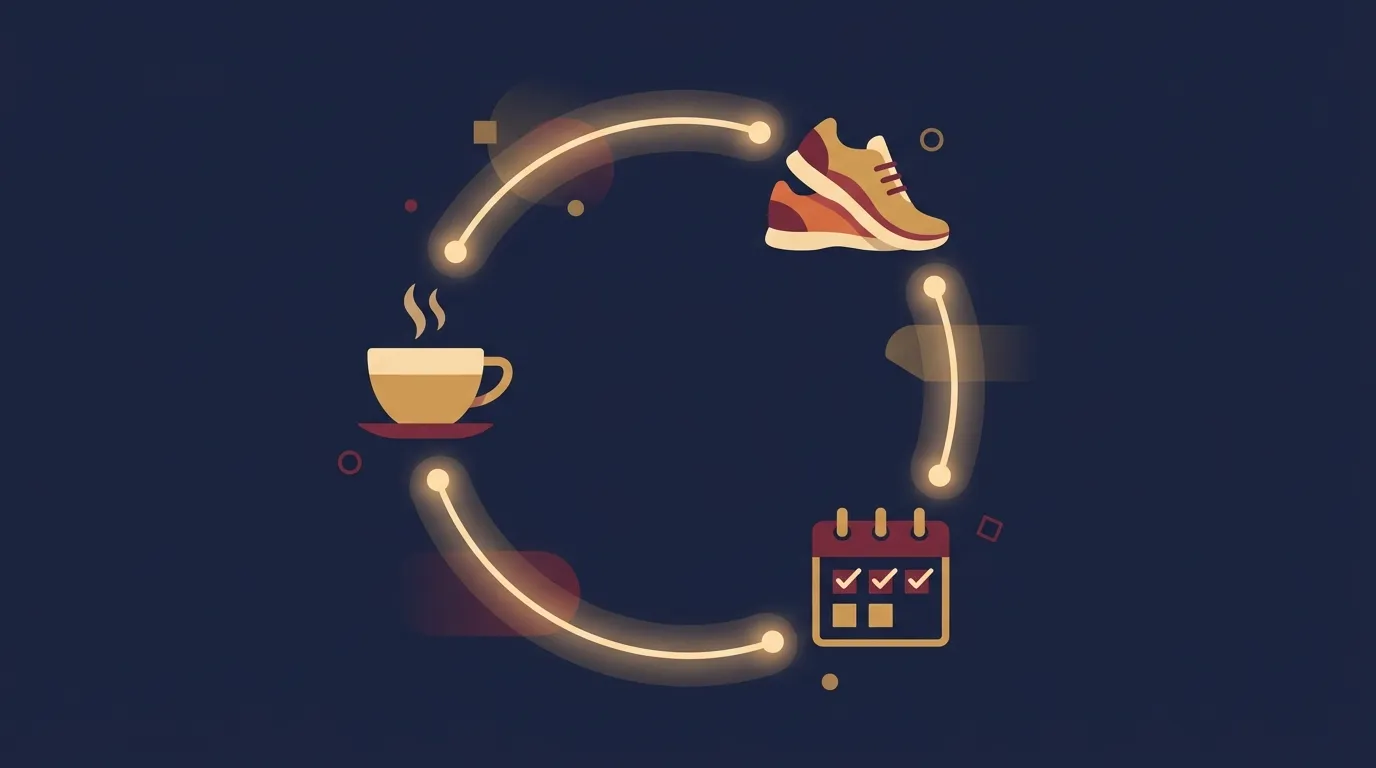
- "When I finish my morning coffee, I do a 10-minute workout."
- "When I park at the office, I walk the long way around the building."
- "When I put the kids to bed, I do my evening stretching routine."
Notice what's happening: you're removing the decision. You're not asking yourself "Should I work out?" You're triggering a pre-committed response to a cue that already exists in your day. The habit piggybacks on something you already do.
Habit Stacking
This is implementation intentions made even simpler. Take something you already do consistently (morning coffee, brushing teeth, lunch break) and attach the exercise behavior directly to it:
- Coffee brews → 5 minutes of bodyweight exercises
- Lunch break starts → 10-minute walk
- Kids' bedtime story ends → 15-minute evening workout
The existing habit becomes the cue. No alarm needed. No calendar reminder. No willpower required. It just becomes part of the sequence.
Ready to put this into practice?
Take the free FitCraft assessment and get a personalized plan based on behavioral science, not willpower.
Take the Free Assessment Free • 2 minutes • No credit cardThe "Tiny Workout" Strategy That Actually Works
Here's a piece of advice that sounds counterintuitive but is backed by everything we know about habit formation: start smaller than you think you should.
Not "start with a 30-minute workout." Start with 5 minutes. Start with one push-up. Start with putting on your shoes and walking to the end of your driveway.
Why? Because the goal right now isn't fitness. It's consistency. You're training the habit loop, not your muscles. And the Lally research tells us that the simpler the behavior, the faster it becomes automatic. A 5-minute workout you do every day for two months beats a 45-minute workout you do for two weeks and then abandon.
Once the habit is locked in, once you're putting on your shoes without thinking about it, then you can gradually increase duration and intensity. But trying to build the habit and push your limits at the same time is why most people fail. It's too much change at once.
The Two-Minute Rule
When you don't feel like exercising (and you won't, some days), commit to just two minutes. That's it. Put on your shoes and do two minutes of movement. If you want to stop after two minutes, stop. No guilt.
What happens in practice? Almost nobody stops at two minutes. Starting is the hard part. Once you're moving, momentum takes over. But the permission to stop is what gets you to start. It removes the psychological weight of committing to a full workout on a day when you have nothing to give.
What to Do When You Miss a Day
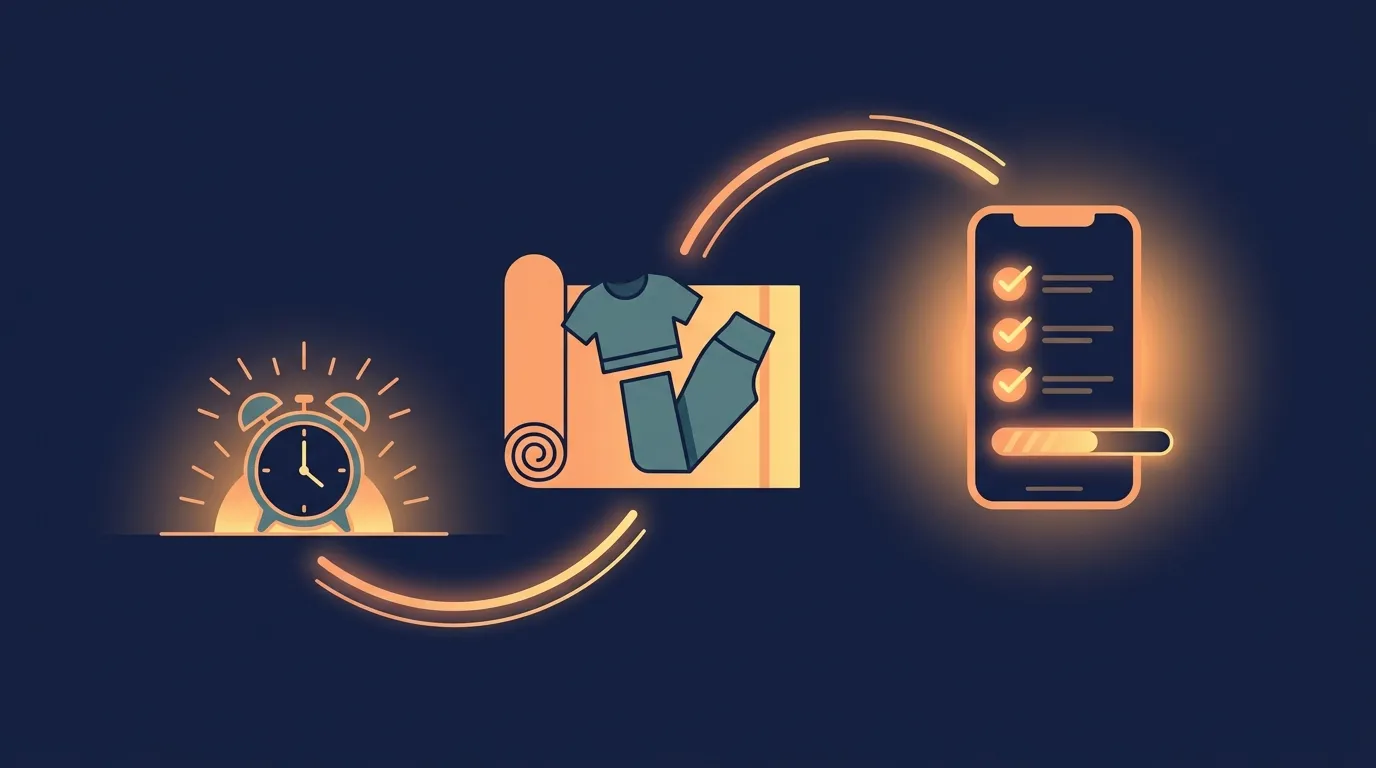
You will miss a day. Maybe several. This isn't failure. It's reality. The question isn't whether you'll break the streak, but what you do next.
Remember: Lally's research found that missing one opportunity to perform a behavior didn't materially affect the habit formation process. The problem isn't the missed day. The problem is the story you tell yourself about the missed day.
"I missed Monday, so the week is ruined" is an extinction-level thought for habits. It turns a single missed day into permission to quit. Instead, try this reframe: "Never miss twice." One missed day is a blip. Two missed days is the start of a new pattern. Get back to it the next day, even if it's a 5-minute version. Protect the streak, not the intensity.
How FitCraft Makes This Automatic
Everything in this article (environment design, identity reinforcement, cue-based systems, small starts, streak protection) is exactly what FitCraft was built around. Not by accident, but by design.
The AI coach Ty doesn't wait for you to feel motivated. Ty sends your daily workout at the same time, to the same place, anchored to your schedule. That's the cue. The workout is personalized by an Ivy League-trained exercise scientist and adapted to your equipment, time, and fitness level, so there's no decision fatigue about what to do. That's the friction removal.
The gamification system, including streaks, quests, collectible cards, and avatar progression, does something clever with your psychology. It turns "I should work out" into "I don't want to break my streak." It transforms exercise from a should into a want. That's the identity shift happening in real-time, reinforced with every completed workout.
As Matt put it: "The real win is I actually want to work out now. That's never happened before."
And Katie's experience captures the identity shift perfectly: "I've tried everything. This is the first time I've stuck with something past two weeks." Two weeks became two months. Two months became a new identity.
Your Action Plan (Start Today, Not Monday)
Don't wait for the perfect moment. Here's what to do right now, tonight, before bed:
- Pick your cue. Choose something you already do every day (morning coffee, lunch break, kids' bedtime) and decide that exercise happens immediately after.
- Set up your environment. Lay out clothes. Charge earbuds. Clear your workout space. Make tomorrow's workout feel inevitable.
- Commit to tiny. Your first workout is 5-10 minutes. That's it. You're building the habit, not training for a marathon.
- Track it visually. Put an X on a calendar. Use a streak app. Whatever makes the consistency visible. Seeing your progress reinforces the identity shift.
- Plan the miss. Decide now: when you miss a day (you will), you'll do a 2-minute version the next day. Never miss twice.
You've seen your pattern. You know what happens when you rely on willpower. This time, build the system first. Let the habit carry you.
Removing the willpower tax is the entire premise of our page for people who hate exercise.
Frequently Asked Questions
How long does it take to make exercise a habit?
Research by Lally et al. (2010) found it takes an average of 66 days for a behavior to become automatic, but the range spans 18 to 254 days depending on the person and behavior complexity. Exercise habits tend to take longer than simpler habits like drinking water, about 1.5 times longer on average. The good news: missing a single day doesn't reset your progress.
Can you build an exercise habit without motivation?
Yes. Behavioral science shows that habits run on cues and systems, not motivation. Implementation intentions (specific if-then plans like "When I finish my morning coffee, I do a 10-minute workout") increase follow-through by two to three times compared to relying on motivation alone. Environment design, identity shifts, and streak systems all reduce the need for willpower.
What is the best way to start an exercise habit?
Start with a workout so small it feels almost too easy, even 5 minutes counts. Attach it to an existing habit (after coffee, after dropping kids off). Remove friction by laying out clothes the night before. Track your consistency visually with a streak. Research shows that reducing barriers and anchoring to existing routines are the two most effective strategies for building lasting exercise habits.
Why do I keep quitting my workout routine?
Most people quit because they rely on motivation, which naturally fluctuates. They start with intense workouts when motivation is high, then miss a day when it dips, feel guilty, and abandon the routine entirely. This is a design problem, not a character flaw. Switching to systems (smaller workouts, environmental cues, streak tracking, and identity-based goals) breaks the quit cycle by removing willpower from the equation.
Does FitCraft help build exercise habits?
Yes. FitCraft is built around habit science. The AI coach Ty uses gamification mechanics like streaks, quests, and collectible cards to take the willpower out of showing up. The free diagnostic assessment identifies your specific consistency patterns and builds a personalized plan. Programs are designed by an Ivy League-trained exercise scientist and adapted to your schedule, equipment, and goals.