Zone 2 is everywhere right now. Longevity podcasts. Training plans. Your running club's group chat. And for good reason. The research connecting moderate aerobic exercise to a longer, healthier life is some of the most consistent in all of exercise science.
But if you don't own a Peloton or a rowing machine, you've probably hit the same wall: every Zone 2 tutorial assumes you have a cardio machine to stare at for 45 minutes. That's not most people's reality.
Here's the thing: Zone 2 is a heart rate, not an activity. Any movement that keeps your heart rate in the right range counts. And that opens up a lot of options you probably haven't considered.
This article covers what Zone 2 actually is, what the science really says (including the nuance the hype skips over), and exactly how to do it at home without buying anything.
What Zone 2 Cardio Actually Is
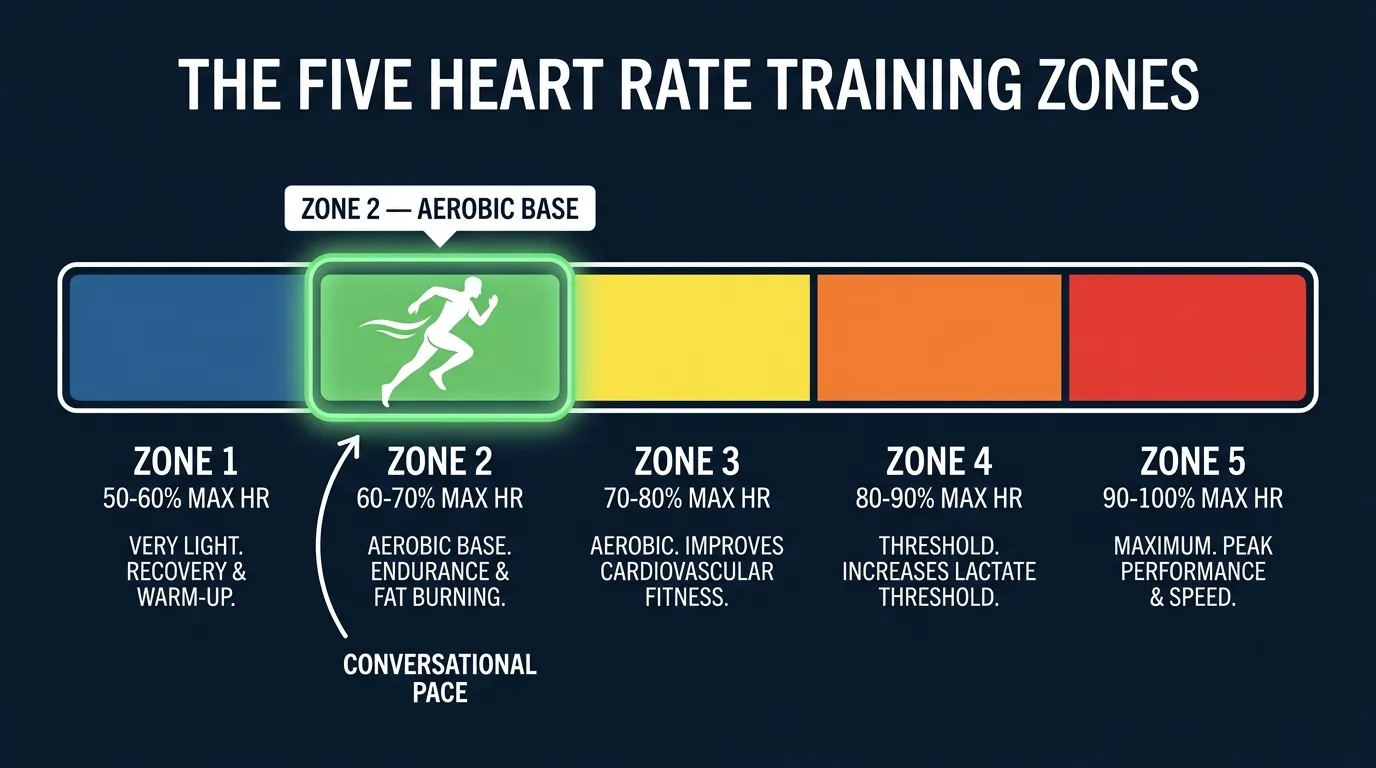
Zone 2 refers to a specific intensity band within the five-zone heart rate model used by exercise physiologists. The zones go from Zone 1 (very light, recovery walking) up to Zone 5 (maximum effort sprints). Zone 2 sits comfortably in the middle-low range.
The heart rate numbers
Zone 2 targets 60–70% of your maximum heart rate. A rough estimate for maximum heart rate is 220 minus your age, though this formula has a margin of error of ±10-12 beats per minute for any individual.
| Age | Est. Max HR | Zone 2 Range (60–70%) |
|---|---|---|
| 25 | 195 bpm | 117–137 bpm |
| 35 | 185 bpm | 111–130 bpm |
| 45 | 175 bpm | 105–123 bpm |
| 55 | 165 bpm | 99–116 bpm |
The talk test: your real-world gauge
You don't need a heart rate monitor to find Zone 2. The talk test is more reliable than most people expect:
- You're in Zone 2 if you can speak in full sentences but your breathing is noticeably elevated and you wouldn't want to sing
- You're below Zone 2 if you could comfortably have a lengthy phone conversation with no effort
- You're above Zone 2 if you can only push out 3–4 words before needing a breath
Most people overshoot Zone 2 when they first try it. They feel like they're going too slowly. That's almost always a sign they're exactly where they should be.
The lactate concept (without the jargon)
Here's why Zone 2 matters biologically. During exercise, your muscles produce lactate as a byproduct of energy metabolism. At low intensities, your aerobic system clears lactate almost as fast as it's produced. You stay in a steady state. Push past Zone 2 and lactate starts accumulating faster than your body can clear it. That burning sensation in your muscles is the result.
Zone 2 training is often called below the lactate threshold training precisely because it sits in the sweet spot where your aerobic system is working hard without tipping into the accumulation zone. Spending time here makes your aerobic system more efficient at clearing lactate. That's one of the key mechanisms behind the performance gains endurance athletes see from high-volume Zone 2 work.
The Science Behind Zone 2 Benefits
The Zone 2 trend took off largely because of research by Dr. Iñigo San Millán, a sports physiologist at the University of Colorado, and his collaborations with Dr. George Brooks of UC Berkeley. Their work on metabolic flexibility and mitochondrial function in Zone 2 training provided a credible physiological framework for something coaches had been doing intuitively for decades.
Mitochondrial adaptations
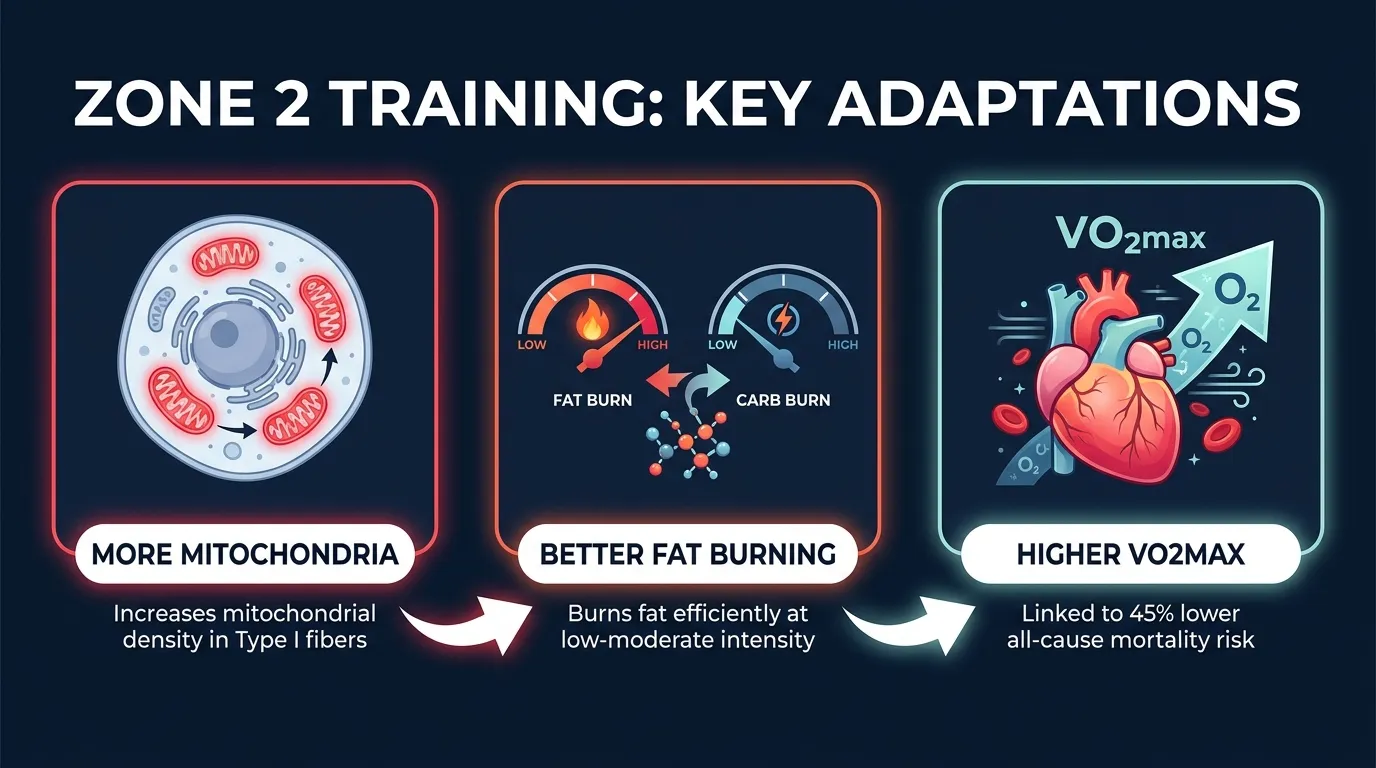
Mitochondria are the organelles that produce ATP (energy) in your cells. More mitochondria, and more efficient mitochondria, means a higher aerobic ceiling. You can sustain a given effort with less strain. San Millán and Brooks published research in Sports Medicine (2018) showing that Zone 2 training is particularly effective at stimulating mitochondrial biogenesis in Type I (slow-twitch) muscle fibers, the fibers you use during sustained, lower-intensity activity. That makes Zone 2 the primary mode for building the aerobic foundation that higher-intensity training later builds on.
Metabolic flexibility
Zone 2 training also improves metabolic flexibility: your body's ability to efficiently switch between burning carbohydrates and fat for fuel depending on availability and demand. Untrained people tend to rely heavily on carbohydrates even at low exercise intensities. Well-trained people burn more fat at the same intensity, preserving glycogen for when they need it during harder efforts. This adaptation is specific to Zone 2 intensity and doesn't happen as effectively at higher intensities (San Millán & Brooks, 2018).
Cardiovascular and longevity benefits
VO2max (the maximum rate at which your body can consume oxygen during exercise) is one of the strongest predictors of all-cause mortality ever identified. Large cardiorespiratory fitness studies have consistently found that each meaningful increase in VO2max is associated with a substantial reduction in all-cause mortality risk. Zone 2 training increases VO2max, though more slowly than HIIT. For most people who do no sustained cardio at all, adding Zone 2 is one of the highest-leverage health interventions available.
The 80/20 rule
Exercise physiologist Stephen Seiler published research (International Journal of Sports Physiology and Performance, 2010) documenting what elite endurance athletes across disciplines actually do in training: roughly 80% of their volume in low intensity (Zone 1–2) and only 20% at high intensity. This polarized distribution, sometimes called the "80/20 rule," outperforms approaches that pile on moderate-intensity work. The Zone 2 majority builds the aerobic base. The high-intensity minority pushes the ceiling. Most recreational athletes get this ratio backwards.
Zone 2 at Home, Without a Treadmill or Bike
Here's the part most Zone 2 content skips. You don't need equipment. Zone 2 is a heart rate target, not a machine. The goal is sustained movement at a conversational pace for 30–60 minutes. Any movement that achieves that works. Once the easy pace is dialed in, the session worth adding next is a tempo run, the sustained comfortably-hard effort that sits just under your lactate threshold.
What actually keeps you in Zone 2 at home
The key insight is pace control. Most bodyweight exercises go above Zone 2 when done at normal tempo. The trick is to slow them down, remove rest periods, and focus on maintaining steady-state rhythm rather than maximum effort.
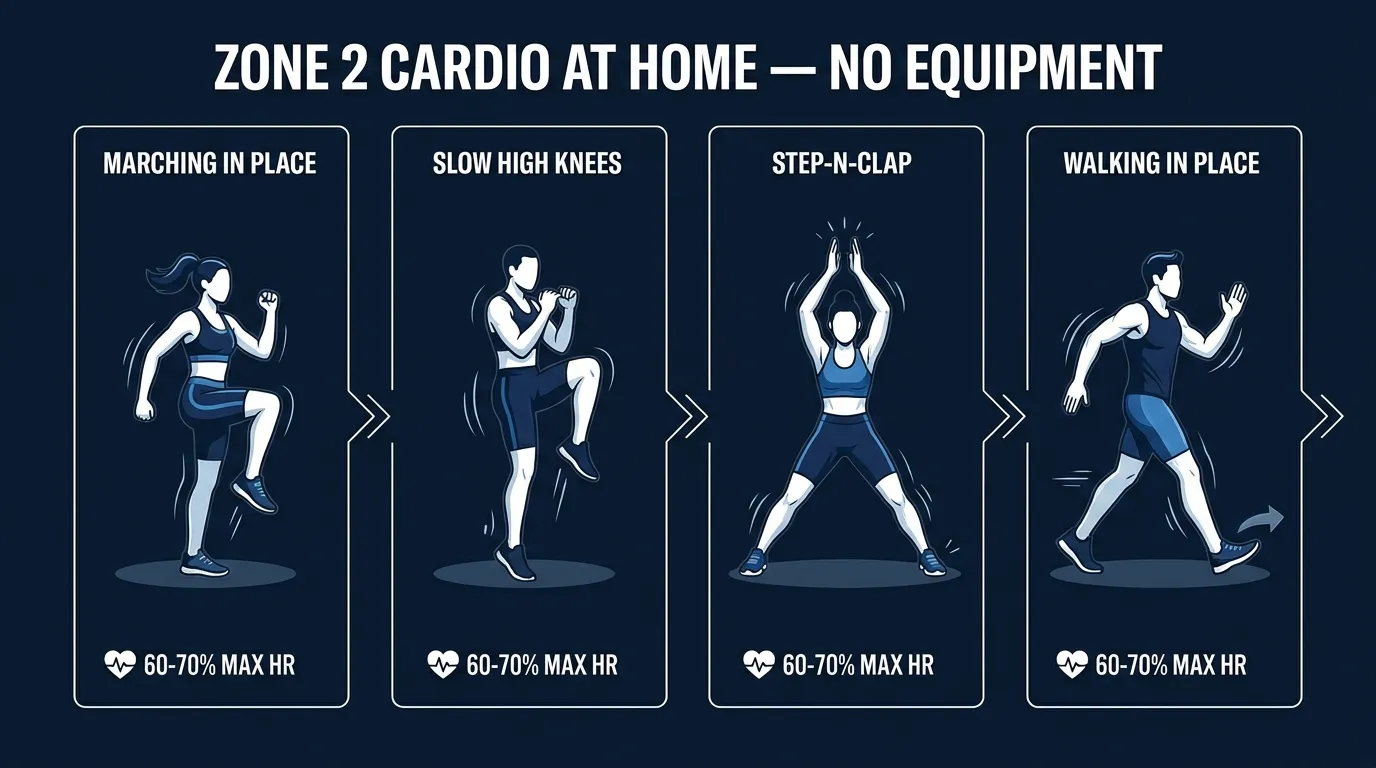
These movements work well for at-home Zone 2 cardio:
- Marching in Place. Arm swing adds enough engagement to raise your heart rate into Zone 2 without going over. Sustainable for 20–40 minutes.
- Walking in Place. Slower than marching, better for beginners or warm-up. Exaggerate arm movement and drive knee height to raise HR into range.
- Slow High Knees. Standard high knees are Zone 3–4 territory. Slowed to a deliberate, controlled tempo they can sit right at Zone 2.
- Step-n-Clap. A rhythmic lateral step pattern that stays aerobic without spiking intensity.
- Low-Intensity Jumping Jacks. Slow the tempo and reduce the arm elevation to bring these into Zone 2.
- Stair climbing. If you have stairs at home, steady up-and-down stair walking is an excellent Zone 2 option with no equipment at all.
The circuit approach
One practical strategy for home Zone 2 is to rotate through 3–4 of these movements continuously, spending 5–10 minutes on each, without stopping between exercises. The continuous rotation prevents any single movement from pushing you too far into fatigue while maintaining consistent heart rate elevation.
A sample 30-minute at-home Zone 2 session:
- 0–8 min: Marching in Place (steady rhythm, active arms)
- 8–16 min: Walking in Place (increase arm drive to maintain HR)
- 16–22 min: Slow High Knees (deliberate tempo, hands active)
- 22–30 min: Step-n-Clap (lateral rhythm, maintain conversational pace)
Throughout the session: check the talk test every 3–4 minutes. If you can't finish a sentence, slow down. If it feels effortless, add more arm movement or increase tempo slightly.
Ready to put this into practice?
Take the free FitCraft assessment and get a personalized plan that builds Zone 2 cardio into a program designed around your schedule and goals.
Take the Free Assessment Free · 2 minutes · No credit cardThe Zone 2 Debate: What the 2025 Research Actually Says
Good science is never final. And in 2025, a significant narrative review out of Queen's University and McMaster University pushed back on some of the bolder claims in the Zone 2 discourse.
Published in Sports Medicine Open (PMID: 40560504), the review's headline finding was blunt: "The majority of available evidence argues against the ability of Zone 2 training to increase mitochondrial capacity." The authors found that higher-intensity exercise protocols produced consistently larger improvements in mitochondrial markers and VO2max than Zone 2 alone, particularly at lower training volumes.
What this means (and doesn't mean)
Before you throw out your Zone 2 plan, some important context:
- The review focused heavily on mitochondrial biogenesis specifically, not the full range of Zone 2 benefits. Cardiovascular, metabolic flexibility, and longevity benefits weren't the primary subject of critique.
- The findings are most relevant for time-limited people who can only do a small volume of exercise. If you have 90–120+ minutes per week to train, Zone 2 still earns its place in a balanced program.
- The research comparing Zone 2 to higher-intensity exercise was often done on untrained people, for whom any exercise produces large gains. The comparison changes for people who already have a fitness base.
- The 80/20 distribution used by elite endurance athletes (documented by Seiler across multiple sports) remains well-supported. The elite athletes doing 80% Zone 2 aren't doing it instead of hard work. They're doing it alongside it.
The honest takeaway: Zone 2 isn't magic, and it isn't the only intensity that matters. What the research consistently supports is that sustained moderate-intensity cardiovascular exercise has substantial health benefits, and that most people do too little of it regardless of what zone they're in. Getting 150+ minutes of moderate cardio per week (Zone 2 or otherwise) matters more than optimizing the exact heart rate.
The consistency problem
Here's where the Zone 2 conversation usually stalls. You understand the theory. You've seen the research. But 45-minute steady-state cardio sessions are, objectively, hard to stick with. There's no dramatic finish, no PR, no moment of breakthrough. Just a steady hum of low-level effort for almost an hour.
This is the point where most people drift to HIIT. Not because HIIT is objectively better, but because it's shorter, more exciting, and produces more immediate feedback. That's a legitimate behavioral response to a real design problem.
The fix isn't more willpower. It's better structure. Tracking your Zone 2 sessions as achievements, building streaks, and seeing aerobic fitness progress in concrete metrics makes the boring sessions feel worth doing. It's a system design problem, not a discipline problem.
What This Means for You
You don't need to become a Zone 2 evangelist. You need a plan that you'll actually follow.
For most people starting from minimal cardio, the single highest-leverage change is adding two to three 30-minute sessions of sustained aerobic work per week. Zone 2, or comfortably close to it. The specific heart rate matters less than the habit of showing up for steady, non-exhausting movement on a regular schedule.
If you're already doing strength training or HIIT, Zone 2 sessions on off-days serve a different purpose. They accelerate recovery, build aerobic base, and create the mitochondrial density that makes your hard training sessions more productive over time. They're the long-term investment in your engine.
"The real win is I actually want to work out now. That's never happened before." That's Matt, 30-something, who built a consistent routine by tracking his sessions, not obsessing over zone percentages. Once he stopped trying to make every session a max-effort event and started treating Zone 2 sessions as maintenance (something he could do without dreading), the habit stuck in a way it never had before.
The goal isn't perfect Zone 2 compliance. The goal is consistent moderate aerobic work, week over week, month over month. That's what the research actually supports. Everything else is optimization for people who've already built the baseline habit.
Frequently Asked Questions
What heart rate is Zone 2 cardio?
Zone 2 cardio targets 60–70% of your maximum heart rate. A quick estimate for max heart rate is 220 minus your age. So a 35-year-old would target roughly 111–130 beats per minute. The easiest field test: you should be able to hold a full conversation but wouldn't want to sing.
Can I do Zone 2 cardio at home without equipment?
Yes. Any sustained, low-to-moderate intensity movement can put you in Zone 2. Marching in place, slow high knees, step exercises, and steady-state bodyweight circuits all work, as long as you keep the intensity conversational. The key is slowing down more than feels intuitive; most people start too fast and push above Zone 2 without realizing it.
How long should a Zone 2 cardio session be?
Most exercise physiologists recommend Zone 2 sessions of 30–60 minutes per bout, 3–4 times per week, for a total of 150+ minutes of moderate-intensity cardio per week, in line with WHO physical activity guidelines. Shorter 20-minute sessions still provide benefit for beginners. 45-minute sessions appear to maximize mitochondrial and metabolic adaptations for people with training experience.
Is Zone 2 cardio better than HIIT?
They serve different purposes and are best combined. Zone 2 builds aerobic base, metabolic flexibility, and mitochondrial density. Those adaptations develop over weeks to months. HIIT produces faster improvements in VO2max and anaerobic capacity for a given time investment. Elite endurance athletes typically do 80% of their training volume in Zone 2 and 20% at high intensity (Seiler, 2010). For most people, both have a place in a well-rounded program.
How does FitCraft help with Zone 2 cardio?
FitCraft's AI coach Ty builds personalized plans that balance aerobic base work with strength and mobility training, including the home-friendly exercises that work for Zone 2 without a treadmill. The app's streak and quest system is specifically designed to keep you consistent through the longer, less dramatic sessions where most people lose motivation.
Sources
- San Millán I, Brooks GA. Assessment of Metabolic Flexibility by Means of Measuring Blood Lactate, Fat, and Carbohydrate Oxidation Responses to Exercise in Professional Endurance Athletes and Less-Fit Individuals. Sports Med. 2018;48(2):467-479.
- Storoschuk KL, Moran-MacDonald A, Gibala MJ, Gurd BJ. Much Ado About Zone 2: A Narrative Review Assessing the Efficacy of Zone 2 Training for Improving Mitochondrial Capacity and Cardiorespiratory Fitness in the General Population. Sports Medicine Open. 2025. PMID: 40560504.
- Seiler S. What is Best Practice for Training Intensity and Duration Distribution in Endurance Athletes? International Journal of Sports Physiology and Performance. 2010;5(3):276–291.
- Wisløff U, et al. Superior Cardiovascular Effect of Aerobic Interval Training Versus Moderate Continuous Training in Heart Failure Patients. Circulation. 2007;115(24):3086–3094.
- World Health Organization. WHO Guidelines on Physical Activity and Sedentary Behaviour. Geneva: WHO; 2020.