Step-N-Clap takes the feel of a jumping jack and removes the jump. You step side to side, sweep the arms wide, and clap with long arms on each beat. That makes it useful for low-impact cardio days, warmups, and finishers when you want heart rate without pounding your knees or ankles.
Quick Facts: Step-N-Clap
- Equipment needed: None
- Difficulty: Beginner to intermediate
- Modality: Low-impact cardio and conditioning
- Body region: Full body, with lower-body lateral movement and upper-body arm sweep
- FitCraft quest category: Cardio
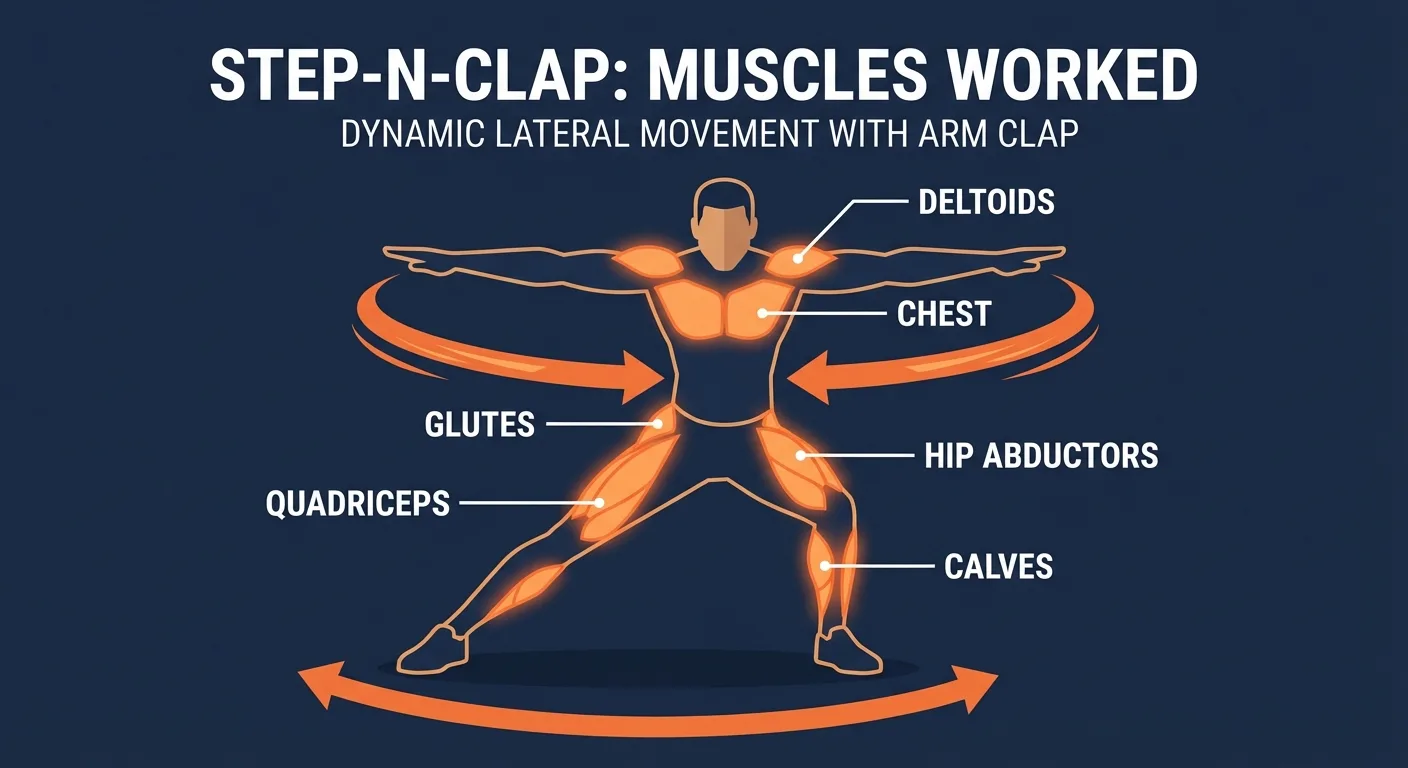
Muscles & Systems Worked
The primary movers are the quadriceps, gluteus maximus, gluteus medius, gluteus minimus, and hip adductors. They control the side step, absorb the landing, and push you back toward center on each rep.
The shoulders, chest, and upper back help drive the clap. The deltoids lift and sweep the arms, the pectorals help bring the arms together, and the scapular muscles keep the shoulder blades moving cleanly instead of shrugging toward your ears.
The core, spinal erectors, and ankle stabilizers work isometrically so the torso stays tall and the feet land quietly. Your calves help with foot control, especially when the tempo rises.
No exercise-specific PubMed, PMC, or DOI citation is included for Step-N-Clap in the verified FitCraft citation library. The mechanism is straightforward: larger side steps raise lower-body demand, longer arm sweeps raise shoulder demand, and continuous rhythm shifts the main stimulus toward cardiovascular and glycolytic conditioning.
Step-by-Step: How to Do Step-N-Clap
- Set your stance. Stand tall with your feet together, ribs stacked over pelvis, and arms relaxed at your sides. Coach Ty's cue: "Start tall before you start fast."
- Step wide to one side. Take a lateral step with your right foot and land quietly through the midfoot and heel. Keep the knee soft and pointed in the same direction as the toes. Coach Ty's cue: "Wide enough to use your hips, quiet enough to spare your joints."
- Clap with long arms. As the foot lands, sweep both arms out and bring the hands together in front of your chest or slightly overhead. Keep the elbows mostly straight so the movement stays big. Coach Ty's cue: "Long arms make the clap count."
- Return to center. Bring the trailing foot in under your hips while the arms open again. Stay upright instead of leaning into the next step. Coach Ty's cue: "Reset tall between sides."
- Alternate continuously. Repeat to the left, then keep switching sides for the full interval. Breathe steadily and end the set when the steps get loud, the arms shorten, or your rhythm falls apart. Coach Ty's cue: "Smooth beats rushed."
Get this exercise in a personalized workout
FitCraft, our mobile fitness app, uses its AI coach Ty to program conditioning work like this into your plan at the right volume and intensity, based on your level, goals, and equipment. Ty was designed and trained by Domenic Angelino, MPH (Brown University) and NSCA-CSCS, with research published in the Journal of Strength and Conditioning Research and Medicine & Science in Sports & Exercise.
Take the Free Assessment Free • 2 minutes • No credit card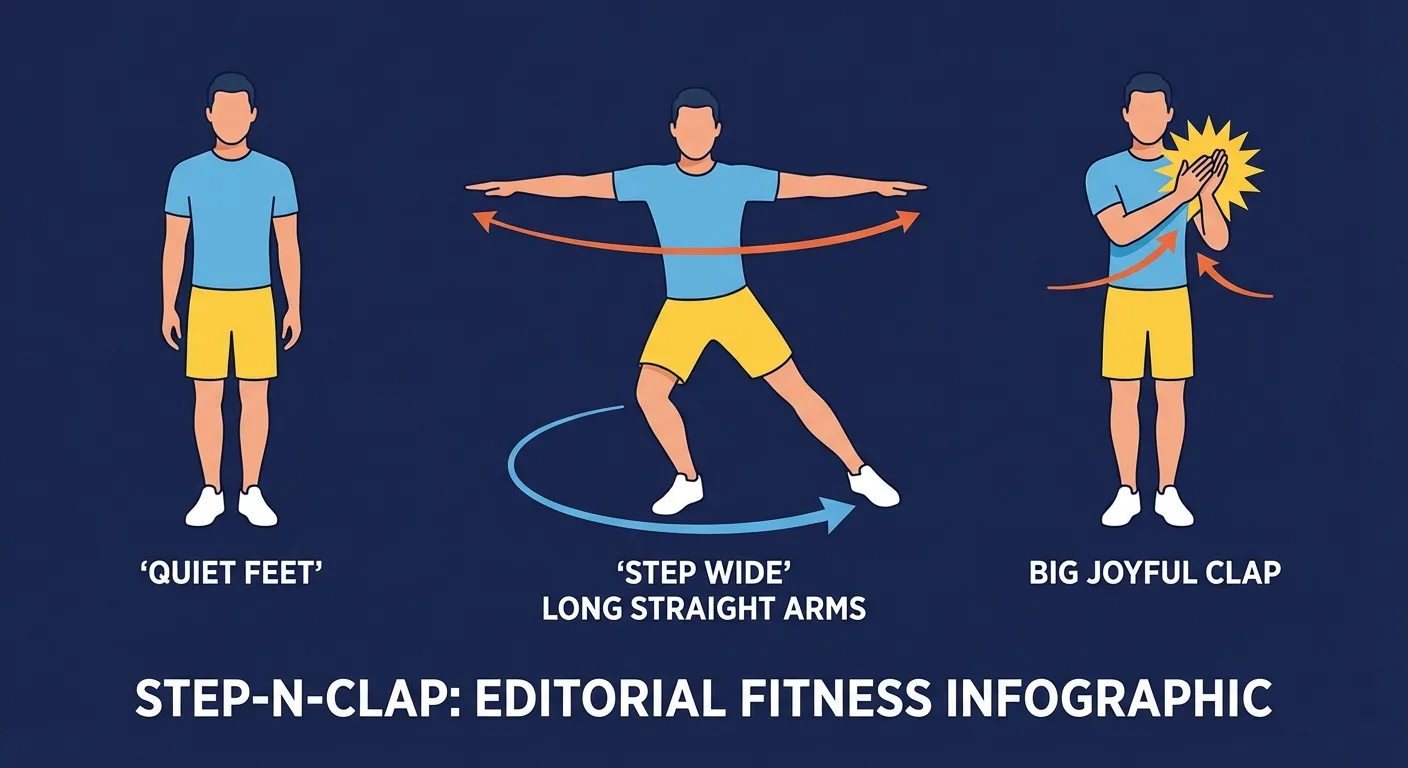
Common Mistakes (And How to Fix Them)
Taking Tiny Shuffle Steps
What it looks like: Your feet tap side to side without leaving much space between landings.
Why it's a problem: The lateral step is what asks the hips and legs to work. A tiny shuffle turns the move into light marching with claps.
The fix: Step at least hip-width away from center. If that bothers your knees or ankles, keep the range smaller and treat it as a regression.
Clapping with Bent Elbows
What it looks like: Your hands meet near your chest with a short, quick clap.
Why it's a problem: The shoulder work comes from the long sweep. Bent elbows make the movement easier and reduce the conditioning cost.
The fix: Reach the arms wide before every clap. Think about moving from the shoulders, with the hands traveling in a large arc.
Landing Loudly
What it looks like: Each step thumps into the floor.
Why it's a problem: Step-N-Clap is meant to be lower impact than jumping jacks. Loud steps usually mean you're dropping weight instead of controlling it.
The fix: Slow down, soften the knee, and roll through the foot. You should be able to keep the rhythm without hearing every landing.
Rushing the Rhythm
What it looks like: The first 10 seconds look clean, then the arms shorten and the feet get messy.
Why it's a problem: Conditioning only helps if the reps stay repeatable. Sloppy speed changes the movement and increases trip risk.
The fix: Pick a pace you can hold for the whole interval. Build speed after the pattern looks the same from start to finish.
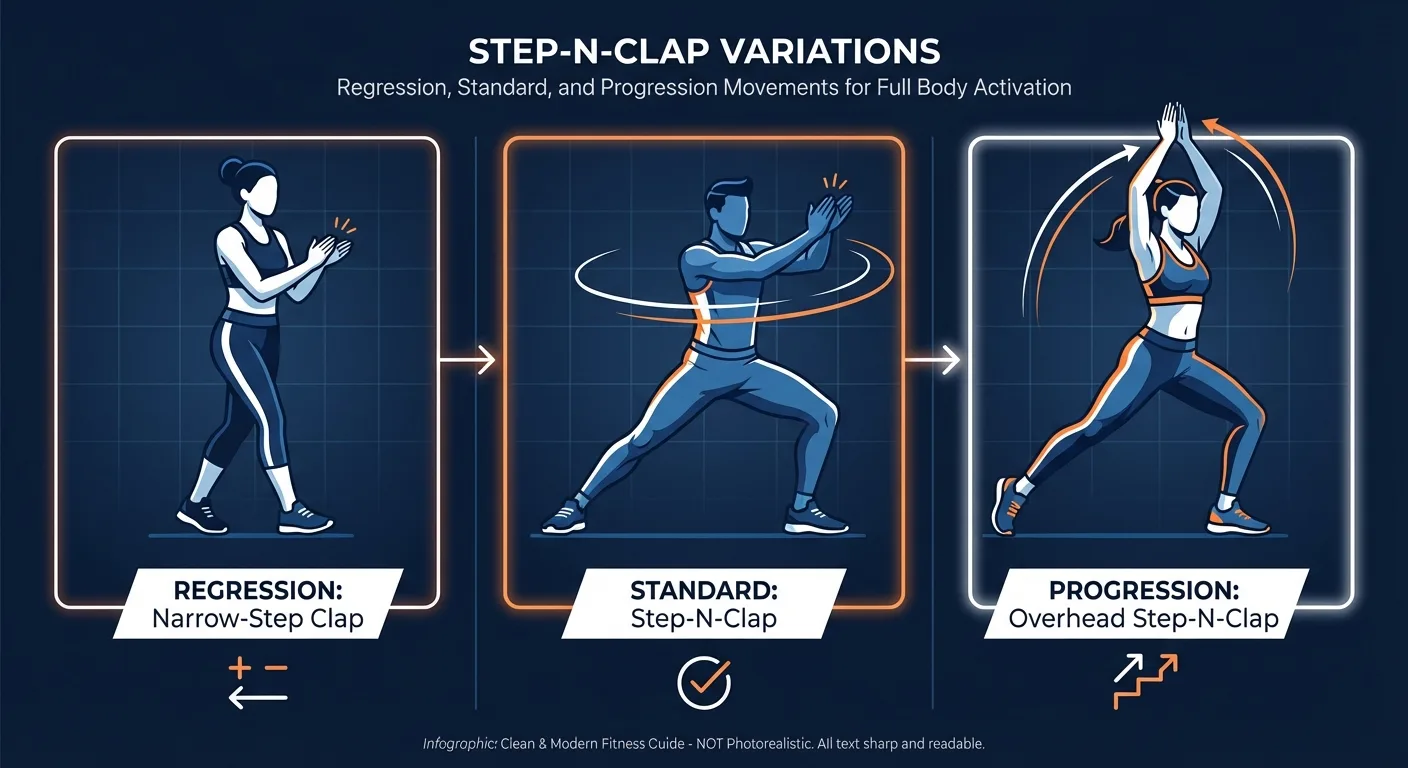
Step-N-Clap Variations: Regressions and Progressions
Step-N-Clap Narrow Step
Use a smaller side step and chest-height clap. This is the best starting point if wide lateral movement bothers your hips, knees, or ankles.
Standard Step-N-Clap
Step wider than hip width, clap with long arms, and alternate sides for 20 to 45 seconds. This version gives the best balance of cardio, coordination, and low-impact joint loading.
Step-N-Clap Overhead
Take the clap higher, finishing slightly overhead if your shoulders tolerate it. The bigger arc raises heart rate faster and asks more from shoulder mobility.
Fast-Tempo Step-N-Clap
Keep the same range while increasing cadence. Use this only after you can move quickly without loud landings or shortened arm swings.
Alternative Exercises
- Jumping Jacks. A higher-impact option with a similar whole-body rhythm.
- Marching in Place. A simpler low-impact option when lateral steps feel irritating.
- High Knees. A more intense upright cardio option if your knees tolerate faster hip flexion.
When to Avoid or Modify Step-N-Clap
Step-N-Clap is safe for many healthy adults, but it still raises heart rate and asks the lower body to control repeated side steps. Always consult your physician before starting or returning to exercise if you have medical concerns.
- Known cardiovascular disease or uncontrolled hypertension. Use clinician-approved intensity limits and consider marching in place until faster intervals are cleared.
- Acute knee, ankle, hip, shin, or foot pain. Reduce step width, slow the tempo, or switch to cat-cow and mobility work until symptoms settle.
- Pregnancy, early postpartum recovery, or pelvic-floor symptoms. Keep the movement small, avoid breath holding, and use low-impact alternatives such as marching in place after getting appropriate clearance.
- Vertigo, balance disorders, or vestibular symptoms. Hold a stable support, slow the side step, or choose stationary conditioning until side-to-side movement feels steady.
- Asthma or exercise-induced bronchoconstriction. Warm up longer, keep medication available if prescribed, and use shorter intervals if breathing tightens.
- Shoulder irritation with the clap. Keep claps at chest height, shorten the arm arc, or use lower-body-only side steps until the shoulders feel comfortable.
Related Exercises
- Lower-impact cardio alternative: Marching in Place keeps one foot grounded and removes the lateral step.
- Higher-impact conditioning option: Jumping Jacks use a similar rhythm with more impact and airtime.
- Lateral conditioning drill: Side Lunge Toe Touch adds more hip and inner-thigh range.
- Core stability foundation: Deadbugs help build trunk control for cleaner upright cardio.
- Ankle and calf prep: Calf Raises build foot and lower-leg tolerance before faster intervals.
- Impact progression: Calf Hops introduce small jumps once low-impact work feels easy.
How to Program Step-N-Clap
Use Step-N-Clap as time-based conditioning. The broader progression model from Ratamess et al., 2009 supports matching training volume, rest, and frequency to your current level instead of forcing one interval length for everyone.
| Level | Sets × Reps | Rest between sets | Frequency |
|---|---|---|---|
| Beginner | 20-30 seconds per interval | 60-90 seconds | 2-3 sessions/week |
| Intermediate | 30-45 seconds per interval | 45-60 seconds | 3-4 sessions/week |
| Advanced | 45-60 seconds per interval | 30-45 seconds | 3-5 sessions/week |
Place Step-N-Clap in a warmup, a standalone low-impact cardio circuit, or a short finisher after resistance training. If you're pairing it with heavier strength work, keep the conditioning block after the lifts so your legs and trunk are fresh for the loaded work.
Use form as the floor. Stop the set when the landings get loud, the step narrows without intention, the arms bend on every clap, or breathing gets too ragged to control the next rep.
Frequently Asked Questions
What is Step-N-Clap?
Step-N-Clap is a low-impact conditioning drill that pairs a wide side step with a long-arm clap. It keeps one foot on the floor, so it feels more joint-friendly than jumping jacks while still raising heart rate.
What muscles does Step-N-Clap work?
Step-N-Clap works the quads, glutes, hip abductors, adductors, calves, shoulders, chest, upper back, and core. The heart, lungs, and energy systems do the conditioning work during longer intervals.
Can I do Step-N-Clap with knee or ankle pain?
Modify it if knee or ankle pain shows up. Use a smaller step, slow the tempo, keep landings quiet, and switch to marching in place if symptoms continue. Persistent or sharp pain needs medical or physical therapy guidance.
How is Step-N-Clap different from jumping jacks?
Jumping jacks use a jump with both feet leaving the floor. Step-N-Clap uses side steps with one foot grounded, which lowers impact while keeping the rhythmic arm sweep and full-body cardio demand.
How long should I do Step-N-Clap?
Start with 20 to 30 second intervals and 60 to 90 seconds of rest. Build toward 30 to 45 second intervals, then 45 to 60 seconds if your rhythm and landing control stay clean.