Quick Facts: Marching in Place
- Equipment needed: None (optional: light resistance band above the knees for the banded variation)
- Difficulty: Beginner (scalable to intermediate and advanced with knee height, tempo, arm drive, and band)
- Modality: Low-impact cardiovascular conditioning
- Body region: Lower body (primary), core and upper body (secondary with active arm swing)
- FitCraft quest category: Cardio & conditioning
Muscles & Systems Worked
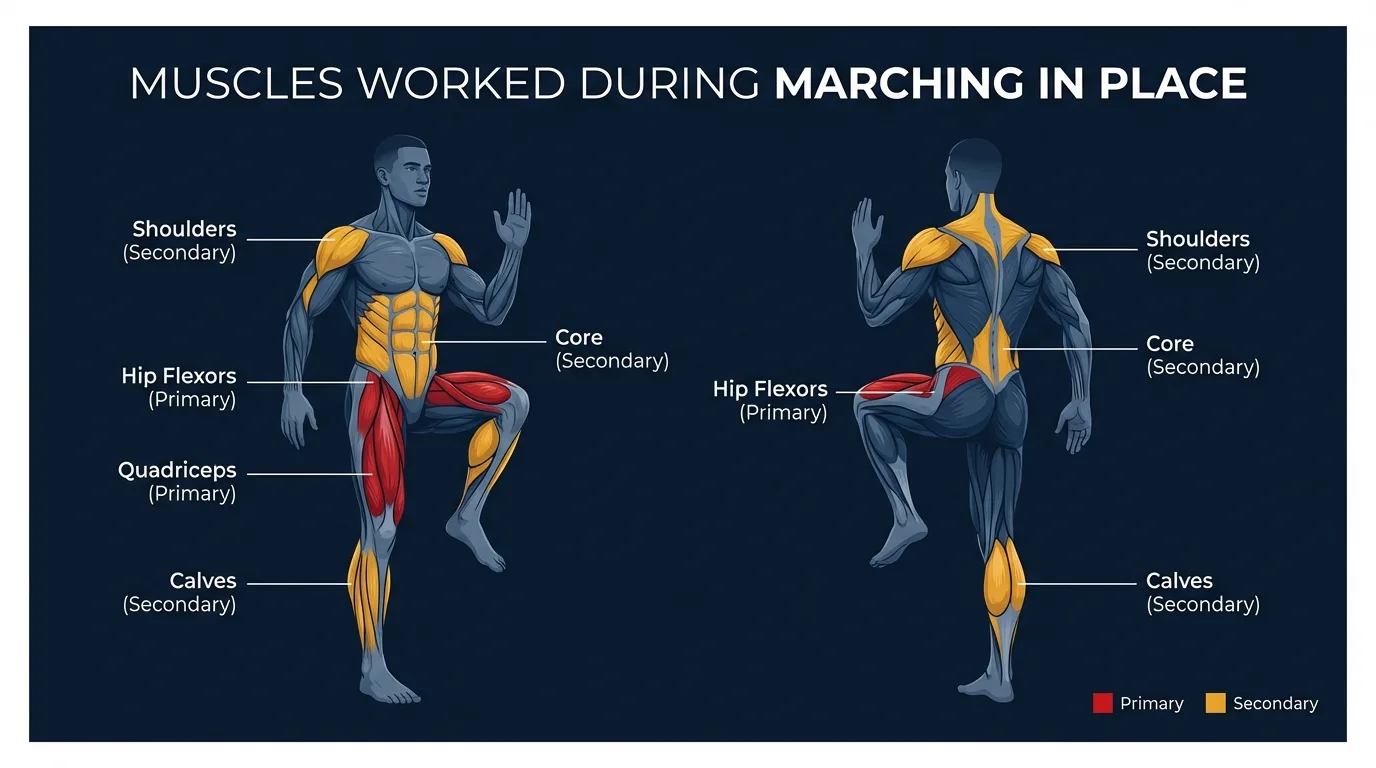
Primary movers are the hip flexors (iliopsoas, rectus femoris) and quadriceps. They fire concentrically to drive the thigh upward toward the chest on every rep. The contralateral glute (the standing-leg side) works isometrically to stabilize the pelvis and prevent it from dropping toward the lifted leg.
Secondary movers include the hamstrings of the lifted leg, which assist hip flexion at higher knee positions, and the calves (gastrocnemius and soleus) of the standing leg, which control the small ankle plantarflexion that springs you back upright as you switch sides. When you actively swing the arms, the deltoids and upper back muscles (rhomboids, mid trapezius) contribute, turning the movement into a full-body conditioning drill.
Stabilizers are the deep core (transverse abdominis and internal obliques) bracing the trunk so the torso stays vertical instead of swaying side to side as the legs alternate. The spinal erectors maintain upright posture under the dynamic load. At the ankle, the peroneals and tibialis anterior/posterior control the foot strike and prevent the ankle from rolling on landing.
Mechanism and energy systems. At a moderate tempo with knees rising to roughly hip height, marching in place produces a steady aerobic stimulus that primarily taxes the oxidative energy system (fat and carbohydrate oxidation via mitochondrial respiration). Push the tempo and knee height higher, add resistance bands, or layer in arm overhead drives, and the demand shifts upward into the glycolytic system, with heart rate climbing toward the upper zone-2 to lower zone-3 range. Because there is no jumping impact, the cardiovascular stimulus comes without the joint loading that limits how much higher-intensity cardio most people can recover from week to week, which is why it works well as a daily-driver conditioning option for older adults, post-rehab populations, and beginners building an aerobic base.
Step-by-Step Instructions
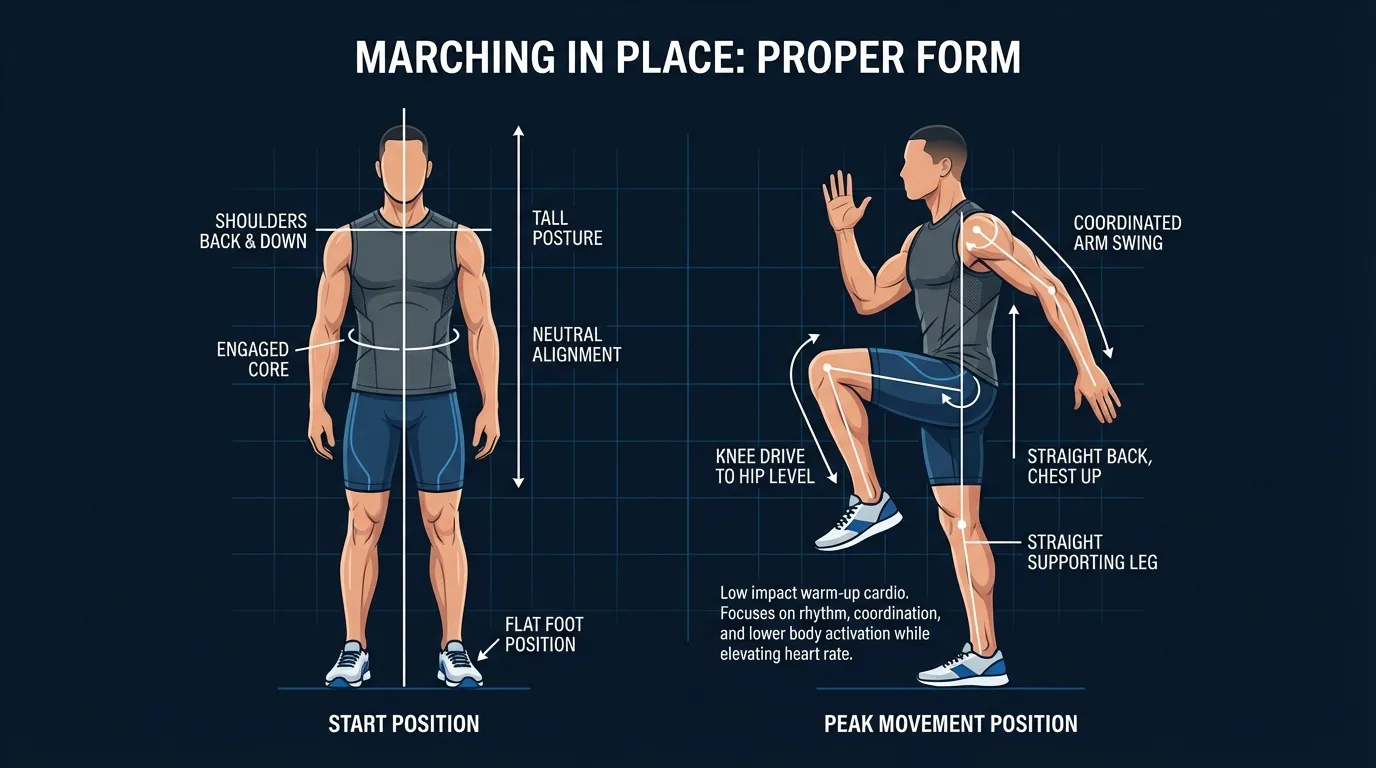
- Stand tall with feet hip-width apart. Start with good posture: chest lifted, shoulders back and relaxed, core lightly braced. Your arms should hang naturally at your sides or bend at about 90 degrees, ready to swing. Coach Ty's cue: "Stand tall. The second you lean back, you're borrowing momentum instead of building strength."
- Lift your right knee toward your chest. Drive your knee upward until your thigh reaches roughly parallel with the floor, or as high as you comfortably can. The lift comes from your hip flexor. Don't lean backward to cheat the height. Your torso stays vertical. Coach Ty's cue: "Drive those knees up. Ankle-height marching is ankle-height results."
- Place your foot down and switch sides. Lower your right foot back to the ground softly, landing ball-first. As it touches, immediately drive your left knee up to the same height. The transition should feel like deliberate, exaggerated walking. Coach Ty's cue: "Land soft. If I can hear your feet, you're stomping."
- Swing your arms in opposition. Left arm forward when your right knee comes up. Right arm forward when your left knee comes up. This natural pattern engages your core through counter-rotation and helps you maintain balance and rhythm. Coach Ty's cue: "Use your arms. They're not decoration."
- Find a steady pace and breathe on a rhythm. You're not sprinting. Think purposeful walking tempo, about one step per second for beginners. As you get comfortable, increase the pace or knee height to raise intensity. Inhale for two marches, exhale for two marches. Coach Ty's cue: "Breathe on a rhythm, not when you remember to."
Get this exercise in a personalized workout
FitCraft, our mobile fitness app, uses its AI coach Ty to program conditioning work like this into your plan at the right volume and intensity, based on your level, goals, and equipment. Ty was designed and trained by Domenic Angelino, MPH (Brown University) and NSCA-CSCS, with research published in the Journal of Strength and Conditioning Research and Medicine & Science in Sports & Exercise.
Take the Free Assessment Free · 2 minutes · No credit cardCommon Mistakes
- Knees not lifting high enough. If your feet are barely clearing the floor, you're barely working. The exercise is called marching, not shuffling. Aim to get your thigh to at least 45 degrees from vertical, ideally parallel with the floor. Slow down if you need to; range of motion matters more than speed.
- Leaning backward. People lean back to counterbalance the knee lift. It feels easier because it is easier. You're taking the hip flexors out of the equation and loading your lower back instead. Keep your torso vertical. If you can't maintain posture at your current knee height, lower the height until you can.
- Forgetting the arm swing. Standing with your arms at your sides while marching leaves half the exercise on the table. The opposite arm-to-leg pattern engages your core, raises your heart rate, and improves coordination. Swing deliberately.
- Going too fast too soon. Beginners sometimes try to march at double time and immediately break form. Speed without control is sloppy movement. Start at a pace where you can maintain perfect posture and full knee height, then gradually increase tempo over weeks.
- Landing flat-footed. Slapping your feet down creates jarring impact through your ankles and knees and breaks your rhythm. Land ball-of-foot first, then let the heel touch down gently. It should feel smooth and continuous.
Variations
- Seated marching (beginner regression). Sit on the edge of a sturdy chair and march your knees up one at a time. This removes all balance demands and is an excellent starting point for older adults, post-rehab patients, or anyone who finds standing marching too challenging. Pair with seated arm swings for an upper-body component.
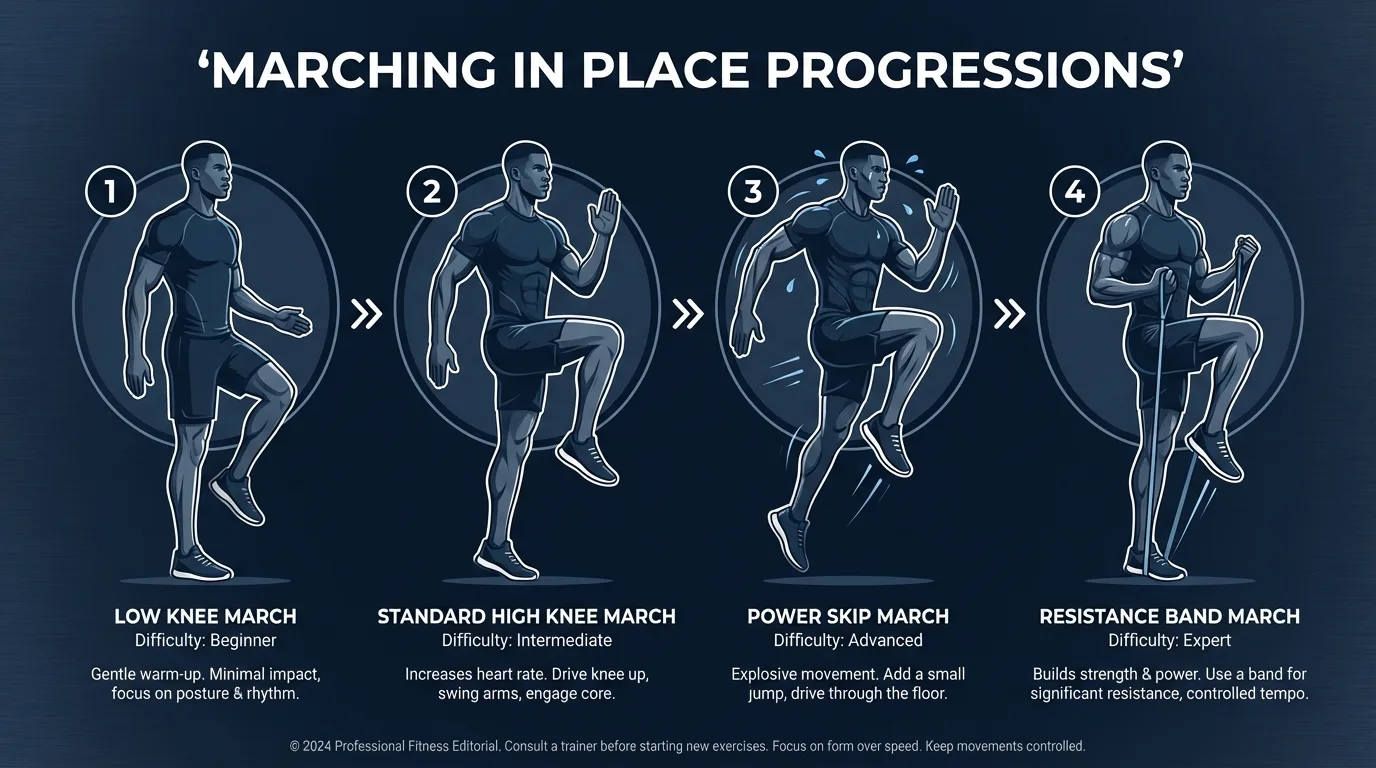
- Low-knee marching (beginner). March at a slower pace with your knees rising only to about 45 degrees instead of parallel. This reduces hip flexor demand and cardiovascular intensity while still building the movement pattern and daily habit.
- Standard marching in place (beginner to intermediate). Knees to hip height, active arm swing, steady aerobic tempo. The default version used for warm-ups, active recovery, and zone-2 cardio sessions.
- High-knee marching (intermediate). Increase the knee height until your thigh is fully parallel with the floor on each rep, and pump your arms harder. This progression significantly increases hip flexor activation and shifts the cardiovascular demand into the upper aerobic zone. If you progress further, this becomes the standalone exercise high knees.
- Power marching with arm overhead reach (intermediate to advanced). On each knee lift, drive the opposite arm straight overhead instead of just swinging forward. This adds a shoulder component and increases the range of motion for your core rotation.
- Banded marching (advanced). Loop a light resistance band just above your knees. The band forces your hip abductors to fire on every rep to keep your knees from collapsing inward, turning a simple march into a serious glute medius and hip-stabilizer challenge.
When to Avoid or Modify Marching in Place
Marching in place is one of the safest cardio movements available, but a few situations still warrant modification. Always consult a qualified healthcare provider or physical therapist before starting or returning to any exercise program, especially if you have one of the conditions below.
- Acute knee, hip, or ankle injury. Even low-impact knee lifting can aggravate fresh injury. Drop to seated marching (above the chair) until cleared to return to standing work. If pain persists at any knee height, stop and consult a physical therapist.
- Balance disorders, vertigo, or vestibular conditions. Lifting one foot off the ground briefly shifts your base of support and can trigger dizziness or falls. Stand next to a sturdy chair or wall for hand support, or use the seated variation until balance work has been addressed separately.
- Known cardiovascular disease or uncontrolled hypertension. Even moderate cardio elevates heart rate and blood pressure. Get your cardiologist's approval and stay within their prescribed heart-rate zones. Marching in place is gentler than most cardio options, but the same medical clearance rules apply.
- Late-pregnancy balance changes. The shifting center of gravity in the second and third trimesters reduces single-leg stability. Use a wall or chair for hand support, lower the knee height, and prioritize the seated variation if standing balance feels unreliable.
- Stress incontinence or pelvic-floor weakness. Marching is non-impact and is usually well tolerated, but some users with significant pelvic-floor issues notice leakage on the foot-strike phase. Focus on the seated variation while working with a pelvic-floor physical therapist on prerequisite core and pelvic-floor strength. Foundational core work like deadbugs and bird-dogs often helps.
- Asthma or exercise-induced bronchoconstriction. Have an inhaler accessible, extend your warm-up, and build session length gradually. The low-impact nature makes this one of the more asthma-friendly cardio options.
Related Exercises
- Same low-impact cardio family: walking in place, step-n-clap. Same accessibility profile, slightly different movement patterns.
- Progression within the pattern: high knees. The natural next step when standard marching no longer challenges you, with the same mechanics at higher intensity.
- Higher-impact cardio progression: jumping jacks, butt kicks. Adds plyometric loading once joints and pelvic floor are conditioned for impact.
- Core stability foundation: deadbugs, bird-dogs, forearm planks. Build the trunk control that keeps you upright during longer marching sessions.
- Lower-body strength foundation: glute bridges, wall sits. Build hip-flexor and quadriceps capacity that translates into higher knees on every rep.
- Mobility prep: cat-cow, butterfly pose. Hip and spine mobility that lets you reach full knee height without compensating through the lower back.
How to Program Marching in Place
Marching in place is a time-based or interval-based movement, not a sets-and-reps movement. Programming guidance follows the cardio principles in the Ratamess et al., 2009 ACSM Position Stand on Progression Models in Resistance Training combined with general ACSM aerobic-training recommendations (150 minutes of moderate-intensity cardio per week).
| Level | Work interval | Rest between intervals | Total session | Frequency |
|---|---|---|---|---|
| Beginner | 30 to 60 seconds at moderate tempo, knees to 45 degrees | 60 to 90 seconds | 10 to 15 minutes (or 2 to 3 intervals) | 2 to 3 sessions per week |
| Intermediate | 1 to 3 minutes at brisk tempo, knees to hip height with active arm swing | 45 to 60 seconds | 15 to 25 minutes continuous or interval | 3 to 4 sessions per week |
| Advanced | 2 to 5 minutes of high-knee or banded marching | 30 to 45 seconds | 20 to 30 minutes interval or 30+ minutes continuous zone-2 | 3 to 5 sessions per week |
Where in your workout. Use marching in place as a 3 to 5 minute dynamic warm-up before strength training or higher-intensity cardio. It works as standalone zone-2 cardio (15 to 30 minutes continuous), as active recovery between hard sets of strength or HIIT work (30 to 60 seconds keeps heart rate elevated without adding fatigue), and as a cool-down at the end of a session to bring heart rate gradually back to baseline. Avoid placing it immediately before a heavy lower-body strength session if the marching session is long, since glycogen depletion in the hip flexors can reduce knee-lift quality in later squat or lunge work.
Form floor over duration targets. If your knee height drops below hip level, your torso starts leaning backward, or your foot strike gets sloppy, end the interval. A clean 60 seconds builds more aerobic capacity than a sloppy 3 minutes, and protects the lower back from compensatory loading.
How FitCraft Programs This Exercise
Marching in place is a foundational movement. FitCraft's AI coach Ty uses it in more places than you might expect.
For beginners, Ty often programs marching in place as the primary cardio component in early workouts. Two to three sets of 60 seconds, paired with bodyweight strength moves like wall sits and glute bridges. The goal is building a daily movement habit without overwhelming you. As your fitness improves, Ty transitions marching in place into a warm-up or active recovery slot and introduces higher-intensity cardio to take its place.
For intermediate and advanced users, marching in place shows up as active recovery between harder exercises. Thirty seconds of marching between sets of jump squats or burpees keeps your heart rate elevated without adding fatigue. Ty also uses it for cool-down periods to gradually bring your heart rate back to baseline after intense work.
Every placement decision is grounded in exercise science. Programs are designed by Domenic Angelino, an Ivy League-trained exercise scientist and NSCA-certified strength coach, then adapted by Ty to your fitness level, goals, and available time. Ty doesn't just tell you to march. The coach demonstrates proper form with interactive 3D models, counts your reps, and adjusts intensity week over week as you progress.
FitCraft's gamification system makes the daily habit stick. Streaks reward consistency, quests give you something to work toward, and collectible cards make progress feel tangible. It turns showing up from a chore into something you actually look forward to.
Frequently Asked Questions
Can I do marching in place if I have knee pain?
Usually yes, and it is often one of the safer cardio options for knee pain because there is no jumping impact. Lower the knee height (45 degrees from vertical instead of parallel to the floor), slow the tempo, and land ball-of-foot first to soften impact. If pain occurs during the movement or worsens after, switch to the seated marching variation or consult a physical therapist before continuing.
What muscles does marching in place work?
Marching in place primarily targets the hip flexors (iliopsoas, rectus femoris) and quadriceps that drive the knee lift, plus the glutes of the standing leg working isometrically to stabilize the pelvis. Secondary muscles include the hamstrings, calves, and core stabilizers. With active arm swing, the shoulders and upper back also contribute, making it a low-impact full-body movement that also conditions the cardiovascular and aerobic energy systems.
How many calories does marching in place burn?
Caloric expenditure for marching in place varies with body weight, knee height, and tempo, but it is broadly comparable to slow-paced walking. Higher knee lift and active arm swing increase the burn meaningfully. The most useful framing is heart-rate zone rather than calorie count: aim for a tempo that puts you in zone 2 (conversational but slightly elevated breathing) for sustained sessions, or higher knee height and faster tempo for short conditioning intervals.
Is marching in place good exercise for beginners?
Yes, marching in place is one of the best beginner-friendly cardio exercises. It requires no equipment, minimal coordination, and puts no jumping impact on the joints. You can do it anywhere, control the intensity by adjusting your speed and knee height, and stop any time without needing to dismount equipment. It is also a useful warm-up before strength training or higher-intensity cardio.
How long should I march in place to see results?
For general fitness and cardiovascular health, the ACSM recommends accumulating at least 150 minutes of moderate-intensity cardio per week. Marching in place counts as moderate intensity when your knees rise to hip height with an active arm swing. Starting with 2 to 3 sessions of 10 to 15 minutes per week and building up over 6 to 8 weeks produces noticeable improvements in resting heart rate, aerobic capacity, and daily movement habit.
Can marching in place help with weight loss?
Marching in place can contribute to weight loss as part of a consistent exercise routine paired with appropriate nutrition. It is not the highest-burn movement per minute, but it is one of the most sustainable because the barrier to starting is so low. For people who find the gym intimidating, are returning from injury, or have limited mobility, marching in place is a realistic starting point that builds the daily habit needed for long-term weight management.