Butt kicks are a bodyweight cardio drill that targets your hamstrings while doubling as one of the best dynamic warm-ups you can do. The movement is simple: jog in place and kick each heel up toward your glute. But that simplicity hides real training value. Runners use butt kicks to reinforce an efficient stride. Strength athletes use them to prime the posterior chain before heavy pulls. And anyone doing HIIT can drop them into a circuit for a low-impact cardio burst that keeps the heart rate climbing.
The problem? Most people treat butt kicks like a throwaway warm-up move. Heels barely clearing calf height, torso folded forward, zero intent behind each rep. Done that way, you get almost nothing out of them. Done right, butt kicks build hamstring speed-strength, improve knee flexion mobility, and train the exact heel-recovery pattern that makes your running stride more efficient.
Quick Facts: Butt Kicks
- Equipment needed: None (resistance band optional for advanced variation)
- Difficulty: Beginner (walking) to Advanced (sprint or banded)
- Modality: Cardio / dynamic warm-up
- Body region: Lower body
- FitCraft quest category: Cardio
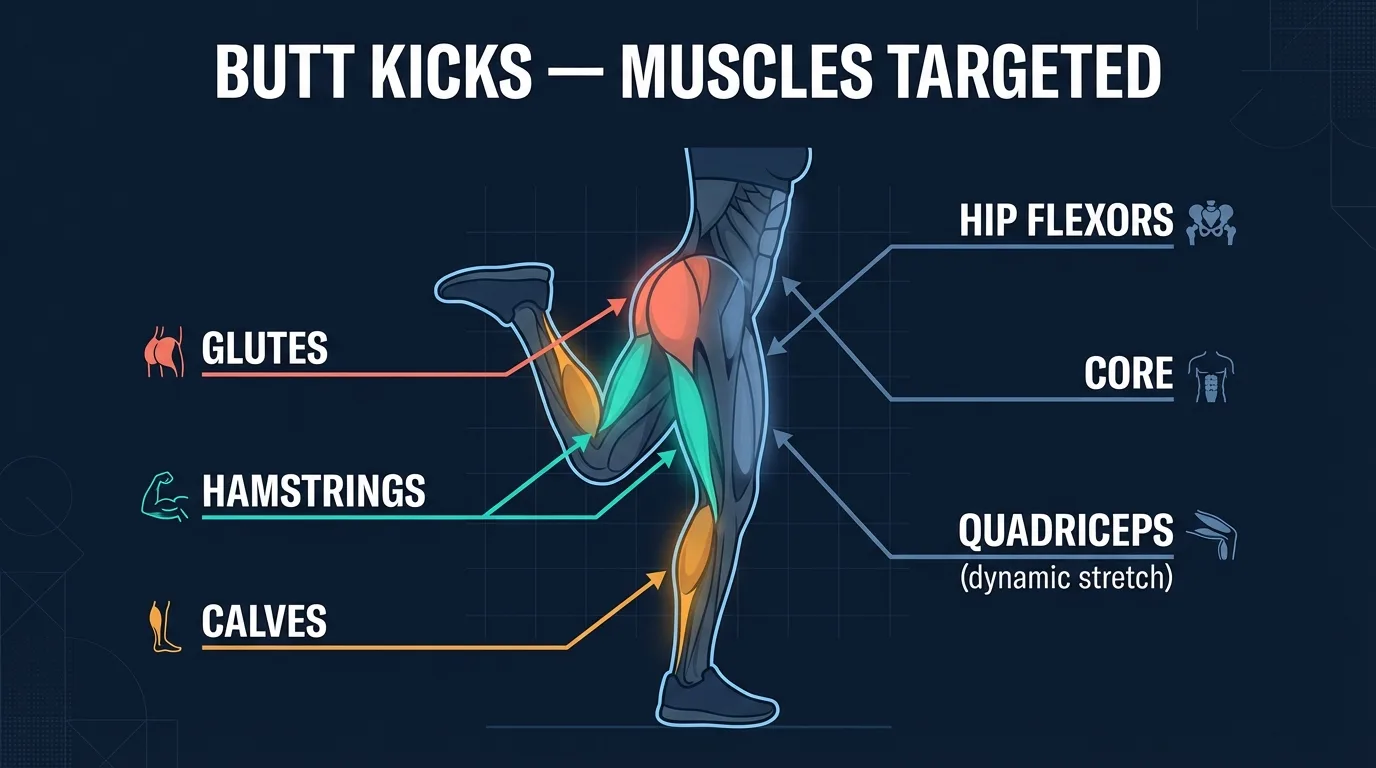
Muscles & Systems Worked
Primary movers: the hamstrings (biceps femoris, semitendinosus, semimembranosus). They contract concentrically to flex the knee and pull the heel toward the glute on every rep. The faster and more forcefully they fire, the higher the heel climbs.
Secondary movers: the gluteus maximus assists in keeping the thigh from drifting backward into hip extension. The gastrocnemius and soleus (calves) absorb landing impact and push off for the next stride. The hip flexors (iliopsoas, rectus femoris) reset the leg between reps.
Stabilizers: the entire anterior core (rectus abdominis, transverse abdominis, obliques) keeps the trunk vertical during the rapid leg cycling. The ankle stabilizers (peroneals, tibialis anterior and posterior) control foot strike on every landing. The spinal erectors prevent forward folding when the pace ramps up.
Energy systems and cardiovascular load: at a sustained jog tempo, butt kicks tap the glycolytic system and elevate heart rate quickly because the rapid heel-to-glute cycling demands repeated high-velocity hamstring contractions. At sprint tempo, the phosphocreatine system dominates for the first 10 to 15 seconds before glycolysis takes over. As a dynamic warm-up, the drill raises core temperature, increases blood flow to the posterior chain, and rehearses the heel-recovery pattern used in running. There is no high-quality EMG study isolating butt kicks specifically; the kinesiology is straightforward enough that the mechanism description above is the better citation than a proxy.
Step-by-Step: How to Perform a Butt Kick
The movement pattern is the same whether you're doing them as a warm-up or as a cardio finisher. Cadence is what changes.
Step 1: Stand Tall with Feet Hip-Width Apart
Start with good posture: chest up, shoulders relaxed and pulled slightly back, core lightly engaged. Your arms should be bent at roughly 90 degrees, like you're about to start jogging.
Coach Ty's cue: "Stay tall. If you're leaning forward, you're cheating."
Step 2: Begin Jogging in Place at an Easy Pace
Land softly on the balls of your feet, directly under your hips. Establish a comfortable rhythm before adding the kick. This base rhythm is your foundation.
Ty's cue: "Light feet, quick turnover. Think springs, not stomps."
Step 3: Kick Your Right Heel Up Toward Your Right Glute
Actively contract your hamstring to pull the heel as close to your glute as possible. Your thigh should stay roughly vertical throughout. The motion comes from bending the knee, not swinging the entire leg backward.
Ty's key cue: "Keep your thighs pointing straight down. The kick comes from the knee, not the hip." Swinging the whole leg back shifts the work away from the hamstrings and into the lower back.
Step 4: Return and Immediately Switch
As your right foot touches down, drive your left heel up toward your left glute with the same intent. The transition should be quick and rhythmic: heel up, foot down, other heel up.
Ty's cue: "Kick your heels all the way up to your glutes. Half reps give you half results." If your heels are only reaching mid-calf, slow down and rebuild the range of motion before chasing speed.
Step 5: Pump Your Arms in Opposition
Swing your arms in a natural running motion. Left arm forward when the right heel kicks up, right arm forward when the left heel kicks up. Active arm drive adds momentum and engages your upper body.
Ty's reminder: "Pump those arms. They're not just along for the ride."
Step 6: Maintain Upright Posture Throughout
Keep your torso tall, your hips stable, and your gaze forward. Don't lean forward at the waist. That's the most common compensation when people try to speed up, and it defeats the purpose. The goal is hamstring contraction speed, not forward lean.
Get this exercise in a personalized workout
FitCraft, our mobile fitness app, uses its AI coach Ty to program conditioning work like this into your plan at the right volume and intensity, based on your level, goals, and equipment. Ty was designed and trained by Domenic Angelino, MPH (Brown University) and NSCA-CSCS, with research published in the Journal of Strength and Conditioning Research and Medicine & Science in Sports & Exercise.
Take the Free Assessment Free · 2 minutes · No credit card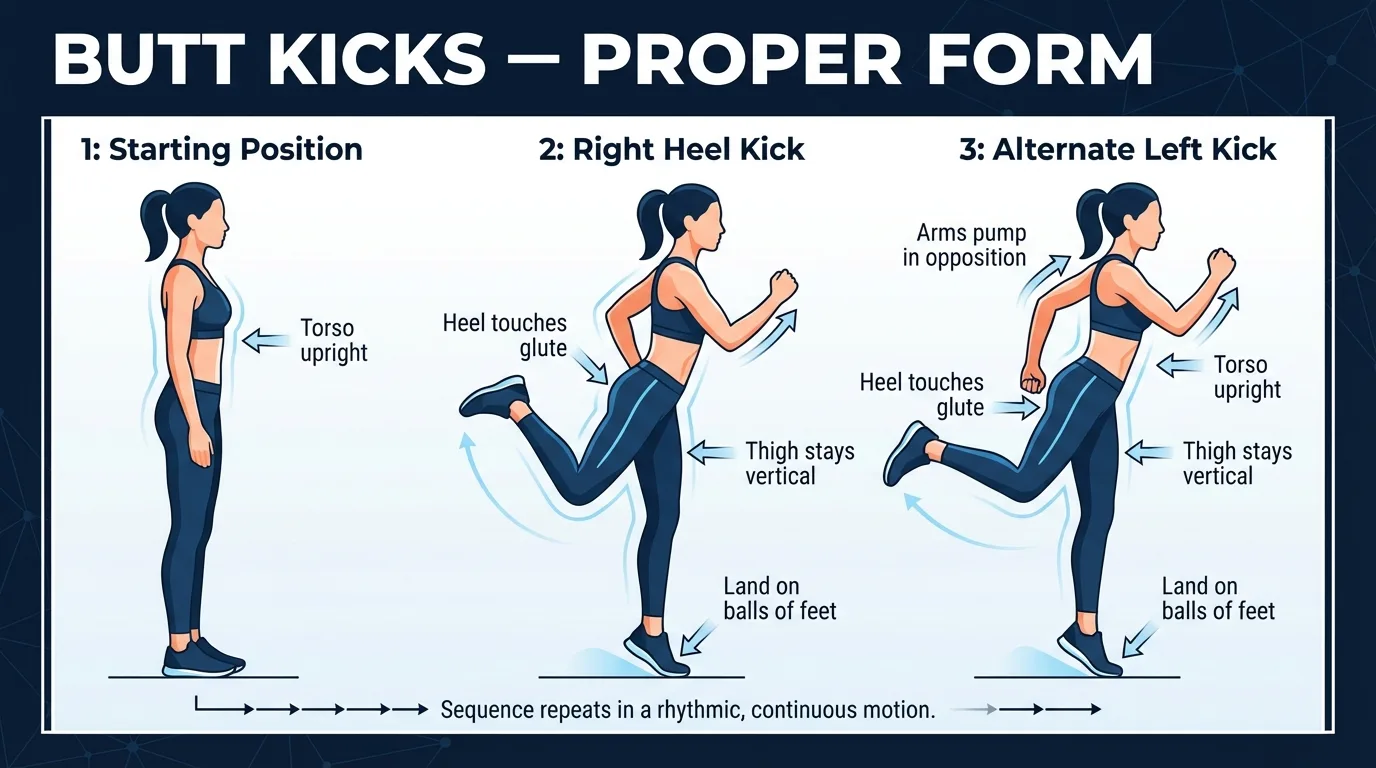
Common Mistakes (and How to Fix Them)
Here are the mistakes Ty corrects most often.
- Heels not reaching glute height. If your heels are stopping at mid-calf or knee level, you're not getting the full hamstring contraction that makes this exercise worthwhile. Slow your pace. Prioritize range of motion over speed.
- Leaning forward at the waist. Bending forward makes it mechanically easier to bring your heel to your glute. But it removes the hamstring demand and places unnecessary stress on your lower back. Keep your torso vertical.
- Swinging the whole leg backward. The movement should come from knee flexion, meaning you're bending the knee to pull the heel up. If your thigh is swinging behind your hip line, you're using hip extension instead of hamstring contraction. Big difference.
- Landing flat-footed or on the heels. Flat-footed landings break your rhythm and create jarring impact through the ankles and knees. Stay on the balls of your feet for a springy, continuous motion.
- Holding your breath. Butt kicks at a brisk pace will spike your heart rate fast. Holding your breath leads to premature fatigue and dizziness. Breathe rhythmically: in through the nose, out through the mouth.
Butt Kick Variations: Regressions and Progressions
Start where you are and progress when your form is solid at the current pace.
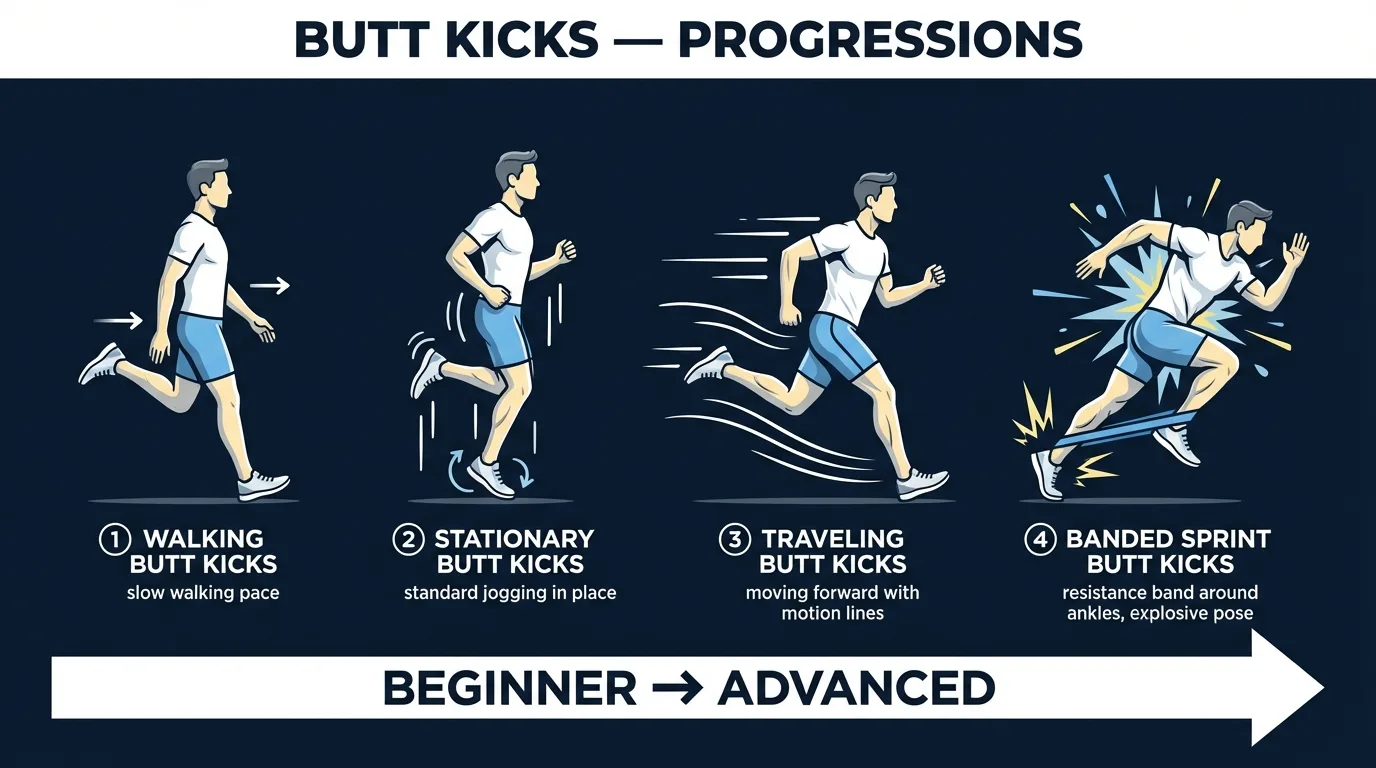
Walking Butt Kicks (Beginner Regression)
Instead of jogging in place, walk forward slowly and kick each heel to your glute with every step. This removes the cardiovascular intensity and lets you focus entirely on the hamstring contraction and range of motion. Same logic as marching in place compared to running drills.
Half Butt Kick (Beginner Regression)
Heels rise only to mid-calf height with a softer cadence. The lower amplitude reduces hamstring demand and landing impact, which makes it the right choice for stress-incontinence-aware programming, postpartum return-to-cardio, and anyone with mild knee sensitivity.
Standard In-Place Butt Kicks (Intermediate)
Stationary jog tempo with full heel-to-glute contact on every rep. This is the version most people picture when they hear "butt kicks." Build to 30 to 45 seconds of continuous work before progressing.
Traveling Butt Kicks (Intermediate)
Do butt kicks while moving forward across a room or field. This adds a locomotion challenge and more closely mimics the running stride pattern, which makes it a better sport-specific warm-up for runners.
Banded Butt Kicks (Advanced)
Loop a light resistance band around your ankles. The band forces your hamstrings to work harder on every rep, turning what's normally a warm-up into a genuine conditioning challenge.
Sprint Butt Kicks (Advanced)
Go at maximum speed for 10 to 15 second bursts. This plyometric variation builds explosive hamstring contraction speed and pushes your cardiovascular system hard. Rest 30 to 45 seconds between bursts.
When to Avoid or Modify Butt Kicks
Butt kicks are safe for most healthy adults, but the rapid heel-cycling and bodyweight impact warrant modification in a few specific situations. None of these are permanent restrictions. They're starting points. Always consult your physician or physical therapist for personalized guidance.
- Acute knee pain, patellar tendinopathy, or post-surgical knees. Repeated knee flexion under impact can aggravate these. Modify with marching in place or the half butt kick (heels rising only to mid-calf), or shift to seated knee-flexion drills until pain resolves. If symptoms persist or worsen, see a physical therapist before returning to high-impact cardio.
- Ankle injury, shin splints, or plantar fasciitis. Every rep is a small landing on the ball of the foot. Substitute with walking in place or low-amplitude marching until the tissue tolerates impact again. Build foot and calf strength with calf raises before returning to plyometric cardio.
- Stress incontinence or pelvic-floor weakness. Bouncing movements often trigger leakage. Use the half butt kick or walking butt kicks instead, and pair with pelvic-floor strengthening (see a pelvic-floor PT for an individualized program). Many people return to full-amplitude butt kicks within weeks of consistent pelvic-floor work.
- First 6 to 12 weeks postpartum. Pelvic-floor recovery prerequisites jumping and high-impact movements. Get clearance from a pelvic-floor PT before adding plyometric cardio. Substitute with marching in place and rebuild core control with deadbugs and bird-dogs.
- Second and third trimester of pregnancy. Joint laxity and balance changes increase fall risk. Swap for marching in place at a comfortable tempo, and stop any cardio drill if you feel dizzy, lightheaded, or short of breath.
- Known cardiovascular disease or uncontrolled hypertension. HIIT spikes heart rate and blood pressure quickly. Get your cardiologist's approval and stay within prescribed heart-rate zones. Lower-intensity steady-state cardio is usually the right starting point.
- Vertigo or balance disorders. Rapid leg cycling combined with a tall posture can trigger symptoms. Use marching in place with a hand on a wall or chair back for support.
Related Exercises
If butt kicks are part of your routine, these movements complement or extend the same training pattern:
- Lower-impact alternative within the same pattern: Half Butt Kick and Marching in Place deliver similar hamstring activation and warm-up effect with less landing impact.
- Same cyclic running pattern: High Knees targets the hip flexors instead of the hamstrings, and Running in Place is the closest direct substitute when you want pure cardio without a specific muscle bias.
- Cardio circuit pairings: Jumping Jacks and Mountain Climbers pair well in 30-second-on, 30-second-off HIIT rounds where butt kicks serve as the active-recovery interval.
- Hamstring strength foundation: Isometric Hamstring Raise and Glute Bridges build the underlying hamstring and posterior-chain strength that makes high-velocity butt kicks safer and more effective.
- Ankle and calf conditioning: Calf Raises and Calf Hops prepare the foot and ankle for the repeated bodyweight landings that butt kicks demand.
- Core stability foundation: Forearm Planks and Deadbugs reinforce the trunk-control pattern that keeps you tall during fast-cadence cardio.
How to Program Butt Kicks
HIIT-style cardio programming is time-based or work-rest-interval-based, not sets-and-reps. The American College of Sports Medicine recommends building from short work intervals with longer rest at the beginner stage to longer work intervals with shorter rest at the advanced stage (Ratamess et al., 2009).
| Level | Work | Rest | Frequency |
|---|---|---|---|
| Beginner | 20 to 30 sec | 60 to 90 sec | 2 to 3 sessions/week |
| Intermediate | 30 to 45 sec | 45 to 60 sec | 3 to 4 sessions/week |
| Advanced | 45 to 60 sec (or 10 to 15 sec sprint bursts) | 30 to 45 sec | 3 to 5 sessions/week |
Where in your workout: butt kicks belong in two slots. First, as part of a dynamic warm-up: 30 to 60 seconds at a moderate tempo to raise core temperature and prime the hamstrings before running, lifting, or any lower-body work. Second, as a HIIT or active-recovery interval: 30 to 45 seconds of butt kicks between higher-intensity moves like burpees or jump squats to keep the heart rate elevated without spiking fatigue. Never use a long, intense butt-kick block before heavy lower-body strength work. Depleting hamstring glycogen tanks the strength session that follows.
Form floor over duration targets: if your heels stop reaching your glutes, your torso starts leaning forward, or your landings turn into flat-footed stomps, end the interval there. Hitting a target time with broken form trains the wrong pattern and increases injury risk.
How FitCraft Programs This Exercise
Knowing how to do a butt kick is step one. Knowing where to slot it in your week, how long to hold each interval, and when to progress to sprint or banded variations is where most people get stuck.
FitCraft's AI coach Ty handles that. During your personalized diagnostic assessment, Ty maps your fitness level, cardio goals, and any joint or pelvic-floor considerations. Then Ty builds a personalized program that slots butt kicks into a balanced training plan at the right tempo and duration for your level.
As you progress, Ty adjusts the variation and volume to match your level. Walking pace becomes jog tempo. Standard intervals lengthen. Sprint and banded variations enter the mix once the standard version feels easy. Every program is designed by an Ivy League-trained exercise scientist and NSCA-certified strength coach using evidence-based periodization, then adapted to you by the AI.
Frequently Asked Questions
What muscles do butt kicks work?
Butt kicks primarily target the hamstrings, which contract concentrically to pull the heel toward the same-side glute on every rep. Secondary muscles include the glutes, calves, and hip flexors. The core, ankle stabilizers, and spinal erectors work isometrically to keep the trunk upright during the dynamic motion. At a brisk pace, the cardiovascular and metabolic systems are the dominant stimulus.
Are butt kicks a good warm-up exercise?
Yes. Butt kicks are one of the most effective dynamic warm-up drills for the lower body. They increase blood flow to the hamstrings, improve knee flexion range of motion, and prime the neuromuscular firing patterns needed for running, jumping, and lower-body strength work. 30 to 60 seconds at a moderate pace is plenty for a warm-up.
How long should I do butt kicks?
For warm-ups, 30 to 60 seconds is sufficient. For cardio conditioning, try 3 to 4 sets of 30 to 45 seconds with 15 to 20 seconds of rest between sets. Beginners should start with shorter intervals of 15 to 20 seconds and increase duration as fitness improves.
Can butt kicks help me run faster?
Butt kicks can improve running speed over time by training the hamstrings to contract more quickly during the recovery phase of your stride. They reinforce the heel-to-glute pull pattern that produces an efficient running gait. Sprinters and distance runners both use butt kicks as a regular drill.
Can I do butt kicks if I have knee pain?
It depends on the cause. Butt kicks involve repeated knee flexion under bodyweight impact, which can aggravate patellar tendinopathy, meniscus issues, or post-surgical knees. Modify with marching in place or low-impact half butt kicks (heels rising only to mid-calf), or do the movement seated to remove ground reaction force. If pain persists during or after, see a physical therapist before continuing high-impact cardio.