The half butt kick is a beginner-friendly cardio drill where you kick your feet up toward your glutes, but do not stress if you cannot quite reach them. That is the whole point. The "half" in half butt kick is not a rule about range of motion. It is a permission slip. You try to bring your heels up to your butt with every kick, and if you only get halfway there on day one, that is perfectly fine. Keep moving, stay light on your feet, and let your hamstrings drive the heels upward. The movement happens regardless of whether you ever touch your glutes.
Here's the thing most people miss. The half butt kick is a legitimate tool with its own job. Coaches use it as an accessible beginner cardio drill that builds hamstring activation and raises the heart rate without punishing the joints. It takes the standard butt kick and removes the pressure. You aren't trying to hit a specific height, you aren't racing the clock, you're just keeping a consistent rhythm and kicking your heels up as best you can. Done right, it's a useful drill that almost anyone can do on day one. Done lazily, it becomes bouncing in place, so let's walk through exactly how to do it.
Quick Facts: Half Butt Kick
- Equipment needed: None
- Difficulty: Beginner
- Modality: Cardio (low-impact)
- Body region: Lower body
- FitCraft quest category: Cardio
Muscles & Systems Worked
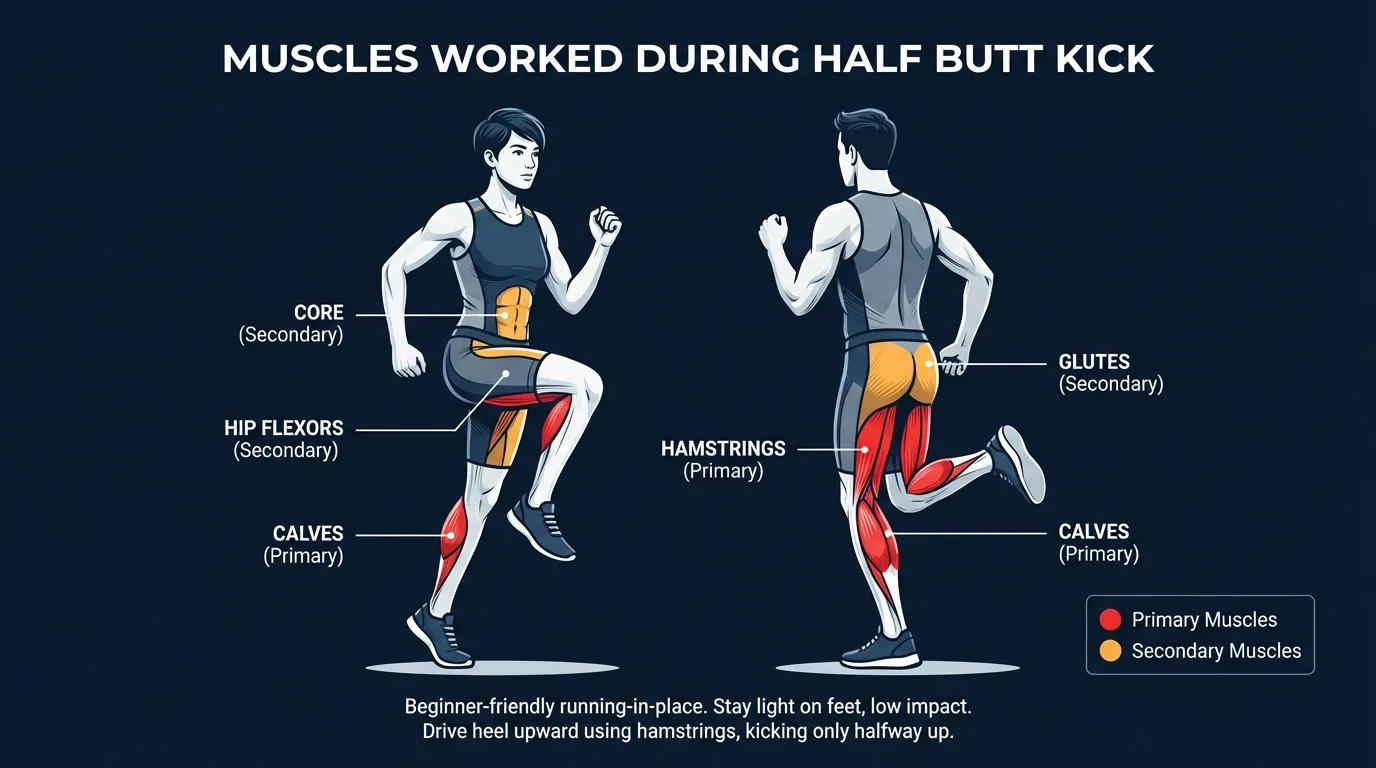
Primary movers: the hamstrings (biceps femoris, semitendinosus, semimembranosus). They shorten concentrically on the way up to flex the knee and drive the heel toward the glute, then lengthen under light tension as the lower leg returns to the floor. Because the range is partial, the demand stays moderate, which is exactly what makes this drill sustainable for long warm-up intervals.
Secondary movers: the gluteus maximus assists hip extension and stabilizes the standing leg between reps; the calves (gastrocnemius and soleus) drive the soft, springy push-off on every bounce; and the hip flexors (iliopsoas, rectus femoris) cycle to reset the leg position between kicks. The shoulders and biceps assist as the arms pump in opposition to maintain rhythm and balance.
Stabilizers: the entire anterior core (rectus abdominis, transverse abdominis, obliques) holds the upright torso position throughout the drill; the spinal erectors prevent forward lean; and the ankle stabilizers (peroneals, tibialis anterior and posterior) control foot strike and rebound. The cardiovascular system and the aerobic energy pathway are also doing real work here, which is the whole point of treating this as a cardio drill rather than just a hamstring activation move.
How the mechanism differs from a full butt kick: the standard butt kick demands enough hamstring shortening and hip control to bring the heel all the way to the glute on every rep, plus the cardiovascular load of a faster, more aggressive cycle. The half butt kick deliberately caps the range at roughly mid-calf to upper-calf height, which keeps the knee from traveling through end-range flexion and keeps the ankle and Achilles loading gentle. The trade-off is a lower hamstring stimulus and lower cardiovascular intensity in exchange for an exercise that almost anyone can perform on day one without coordination drills or impact prep.
Step-by-Step Instructions
- Stand tall with feet hip-width apart. Start with good posture: chest up, shoulders relaxed, core lightly engaged. Your arms should be bent at about 90 degrees, like you are ready to jog. This is your base.
Coach Ty's cue: "Stay tall. No forward lean, even when you're getting tired."
- Stay light on the balls of your feet. Start bouncing gently, almost like you are dancing. Keep the landings soft and quiet. This light-footed bounce keeps the exercise low-impact and easy on your joints.
Ty's cue: "Feet light, landings soft. Think rolling, not stomping."
- Kick your right heel up toward your glute. Squeeze your hamstring and drive your right heel upward as high as you comfortably can. Aim for the glute, but don't stress if your heel doesn't reach. The "half" in half butt kick is there for a reason. The goal is to kick up, not to make contact.
Ty's key cue: "Half means half. If your heel is hitting your glute, you're doing the wrong exercise."
- Return and kick the left heel up. As the right foot lands softly, immediately drive the left heel up the same way. Alternate legs in a smooth, dancing rhythm. One heel on the way up while the other is on the way down.
Ty's cue: "Thigh stays straight down. Let the knee do the work." Swinging the leg backward to get the heel higher shifts load into the lower back and defeats the purpose. Only the lower leg moves.
- Pump your arms in opposition and keep moving. Swing your arms in a natural running motion. Left arm forward when the right heel comes up, right arm forward when the left heel comes up. Hold a steady, sustainable pace you can keep for the full set. Stay tall, keep your gaze forward, and just keep moving until the timer ends.
Ty's reminder: "Breathe with the rhythm. In through the nose, out through the mouth."
Get this exercise in a personalized workout
FitCraft, our mobile fitness app, uses its AI coach Ty to program conditioning work like this into your plan at the right volume and intensity, based on your level, goals, and equipment. Ty was designed and trained by Domenic Angelino, MPH (Brown University) and NSCA-CSCS, with research published in the Journal of Strength and Conditioning Research and Medicine & Science in Sports & Exercise.
Take the Free Assessment Free · 2 minutes · No credit card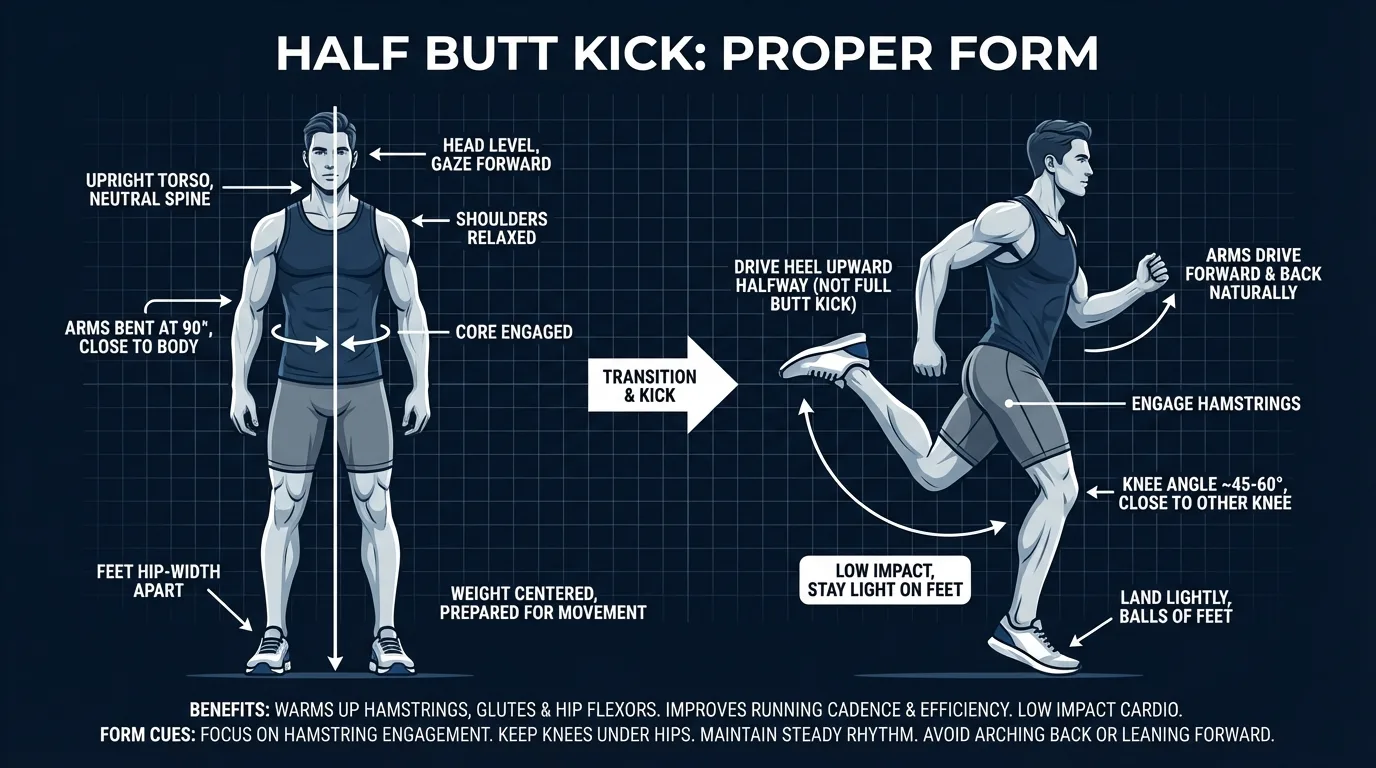
Common Mistakes (and How to Fix Them)
Here are the mistakes Ty corrects most often.
- Accidentally turning it into a full butt kick. The most common mistake, by far. You start with good intent, then the heels creep higher and higher until you're doing the full version. If this exercise was prescribed to you because you're a beginner or recovering, that defeats the point. Keep the range honest.
- Leaning forward at the waist. Forward lean makes the knee bend feel easier, but it loads your lower back and sends the work away from the hamstrings. Stay vertical. If you can't hold upright posture, take a break.
- Swinging the leg backward from the hip. The movement should come from bending the knee, meaning the thigh stays down and only the lower leg travels. If your whole leg is swinging behind your hip line, you're using hip extension instead of knee flexion. Big difference, both in what gets worked and in how much stress hits the lower back.
- Rushing the pace. Half butt kicks are a low-intensity drill. Trying to do them fast misses the point. If you want speed and intensity, do a full butt kick instead. The half version should feel controlled, almost lazy.
- Heavy landings. Flat-footed or heel-first landings create impact through the ankles and knees, which is exactly what this variation is supposed to avoid. Stay on the balls of your feet and keep the footfalls light.
Half Butt Kick Variations: Regressions and Progressions
Start where you are and progress when your form is solid at the current level.
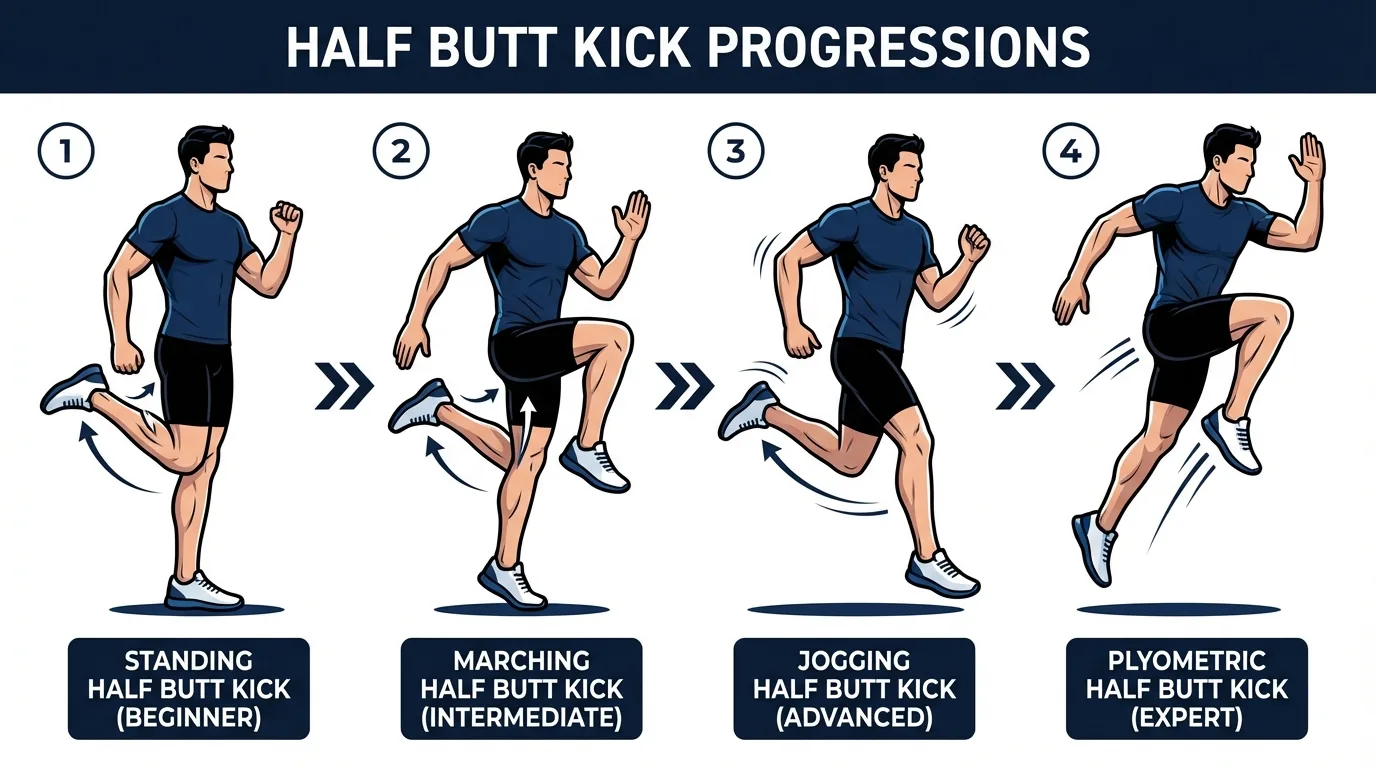
Marching Half Butt Kicks (Easiest)
Instead of jogging in place, march in place slowly and lift each heel halfway up with every step. There is no hop, no airtime. Just a deliberate march with a partial knee bend. This is the absolute entry point for anyone coming back from injury, just starting out, or working around joint issues.
Seated Half Butt Kicks (Zero-Impact)
Sit tall in a sturdy chair, feet flat on the floor, and alternate lifting each heel toward the seat of the chair by bending the knee. This version gives you the hamstring activation with zero impact and works well for the first few minutes of a seated warm-up or for anyone with significant mobility limitations.
Standard Half Butt Kick
Jog in place and lift each heel halfway up. The version described above. This is the baseline beginner cardio variation and the right place to live for most warm-ups.
Traveling Half Butt Kicks
Perform the half butt kick while moving slowly forward across a room. Adding locomotion bumps the coordination demand slightly and makes it a better running-specific warm-up.
Full Butt Kick (Progression)
When you're ready, graduate to driving the heel all the way up to the glute on every rep. This is the standard version of the exercise and carries more cardio intensity and more hamstring demand.
When to Avoid or Modify Half Butt Kicks
Half butt kicks are safe for most healthy adults, including most beginners. The whole reason this variation exists is to give people a low-impact entry point to cardio. Still, a few conditions warrant modification or temporarily swapping for an even gentler variation. None of these are permanent restrictions. They're starting points. Always consult your physician or physical therapist for personalized guidance, especially if you have any of the conditions below.
- Knee pain, patellar tendinopathy, or post-surgical knees. Even the half version still asks the knee to flex repetitively under partial load. If you have anterior knee pain or tendinopathy, drop to the seated or marching variation, which removes the bounce entirely. Post-surgical knees and meniscus repairs need clearance from your surgeon or PT before any rebound pattern.
- Acute ankle injuries, shin splints, or plantar fasciitis. The repeated soft bouncing on the balls of the feet still creates ankle load. Switch to seated half butt kicks until you're symptom-free, then re-test with marching before returning to the jog tempo.
- First 6-12 weeks postpartum or active pelvic-floor weakness. Any rebound pattern (even gentle bouncing) loads the pelvic floor. Get clearance from a pelvic-floor PT, rebuild bracing strength with deadbugs and bird-dogs, and live with the seated or marching variations until your PT signs off.
- Stress incontinence. Even the gentle bounce of the standard half butt kick can trigger leakage. The marching variation usually solves this. If it doesn't, see a pelvic-floor PT for a proper assessment.
- Vertigo, balance disorders, or vestibular conditions. The single-leg moments and the bouncing rhythm can provoke balance issues. Use the seated version, or perform the marching variation next to a wall or sturdy chair for support.
- Known cardiovascular disease or uncontrolled hypertension. Even a beginner cardio drill raises heart rate. Get your cardiologist's clearance and stay within their prescribed heart-rate zones. Start with very short intervals (10-15 seconds) and rest fully between sets.
Related Exercises
If half butt kicks are part of your routine, these movements complement or extend the same training pattern:
- Direct progression (same pattern, more intensity): Butt Kicks are the full-range, full-speed version once half butt kicks feel easy and your form holds up.
- Lower-impact alternatives within the same family: Marching in Place and Walking in Place are the no-bounce regressions that keep the heart rate moving without any ankle or knee load.
- Other low-impact cardio drills: Step-n-Clap and Squat Walks work in the same beginner-friendly, no-jump cardio slot.
- Cyclic running-pattern conditioning: High Knees and Run in Place work the opposite hip pattern (flexion-dominant rather than knee-flexion-dominant) and pair well in alternating intervals.
- Core foundation for upright posture: Forearm Planks, Deadbugs, and Bird-Dogs build the bracing strength that keeps your torso vertical when fatigue hits.
- Ankle and foot conditioning: Calf Raises and Calf Hops graduate the ankle's ability to handle soft, springy foot strikes.
How to Program Half Butt Kicks
Half butt kick programming follows the time-based, work/rest-interval format used for any cardio drill. The American College of Sports Medicine (ACSM) Position Stand on resistance and conditioning training recommends scaling work duration and rest based on training experience, with shorter work intervals and longer rest for beginners (Ratamess et al., 2009). Because half butt kicks are deliberately low-intensity, they can also be programmed as a continuous warm-up block rather than discrete intervals.
| Level | Work × Sets | Rest between sets | Frequency |
|---|---|---|---|
| Beginner (seated or marching) | 15-20 sec × 2-3 | 60-90 seconds | 2-3 sessions/week |
| Intermediate (standard half butt kick) | 20-30 sec × 3-4 | 45-60 seconds | 3-4 sessions/week |
| Advanced (traveling, or paired with full butt kicks) | 30-45 sec × 3-5 | 30-45 seconds | 3-5 sessions/week |
Where in your workout: Half butt kicks belong in the warm-up, in a low-impact cardio circuit, or as a recovery interval between higher-intensity efforts. They work especially well as the third or fourth movement in a 5-minute dynamic warm-up, after general mobility and before any plyometric or strength work. As a metabolic finisher, they're too low-intensity to drive much conditioning adaptation on their own, but they pair well with a higher-intensity drill in a circuit (e.g., 30 seconds of jumping jacks followed by 30 seconds of half butt kicks as active recovery).
Form floor over duration targets: if your posture starts collapsing forward, your heels start dragging instead of lifting, or your foot strikes get heavy, stop the interval there. Hitting a target time with degraded form trains exactly the patterns the half butt kick is meant to teach you to avoid.
How FitCraft Programs This Exercise
Knowing how to do a half butt kick is step one. Knowing when to do it, how long, and when to progress is where most people get stuck.
FitCraft's AI coach Ty handles that. During your personalized diagnostic assessment, Ty maps your fitness level, goals, and available equipment. Then Ty builds a personalized program that slots half butt kicks into a balanced training plan at the right variation for your level. For total beginners, that usually means a 20-second warm-up interval. For users coming back from injury, half butt kicks may show up as a low-impact cardio interval for the first few weeks. For older users or anyone working around knee sensitivity, half butt kicks can stay in the plan long-term as a sustainable cardio option that doesn't beat up the joints.
As you get stronger, Ty adjusts the variation and volume to match your level. Marching becomes the standard jog tempo. The jog tempo becomes traveling half butt kicks. Eventually you graduate to the full butt kick. Every program is designed by an Ivy League-trained exercise scientist and NSCA-certified strength coach using evidence-based periodization, then adapted to you by the AI.
Frequently Asked Questions
What muscles do half butt kicks work?
Half butt kicks primarily target the hamstrings, which drive the heel upward on every kick. Secondary muscles include the glutes, calves, hip flexors, and core. Because you stay light on your feet throughout the movement, the calves and ankles also get a gentle conditioning stimulus without the joint impact of a standard butt kick.
What is the difference between a half butt kick and a regular butt kick?
In a half butt kick, you kick your feet up as high as you can toward your glutes but don't need to actually reach them. The "half" refers to the fact that most beginners only make it halfway. You also stay lighter on your feet with softer landings, which lowers impact on the knees and ankles. A full butt kick is faster, more aggressive, and the heel should touch the glute on every rep.
Are half butt kicks good for beginners?
Yes. Half butt kicks are one of the best entry-level cardio drills because they raise the heart rate, warm up the hamstrings and calves, and teach the rhythm of a butt kick without demanding that beginners reach full range or move at full speed. Stay light on your feet, keep moving, and don't worry about how high your heels get. The movement itself is what counts.
How long should I do half butt kicks?
For a warm-up, 20 to 30 seconds of half butt kicks is plenty. For beginner cardio conditioning, try 2 to 3 sets of 20 to 30 seconds with 20 seconds of rest between sets. Keep a consistent pace. As your fitness improves, you can gradually kick higher and faster until you're doing full butt kicks.
Can I do half butt kicks if I have knee pain?
Often yes, but it depends on what's driving the pain. Half butt kicks are intentionally lower-impact than the full version and load the knee through a partial range, which is gentler than jumping or full butt kicks. If you have patellar tendinopathy or general anterior knee irritation, the marching variation (no bounce, just lift each heel halfway from a standing march) is usually well tolerated. Stop if any sharp, pinching, or grinding sensation appears, and see a physical therapist before progressing. Surgical knees, meniscus repairs, and acute ligament injuries need clearance from your surgeon or PT before adding any rebound or bouncing pattern.