Running in place is the simplest cardio drill you can do in a small room. You stand where you are, build a jogging rhythm, and use knee drive plus arm swing to raise your heart rate without a treadmill, track, or sidewalk.
The trap is treating it like casual shuffling. If your feet slap the floor and your knees barely move, the drill turns into noisy movement with a weak training signal. Done well, run in place is springy, upright, and repeatable.
Quick Facts: Run In Place
- Equipment needed: None
- Difficulty: Beginner to Intermediate
- Modality: Cardio conditioning
- Body region: Lower body and cardiovascular system
- FitCraft quest category: Cardio
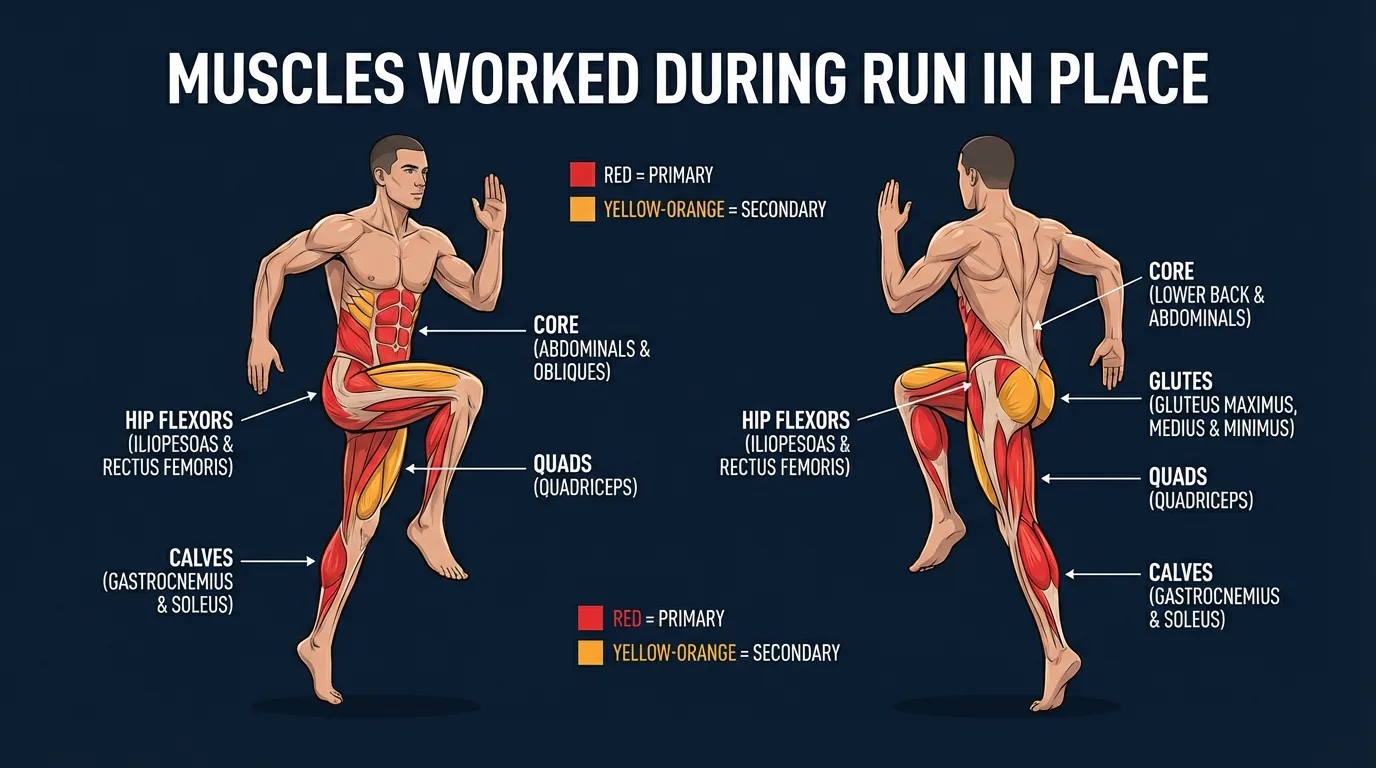
Muscles & Systems Worked
Primary movers: the hip flexors lift each thigh, the quadriceps extend and control the knee, and the calves create the springy push from the ball of the foot. These muscles cycle through rapid shortening and controlled lengthening on every stride.
Secondary movers: the glutes and hamstrings assist hip control and help each leg recover under the body. The anterior tibialis helps lift the foot so you can land softly instead of slapping the floor.
Stabilizers: the rectus abdominis, transverse abdominis, obliques, spinal erectors, peroneals, and deeper ankle stabilizers work isometrically to keep your trunk stacked and each foot strike controlled while your arms and legs move quickly.
Cardio and energy-system demand: run in place works the heart, lungs, phosphocreatine system, glycolytic system, and oxidative system. Short fast intervals lean more on phosphocreatine and glycolysis. Longer steady bouts shift more work to the aerobic system. That is why the same drill can serve as a warm-up, cardio block, or finisher depending on pace and duration.
Step-by-Step: How to Perform Run In Place
Step 1: Stand Tall With Feet Hip-Width Apart
Start with your feet under your hips, chest lifted, ribs stacked over your pelvis, and arms bent at roughly 90 degrees. Keep your shoulders relaxed so your arms can swing freely.
Coach Ty's cue: "Stand tall before you speed up. Posture first, pace second."
Step 2: Lift One Knee to a Natural Running Height
Drive one knee upward until the thigh moves toward parallel with the floor. You do not need the exaggerated height of high knees. Aim for a clean running stride.
Coach Ty's cue: "Pick the knee up, then put the foot down quietly under your hip."
Step 3: Switch Legs in a Steady Jogging Rhythm
As one foot returns to the floor, drive the other knee up. Land on the ball of the foot with a soft knee and quick turnover. Keep the contact light enough that the floor does not thud.
Coach Ty's cue: "Quiet feet, quick rhythm."
Step 4: Pump Your Arms in Opposition
Swing the opposite arm and leg together: right knee with left arm, left knee with right arm. Keep the hands relaxed and the elbows close to 90 degrees instead of crossing your arms across your body.
Coach Ty's cue: "Your arms set the rhythm. Let them help your legs."
Step 5: Breathe and Stop Before Form Breaks
Use a pace you can sustain with a tall torso. If your shoulders rise, your feet slap, or your lower back starts arching, slow to a march until you recover.
Coach Ty's cue: "Slow down before sloppy reps take over."
Get this exercise in a personalized workout
FitCraft, our mobile fitness app, uses its AI coach Ty to program conditioning work like this into your plan at the right volume and intensity, based on your level, goals, and equipment. Ty was designed and trained by Domenic Angelino, MPH (Brown University) and NSCA-CSCS, with research published in the Journal of Strength and Conditioning Research and Medicine & Science in Sports & Exercise.
Take the Free Assessment Free · 2 minutes · No credit card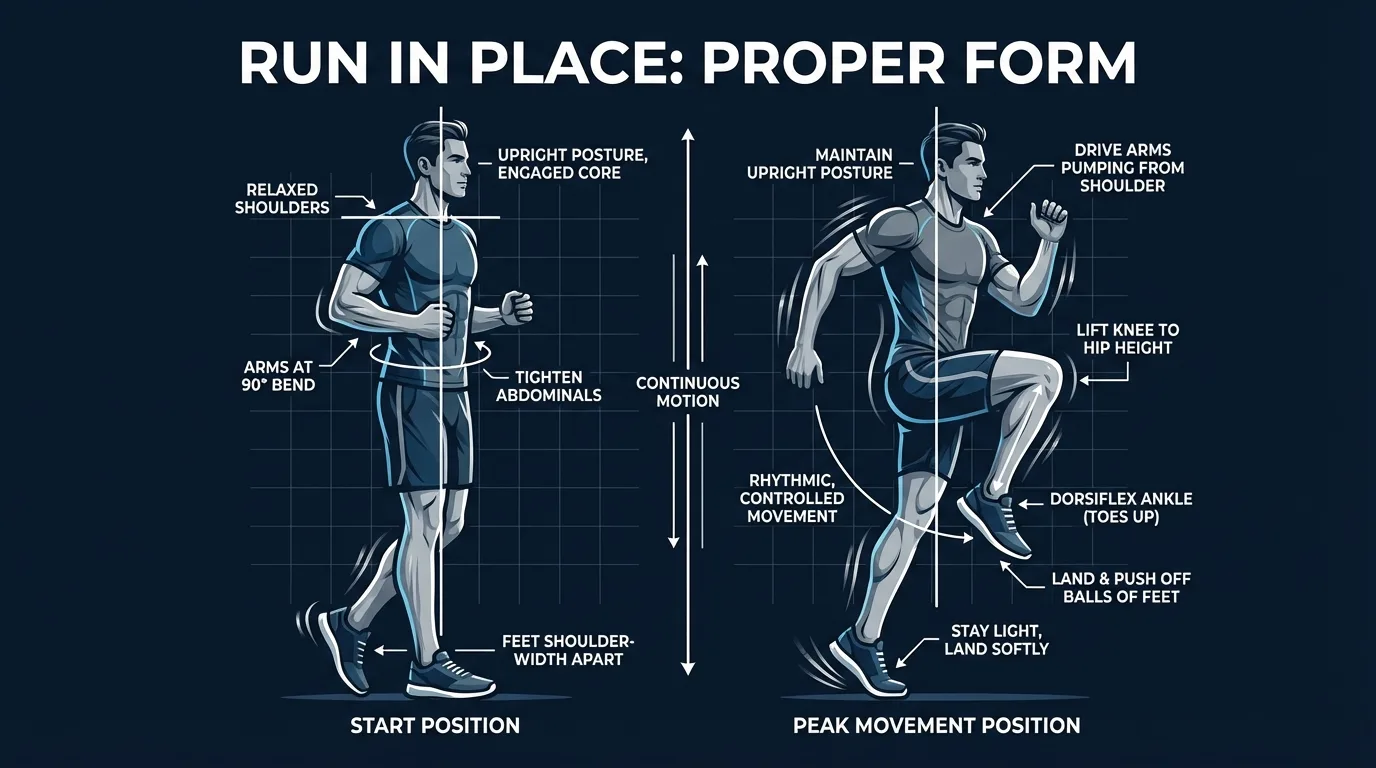
Common Mistakes (and How to Fix Them)
- Landing on flat feet or heels. Heavy landings send impact up the ankle, knee, and hip. Fix it by landing softly on the ball of the foot with a slight knee bend.
- Shuffling instead of driving the knees. Tiny foot lifts lower the cardio demand and turn the drill into busywork. Pick each knee up enough to create a real running rhythm.
- Leaning forward at the waist. Forward lean often shows up when the pace is too fast. Slow down and stack your ribs over your pelvis.
- Freezing the arms. Stiff arms make the movement awkward and reduce rhythm. Pump the arms forward and back without crossing the midline.
- Sprinting before you have control. Speed magnifies every foot-strike error. Build duration first, then add faster intervals once your landings stay quiet.
- Ignoring pain signals. Burning lungs during a planned interval is expected. Sharp knee, shin, ankle, or foot pain is a stop sign. Switch to marching or walking in place.
Run In Place Variations: Regressions and Progressions
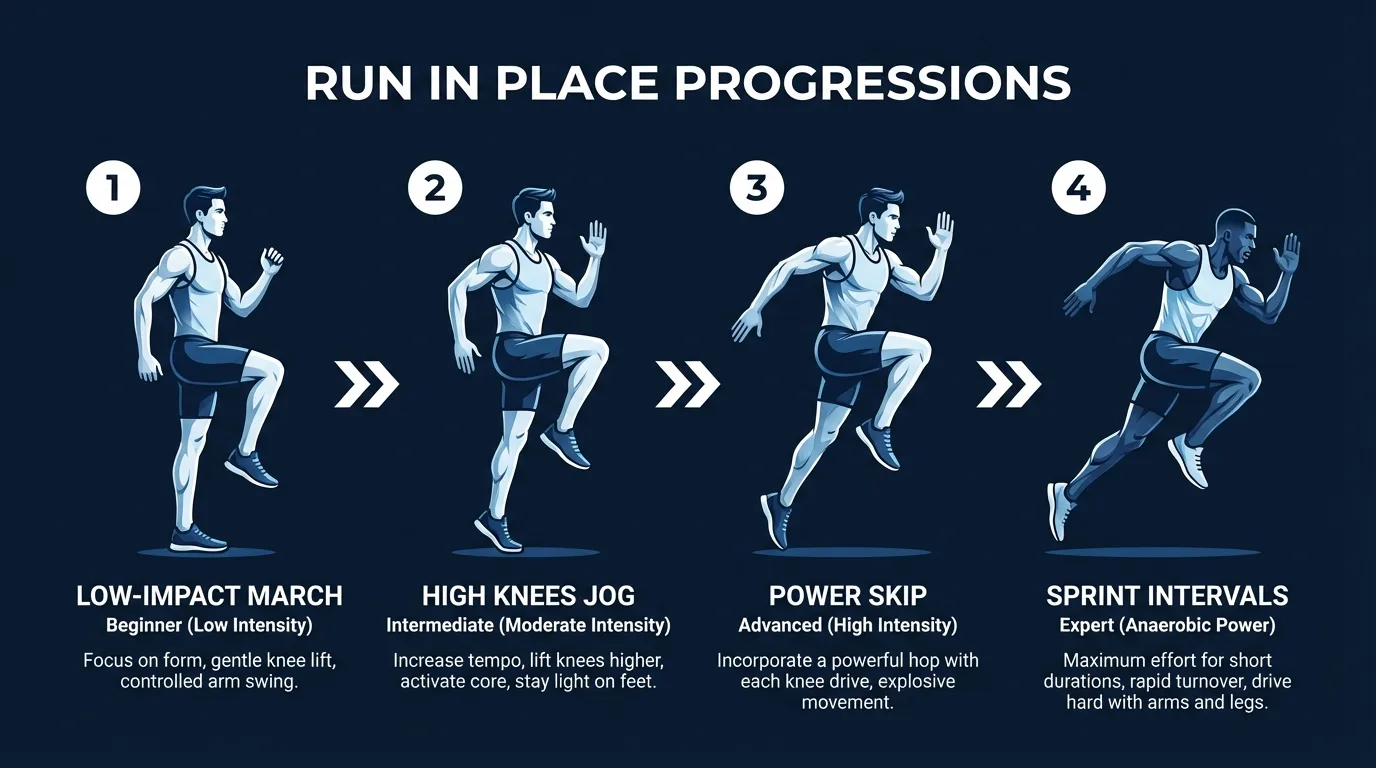
Choose the version that lets you keep a quiet landing and tall posture. Progress when that version feels controlled for the full work interval.
Marching in Place (Beginner Regression)
Walk in place with deliberate knee lifts and no bounce. This is the best starting point if impact bothers your knees, ankles, shins, or pelvic floor.
Walking in Place (Low-Impact Cardio)
Keep the cadence easy and continuous. Use it between harder intervals, during warm-ups, or on days when you want movement without jumping.
Slow Jog in Place (Standard)
Jog at a pace you can maintain for several minutes without posture breaking. This is the base version most people should master before interval work.
High Knees (Intermediate Progression)
Drive each knee higher and increase cadence. This raises hip-flexor demand, core demand, and heart rate, so keep the sets shorter.
Sprint in Place (Advanced Interval)
Run as fast as you can control for 15 to 20 seconds, then recover with walking in place. Keep this as a short finisher instead of a long steady-state drill.
When to Avoid or Modify Run In Place
Run in place is safe for most healthy adults, but a few conditions call for a lower-impact version or medical guidance before you add speed. Always consult your physician or physical therapist for personalized guidance.
- Known cardiovascular disease or uncontrolled hypertension. Fast intervals can spike heart rate and blood pressure quickly. Get medical clearance and stay within the heart-rate zones your clinician gives you.
- Knee, ankle, foot, shin, or plantar fascia pain. Repeated foot strikes can aggravate irritated tissue. Substitute marching in place or walking in place until symptoms settle.
- Pregnancy or early postpartum recovery. Joint laxity, pelvic-floor pressure, and changing balance can make bouncing uncomfortable. Use walking in place, step drills, or clinician-approved low-impact cardio.
- Stress incontinence or pelvic-floor symptoms. Running in place can trigger leakage because every landing adds pressure. Start with no-bounce marching and get guidance from a pelvic-floor physical therapist.
- Vertigo, balance disorders, or vestibular symptoms. Fast alternating steps can increase fall risk. Hold a stable surface, slow to marching, or choose seated cardio instead.
- Asthma or exercise-induced bronchoconstriction. Warm up longer, keep your inhaler accessible if prescribed, and use shorter intervals until you know how your breathing responds.
Related Exercises
If run in place fits your workout, these exercises help you adjust the impact, build the same conditioning base, or support the lower-leg control it needs:
- Lower-impact alternatives: Marching in Place and Walking in Place keep you moving with less bounce.
- Higher-knee progression: High Knees and High Knee Running increase cadence, hip-flexor demand, and cardio intensity.
- Posterior-chain pairing: Butt Kicks balance the forward knee-drive pattern with more hamstring emphasis.
- Core stability foundation: Forearm Planks and Deadbugs teach the trunk control that keeps your posture steady.
- Ankle and calf conditioning: Calf Raises and Calf Hops build the lower-leg stiffness needed for quiet, springy foot strikes.
How to Program Run In Place
For conditioning work, treat run in place as an interval tool or short steady cardio block. The ACSM resistance-training position stand is still useful as a progression anchor because it emphasizes gradual overload, recovery, and matching dose to training status (Ratamess et al., 2009).
| Level | Work | Rest between sets | Frequency |
|---|---|---|---|
| Beginner | 20-30 sec | 60-90 sec | 2-3 sessions/week |
| Intermediate | 30-45 sec | 45-60 sec | 3-4 sessions/week |
| Advanced | 45-60 sec | 30-45 sec | 3-5 sessions/week |
Where in your workout: use run in place as a 3 to 5 minute warm-up, a standalone interval block, or a short metabolic finisher after strength work. If lower-body strength is the main goal for the day, do heavy strength work first and save faster intervals for the end.
Form floor over time targets: stop the interval when your feet get loud, your posture collapses, or pain changes your stride. Clean 20-second rounds beat sloppy 60-second rounds every time.
How FitCraft Programs This Exercise
Run in place is useful when you need cardio without equipment or much space. FitCraft can place conditioning work like this inside a balanced plan so it supports your goal instead of turning every workout into random sweat.
Ty adjusts the variation and volume to match your level. A beginner may see marching or short jogging intervals. A more advanced user may see faster intervals paired with movements like high knees, butt kicks, or core work so the session has structure.
Frequently Asked Questions
Is run in place a good exercise?
Yes. Run in place is a useful cardiovascular exercise when you use active knee drive, soft foot strikes, and a pace that keeps your heart rate elevated. It works well for warm-ups, low-space cardio, and interval circuits.
What muscles does run in place work?
Run in place primarily uses the hip flexors, quadriceps, calves, and ankle muscles. The glutes and hamstrings assist each stride, while the core and spinal erectors keep your trunk stacked as your arms and legs move quickly.
Is run in place as good as running outside?
Run in place can raise your heart rate and train running rhythm, but it does not fully replace outdoor running because there is less forward propulsion and less horizontal force. It is still a strong option when space, weather, or equipment limits your choices.
How long should I run in place for a workout?
Start with 3 to 5 minutes at an easy pace if you are new. For conditioning, use 20 to 60 second work intervals with planned rest, or build toward 10 to 20 minutes of steady low-space cardio.
Can I run in place with knee, ankle, or shin pain?
Modify it if running in place worsens knee, ankle, foot, or shin pain. Switch to marching in place, walking in place, or low-knee step drills, and get professional guidance if pain persists or changes your gait.