High knee running is what happens when you take running in place and add serious intent to every knee lift. Instead of a comfortable jog cadence with mid-height knees, you drive each knee to hip level or higher on every single stride, and you do it at the speed of an actual run. The result is a stationary exercise that hits your hip flexors, quads, and calves hard enough to count as a legitimate lower-body strength movement on top of the conditioning work.
Most people treat it like a throwaway warm-up. They bounce for ten seconds with sloppy form, call it done, and move on. That's a waste. Hip flexor strength is a meaningful predictor of acceleration and top-end running speed, and high knee running is one of the most time-efficient ways to train that exact quality without needing a sled, a hill, or a single piece of equipment. Done with good form, it's a legitimate strength tool.
Quick Facts: High Knee Running
- Equipment needed: None
- Difficulty: Intermediate (marching regression available for beginners)
- Modality: Conditioning (strength-tilted)
- Body region: Lower body and cardiovascular system
- FitCraft quest category: Cardio
Muscles & Systems Worked
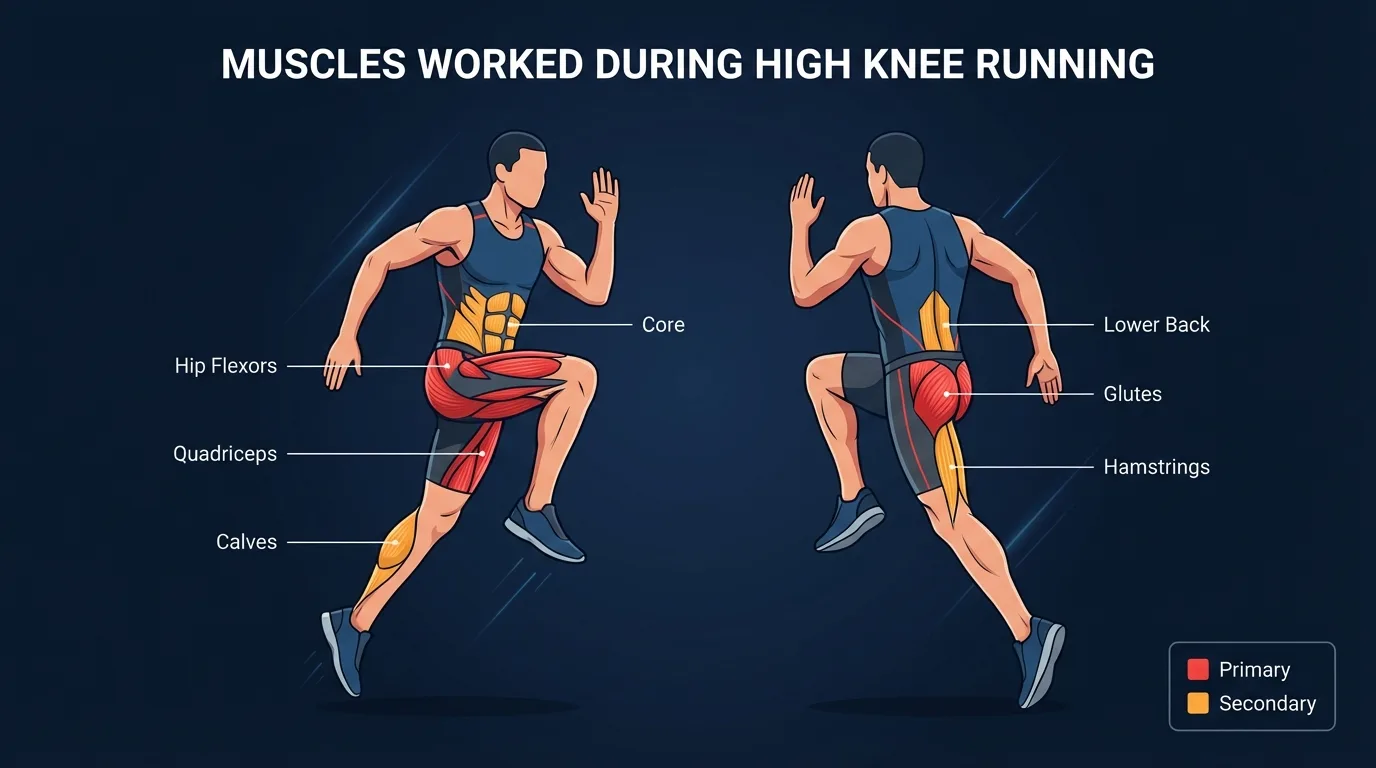
Primary movers: the hip flexors (iliopsoas and rectus femoris) drive the knee upward concentrically on every stride and decelerate it eccentrically as the foot returns to the floor. The quadriceps assist the knee drive and absorb landing force. The calves (gastrocnemius and soleus) generate the springy push-off through ankle plantarflexion at the ball of the foot.
Secondary movers: the glutes and hamstrings on the standing leg work to extend the hip and hold pelvic position while the opposite knee drives up. The tibialis anterior dorsiflexes the swinging foot so your toe clears the floor on every cycle, which is why fast-twitch shin work shows up in your soreness after a long set.
Stabilizers: the entire anterior core (rectus abdominis, transverse abdominis, obliques) braces against rotation as the arms and legs alternate at high speed. The spinal erectors hold the vertical torso. The peroneals and tibialis posterior stabilize the ankle on every quick landing. Without that isometric trunk work, the torso starts to twist with every stride and the knee drive collapses.
Cardiovascular and energy systems: short, high-effort sets (15 to 30 seconds) tap the phosphocreatine system primarily and the glycolytic system secondarily, which is why you feel a hard local burn in the legs faster than you feel out of breath. Longer interval work (30 seconds on / 30 seconds off for several rounds) shifts the demand toward the glycolytic and oxidative systems, pushing heart rate into the 85 to 95 percent of maximum range. That blend of high local muscle demand and high central cardiovascular demand is what makes the exercise punch above its bodyweight.
Step-by-Step: How to Perform High Knee Running
Whether you're using it as a strength-focused interval or a conditioning finisher, the movement pattern is the same. The cues below apply to both.
Step 1: Stand Tall in an Athletic Ready Position
Feet hip-width apart, chest lifted, shoulders pulled back and down, core gently braced. Bend your arms to roughly 90 degrees with loose fists. Your weight should sit forward on the balls of your feet, never back on the heels. Keep a soft bend in both knees so you're ready to move.
Step 2: Drive Your Right Knee Explosively to Hip Height
Using your hip flexors and core, snap your right knee upward until your thigh is at or above parallel to the floor. At the same time, push off the ball of your left foot with force. This is not a leisurely lift. You're driving the knee like you're sprinting.
Coach Ty's cue: "Knees up, not forward. If the thigh is not at parallel, it does not count."
Step 3: Land Softly and Switch Legs Immediately
As your right foot returns to the ground, land on the ball of the foot with a quiet, springy contact. In the same instant, drive your left knee up to the same height. Each foot should spend as little time on the ground as possible.
Ty's cue: "Stay quiet on the landings. Heavy feet are wasted energy."
Step 4: Match Your Arms to the Cadence of a Real Run
Swing your arms forward and back in opposition to your legs. Right knee up, left arm forward. Left knee up, right arm forward. Keep elbows bent at 90 degrees. Don't let your arms cross your midline. That wastes energy and rotates the torso.
Ty's reminder: "Arms drive the legs. Pump them like you mean it."
Step 5: Hold Your Posture Tall and Breathe
Stay vertical through the torso. No forward lean, no hips sagging back. Fix your eyes on a point straight ahead for balance. Breathe in a rhythm that matches your cadence. This is a high-intensity movement, and holding your breath is the fastest way to gas out.
Ty's closing cue: "Stop when knee height drops, not when the timer ends. Quality reps over total time, every set."
Get this exercise in a personalized workout
FitCraft, our mobile fitness app, uses its AI coach Ty to program conditioning work like this into your plan at the right volume and intensity, based on your level, goals, and equipment. Ty was designed and trained by Domenic Angelino, MPH (Brown University) and NSCA-CSCS, with research published in the Journal of Strength and Conditioning Research and Medicine & Science in Sports & Exercise.
Take the Free Assessment Free · 2 minutes · No credit card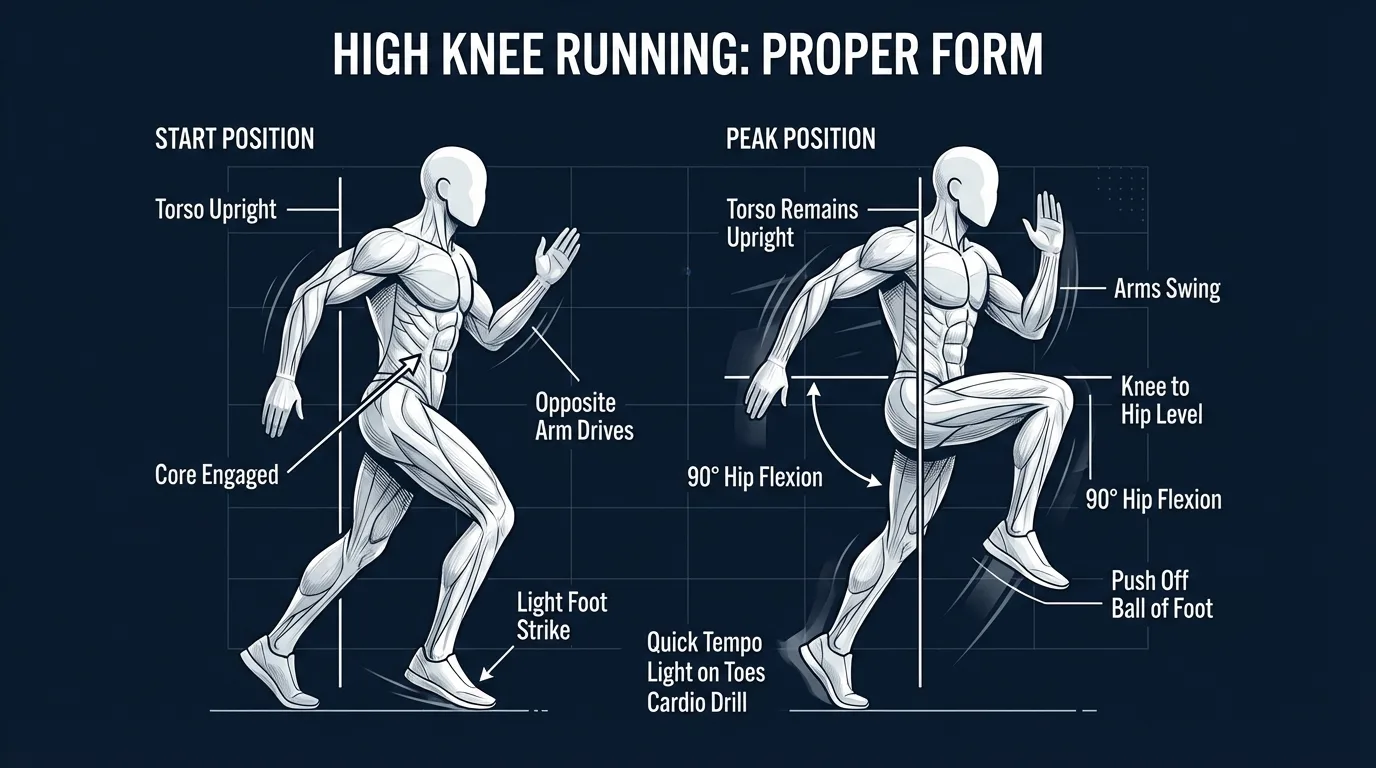
Common Mistakes (and How to Fix Them)
Here are the mistakes Ty corrects most often.
- Knees not reaching hip height. This is the single most common mistake and the one that turns high knee running into a wasted exercise. If your knees are coming up to mid-thigh or lower, you're not getting the hip flexor engagement that makes this movement worth doing. Slow the cadence if you need to, but keep the knees at or above parallel.
- Leaning forward to compensate. Many people lean the torso forward to make the knee drive feel easier. It doesn't actually make the exercise easier. It just shifts the work off the hip flexors and onto the lower back. Stay vertical.
- Flat-footed or heel-striking landings. Landing on your heels sends impact straight into your ankles, knees, and lower back. It also kills your cadence, because you can't bounce off a heel the way you can off the ball of the foot. Stay on the balls of your feet.
- Arms across the body. Letting your arms cross your midline rotates your torso and forces your core to work overtime just to stabilize. Keep the arm swing straight forward and back in line with your hips.
- Going too long at the wrong intensity. High knee running programmed for strength should be short and sharp, 20 to 30 seconds max. If you can maintain it for two minutes, the knees aren't going high enough or you're not driving the push-off hard enough. Cut the duration and add intensity.
- Holding your breath. High knee running spikes your heart rate fast. If you hold your breath, you'll lose your rhythm and the set will fall apart. Breathe in a steady cadence that matches your stride.
High Knee Running Variations: Regressions and Progressions
Start where you are and progress when your form is solid at the current level.
Marching High Knees (Beginner Regression)
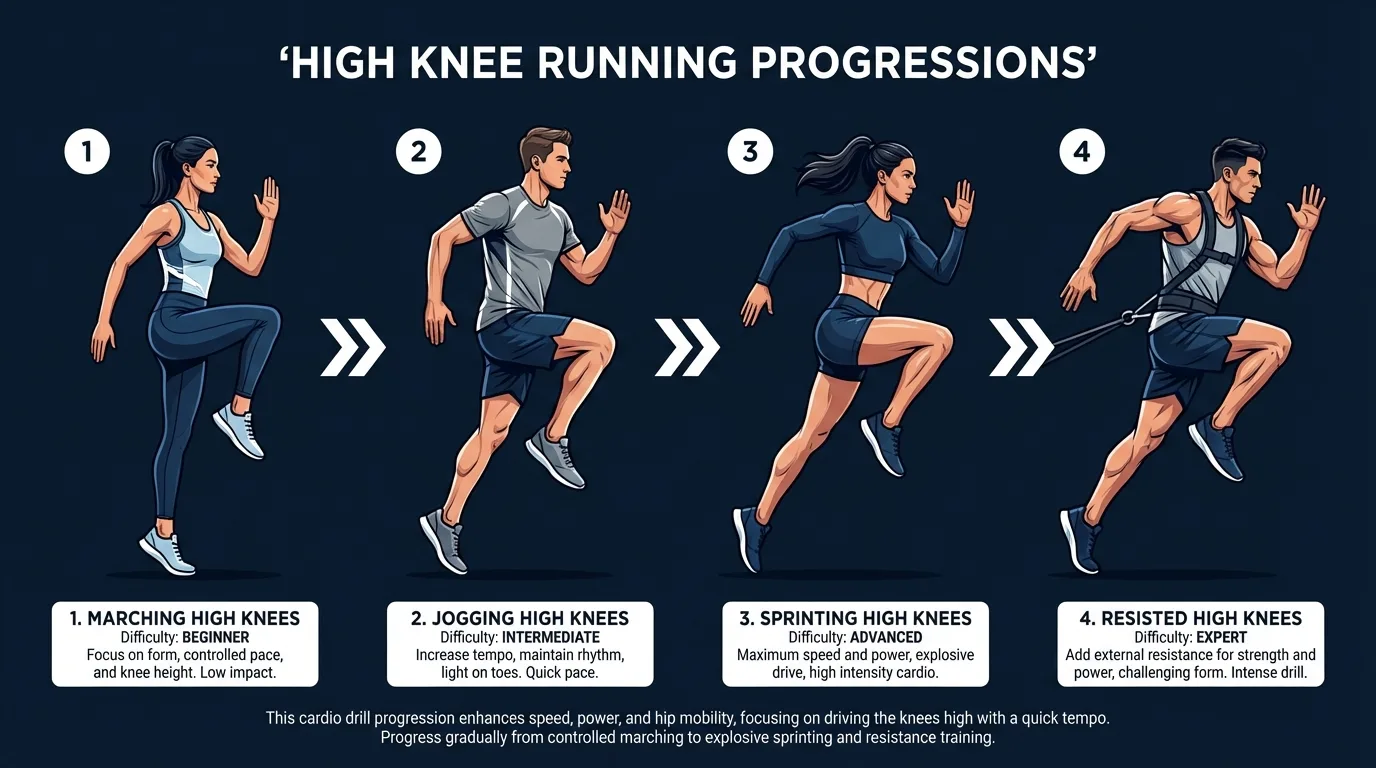
Perform the knee drive at a walking cadence instead of a running cadence. One knee up, foot down, then the other knee up. This removes the impact and lets you focus on getting full hip flexion before you add the running speed. A great starting point if you haven't trained the movement before, or if you're avoiding jumping for pelvic-floor or joint reasons.
Standard High Knees (Intermediate)
A slower, more controlled version that emphasizes the knee drive without the full running push-off. Useful if you want to prioritize hip flexor strength without the cardiovascular demand of the full-speed version.
Banded High Knee Running (Advanced Progression)
Loop a light resistance band around your thighs just above the knees. The band makes the hip flexors fight harder on every rep and significantly increases the strength demand. Keep the sets short, 15 to 20 seconds, because fatigue comes fast.
Sprint High Knee Running (Advanced Progression)
Go all-out for 10 to 15 seconds at maximum effort with 45 to 60 seconds of rest between rounds. This turns the movement into a true power and conditioning exercise. Four to six rounds is plenty.
Butt Kicks (Complementary Pairing)
Not a variation, but a natural pairing. Butt kicks shift the emphasis from the quadriceps and hip flexors to the hamstrings. Alternating sets of the two makes a balanced lower-body conditioning circuit.
When to Avoid or Modify High Knee Running
High knee running is safe for most healthy adults, but a few conditions call for modification or temporarily swapping the full-speed version for a low-impact alternative. None of these are permanent restrictions. They're starting points. Always consult your physician or physical therapist for personalized guidance.
- Knee pain or post-surgical knees. The repetitive ball-of-foot landings transmit force through the patellofemoral joint on every stride, which can aggravate patellofemoral pain, meniscus irritation, or post-surgical knees. Substitute with marching high knees at walking tempo to keep the hip-flexor stimulus without the impact. Build up calf raises first to improve ankle and lower-leg shock absorption before reintroducing the running cadence.
- Acute ankle injury, shin splints, or plantar fasciitis. Plyometric loading aggravates these. Stay with marching high knees or low-knee marching until symptoms resolve, and address the underlying issue with a clinician before adding speed back in.
- Second and third trimester of pregnancy. Increased joint laxity, a shifting center of mass, and pelvic-floor load make jumping movements high risk. Substitute with marching high knees and prioritize core and pelvic-floor work like deadbugs and bird-dogs.
- First 6 to 12 weeks postpartum, or active stress incontinence. Pelvic-floor recovery is a prerequisite for any jumping or rapid-impact movement. Get clearance from a pelvic-floor PT, stay with marching high knees in the meantime, and use forearm planks and deadbugs to rebuild deep-core control first.
- Cardiovascular disease or uncontrolled hypertension. High knee running spikes heart rate and blood pressure rapidly. Get your cardiologist's approval, work within their prescribed heart-rate zones, and consider lower-intensity conditioning options like marching in place or walking intervals while you build a base.
- Vertigo, balance disorders, or vestibular conditions. The fast cadence and quick foot turnover risk falls. Stay with marching high knees while you address the underlying issue, and use a wall or chair for balance if needed.
Related Exercises
If high knee running is part of your routine, these movements complement or extend the same training pattern:
- Lower-impact alternative within the same pattern: High Knees and Run in Place let you keep the knee-drive stimulus at a lower cardiovascular and impact cost.
- Complementary cardio pairing: Butt Kicks shift the load from quads and hip flexors to the hamstrings, making a balanced lower-body conditioning circuit when alternated.
- Same energy-system stimulus: Mountain Climbers, Jumping Jacks, and Jump Squats are all in the same HIIT family. Use them as substitutes or rotate through them in a circuit to spread joint stress.
- Compound strength foundation for the lower body: Bulgarian Split Squats and Calf Raises build the unilateral leg strength and ankle stiffness that translate directly into a more powerful high knee running stride.
- Core stability foundation: Forearm Planks, Deadbugs, and Bird-Dogs isolate the bracing pattern that holds your vertical torso during high-speed alternating leg drive.
How to Program High Knee Running
High knee running programming is time-based and work/rest-interval-based rather than sets and reps. The American College of Sports Medicine (ACSM) Position Stand on resistance training emphasizes matching work intensity to the trained adaptation: short, high-effort intervals for power and strength, longer intervals for cardiovascular conditioning, with at least 48 hours of recovery between high-intensity sessions training the same pattern (Ratamess et al., 2009).
| Level | Work | Rest | Total session | Frequency |
|---|---|---|---|---|
| Beginner | 20 to 30 sec | 60 to 90 sec | 10 to 15 min | 2 to 3 sessions/week |
| Intermediate | 30 to 45 sec | 45 to 60 sec | 15 to 25 min | 3 to 4 sessions/week |
| Advanced | 45 to 60 sec (or 10 to 15 sec sprint format) | 30 to 45 sec (or 45 to 60 sec for sprints) | 20 to 30 min | 3 to 5 sessions/week |
Where in your workout: use high knee running early in a session when you're fresh, either as a power-focused warm-up finisher or as part of a dedicated conditioning block. It also works as a metabolic finisher at the end of a session, capped at 5 to 10 minutes. Don't do it before heavy lower-body strength work. The hip flexor and quad fatigue will cut your squat and split-squat output. After resistance training is fine; before a low-intensity zone-2 cardio session is also fine.
Form floor over time targets: if knee height drops below hip level in the final seconds of a set, the set is over. Stop, rest, and restart with quality. A clean 20 seconds beats a sloppy 45 seconds every time.
How FitCraft Programs This Exercise
Knowing how to do high knee running is step one. Knowing when to use it, at what work-to-rest ratio, and how to pair it with the rest of your week is where most people get stuck.
FitCraft's AI coach Ty handles that. During your personalized diagnostic, Ty maps your fitness level, goals, and available equipment. Then Ty builds a personalized program that slots high knee running into a balanced training week at the right intensity for your level.
For intermediate users, Ty might program high knee running as a conditioning move in a bodyweight circuit, 3 sets of 25 seconds paired with Bulgarian split squats and calf raises. For more advanced users, the coach might use it as a sprint interval finisher, 6 rounds of 15 seconds at maximum effort with 45 seconds of rest to build explosive power after the main strength work is done. As you get stronger, Ty adjusts the work duration and intensity to match your level.
Every programming decision is grounded in the exercise science principles of Domenic Angelino, an Ivy League-trained exercise scientist and NSCA-certified strength coach. Ty walks you through every rep with an interactive 3D demonstration, counts your intervals in real time, and adjusts your plan based on how you're actually progressing.
Frequently Asked Questions
Can I do high knee running if I have knee pain?
The repetitive ball-of-foot landings transmit force through the knee on every stride, which can aggravate patellofemoral pain, meniscus irritation, or post-surgical knees. Substitute with marching high knees at walking tempo (no impact) or low-knee marching while you address the underlying issue. If pain persists after these modifications, see a physical therapist before adding any plyometric work back into your program.
What is high knee running?
High knee running is a stationary exercise where you run in place while driving each knee up to hip height or higher on every stride. It combines the cadence of a full-speed run with the exaggerated hip flexion of a high-knee drill, which builds lower-body strength, power, and cardiovascular conditioning in one movement.
What muscles does high knee running work?
High knee running primarily works the hip flexors, quadriceps, and calves. It also engages the glutes, hamstrings, and core as secondary movers. Because you're driving each knee to hip height at running speed, the hip flexors take on a larger strengthening role than they would during standard jogging or running in place.
Is high knee running a strength exercise or a cardio exercise?
High knee running is both. Programmed in short, high-effort sets it functions as a lower-body strength and power movement by overloading the hip flexors and quads. Programmed in longer intervals it doubles as a cardiovascular conditioning tool. FitCraft programs it primarily as a conditioning movement because the knee drive and push-off load the legs aggressively while spiking heart rate fast.
How long should I do high knee running?
For strength and power, 3 to 4 sets of 20 to 30 seconds at high intensity with 30 to 60 seconds of rest between sets is plenty. For conditioning, try 6 to 8 rounds of 30 seconds on and 30 seconds off. Beginners should start with 2 sets of 15 seconds and build duration before increasing intensity.
What is the difference between high knees and high knee running?
High knees emphasizes the knee drive itself and is often performed at a slower, more controlled cadence that prioritizes hip flexor contraction. High knee running adds the cadence and push-off mechanics of an actual run, so you get the same knee lift but with a faster turnover and a more powerful ground contact. High knee running is generally more demanding on the legs and lungs.