The jump squat is a regular squat that ends with you leaving the ground. Simple concept. But here's what makes it special: it's one of the few bodyweight exercises that actually develops explosive power. Regular squats build strength. Jump squats build the ability to use that strength fast. And that speed component is what most people are missing in their training.
Plyometric exercises like jump squats also create significant metabolic demand, which is why they show up in nearly every HIIT workout. The combination of large muscle recruitment and rapid heart-rate elevation makes them efficient for conditioning sessions where time is limited.
But there's a catch. The landing is where injuries happen. Get the landing wrong and you're loading your joints instead of your muscles. This guide covers how to jump safely, land properly, and program jump squats without destroying your knees.
Quick Facts: Jump Squats
- Equipment needed: Bodyweight only. A padded gym floor, turf, or thick exercise mat reduces joint impact.
- Difficulty: Expert. Prerequisite: 20 controlled bodyweight squats with good form under fatigue.
- Modality: Compound, bilateral, plyometric.
- Body region: Lower body and cardiovascular system.
- FitCraft quest category: Strength and conditioning (power development + HIIT).
Muscles and Systems Worked
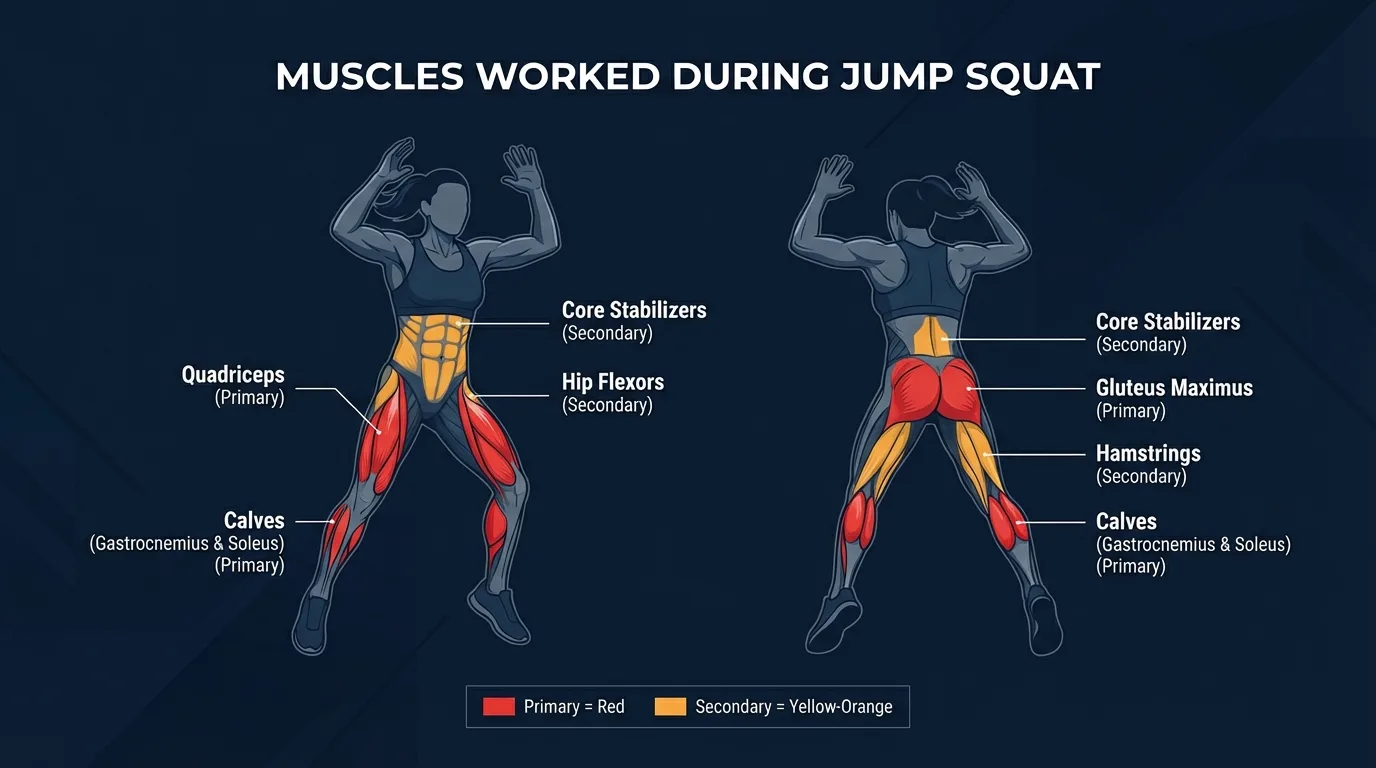
Primary movers. The quadriceps (rectus femoris, vastus lateralis, vastus medialis, vastus intermedius) extend the knee both concentrically during the explosive push-off and eccentrically during the soft landing. The gluteus maximus extends the hip with maximum force at the moment of takeoff. The gastrocnemius and soleus (calves) drive the final ankle plantarflexion that completes triple extension, then absorb the first wave of landing impact.
Secondary movers. The hamstrings contribute to hip extension and help control the descent into the squat. The hip flexors (iliopsoas, rectus femoris) work briefly at the top of the jump as you pull the legs up. The deltoids and trapezius drive the arm swing that adds roughly 10 to 20 percent of total jump force.
Stabilizers. The deep core (rectus abdominis, transverse abdominis, obliques) braces the trunk so force transfers cleanly from legs to ground without lower-back compensation. The gluteus medius and minimus keep the knees tracking over the toes on both takeoff and landing, which is the load-bearing safety mechanism that prevents valgus collapse. The peroneals and tibialis anterior/posterior stabilize the ankle on every landing.
Mechanism (cardiovascular and metabolic systems). Jump squats are a true plyometric movement: the rapid eccentric loading of the squat descent stretches the tendons and elastic components of the muscles, storing energy that is released during the concentric jump. This stretch-shortening cycle is what trains fast-twitch fiber recruitment and rate of force development. Metabolically, jump squats hit the phosphocreatine system in the first few reps and the glycolytic system as the set continues, with heart rate spiking within seconds and staying elevated through the rest interval. That combination is why HIIT protocols built around jump squats produce strong EPOC and conditioning adaptations.
How to Do Jump Squats (Step-by-Step)
-
Set your stance. Stand with feet shoulder-width apart, toes pointed slightly outward (about 15 to 30 degrees). Arms at your sides or hands in front of your chest. Look straight ahead.
Coach Ty's cue: "Plant your feet like you mean it. The wider you go, the more glute. Narrower, more quad. Shoulder-width is the balanced default."
-
Lower into a squat. Push your hips back and bend your knees. Lower until your thighs are at or just above parallel to the floor. Keep your chest up, core braced, and weight in your heels and midfoot. This is your loading position.
Coach Ty's cue: "Don't go too deep. For jump squats, parallel or just above is plenty. Deeper reduces your explosive force and stresses the knees on landing."
-
Explode upward. Drive through your entire foot. Extend your hips, knees, and ankles as explosively as you can. Swing your arms up to generate extra force. Leave the ground with full triple extension. You should feel this mostly in your quads and glutes.
Coach Ty's cue: "Arm swing isn't optional. It's worth 10 to 20 percent of your jump force. Arms down as you load, arms up as you explode."
-
Land softly. This is the most important step. Land on the balls of your feet first, then roll to your heels. Bend your knees and hips to absorb the impact. Think of it as catching yourself. Your landing should be quiet. If you can hear it from across the room, you're landing too hard.
Coach Ty's cue: "Land like a ninja. Quiet landings mean controlled landings. If your feet are slamming the floor, the force is going through your joints instead of your muscles."
-
Reset and repeat. Pause briefly at the bottom to check your position. Then explode up again. Beginners should fully reset between each rep. More advanced? Transition immediately into the next jump.
Coach Ty's cue: "When your landing starts getting sloppy, the set is over. Doesn't matter if you planned 10 reps and only got 6. Plyometrics are about power output, not endurance."
Get this exercise in a personalized workout
FitCraft, our mobile fitness app, uses its AI coach Ty to program conditioning work like this into your plan at the right volume and intensity, based on your level, goals, and equipment. Ty was designed and trained by Domenic Angelino, MPH (Brown University) and NSCA-CSCS, with research published in the Journal of Strength and Conditioning Research and Medicine & Science in Sports & Exercise.
Take the Free Assessment Free · 2 minutes · No credit card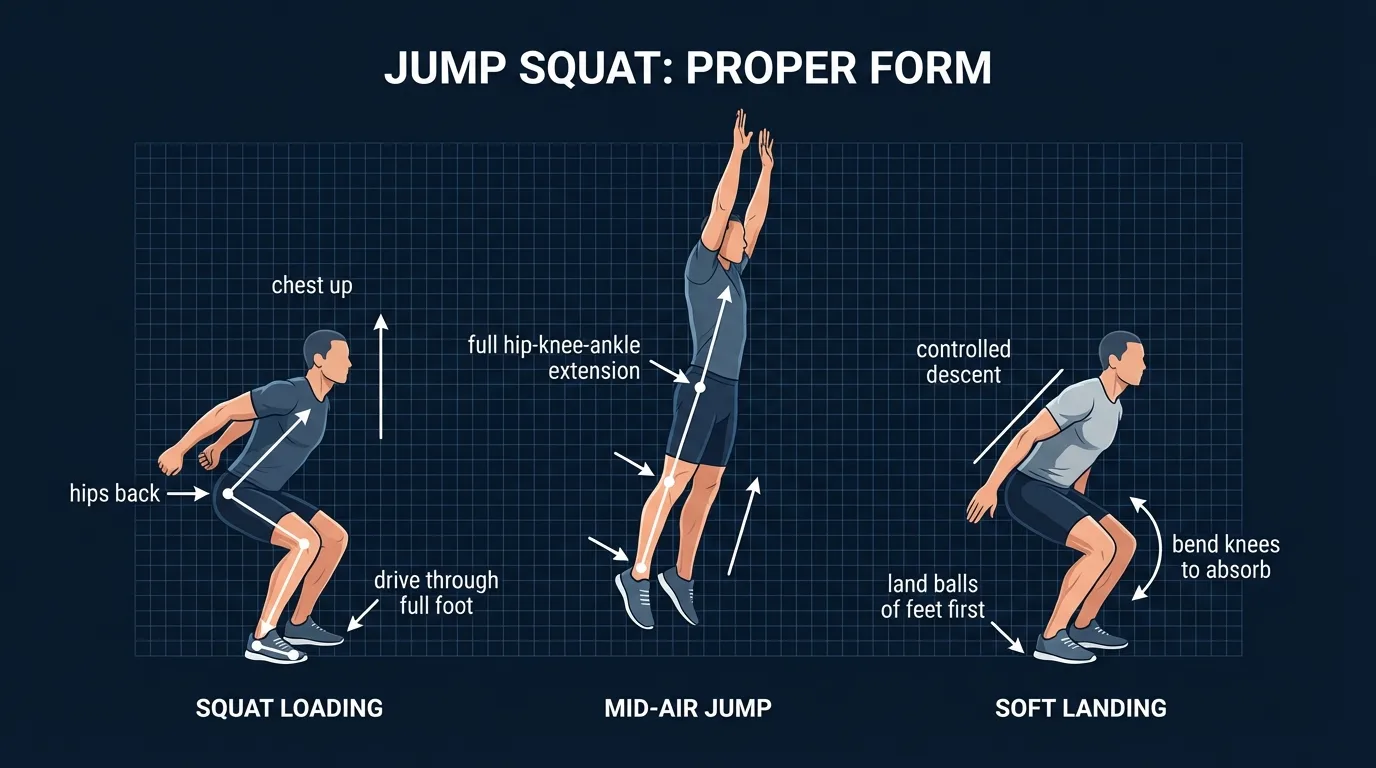
Common Mistakes to Avoid
Jump squats are an expert-level exercise. These mistakes are common, and some of them can actually get you hurt:
- Hard landings. The most dangerous mistake. Landing with straight legs or flat feet sends the impact force directly through your knee and ankle joints instead of being absorbed by your muscles. Always land with bent knees and hips, balls of feet first.
- Knees caving in on landing. This puts massive stress on the ACL and meniscus. It usually means your gluteus medius is weak. Fix the root cause with fire hydrants and bodyweight squats before doing jump squats.
- Leaning too far forward. If your chest drops forward during the squat portion, you lose power on the takeoff and your lower back takes unnecessary load. Keep your chest up and your eyes forward.
- Squatting too deep. Deep squats are great for strength. Deep jump squats are not. The deeper you go, the more time you spend in the bottom position and the harder it is to generate explosive force. Stay at or just above parallel.
- Too many reps. Jump squats are not a high-rep exercise. After about 8 to 10 reps, fatigue degrades your landing mechanics and your power output drops. At that point you're just doing tired, dangerous squats with a little hop at the top. Keep sets short and rest fully between them.
- Bad surface. Jump squats on a padded gym floor or turf are far easier on your joints than jumping on concrete or tile. If you're training at home, a thick exercise mat helps a lot.
Variations and Progressions
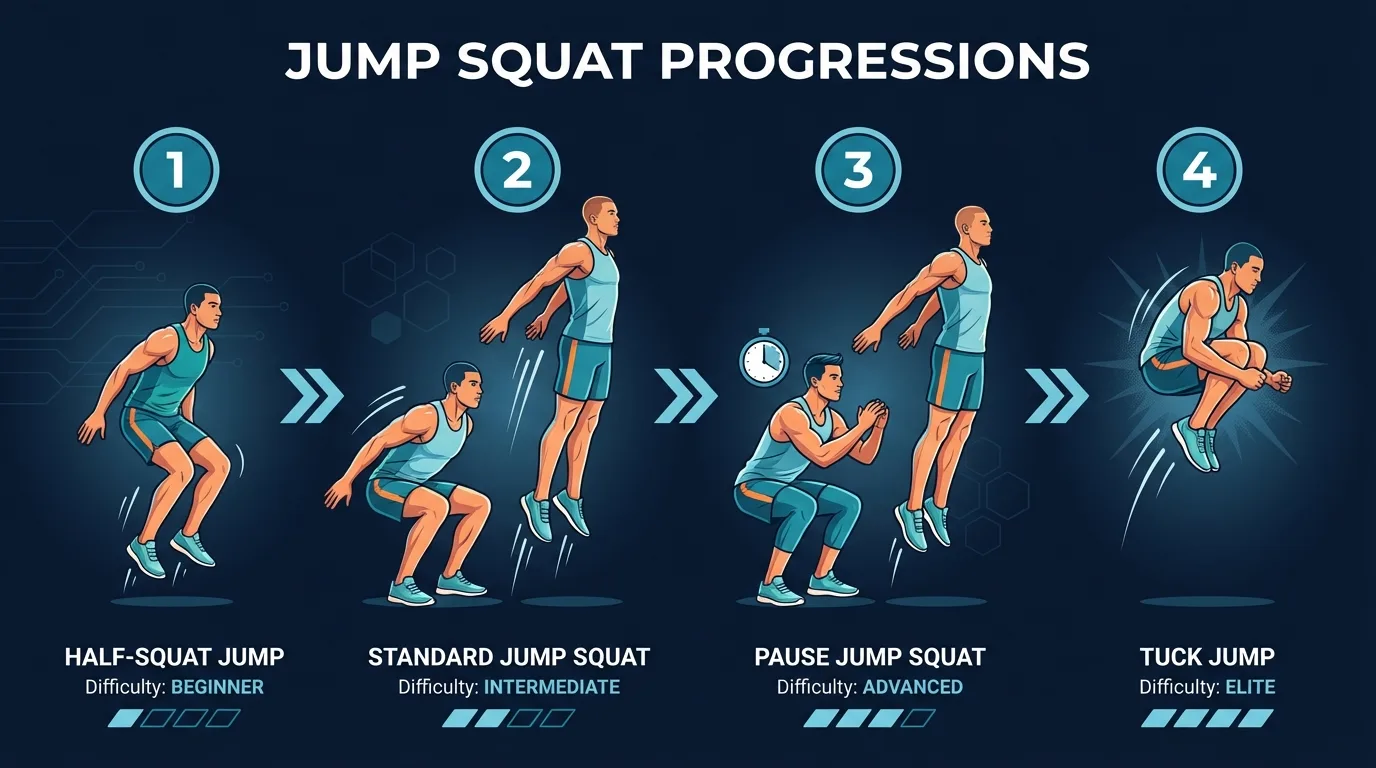
Half-Squat Jump (Intermediate)
Same as a full jump squat but you only lower to about 45 degrees instead of parallel. This reduces the impact on your knees and is a good entry point if regular jump squats are too advanced. Once you can do 3 sets of 10 with soft, controlled landings, progress to full depth.
Pause Jump Squat (Expert)
Lower into the squat, hold the bottom position for 2 to 3 seconds, then explode up. The pause eliminates the stretch-shortening cycle (the bounce at the bottom), forcing your muscles to generate all the force from a dead stop. Harder than it sounds. Really effective for building starting strength.
Tuck Jump (Expert)
Jump as high as you can and pull your knees toward your chest at the peak. Land in a squat position. This demands more power, more coordination, and more core strength. Only attempt if your standard jump squat form is solid.
Alternative Exercises
- Squats: The non-plyometric version. Same muscles, no impact. Build your squat strength first, then add the jump.
- High knees: Lower-impact cardio alternative that still develops leg power and elevates heart rate.
- Burpees: Full-body plyometric that includes a jump squat as part of the movement. More metabolically demanding but also more complex.
- Jump lunges: Unilateral plyometric alternative that exposes left-right imbalances and adds an extra coordination demand.
When to Avoid or Modify Jump Squats
Jump squats are safe for most healthy adults with adequate strength foundations, but several conditions warrant modification or full avoidance. Always consult a qualified healthcare provider or physical therapist before starting plyometric work, especially if any of the following apply:
- Acute knee, ankle, hip, or lower-extremity injury, shin splints, or plantar fasciitis. Plyometric landing impact aggravates all of these. Substitute with low-impact alternatives like marching in place, low-knee cycles, or seated leg drives until cleared by a clinician.
- Recent knee or lower-extremity surgery. Get explicit surgeon clearance before resuming jump training. Rebuild quad and glute strength with bodyweight squats and fire hydrants first.
- Known cardiovascular disease or uncontrolled hypertension. HIIT spikes heart rate and blood pressure quickly. Get your cardiologist's approval and stay within their prescribed heart-rate zones.
- First trimester (some movements) and second or third trimester of pregnancy. Joint laxity from relaxin increases injury risk, and the impact load is uncomfortable. Substitute with low-impact alternatives like step-ups or marching.
- First 6 to 12 weeks postpartum, or any stress incontinence or pelvic-floor weakness. Pelvic-floor recovery is a prerequisite for jumping. Get clearance from a pelvic-floor PT and build core foundations with deadbugs and forearm planks first.
- Vertigo, balance disorders, or vestibular conditions. The rapid up-and-down motion and brief airborne phase risk falls. Stick to grounded movements until symptoms are managed.
- Asthma or exercise-induced bronchoconstriction. Have an inhaler accessible, do a longer warm-up, and consult your physician about appropriate intensity caps for HIIT.
- Inadequate strength foundation. If you can't perform 20 controlled bodyweight squats with chest up and knees tracking, you're not ready for jump squats. Build the prerequisite first.
Related Exercises
- Lower-impact alternative within the same pattern: high knees and bodyweight squats for anyone avoiding the airborne phase. Both elevate heart rate and load the legs without the landing impact.
- Compound strength foundation: bodyweight squats as the prerequisite pattern. Master 20 controlled reps under fatigue before adding the jump.
- Plyometric progression: jump lunges as a unilateral plyometric that exposes left-right power imbalances; burpees as the full-body conditioning escalation that includes a jump squat.
- Core stability foundation: forearm planks and deadbugs to build the trunk control that protects the lower back through the explosive hip extension and the absorption phase.
- Hip-stability foundation: fire hydrants to strengthen the gluteus medius and keep knees tracking the toes on every landing.
- Ankle and foot conditioning: calf raises to prepare the calves and Achilles for the repeated absorption demand of plyometric landings.
How to Program Jump Squats
Programming guidance for jump squats follows the evidence-based ranges in the ACSM Position Stand on Resistance Training (Ratamess et al., 2009), with adjustments for the plyometric, time-based nature of conditioning work:
| Level | Sets × Reps (power) or Work/Rest (conditioning) | Rest between sets | Frequency |
|---|---|---|---|
| Beginner (half-squat jumps) | 2-3 × 5-6 reps for power; 20-30 sec on / 60-90 sec off for conditioning | 60-90 sec (power) | 2 sessions/week |
| Intermediate (standard jump squats) | 3-4 × 6-8 reps for power; 30-45 sec on / 45-60 sec off for conditioning | 90-120 sec (power) | 2-3 sessions/week |
| Advanced (pause jumps, tuck jumps) | 4-5 × 5-8 reps for power; 45-60 sec on / 30-45 sec off for conditioning | 2-3 min (power) | 2-3 sessions/week |
Where in your workout. For power, place jump squats early in the session when you're fresh, before any heavy lower-body strength work. Power exercises lose their training effect when done fatigued. For conditioning, jump squats fit at the end of a strength session as a metabolic finisher (5 to 10 minutes max), or as a standalone HIIT block. Never do them before a heavy lower-body strength session, since the plyometric work will deplete the glycogen and motor-unit recruitment you need for the lifts.
Form floor over rep targets. Plyometrics live or die by landing quality. The instant your landing gets sloppy (loud, knees caving, feet slapping), the set is over. It doesn't matter if you planned 10 reps and only got 6. Quality reps build power and protect the joints. Sloppy reps train you to land badly and increase injury risk.
Frequency cap. Plyometrics need 48 hours of nervous-system and joint recovery between sessions. More than 3 sessions per week is rarely productive for jump squats specifically; the diminishing returns kick in fast and the injury risk climbs.
Frequently Asked Questions
Can I do jump squats if I have knee pain or a history of knee injury?
Not without clearance. Jump squats are a high-impact plyometric exercise, and the landing phase loads the patellofemoral joint and ACL. If you have acute knee pain, recent surgery, or known meniscus or ligament injury, avoid jump squats until cleared by a physical therapist or orthopedist. If you have minor wear-and-tear or want to ease back in after recovery, start with half-squat jumps (45-degree depth) on a padded surface, and focus on soft, controlled landings. Build foundational glute and quad strength with bodyweight squats, fire hydrants, and step-ups first.
What muscles do jump squats work?
Jump squats target the quadriceps, gluteus maximus, and calves as primary movers. The hamstrings, core stabilizers, and hip flexors work as secondary muscles. Because jump squats are plyometric, they recruit the fast-twitch muscle fibers responsible for explosive power, which standard squats do not fully activate. The cardiovascular system also works hard: heart rate spikes within seconds, making jump squats one of the most metabolically demanding bodyweight movements.
How many jump squats should I do?
For power development, 3 to 4 sets of 5 to 8 reps with full rest (90 seconds to 2 minutes) between sets. For conditioning, 3 sets of 10 to 15 reps with shorter rest (30 to 45 seconds). Quality matters more than quantity with plyometrics. When your landing mechanics start breaking down, stop the set regardless of rep count. Sloppy reps train you to land badly.
Do jump squats burn fat?
Jump squats are one of the most metabolically demanding bodyweight exercises because they recruit large muscle groups explosively and elevate heart rate quickly. High-intensity exercise increases excess post-exercise oxygen consumption (EPOC), so you continue burning calories after the workout ends. But fat loss ultimately comes down to overall caloric balance over weeks and months. No single exercise carries that load on its own.
What is the difference between a jump squat and a squat jump?
They are the same exercise in common usage. Both terms refer to a bodyweight squat with an explosive jump at the top. Some coaches use "squat jump" specifically for a version where you pause at the bottom (eliminating the stretch-shortening cycle), but in everyday training the terms are interchangeable. The pause variation is harder and trains starting strength from a dead stop.