Squat walks look simple: get low, stay low, and walk. The difficulty comes from the part most people try to skip. Your legs never get the easy lockout at the top of a squat.
That constant time under tension is why squat walks work well as a lower-body finisher or low-impact conditioning drill. Your quads keep the knees bent, your glutes drive the hips, and your hip stabilizers keep the pelvis from tilting as each foot moves.
If you've already built a clean squat and want a no-jump challenge that still makes your legs work hard, squat walks fit that slot. Use a shorter distance than you think at first. The set gets harder quickly.
Quick Facts: Squat Walks
- Equipment needed: None
- Difficulty: Intermediate to Advanced
- Modality: Low-impact conditioning and strength endurance
- Body region: Lower body
- FitCraft quest category: Cardio
Muscles & Systems Worked
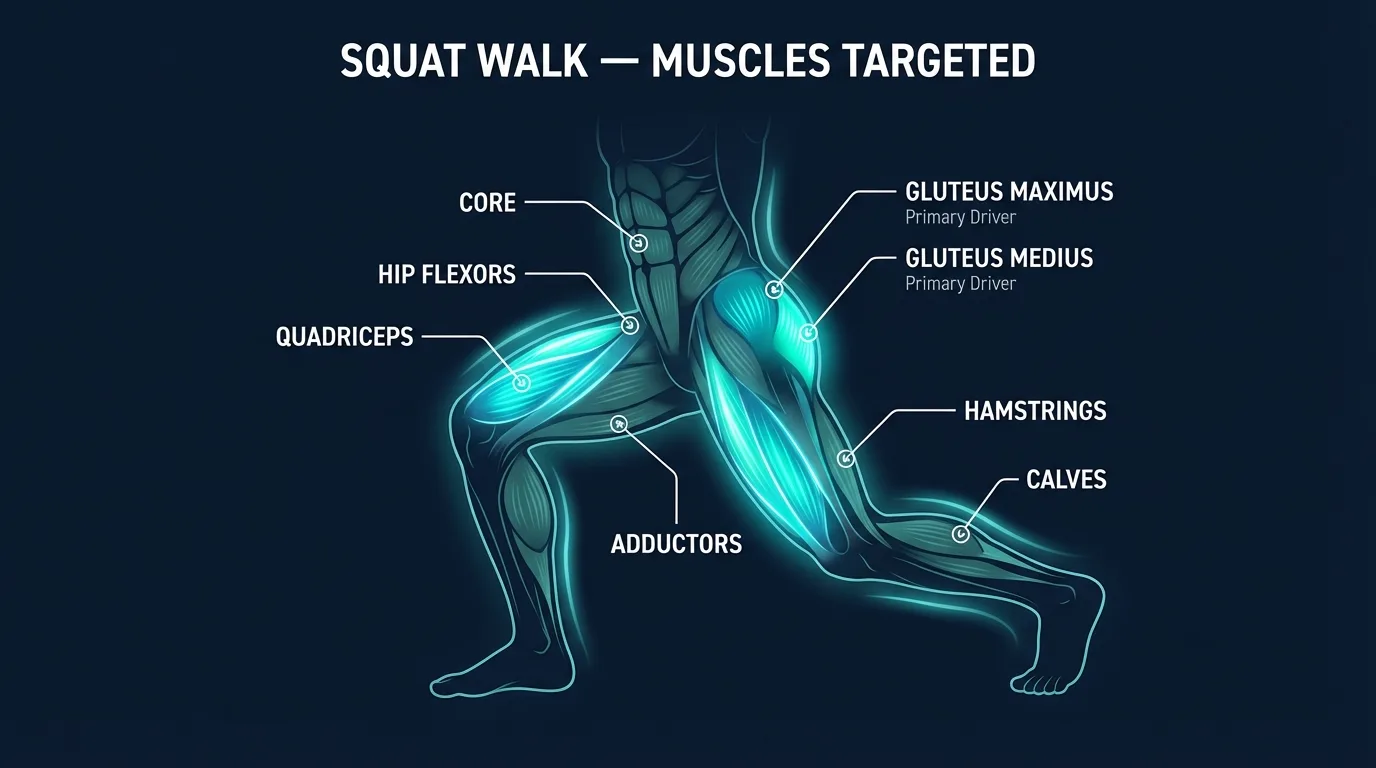
Primary movers: the quadriceps hold the knees in deep flexion and control each step, while the gluteus maximus helps maintain hip extension strength from the bottom position. During each step, these muscles work through small concentric and eccentric pulses instead of a full squat cycle.
Secondary movers: the gluteus medius and minimus keep the pelvis level as weight shifts from side to side. The hamstrings, adductors, hip flexors, and calves assist with stance control, foot placement, and the small forward steps.
Stabilizers: the rectus abdominis, transverse abdominis, obliques, spinal erectors, and deep hip stabilizers work isometrically so your torso stays tall instead of folding forward. The ankle stabilizers help keep the whole foot grounded while the center of mass moves.
Conditioning demand: squat walks are low impact, but the local fatigue is high because the legs stay loaded without a lockout. The phosphocreatine and glycolytic energy systems support short hard sets, while your heart and lungs ramp up when you repeat them in circuits.
Step-by-Step: How to Perform Squat Walks
Step 1: Set Your Stance
Stand with your feet slightly wider than shoulder-width apart and toes turned out about 15 to 30 degrees. Put your arms forward, clasp your hands at chest height, or keep your hands behind your head if that helps you stay upright.
Coach Ty's cue: "Own your stance before you move. Your feet set the rest of the walk."
Step 2: Lower into Your Working Squat
Push your hips back and bend your knees until you reach the deepest squat you can hold with flat heels, knees tracking over toes, and a lifted chest. This is your working depth for the set.
Coach Ty's cue: "Pick the depth you can keep. Don't negotiate with it after step three."
Step 3: Take a Short Controlled Step
Step one foot forward about 12 to 18 inches. Keep your hips low, your weight spread across the whole foot, and your torso as tall as you can manage.
Coach Ty's cue: "Small steps. If it turns into a lunge, the step is too big."
Step 4: Bring the Trailing Foot Forward
Move the back foot forward to restore your starting stance width. Do not stand up between steps. The point is to keep the quads and glutes loaded the whole time.
Coach Ty's cue: "Meet the feet, stay low, then go again."
Step 5: Stop When Form Changes
Alternate lead legs for the planned step count, distance, or work interval. End the set when your hips rise without control, your heels lift, your knees cave inward, or your torso collapses forward.
Coach Ty's cue: "The set ends when the squat changes, not when your ego says one more."
Get this exercise in a personalized workout
FitCraft, our mobile fitness app, uses its AI coach Ty to program conditioning work like this into your plan at the right volume and intensity, based on your level, goals, and equipment. Ty was designed and trained by Domenic Angelino, MPH (Brown University) and NSCA-CSCS, with research published in the Journal of Strength and Conditioning Research and Medicine & Science in Sports & Exercise.
Take the Free Assessment Free · 2 minutes · No credit card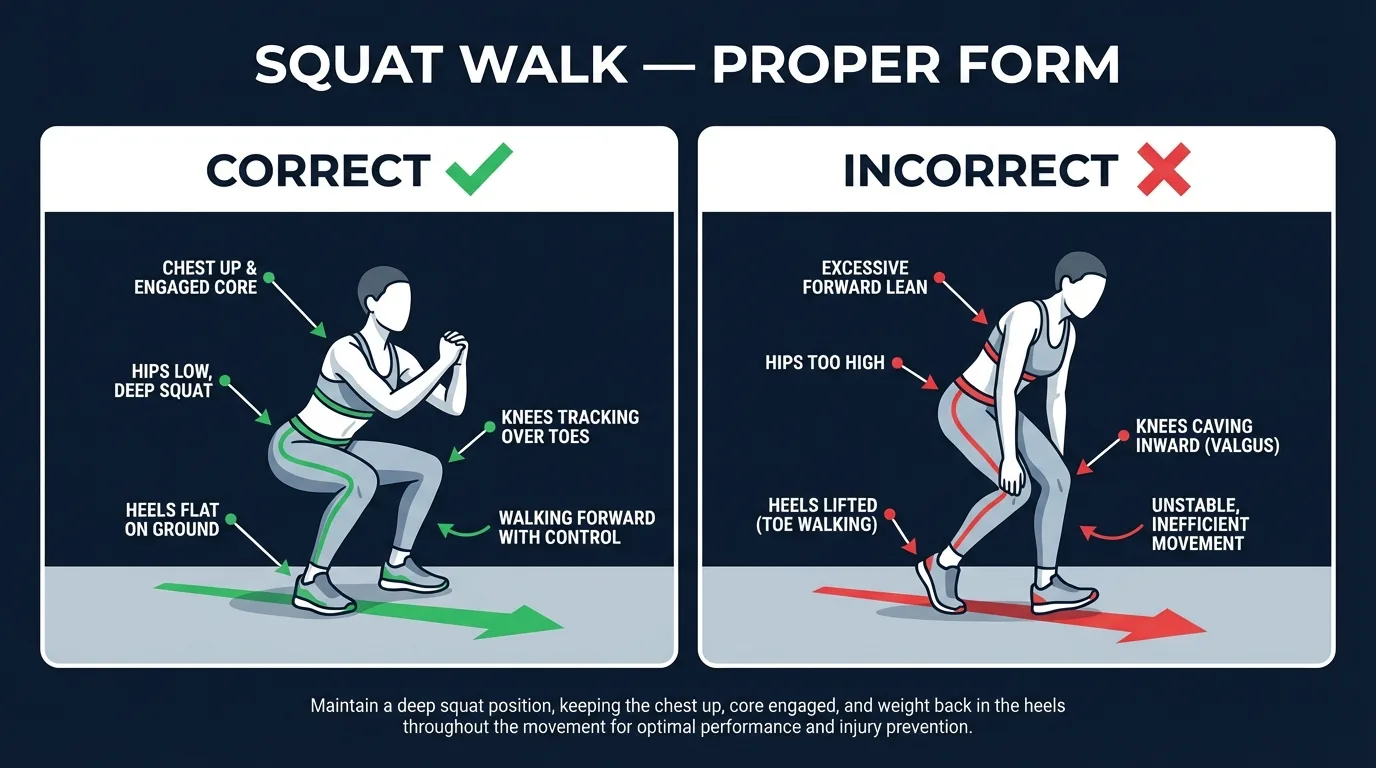
Common Mistakes (and How to Fix Them)
Squat walks punish small form leaks. Fix these first, then add distance or load.
- Rising between steps. Your hips pop up every time you move, turning the drill into a crouched walk. Fix it by shortening the set and choosing a depth you can actually hold.
- Taking long strides. Big steps push your weight forward and make the knees absorb more stress. Fix it with short, quiet steps that feel closer to a shuffle than a lunge.
- Letting the heels lift. Heel lift usually means the step is too long, ankle mobility is limiting you, or you are too low for your current control. Reduce depth or distance until the whole foot stays down.
- Knees caving inward. Valgus collapse changes the knee angle under fatigue. Push the knees in the same direction as the toes and regress to wall sits or regular squats if you cannot hold that line.
- Folding the torso forward. A collapsed chest shifts stress toward the low back and makes the squat depth harder to control. Brace the core, keep the ribs stacked over the pelvis, and shorten the walk.
- Rushing for speed. Squat walks are a control drill. Fast steps hide depth loss, heel lift, and knee cave. Move slowly enough that every step looks the same.
Squat Walk Variations: Regressions and Progressions
Stationary Squat Hold (Regression)
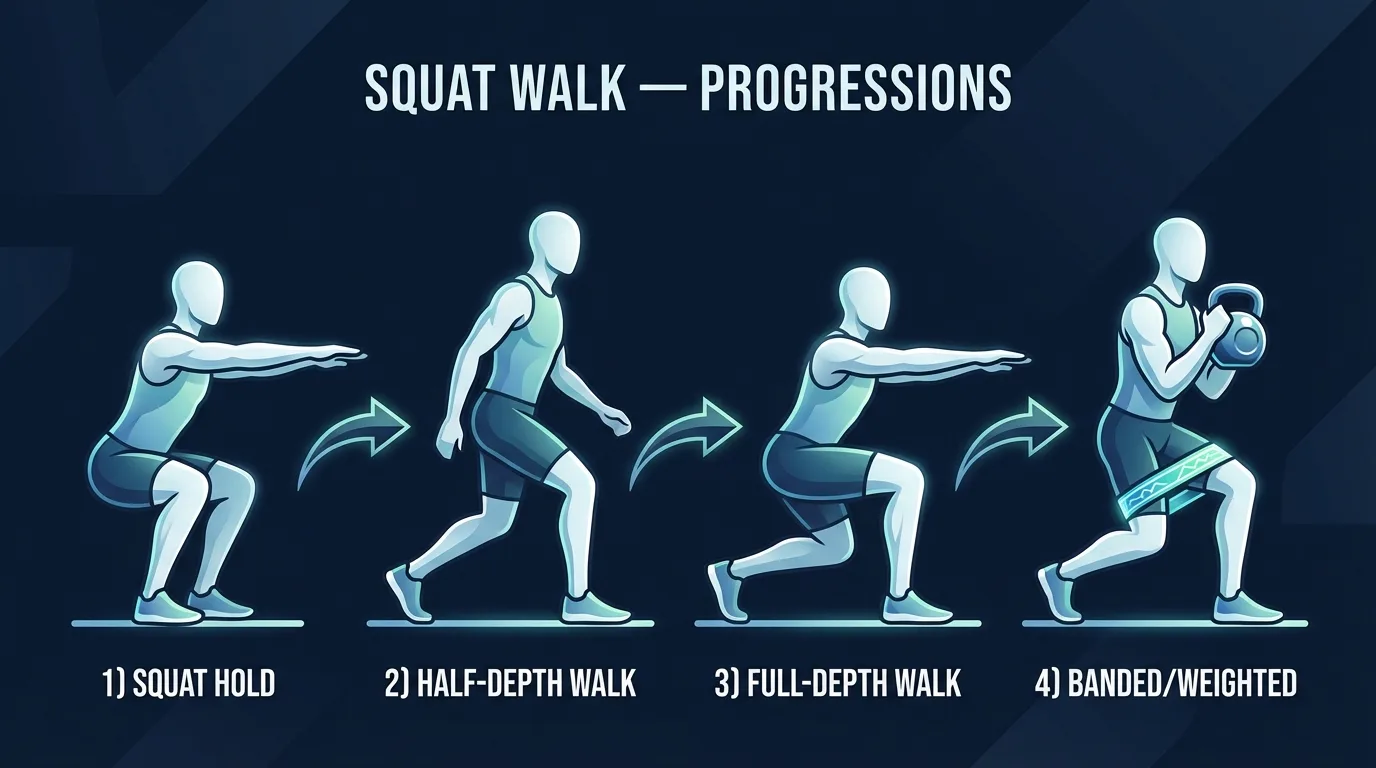
Drop into a squat and hold for 20 to 45 seconds without walking. This builds the static strength and ankle control you need before adding steps.
Half-Depth Squat Walk (Regression)
Use the same walking pattern from a quarter or half squat. This is the better starting point if full depth makes your heels lift or your knees ache.
Lateral Squat Walk (Variation)
Step sideways while holding the squat. This shifts more work toward the hip abductors and pairs well with forward squat walks in a lower-body circuit.
Banded Squat Walk (Progression)
Place a light resistance band above the knees and keep steady outward pressure as you walk. The band increases glute medius demand, but it should not force knee pain or sloppy steps.
Goblet Squat Walk (Progression)
Hold a light dumbbell or kettlebell at chest height. The front load makes your quads, glutes, and trunk work harder, so start lighter than you would for regular goblet squats.
When to Avoid or Modify Squat Walks
Squat walks are low impact, but they still demand deep knee flexion, hip control, balance, and steady breathing under fatigue. Modify early, and consult your physician or physical therapist for personal guidance.
- Knee pain during deep flexion. Full-depth squat walks can irritate sensitive knees. Use half-depth walks, wall sits, or regular squats in a pain-free range.
- Acute ankle, hip, shin, or foot injury. The drill needs repeated loaded steps from a low position. Substitute marching in place or walking in place until normal walking and squatting are pain-free.
- Known cardiovascular disease or uncontrolled hypertension. Repeated hard intervals can raise heart rate and blood pressure quickly. Get medical clearance and stay inside prescribed intensity zones.
- Pregnancy or early postpartum recovery. Squat walks are lower impact than jumping, but fatigue, balance changes, and pelvic-floor pressure still matter. Use shallow ranges and get OB or pelvic-floor PT guidance.
- Vertigo, balance disorders, or vestibular symptoms. Walking while low in a squat can increase fall risk. Use a supported squat hold or standing low-impact drill instead.
- Asthma or exercise-induced bronchoconstriction. Use a longer warm-up, keep an inhaler accessible if prescribed, and stop if breathing symptoms escalate.
Related Exercises
Use these when you want the same training slot, an easier entry point, or a stronger foundation for squat walks:
- Compound strength foundation: Squats and sumo squats build the same knee and hip pattern without the walking component.
- Low-impact conditioning alternatives: Marching in Place and Walking in Place raise heart rate with less knee bend.
- Quad endurance regression: Wall Sits train squat-position endurance without stepping.
- Power progression: Jump Squats train the same squat pattern with impact and explosive intent once landing mechanics are ready.
- Lateral hip work: Side Lunges and Side-Lunge Toe Touches train frontal-plane hip control that supports cleaner squat walks.
- Ankle and foot conditioning: Calf Raises and Calf Hops build lower-leg control for longer conditioning sets.
How to Program Squat Walks
Squat walks sit between strength endurance and low-impact conditioning. The American College of Sports Medicine position stand on resistance training supports progressive loading, appropriate rest, and recovery between repeated hard sessions (Ratamess et al., 2009).
| Level | Sets × Reps | Rest between sets | Frequency |
|---|---|---|---|
| Beginner | 2-3 × 20-30 seconds or 10-15 total steps | 60-90 seconds | 2-3 sessions/week |
| Intermediate | 3-4 × 30-45 seconds or 15-25 total steps | 45-60 seconds | 3-4 sessions/week |
| Advanced | 3-5 × 45-60 seconds or 25-40 total steps | 30-60 seconds | 3-5 sessions/week |
Where in your workout: use squat walks after strength work as a finisher, in a low-impact circuit, or in a warm-up at half depth. Avoid placing hard squat-walk intervals before heavy lower-body lifts because they can drain the exact leg endurance you need for clean reps.
Form floor over rep targets: stop the set when depth, knee tracking, heel contact, or torso position changes. A shorter clean set gives you more than a longer set that turns into a crouched walk.
How FitCraft Programs This Exercise
FitCraft's AI coach Ty uses your personalized diagnostic to place conditioning drills at a level that matches your current strength, goals, and equipment. For a squat-walk pattern, that can mean starting with a hold or half-depth walk before moving to longer intervals.
As your consistency and performance improve, Ty adjusts the variation and volume to match your level. The goal is steady progression without turning every lower-body session into a knee-grinding test of willpower.
Frequently Asked Questions
What muscles do squat walks work?
Squat walks primarily work the quadriceps, gluteus maximus, and gluteus medius. The hamstrings, adductors, calves, hip flexors, spinal erectors, and core stabilize the squat position while the cardiovascular system supplies the repeated low-impact effort.
Are squat walks good for building leg strength?
Yes. Squat walks build lower-body muscular endurance, hip stability, and squat-position strength. They are best used as a conditioning drill, warm-up pattern, or finisher rather than as a replacement for heavy squats.
How far should I squat walk?
Start with 10 to 15 total steps or 20 to 30 seconds at a depth you can control. Intermediate exercisers can use 30 to 45 second sets, and advanced exercisers can progress to 45 to 60 seconds or a light loaded variation.
Can I do squat walks with knee pain?
Modify or skip squat walks if deep knee flexion causes pain. Use a half-depth squat walk, stationary wall sit, or regular squat in a pain-free range, and get guidance from a physical therapist if pain persists or changes your gait.
What is the difference between a squat walk and a duck walk?
Both involve walking while low in a squat. Duck walks usually use a very deep squat and a playful full-depth style. Squat walks can be trained at half depth, parallel, or below parallel, which makes them easier to scale for conditioning.