The sumo squat looks like a regular squat with your feet farther apart, but the wider stance changes the job your hips have to do. Your knees travel outward, your torso stays more upright, and your inner thighs help control the bottom of the rep.
That makes it useful for home lower-body training because you can get a strong squat stimulus with bodyweight or a single dumbbell. It also exposes weak knee tracking fast. If your knees cave inward, the rep tells you immediately.
The goal is controlled range, not maximum stance width. Pick the widest position that lets your heels stay flat, your knees follow your toes, and your hips move without pinching.
Quick Facts: Sumo Squats
- Equipment needed: None, or one dumbbell for the goblet variation
- Difficulty: Beginner to Intermediate
- Modality: Strength
- Body region: Lower body
- FitCraft quest category: Strength
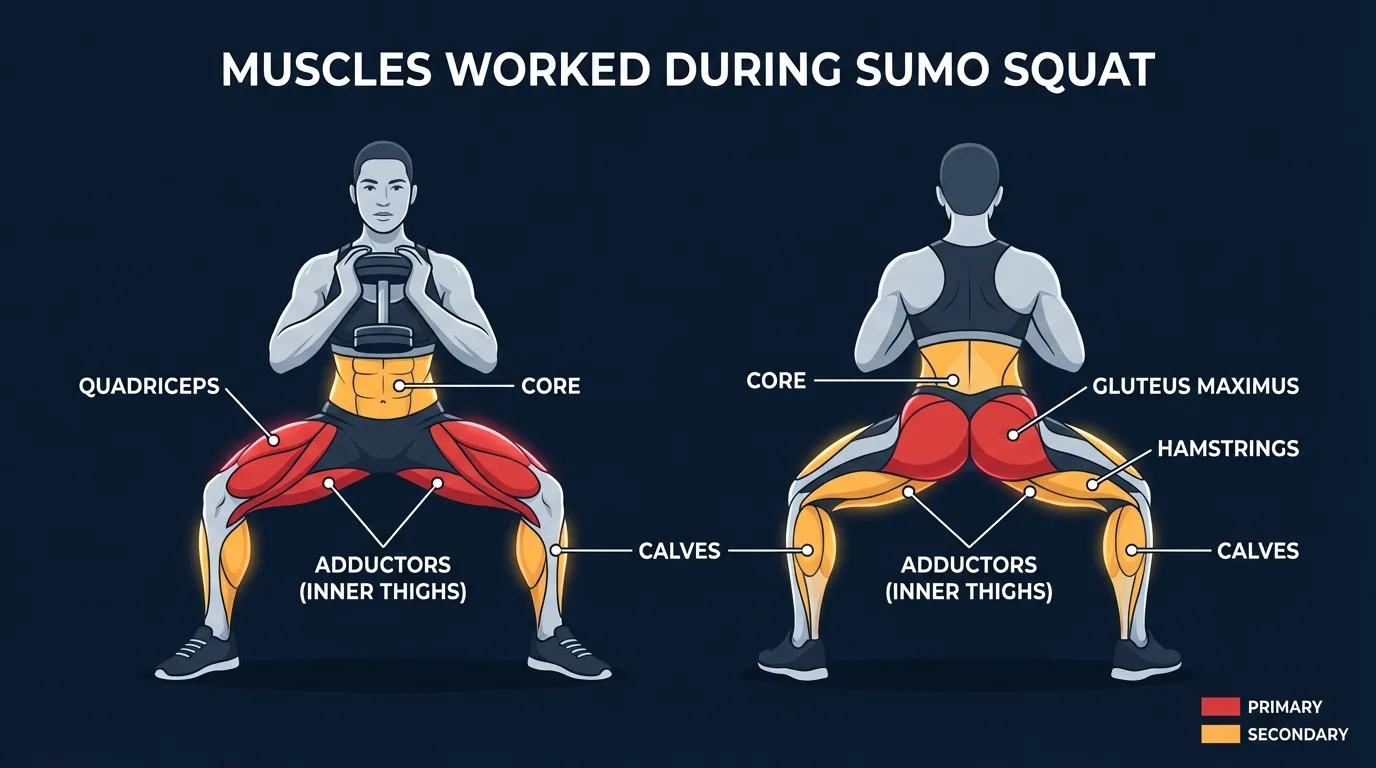
Muscles Worked
Primary movers: the quadriceps extend the knees as you stand, the gluteus maximus extends the hips, and the hip adductors help control the wide stance as they lengthen on the descent and contribute as you drive back up.
Secondary movers: the hamstrings assist hip extension, the calves help keep the foot and ankle stable, and the gluteus medius plus deep hip rotators help keep your knees tracking outward instead of collapsing inward.
Stabilizers: the rectus abdominis, transverse abdominis, obliques, erector spinae, and upper-back muscles work isometrically to keep your ribcage stacked over your pelvis. If you hold a dumbbell, your grip and forearms also work to keep the load centered.
Why the wide stance changes the feel: moving the feet wider increases hip abduction and external rotation demands. That shifts the bottom position toward the glutes and adductors while the quadriceps still handle knee extension. The best stance is the one that lets you hit depth with a tall chest, flat feet, and quiet knees.
Step-by-Step: How to Perform Sumo Squats
Use the same setup for bodyweight and dumbbell sumo squats. Add load only after the stance feels repeatable.
Step 1: Set Your Wide Stance
Stand with your feet about 1.5 to 2 times shoulder-width apart. Turn your toes out 30 to 45 degrees, then check that your knees can point in the same direction without strain.
Coach Ty's cue: "Find the stance your hips can actually control."
Step 2: Brace Before You Move
Take a breath into your midsection and brace as if you were about to carry something heavy. Keep your ribs stacked over your pelvis so your torso can stay tall.
Coach Ty's cue: "Tall chest, locked-in core."
Step 3: Lower Between Your Legs
Bend your knees and hips together, letting your hips travel down between your legs. Keep pressure through your heels and midfoot, and guide your knees outward over your toes.
Coach Ty's cue: "Drop straight down. Push the floor apart."
Step 4: Own the Bottom Position
Lower until your thighs are near parallel, or slightly below if your hips allow it. Stop higher if your heels lift, your knees cave, or you feel pinching in the hips or groin.
Coach Ty's cue: "Depth only counts if you can hold the shape."
Step 5: Stand Tall and Repeat
Exhale as you press through the floor and stand back up. Squeeze your glutes at the top without leaning back, then repeat with the same stance and tempo.
Coach Ty's cue: "Same rep every time."
Get this exercise in a personalized workout
FitCraft, our mobile fitness app, uses its AI coach Ty to program compound strength exercises like this into your plan at the right volume and intensity, based on your level, goals, and equipment. Ty was designed and trained by Domenic Angelino, MPH (Brown University) and NSCA-CSCS, with research published in the Journal of Strength and Conditioning Research and Medicine & Science in Sports & Exercise.
Take the Free Assessment Free · 2 minutes · No credit card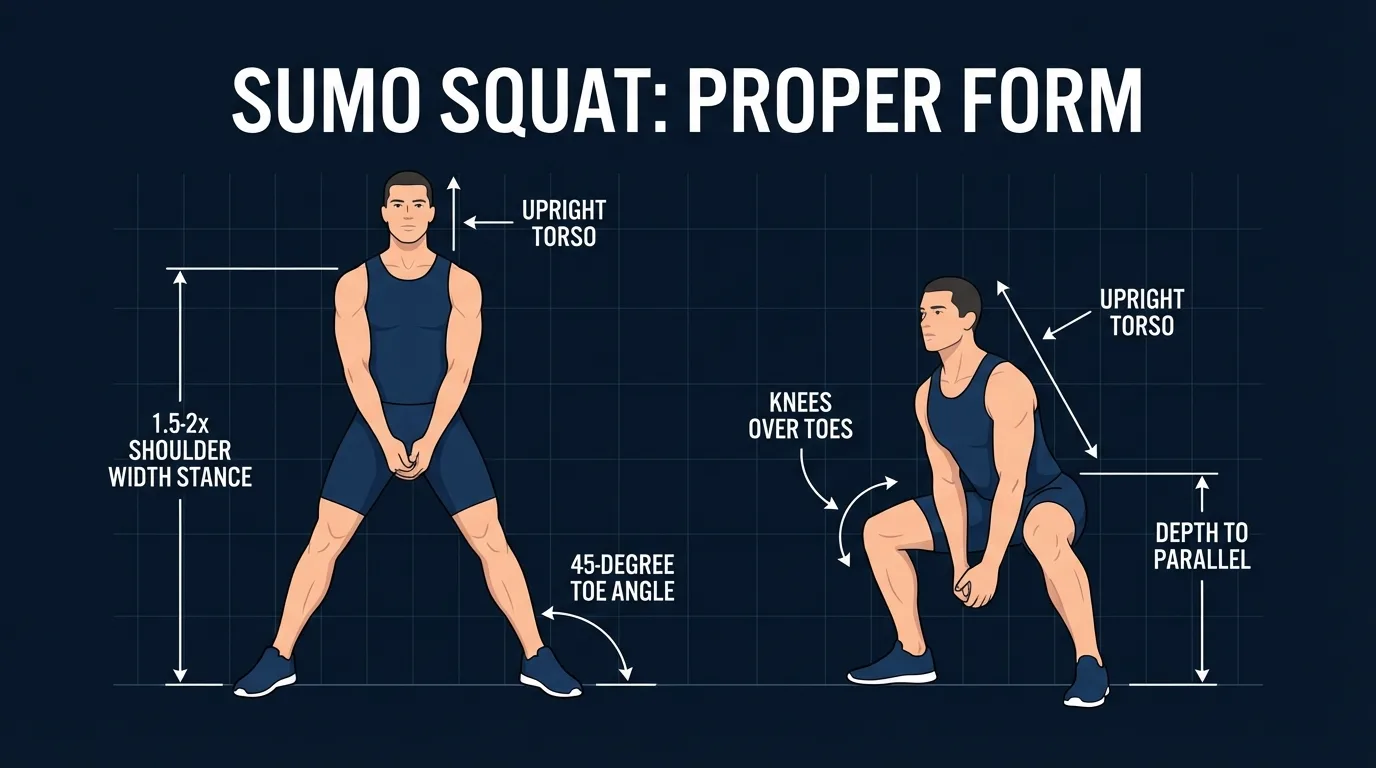
Common Mistakes (and How to Fix Them)
Most sumo squat problems come from forcing a stance that your hips, ankles, or knee control cannot support yet.
- Knees caving inward. This turns the wide stance into valgus stress at the knee. Fix it by narrowing your stance slightly, reducing depth, and actively driving your knees over your second and third toes.
- Going too wide. More width does not mean more muscle. If your heels lift, hips pinch, or knees drift, bring your feet in until the rep feels controlled.
- Folding forward. A sumo squat should keep your torso more upright than a standard squat. Brace before the descent, keep the dumbbell centered if you use one, and think about lowering your hips between your feet.
- Bouncing out of the bottom. The bounce hides whether you own the position. Lower under control, pause for a brief beat, then drive up with your glutes and quads.
- Letting the feet roll inward. Keep pressure through the heel, big-toe base, and little-toe base. If the arch collapses, the knee often follows.
- Adding weight too early. A dumbbell makes the movement more useful only if your stance is already clean. Earn load with stable bodyweight reps first.
Sumo Squat Variations: Regressions and Progressions
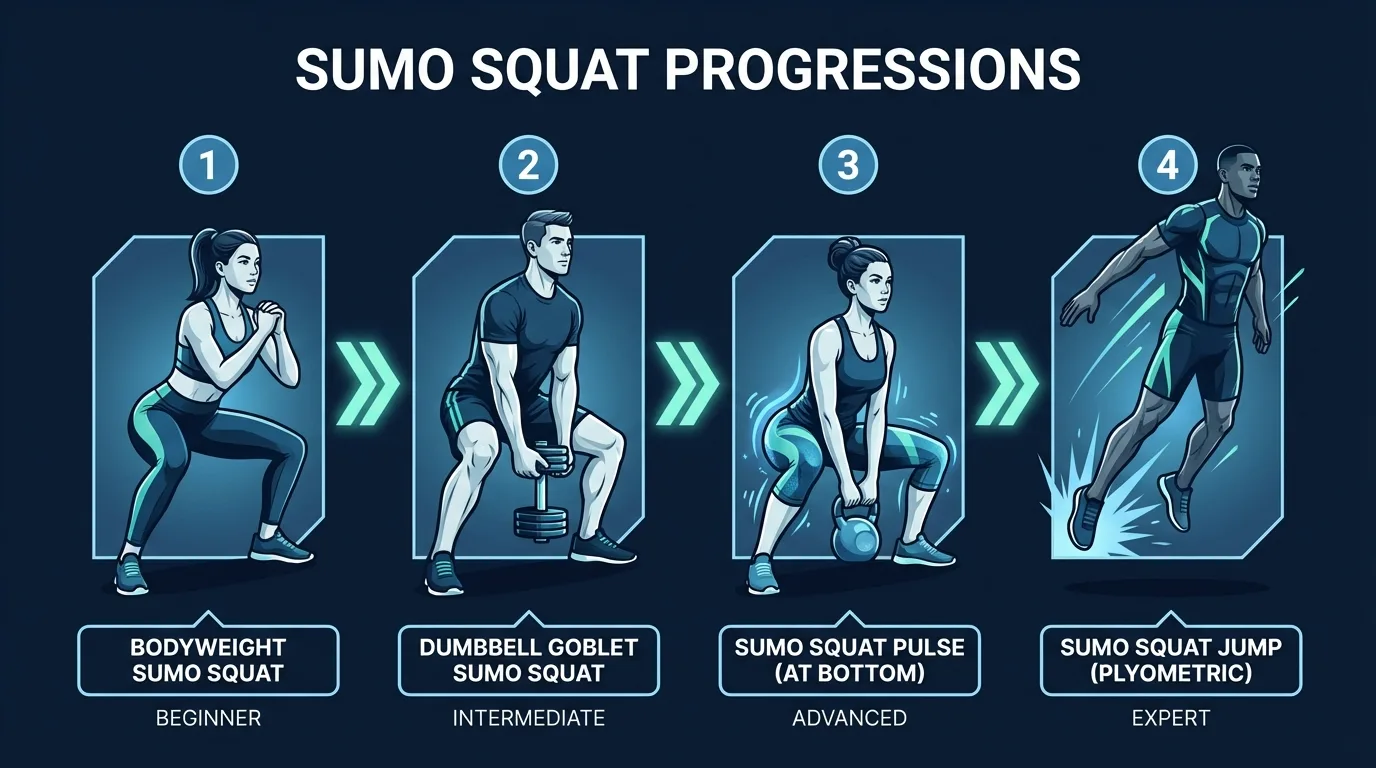
Progress the sumo squat by changing load, tempo, depth, and time under tension. Keep the knee path consistent at every level.
Bodyweight Sumo Squat (Beginner)
Start with hands on hips or clasped in front of your chest. Use a stance that lets you reach comfortable depth with flat feet and knees tracking out.
Dumbbell Goblet Sumo Squat (Intermediate)
Hold one dumbbell vertically at chest height or let it hang between your legs. The load should stay centered so your torso does not tip forward.
Pause Sumo Squat (Intermediate)
Pause for 1 to 2 seconds at the bottom of each rep. This builds control where the knees and hips are most likely to drift.
Sumo Squat Pulse (Advanced)
Hold the bottom position and pulse a few inches for 3 to 5 controlled reps before standing. Use this as a short finisher, not as your main strength work.
When to Avoid or Modify Sumo Squats
Sumo squats are safe for most healthy adults, but the wide stance and optional external load make a few modifications important. Always consult your physician or physical therapist for personalized guidance.
- Knee pain or ligament irritation. Use a narrower stance, reduce depth, and keep the knees tracking with the toes. If pain is sharp or follows an injury, stop and get assessed before loading the movement.
- Hip pinching, groin strain, or labral symptoms. Do not force the wide stance. Use standard squats, glute bridges, or a shorter range until hip motion feels smooth.
- Recent spine, knee, hip, or ankle surgery. Compound squat patterns can re-aggravate healing tissue. Get clearance from your surgeon or physical therapist and restart with assisted bodyweight work.
- Uncontrolled hypertension or known cardiovascular disease. Heavy bracing can spike blood pressure. Use lighter loads, avoid breath-holding, and follow your cardiologist's guidance.
- Pregnancy, early postpartum, or active diastasis recti. Use lighter loads and comfortable depth. Rebuild bracing with deadbugs, bird-dogs, and forearm planks before heavier dumbbell squats.
- Acute lower-back pain. Keep the movement bodyweight, reduce depth, and switch to glute bridges if bracing or upright posture is painful.
Related Exercises
Use these movements to build the same lower-body pattern or support the hip control that sumo squats need:
- Same squat pattern: Squats, Goblet Squats, and Bulgarian Split Squats train knee and hip extension with different stance demands.
- Glute support: Glute Bridges build hip extension strength without the wide-stance mobility demand.
- Lateral hip control: Side Lunges and Curtsy Lunges train frontal-plane control that carries over to knee tracking.
- Core foundation for bracing: Deadbugs, Bird-Dogs, and Forearm Planks help you keep the torso stacked under load.
- Posterior-chain partner: Romanian Deadlifts train the hip-hinge side of lower-body strength alongside squat variations.
How to Program Sumo Squats
Sumo squat programming follows the same evidence-based progression model used for other compound strength exercises. The American College of Sports Medicine Position Stand recommends progressing resistance training by matching load, reps, rest, and frequency to training status (Ratamess et al., 2009).
| Level | Sets × Reps | Rest between sets | Frequency |
|---|---|---|---|
| Beginner (bodyweight) | 2-3 × 8-12 | 90-120 seconds | 2-3 sessions/week |
| Intermediate (dumbbell) | 3-4 × 6-12 | 120-180 seconds | 2-4 sessions/week |
| Advanced (tempo, pause, heavier dumbbell) | 3-5 × 6-10 | 180-300 seconds | 3-4 sessions/week |
Where in your workout: place sumo squats first or second in a lower-body session, while your hips and knees can still track cleanly. Pair them with a hinge like Romanian deadlifts or a glute-focused movement like glute bridges.
Form floor over rep targets: stop the set when your knees cave, heels lift, torso folds, or hip pinching starts. Fewer clean reps beat more sloppy reps.
How FitCraft Programs This Exercise
Knowing how to do a sumo squat is useful. Knowing when to use it, how much volume to do, and when to add load is where most people get stuck.
FitCraft's AI coach Ty uses your personalized diagnostic, goals, and available equipment to place compound strength exercises inside a balanced plan. Sumo squat patterns can fit as a lower-body strength movement, a dumbbell home-workout option, or an accessory after a main squat variation.
As you get stronger, Ty adjusts the variation and volume to match your level. Bodyweight reps can become dumbbell reps, pauses, or slower tempo work. Every program is designed by an Ivy League-trained exercise scientist and NSCA-certified strength coach using evidence-based periodization, then adapted to you by the AI.
Frequently Asked Questions
What muscles do sumo squats work?
Sumo squats work the quadriceps, gluteus maximus, and hip adductors as the primary movers. The hamstrings, calves, deep hip rotators, core, and spinal stabilizers help control the wide stance and keep the torso upright.
What's the difference between a sumo squat and a regular squat?
A regular squat usually uses a shoulder-width stance with a small toe-out angle. A sumo squat uses a wider stance and more toe-out, which increases hip abduction and external rotation. That changes the feel of the exercise toward the glutes and inner thighs while still training the quads.
Are sumo squats good for glutes?
Yes. The wide stance asks the gluteus maximus to extend the hip while the gluteus medius and deep hip rotators help keep the knees tracking outward. You should feel glutes working hardest when you drive up from the bottom and finish tall.
How many sumo squats should I do?
Start with 2 to 3 sets of 8 to 12 controlled bodyweight reps. Intermediate lifters can use 3 to 4 sets of 6 to 12 with a dumbbell. Stop each set when your knees cave, heels lift, or torso folds forward.
Can I do sumo squats with knee pain?
Modify first. Shorten the range of motion, narrow the stance slightly, use bodyweight, and keep your knees tracking with your toes. If knee pain persists, feels sharp, or follows an injury, stop and get assessed by a qualified healthcare provider or physical therapist.