The iso ham raise is a beginner-to-intermediate posterior-chain exercise. You lie on your back with your heels on a bench, then drive your hips up into a straight-line bridge while squeezing your glutes and hamstrings hard at the top. Primary muscles are the hamstrings and gluteus maximus. Secondary work goes to the gluteus medius, spinal erectors, and deep core. The bench elevation increases the knee-flexion angle, which biases the hamstrings more than a floor glute bridge would. It needs nothing but a sturdy chair or bench, scales from regular floor bridges (beginner) up to single-leg or weighted variations (advanced), and works equally well as a posterior-chain warm-up or a finisher on leg day.
Most people who want to build their hamstrings jump straight to Romanian deadlifts or machine curls. Both are great. Both also need equipment, a hinge pattern, and some technique you might not have yet. The iso ham raise skips all of that. You lie down, put your heels on a bench, and drive your hips up. That's the whole thing.
Quick Facts: Iso Ham Raise
- Equipment needed: Bench, sturdy chair, or low box (12 to 18 inches high)
- Difficulty: Beginner to Intermediate
- Modality: Strength (isometric-dominant)
- Body region: Lower body, posterior chain
- FitCraft quest category: Strength
Muscles Worked
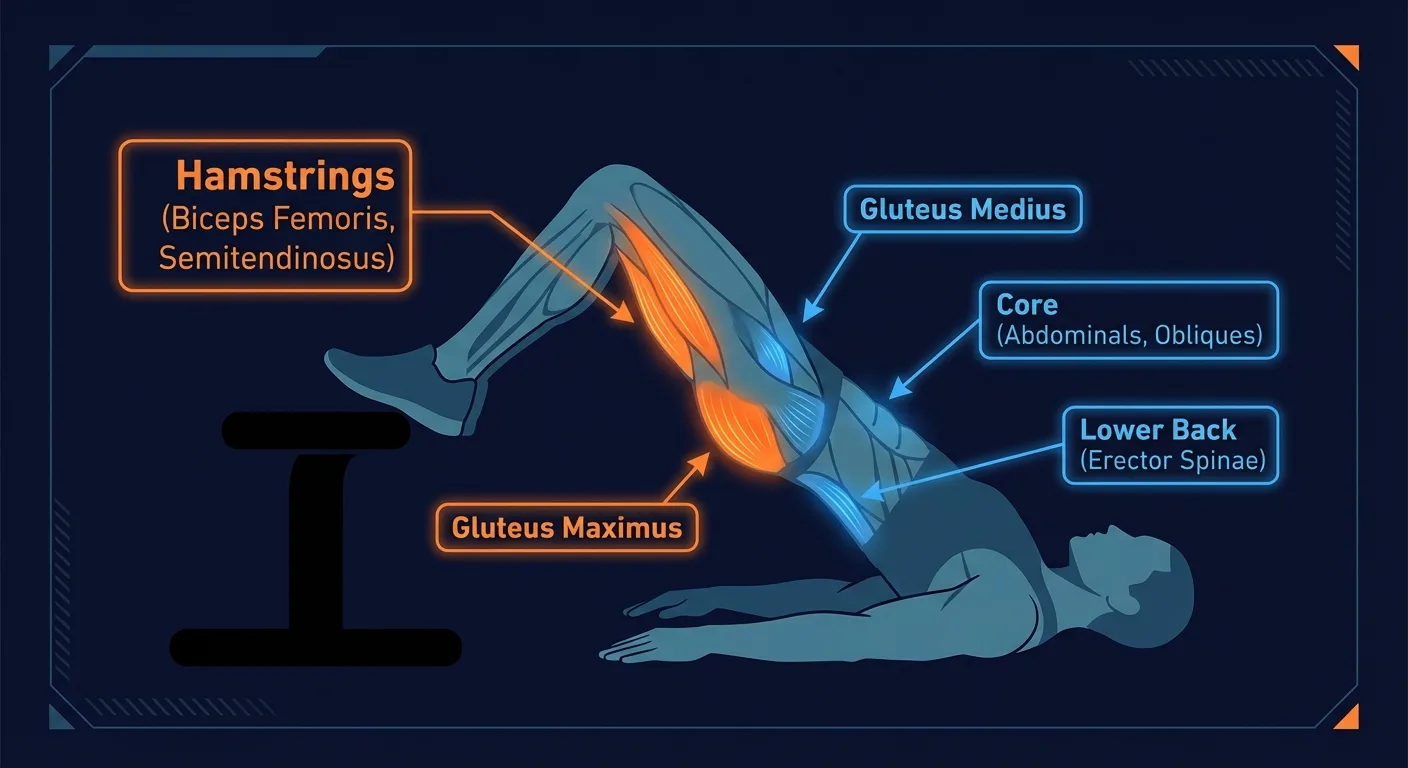
Primary movers. The hamstring complex (semitendinosus, semimembranosus, and biceps femoris) and the gluteus maximus drive the hips upward. The hamstrings work harder than they do in a standard floor glute bridge because the increased knee-flexion angle from the bench setup keeps them in a shortened, mechanically advantaged position throughout the lift. The glutes finish the rep at the top, where the squeeze locks in hip extension.
Secondary movers. The gluteus medius (on the side of each hip) keeps the pelvis level, especially in the single-leg variation. The adductor magnus contributes to hip extension and assists the glutes at the top of the bridge.
Stabilizers. The spinal erectors hold a neutral spine through the lift, resisting overextension at the top. The deep core canister (transverse abdominis, diaphragm, and pelvic floor) maintains intra-abdominal pressure and prevents the lower back from arching into a banana shape. The breath itself is a stabilizer: a slow exhale on the way up reinforces TVA activation, while inhaling on the descent loads the descent eccentrically.
Mechanism. Knee flexion plus hip extension is the textbook recipe for biasing the hamstrings. With the knees bent past 90 degrees, the hamstrings cross both joints simultaneously (extending the hip and flexing the knee), which is why bench-elevated bridges feel harder in the back of the thigh than floor bridges feel in the glutes. The isometric pause at the top recruits high-threshold motor units that fast concentric reps miss, which is the "iso" payoff in the exercise name.
Step-by-Step: How to Do an Iso Ham Raise
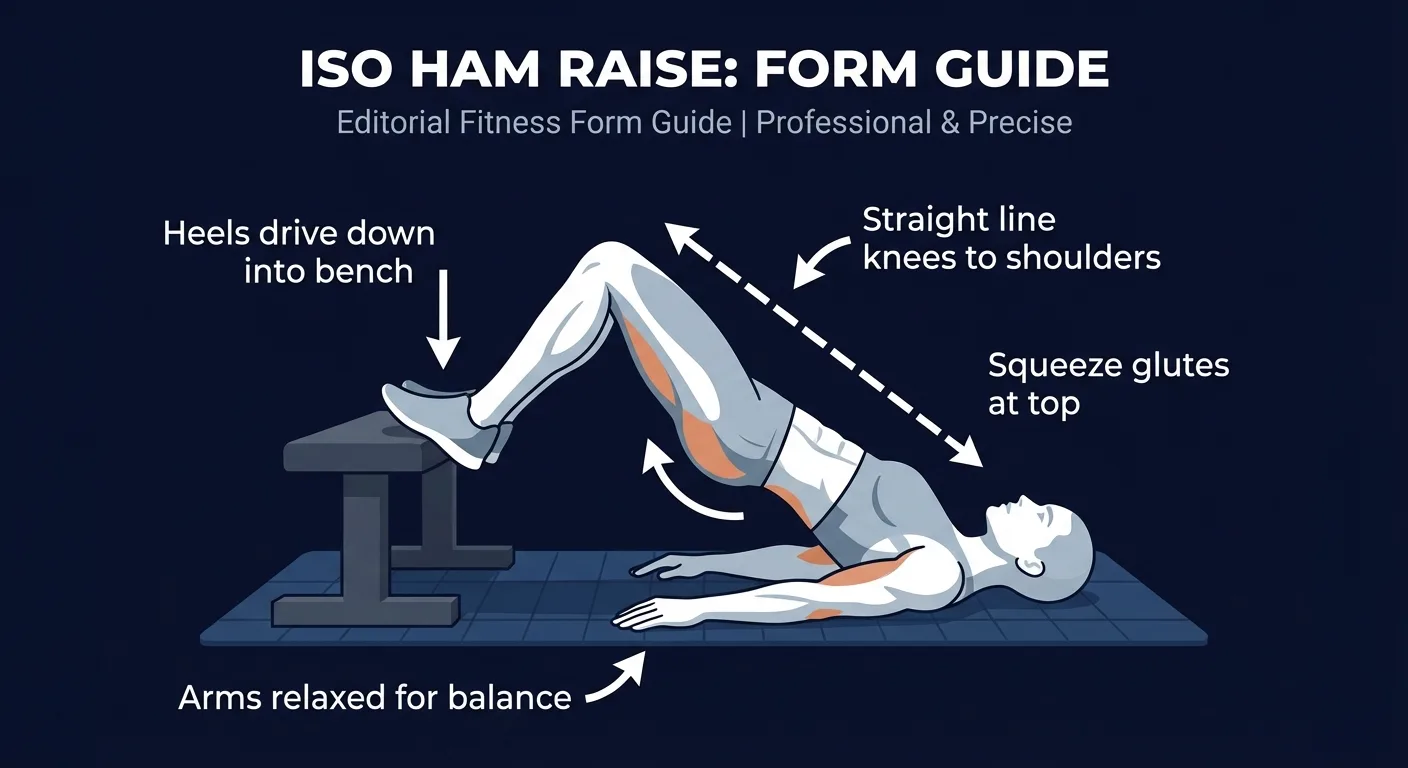
- Lie down on your back. Find a sturdy bench or chair about 12 to 18 inches high. Lie with your head on the floor and place both heels on top of the bench. Your knees should bend to about 90 degrees and your calves should roughly parallel the bench surface.
- Plant the heels. Drive your heels firmly into the bench. This is not optional. It creates the stable base your glutes and hamstrings will push off from. If the bench wobbles, move it. Coach Ty's cue: "Pretend you're trying to drag your heels back toward your butt without actually moving them. That's heel drive."
- Relax the arms. Keep your arms flat on the floor at your sides, palms down. They're there for balance, not lifting. Don't push through your hands.
- Brace the core. Take a short breath into your belly and lightly tense your abs. Keep your eyes on the ceiling so your neck stays neutral.
- Drive the hips up. Push through your heels and lift your hips toward the ceiling. Stop when your body forms a straight line from your knees down through your hips to your shoulders. Both hips should move together. Coach Ty's cue: "Both hip bones should rise like the two ends of a broomstick. If one side dips, drop to single-leg work."
- Squeeze and hold. At the top, squeeze your glutes like you're trying to crush a walnut between them. Hold for 1 to 2 seconds. This is where the iso in "iso ham raise" earns its name.
- Lower slowly. Take 2 to 3 seconds to return your hips to the floor. Resist gravity the whole way down. That eccentric portion is where a lot of the hamstring work actually happens. Inhale on the way down, exhale on the way up.
Common Mistakes (And How to Fix Them)
One Hip Drops Lower
What it looks like: At the top of the rep, one side of the pelvis sits lower than the other, so your bridge is uneven.
Why it's a problem: Shifts the load onto one side and reinforces an existing imbalance. Over time the weaker side stays weak.
The fix: Think about your hip bones as the two ends of a broomstick. They should rise together, stop together, and lower together. If one side keeps dropping, drop to single-leg iso ham raises to train each side independently.
Overextending the Lower Back
What it looks like: You push so high that your lower back arches dramatically and your ribs flare up.
Why it's a problem: The glutes and hamstrings stop doing the work. Your lower back takes over, and that's a fast route to soreness in all the wrong places.
The fix: Stop when your body forms a straight line from knees to shoulders, not a banana shape. Before you lift, exhale and tuck your ribs toward your pelvis. That locks the spine in neutral.
Pushing Through the Toes
What it looks like: Heels lift off the bench as you drive up, and you end up pressing through the balls of your feet.
Why it's a problem: Shifts the work away from the hamstrings and toward the quads and calves. You lose most of the point of this exercise.
The fix: Actively drive your heels down into the bench like you're trying to drag them back toward your butt. Lift your toes slightly off the bench surface if you have to. It makes the heel drive automatic.
Using Momentum
What it looks like: Rapid, bouncy reps where the hips barely pause at the top or bottom.
Why it's a problem: Momentum steals the tension. You get to call it a workout, but your hamstrings and glutes barely work.
The fix: Slow everything down. 2 seconds up, 1 to 2 second squeeze at the top, 2 to 3 seconds down. If you can do 20 reps this way without burning, you're still going too fast.
Get this exercise in a personalized workout
FitCraft, our mobile fitness app, uses its AI coach Ty to program core stability work like this into your plan at the right volume and intensity, based on your level, goals, and equipment. Ty was designed and trained by Domenic Angelino, MPH (Brown University) and NSCA-CSCS, with research published in the Journal of Strength and Conditioning Research and Medicine & Science in Sports & Exercise.
Take the Free Assessment Free • 2 minutes • No credit cardVariations
Easier (Regression)
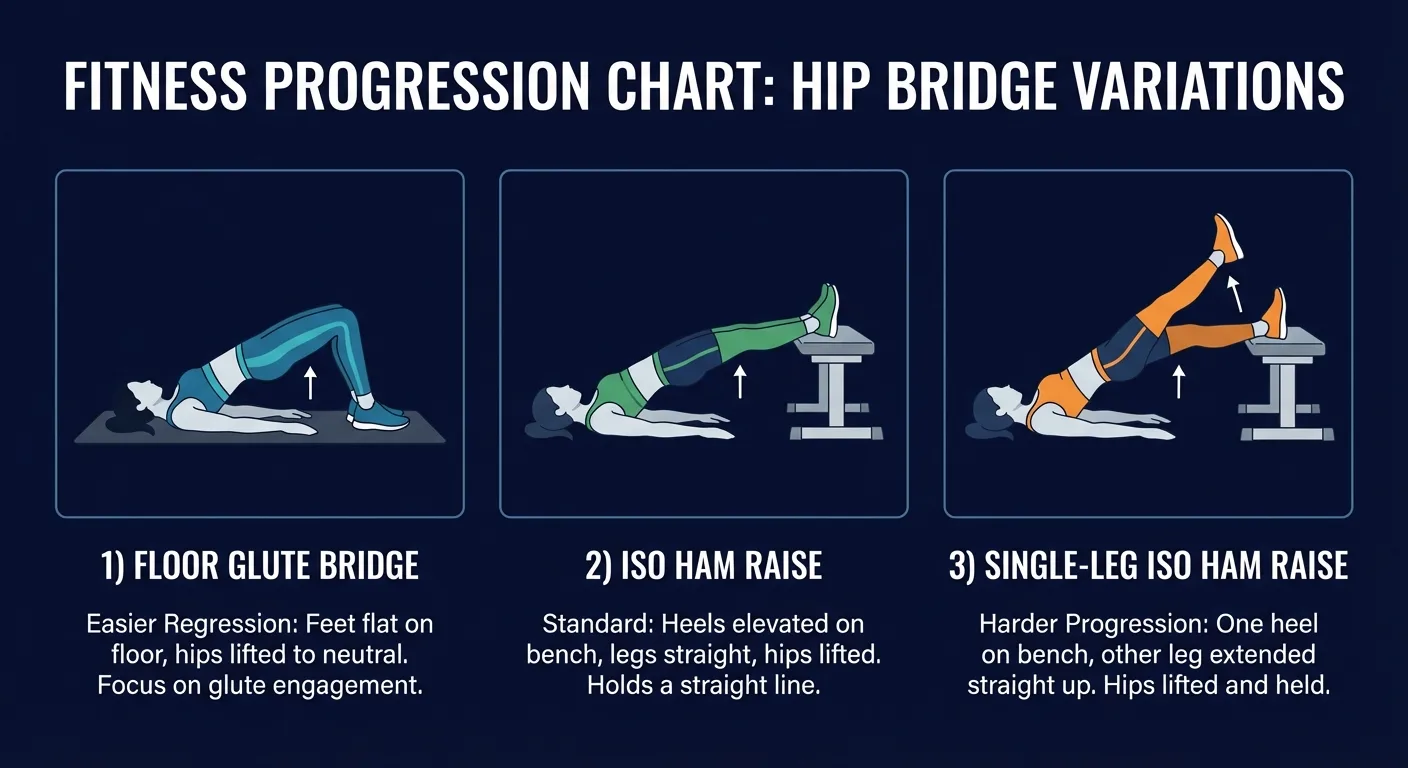
- Standard Glute Bridge. Feet flat on the floor instead of elevated on a bench. Easier on the hamstrings and a better place to start if you're brand new to hip extension work.
- Partial Glute Bridge. Lift only halfway. Builds confidence and lets you focus on the squeeze before adding full range.
Harder (Progression)
- Single-Leg Iso Ham Raise. Keep one heel on the bench, extend the other leg toward the ceiling, and drive up using only one side. Doubles the load on the working leg and exposes side-to-side imbalances.
- Weighted Iso Ham Raise. Place a dumbbell, plate, or loaded backpack across your hips. Hold it steady with your hands. Even 10 pounds makes a noticeable difference.
Alternative Exercises
- Romanian Deadlift. Trains the same muscles through a different pattern (hip hinge instead of supine bridge). Better for carrying strength into real-world movements like picking things up.
- Single-Leg Deadlift. Loads the hamstrings and glutes while also training balance. Progressive next step once iso ham raises feel too easy.
When to Avoid or Modify Iso Ham Raises
Iso ham raises are gentler on the spine than most posterior-chain exercises because the back stays supported by the floor through the bottom of the rep. Even so, a few conditions warrant modification. Always consult a qualified healthcare provider or physical therapist before starting or returning to any exercise program, especially if you have acute lower-back pain or known disc pathology, are within 6 to 8 weeks postpartum, have active diastasis recti, are recovering from abdominal or hip surgery, have a hamstring strain or recent hamstring tear, have a hernia, are pregnant, or have pelvic-floor dysfunction or pelvic-organ prolapse.
- Acute lower-back pain or known disc pathology. The risk in this exercise comes at the top of the lift, where overextending the lumbar spine instead of finishing with a glute squeeze can aggravate facet joints or a disc. Start with deadbugs and bird-dogs to restore deep-core control, then reintroduce hip bridge work at a partial range under PT guidance.
- Acute hamstring strain or recent tear. Loaded hamstring work can extend the injury. Wait for the acute phase to resolve, then reintroduce isometric work at short range before going through full range.
- Postpartum (first 6 to 8 weeks) or active diastasis recti. Loaded hip extension under brace can widen abdominal separation. Restore deep-core function first with diaphragmatic breathing, transverse abdominis activation, and bird-dogs/deadbugs, then layer the iso ham raise in.
- Recent hip or lower-back surgery. Wait for surgical clearance and follow your PT's protocol. Most post-surgical programs start with supine glute activation drills (clamshells, glute squeezes) before progressing to bridges.
- Pregnancy (second and third trimesters). Long durations supine can compress the vena cava and reduce blood flow. Keep sets short, use a slight wedge under one hip, or substitute side-lying clamshells and standing hip extension drills.
- Pelvic-organ prolapse or pelvic-floor dysfunction. The brace-and-bridge pattern increases intra-abdominal pressure. Work with a pelvic-floor PT before loading this pattern.
Related Exercises
- Same muscle group: Glute Bridges, Partial Glute Bridge, Donkey Kicks.
- Hip hinge progression: Romanian Deadlift, Single-Leg Deadlift.
- Posterior-chain foundation: Bird-Dogs, Deadbugs.
- Advanced single-leg variation: Single-Leg Iso Ham Raise.
- Compound that benefits from strong hamstrings: Squats, Rear Lunges.
How to Program Iso Ham Raises
Programming ranges below follow the ACSM Position Stand on Resistance Training (Ratamess et al., 2009). The iso ham raise splits cleanly into dynamic rep-based work for hamstring volume and pure isometric holds for tension and motor-unit recruitment.
| Level | Sets × Reps (or Hold) | Rest Between Sets | Frequency |
|---|---|---|---|
| Beginner | 2 to 3 × 10 to 12 (with 1 to 2 sec hold at top) | 45 to 60 seconds | 2 sessions per week |
| Intermediate | 3 × 12 to 15 (or 3 × 20 to 30 sec iso hold) | 60 seconds | 2 to 3 sessions per week |
| Advanced | 3 to 4 × 8 to 10 single-leg or weighted (or 3 to 4 × 30 to 60 sec iso hold) | 60 to 90 seconds | 3 sessions per week |
Where in your workout. Two natural spots. As a posterior-chain activation primer before heavy lower-body work (2 sets of 8 to 10 slow reps before squats or deadlifts wakes up the glutes and hamstrings without fatiguing them). Or as an accessory finisher after the main compound work, where the higher rep ranges drive hypertrophy without spinal load.
Form floor over rep targets. If you can't hold a straight line from knees to shoulders for a full one-to-two-second squeeze at the top, drop the rep target. Five clean reps with a real hold beat fifteen sloppy ones every time. The point of the "iso" is the time under tension, and momentum erases it.
FitCraft's AI coach Ty adjusts the iso ham raise variation, volume, and tempo to match your training history, equipment, and goals. The app includes 3D demonstrations so you can dial in the setup before your first rep.
Frequently Asked Questions
Can I do iso ham raises if I have lower-back pain?
Often yes, with caveats. The iso ham raise is gentler on the lumbar spine than a Romanian deadlift or a barbell hip thrust because the back stays supported by the floor through the bottom of the rep. The risk comes at the top, where overextending the lower back instead of finishing with a glute squeeze can aggravate facet joints or a disc. Stop at a straight line from knees to shoulders, not a banana arch. If you have acute lower-back pain or a known disc issue, start with bird-dogs and deadbugs to restore deep-core control, then reintroduce hip bridge work under PT guidance.
What muscles does the iso ham raise work?
The iso ham raise primarily targets the hamstrings (semitendinosus, semimembranosus, biceps femoris) and the gluteus maximus, working both through hip extension. Secondary muscles include the gluteus medius, which keeps the pelvis level, and the spinal erectors, which maintain a neutral spine through the lift. The deep core (transverse abdominis and diaphragm) stabilizes the trunk. Because the feet are elevated on a bench, the increased knee-flexion angle shifts more of the load onto the hamstrings than a floor glute bridge would.
Why elevate the feet on a bench?
Elevating the heels increases the knee-flexion angle at the start position. With the knees bent past 90 degrees, the hamstrings cross both the hip (extending it) and the knee (flexing it) at the same time, which pulls more of the work onto the hamstrings. A standard glute bridge with feet flat on the floor opens the knee angle and biases the gluteus maximus. The bench setup is the simplest way to bias hamstrings without specialized equipment.
Is the iso ham raise a good hamstring exercise for beginners?
Yes. It's one of the most accessible hamstring exercises because it needs no equipment beyond a bench or chair and puts minimal load on the spine. It also teaches hip extension under tension without the technical demand of a hip hinge, which makes it a safer starting point than a Romanian deadlift for people new to posterior chain work.
How many iso ham raises should I do?
Beginners should aim for 2 to 3 sets of 10 to 12 reps with a one-to-two-second squeeze at the top. Intermediate trainees can progress to 3 sets of 12 to 15 reps. Advanced trainees should add load (a dumbbell or plate across the hips) or move to the single-leg variation for 3 to 4 sets of 8 to 10 reps per side. Rest 60 to 90 seconds between sets. Train 2 to 3 times per week on lower-body or posterior-chain days.
Can the iso ham raise replace the Romanian deadlift?
Not entirely. The iso ham raise builds hamstring and glute strength through hip extension, but it doesn't train the hip hinge pattern the same way a Romanian deadlift does. The hinge is a foundational pattern for picking things up, sprinting, and most posterior-chain athletic movements. Use the iso ham raise as a warm-up, accessory, or beginner substitute. Once you can hinge safely with load, add the Romanian deadlift back in.