The donkey kick is one of those exercises that looks ridiculously easy and, honestly, kind of silly. You're on all fours kicking your foot at the ceiling. It doesn't look like much. But when done correctly, with a real squeeze at the top and your core actually braced, it's one of the best glute activation exercises you can do without any equipment.
Here's the catch though. Most people do donkey kicks wrong. They arch their back, swing their leg, and feel it everywhere except the glute. A 2012 study published in the Journal of Orthopaedic and Sports Physical Therapy found that quadruped hip extension exercises produce high gluteus maximus activation when performed with controlled form (Reiman et al., 2012). But that "controlled form" part is doing a lot of work in that sentence. Speed it up or arch your back, and the activation drops off fast.
This guide covers how to do donkey kicks properly, the mistakes that kill your glute activation, and how to pair them with fire hydrants for a complete glute warm-up.
Quick Facts: Donkey Kick
- Equipment needed: None (optional: mini resistance band for the advanced variation)
- Difficulty: Intermediate
- Modality: Strength (isolation, activation)
- Body region: Lower body (glutes)
- FitCraft quest category: Strength
Muscles Worked
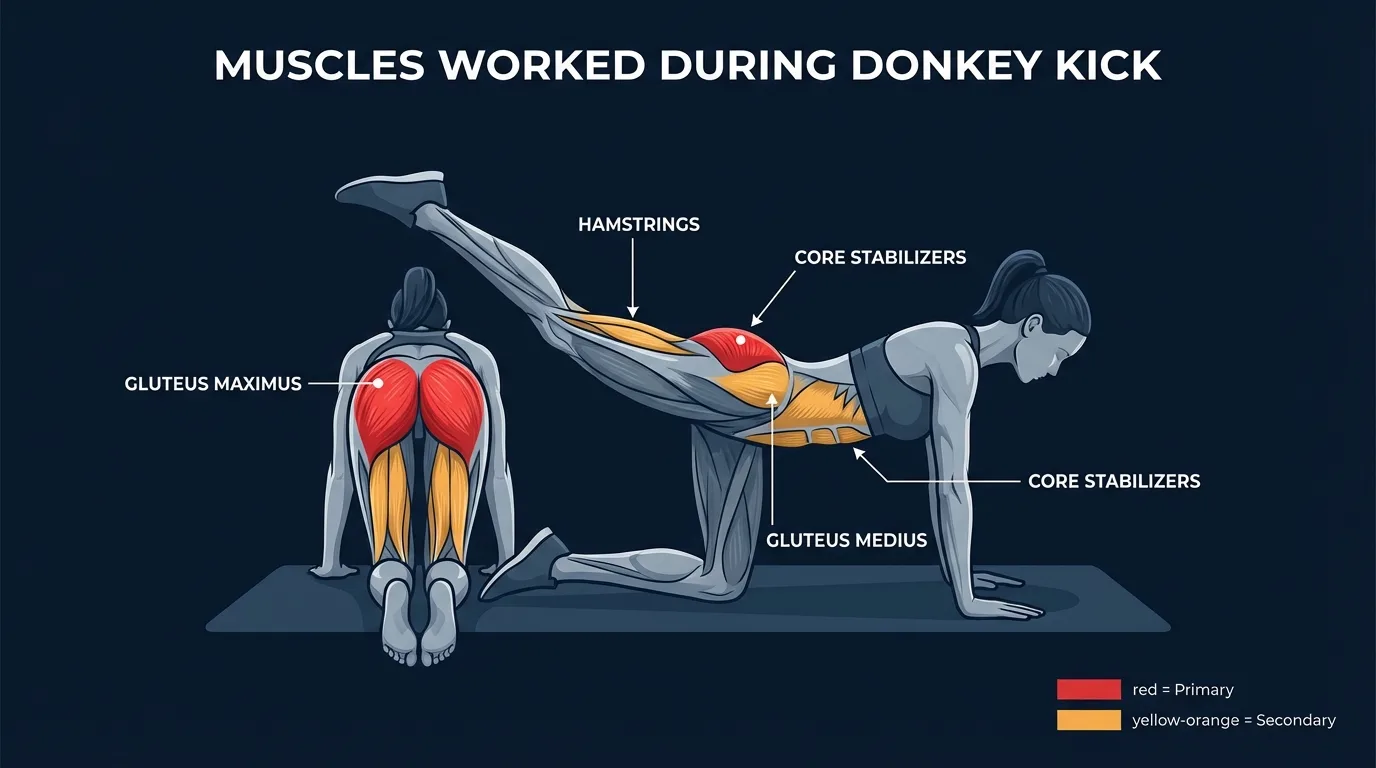
Primary movers: the gluteus maximus. This is the largest muscle in the glute complex, and it's the engine of hip extension. It shortens (concentric phase) as you drive your foot toward the ceiling and lengthens under tension (eccentric phase) as you lower the knee back down. Because the donkey kick isolates hip extension at a single joint, it produces a more direct contraction in the glute than compound lifts that share the work across multiple muscle groups.
Secondary movers: the hamstrings (biceps femoris, semitendinosus, semimembranosus) assist with hip extension, especially as the leg approaches the top of the rep. The long head of the biceps femoris is the most active hamstring during this pattern. If you feel the back of your thigh cramping more than your glute, you've gone too high or you're driving through the toes instead of the heel.
Stabilizers: the entire anterior core (rectus abdominis, transverse abdominis, obliques) works isometrically to hold the spine neutral and prevent the lumbar from arching as the working leg lifts. The opposite-side gluteus medius fires to prevent hip drop. The shoulders and serratus anterior stabilize the upper body in the quadruped position. The opposite-side hand and knee bear weight to keep the torso steady. A clean donkey kick is a whole-body bracing exercise that just happens to load one glute.
How form changes which muscle you bias: Reiman et al. (2012) reviewed EMG data on gluteal activation across common hip-extension exercises and found that quadruped patterns like the donkey kick produce high gluteus maximus activation when the lumbar spine is held neutral and the movement is driven by hip extension rather than spinal extension. The moment you let the lower back arch to gain extra range, the back extensors take over and glute activation drops. Heel-leading versus toe-leading also matters: pushing through the heel keeps the glute as the primary mover, while pointing the toes shifts work toward the hamstrings. Form is the programming lever here, not load.
How to Do Donkey Kicks (Step-by-Step)
- Get on all fours. Hands directly under your shoulders, knees directly under your hips. Spine neutral, not arched up, not sagging down. Look at a spot on the floor about a foot in front of your hands to keep your neck in line with your spine.
Coach Ty's cue: "Stack your wrists under your shoulders and your knees under your hips. Imagine a coffee table on your back, you don't want it to slide off."
- Brace your core. This is the step people skip, and it's the most important one. Tighten your abs like someone is about to poke your stomach. This prevents your lower back from arching when you lift, which is what causes people to feel it in their back instead of their glute.
Ty's cue: "Lock the rib cage down to the pelvis. Your torso shouldn't move at all when the leg moves."
- Drive one foot toward the ceiling. Keep your knee bent at 90 degrees the entire time. Push through your heel, not your toes. Lift until your thigh is roughly in line with your torso. That's it. No higher. If you go higher, your back arches and the glute stops doing the work.
Ty's key cue: "Ceiling, not sky. Press the heel up like you're stamping a footprint on a low ceiling right above you."
- Squeeze at the top. Hold for a full second. Actually squeeze. You should feel the contraction deep in the glute, not in your lower back. If you can't feel it in the glute, you've gone too high or your core has relaxed.
Ty's reminder: "The squeeze is the rep. Everything else is just getting to the squeeze."
- Lower slowly. Bring your knee back down under control. Stop just before it touches the floor, then drive back up. Don't let your knee slam down between reps. Complete all reps on one side before switching.
Ty's cue: "Two seconds up, one second hold, two seconds down. Rushing donkey kicks is like swinging a curl."
Get this exercise in a personalized workout
FitCraft, our mobile fitness app, uses its AI coach Ty to program isolation exercises like this into your plan at the right volume and intensity, based on your level, goals, and equipment. Ty was designed and trained by Domenic Angelino, MPH (Brown University) and NSCA-CSCS, with research published in the Journal of Strength and Conditioning Research and Medicine & Science in Sports & Exercise.
Take the Free Assessment Free · 2 minutes · No credit card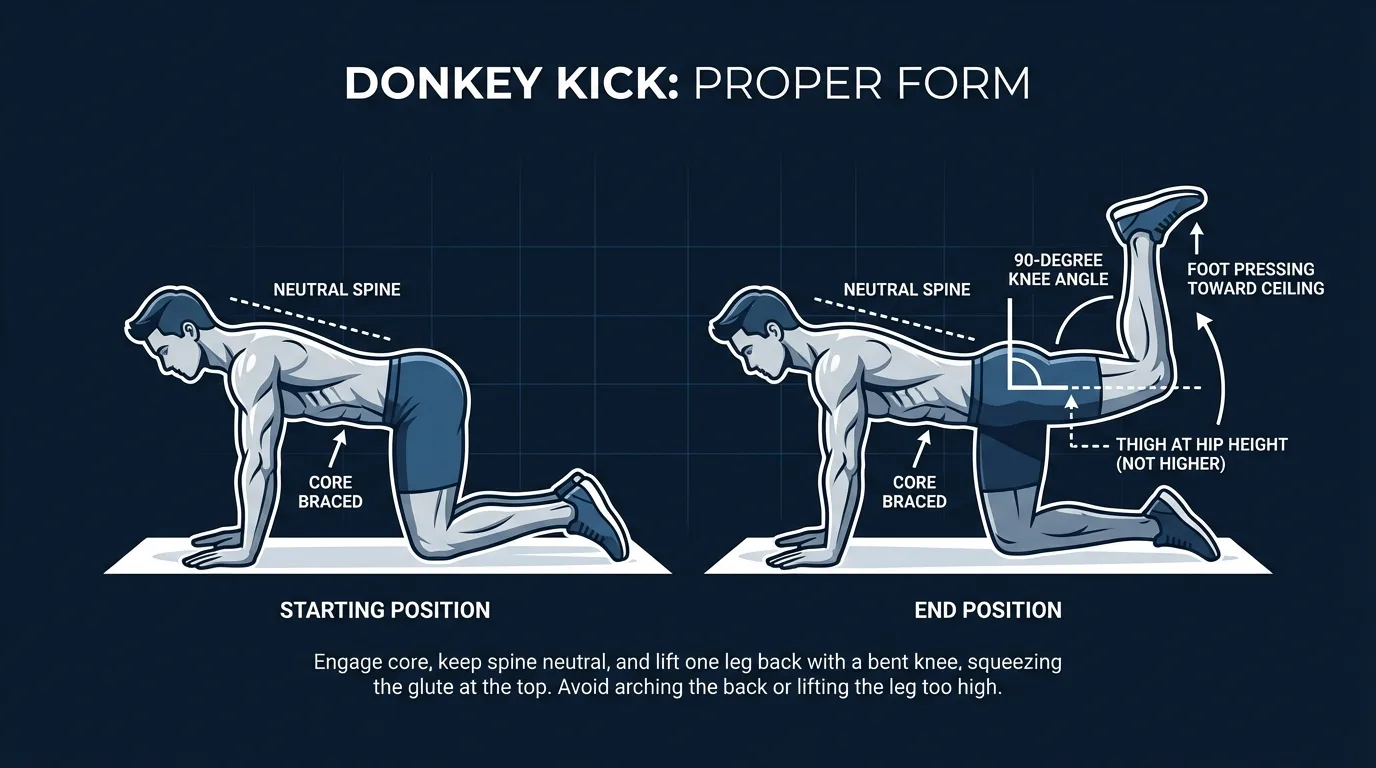
Common Mistakes (and How to Fix Them)
Donkey kicks look simple, but the form errors are sneaky. You won't always know you're making them unless someone tells you.
- Arching the lower back. This is mistake number one. When people try to kick higher, the lower back arches to create the illusion of more range. But the extra height comes from spinal extension, not hip extension. Your glute stopped working 3 inches ago. Fix: reduce the height and brace your abs harder.
- Swinging the leg. Using momentum instead of muscle. If you're swinging your leg up fast and letting it drop, you're getting maybe 20% of the benefit. Slow it down. If the exercise suddenly feels twice as hard, you were definitely swinging.
- Shifting your weight to one side. As you lift your right leg, your body naturally wants to shift left. This takes tension off the working glute. Press both hands firmly into the floor and keep your weight centered. Imagine balancing a cup of water on your lower back.
- Pointing the toes. Pointing your toes shifts the work toward your hamstring. Flex your foot and drive through the heel to keep the glute as the primary mover. If the back of your thigh starts cramping mid-set, that's the signal you're toe-dominant.
- Forgetting to breathe. Sounds basic, but people hold their breath during donkey kicks all the time. Exhale as you lift, inhale as you lower. Holding your breath increases intra-abdominal pressure unnecessarily for an exercise that doesn't need it.
- Skipping the squeeze. Most people lift the leg and immediately lower it. The squeeze at the top is where most of the glute activation happens. One full second at the top, hard contraction. If you skip it, you've turned the exercise into a leg lift.
Donkey Kick Variations: Regressions and Progressions
Start where you can hold form, and progress when you can hit the rep target with a full squeeze at the top.
Bench-Supported Donkey Kick (Beginner Regression)
Place your forearms on a bench or low surface instead of supporting yourself on your hands. This reduces wrist load and makes it easier to hold a neutral spine. Good starting point if you have wrist issues or if the standard quadruped position causes back discomfort. Same movement pattern, lower stability demand.
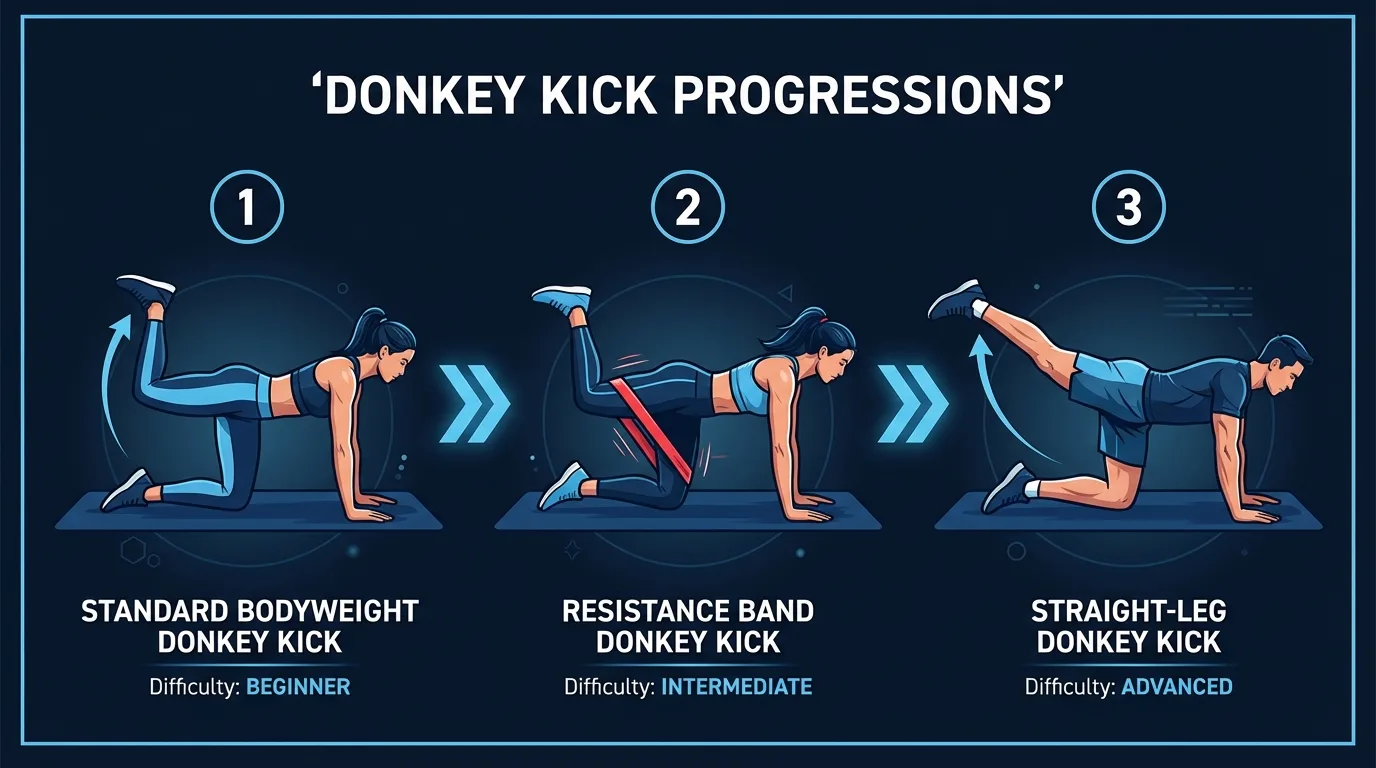
Standard Donkey Kick (Intermediate)
The version described above. Bodyweight, all fours, 90-degree knee bend. This is the version most people should stick with until they can do 3 sets of 20 with a full 1-second squeeze at the top and zero lower-back involvement.
Resistance Band Donkey Kick (Advanced)
Loop a mini band around both thighs just above the knees, or use a longer band anchored under your hands with the loop around the sole of your working foot. The band adds resistance at the top, where the glute is in its shortest position. This makes the squeeze significantly harder. Good progression once bodyweight gets too easy.
Straight-Leg Donkey Kick (Advanced)
Same setup, but extend your working leg straight instead of keeping the 90-degree bend. This lengthens the lever arm and makes the exercise harder. It also shifts slightly more work to the hamstring, so it's less of a pure glute isolation. Use it as a variation, not a replacement.
When to Avoid or Modify Donkey Kicks
Donkey kicks are safe for most healthy adults, but a few conditions call for modification or temporarily swapping in alternative glute work. None of these are permanent restrictions. They're starting points. Always consult your physician or physical therapist for personalized guidance.
- Lower-back pain that worsens with arching or quadruped positions. If you cannot brace your core hard enough to keep your spine neutral, donkey kicks will load the lumbar instead of the glute. Drop the range of motion to a tiny lift, focus exclusively on the squeeze, or substitute supine glute bridges until you can hold a neutral plank position. Rebuild bracing strength with deadbugs and bird-dogs first.
- Wrist pain or carpal tunnel. The quadruped position loads the wrists at roughly 90 degrees of extension. Modify by placing your forearms on a bench or by using push-up handles to keep the wrists neutral. Forearm-supported donkey kicks are a clean substitute when wrist load is the limiting factor.
- Knee pain or recent knee surgery. Kneeling on the floor compresses the patella. Use a folded mat, two stacked yoga mats, or a thick towel under the knees. If sharp pain persists, switch to standing kickbacks or glute bridges, which don't load the patella, until cleared by your PT.
- First 6 to 8 weeks postpartum or active diastasis recti. The quadruped position with leg lift demands real deep-core engagement. If the core can't hold a neutral spine, the lumbar will sag and intra-abdominal pressure can worsen abdominal separation. Start with deadbugs for diaphragmatic breathing and transverse abdominis activation, then progress to small-range bird-dogs, and only return to donkey kicks once you can hold a flat plank without doming or coning. Get clearance from a pelvic-floor PT first.
- Recent hip surgery or labral injury. Hip extension at end range can aggravate anterior hip impingement and labral tears. Stay within a pain-free range, keep the lift low, and follow your surgeon or PT's protocol for graded return to hip work.
- Acute SI joint pain. Unilateral hip extension can stress the sacroiliac joint. Reduce range, focus on symmetrical bracing, or substitute bilateral glute work like glute bridges until symptoms resolve.
Related Exercises
If donkey kicks are part of your routine, these movements complement or extend the same training pattern:
- Complementary glute pairing: Fire hydrants work hip abduction and target the gluteus medius, while donkey kicks work hip extension and target the gluteus maximus. Pairing them as a superset covers the full glute complex and is the gold-standard pre-leg-day warm-up.
- Same primary muscle, heavier loading: Glute bridges hit the same gluteus maximus pattern but allow for heavier loading and bilateral work. Use glute bridges for strength and donkey kicks for activation and the mind-muscle connection.
- Anti-rotation core foundation: Bird-dogs use a similar quadruped position with an anti-rotation core challenge added. Great prerequisite for donkey kicks if your core gives out before your glute does, and a useful progression once donkey kicks feel easy.
- Supine core-bracing foundation: Deadbugs train the same anterior core bracing pattern in a supine position. Use them to build the bracing strength that makes donkey kicks effective.
How to Program Donkey Kicks
Donkey kick programming follows the same evidence-based ranges as any isolation exercise. The American College of Sports Medicine (ACSM) Position Stand on resistance training recommends moderate-to-high rep ranges (10 to 20 reps) for accessory and isolation work, with shorter rest periods between sets (Ratamess et al., 2009). Because donkey kicks are bodyweight-only, volume and time-under-tension are the primary loading variables.
| Level | Sets × Reps | Rest between sets | Frequency |
|---|---|---|---|
| Beginner | 2 × 10-15 per leg | 30-45 seconds | 2-3 sessions/week |
| Intermediate | 3 × 15-20 per leg | 30-45 seconds | 2-4 sessions/week |
| Advanced (banded or straight-leg) | 3-4 × 12-15 per leg | 45-60 seconds | 2-4 sessions/week |
Where in your workout: donkey kicks slot in cleanly as either a warm-up or an accessory finisher. As warm-up, run 2 sets of 15 per leg before squats, deadlifts, or lunges, ideally paired with fire hydrants as a superset (no rest between exercises, 30 seconds between supersets). As accessory, do 3 sets of 15 to 20 per leg at the end of a lower-body session, after your compound lifts have done the heavy work. Avoid running donkey kicks first in a strength session; isolation fatigue before compound lifts leaves you weaker on the lifts that actually drive most of your progress.
Form floor over rep targets: if your last 2 reps of a set break form (lower back arching, leg swinging, torso shifting), stop the set there. Hitting a target rep count with broken form is worse than hitting fewer reps with a real squeeze at the top.
How FitCraft Programs This Exercise
Knowing how to do a donkey kick is step one. Knowing when to slot it into your week, whether to use it as activation or accessory, and when to add a band or progress to straight-leg is where most people get stuck.
FitCraft's AI coach Ty handles that. During your personalized diagnostic assessment, Ty maps your fitness level, goals, and available equipment. Then Ty builds a personalized program that uses donkey kicks where they fit best in your week, paired with the right complementary movements.
As you get stronger, Ty adjusts the variation and volume to match your level. Standard bodyweight progresses to banded. Volume scales based on your recovery and consistency. The 3D demonstrations show the exact height to kick (lower than you think) and the cueing system flags it when your back starts to arch.
Frequently Asked Questions
Why do I feel donkey kicks in my lower back instead of my glutes?
This almost always means you're arching your lower back to lift your leg higher. Your core isn't braced, so your back extensors take over. The fix: brace your abs hard, reduce the range of motion, and focus on squeezing the glute to initiate the movement. Your thigh only needs to reach hip height, not higher. If lower-back pain persists after these fixes, build foundational core stability with deadbugs and bird-dogs before returning to donkey kicks, and see a physical therapist if the pain continues.
Do donkey kicks actually build glutes?
Yes. Donkey kicks effectively activate the gluteus maximus when done with proper form and a deliberate squeeze at the top. They won't replace heavy compound movements like glute bridges or squats for muscle growth, but they're excellent for activation, isolation, and building the mind-muscle connection that makes your compound lifts more effective.
How many donkey kicks should I do?
For most people, 3 sets of 15 to 20 reps per leg. Donkey kicks are a low-load isolation exercise, so higher rep ranges work better than trying to do heavy sets of 5. Focus on the squeeze at the top rather than rushing through reps.
What's the difference between donkey kicks and fire hydrants?
Donkey kicks push your foot toward the ceiling (hip extension), targeting the gluteus maximus. Fire hydrants lift your knee out to the side (hip abduction), targeting the gluteus medius. They're complementary exercises that work different parts of the glute complex, which is why they're often paired together as a superset.
Can donkey kicks replace squats?
No. Donkey kicks are an isolation exercise for glutes, while squats are a compound movement that trains quads, glutes, hamstrings, and core simultaneously under load. Use donkey kicks as a warm-up or accessory alongside compound movements like squats, lunges, and glute bridges.