The Romanian deadlift looks like a simple bend-and-stand exercise, but the details matter. A clean RDL loads the hamstrings through a hip hinge. A sloppy one turns into a squat, a toe touch, or a lower-back stress test.
This guide focuses on the dumbbell version because it matches how most people train at home and how FitCraft programs hinge patterns. The barbell version is a gym alternative with the same hip-hinge idea, but dumbbells give most lifters a cleaner path while they learn.
The goal is controlled tension. You lower until your hamstrings say stop, keep your back neutral, and stand by squeezing the glutes rather than yanking from the spine.
Quick Facts: Romanian Deadlift
- Equipment needed: Dumbbells, or bodyweight for the hinge drill
- Difficulty: Beginner to Intermediate
- Modality: Strength
- Body region: Posterior chain
- FitCraft quest category: Strength
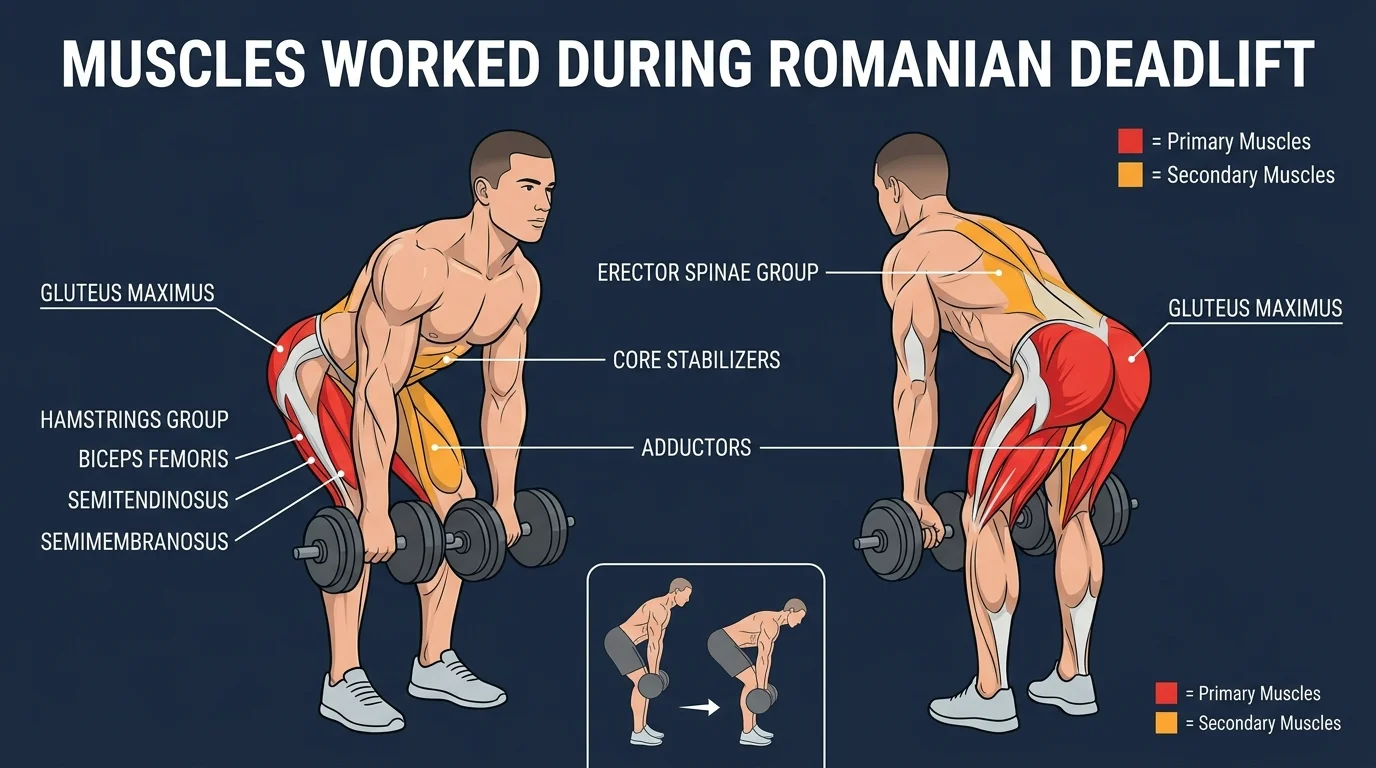
Muscles Worked
Primary movers: the hamstrings (biceps femoris, semitendinosus, and semimembranosus) and gluteus maximus. The hamstrings lengthen under tension as you hinge down and help extend the hip as you stand. The glutes finish the lockout by driving the hips forward.
Secondary movers: the adductor magnus assists hip extension, especially as the dumbbells pass the knees. The upper back and lats help keep the dumbbells close instead of letting them drift away from your center of mass.
Stabilizers: the erector spinae, rectus abdominis, transverse abdominis, obliques, forearms, and grip musculature work isometrically. Their job is to hold the hinge position, keep the ribs stacked, and stop the spine from flexing under load.
Evidence and mechanism: McAllister et al. (2014) measured muscle activation during hamstring exercises. The Romanian deadlift fits that hamstring-biased profile because the knee stays slightly bent while the hip moves through a long hinge, placing the hamstrings under tension without needing floor-level depth.
How to Do a Romanian Deadlift Step by Step
Step 1: Set Your Starting Position
Stand with your feet hip-width apart and hold the dumbbells in front of your thighs. Pull your shoulders down, keep your ribs stacked over your pelvis, and set a small bend in your knees.
Coach Ty's cue: "Soften your knees once, then freeze that angle for the whole rep."
Step 2: Hinge at the Hips
Push your hips straight back as if you were closing a drawer behind you. The dumbbells should slide down the front of your thighs rather than moving forward into space.
Coach Ty's cue: "Hips back first. The weights just follow your legs."
Step 3: Lower Until the Hamstrings Stop You
Keep hinging until you feel a strong stretch through the back of your thighs. For most lifters, that happens around the knees to mid-shin. Stop before your lower back rounds.
Coach Ty's cue: "Your depth is where your hamstrings stretch and your back still looks the same."
Step 4: Drive Your Hips Forward
Press through your feet, squeeze your glutes, and stand tall by bringing the hips forward. Keep the dumbbells close on the way up and finish upright without leaning back.
Coach Ty's cue: "Stand by squeezing your glutes, not by pulling with your lower back."
Step 5: Repeat with the Same Shape
Use a controlled 2- to 3-second lowering phase, breathe in as you hinge, and exhale as you stand. End the set when your knees start bending more, the dumbbells drift forward, or your back position changes.
Coach Ty's cue: "Every rep should have the same hinge, the same stretch, and the same finish."
Get this exercise in a personalized workout
FitCraft, our mobile fitness app, uses its AI coach Ty to program compound strength exercises like this into your plan at the right volume and intensity, based on your level, goals, and equipment. Ty was designed and trained by Domenic Angelino, MPH (Brown University) and NSCA-CSCS, with research published in the Journal of Strength and Conditioning Research and Medicine & Science in Sports & Exercise.
Take the Free Assessment Free · 2 minutes · No credit card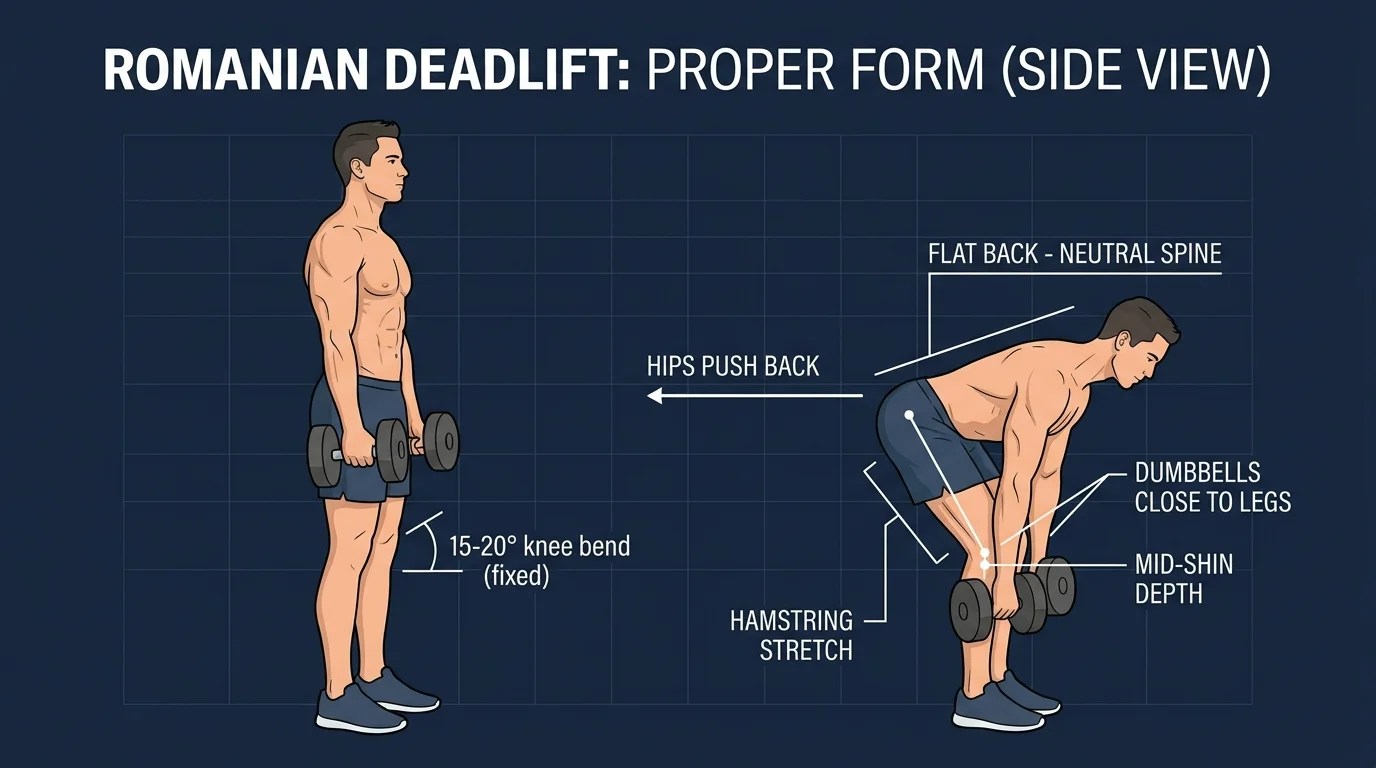
Common Mistakes and How to Fix Them
The RDL is unforgiving because small setup errors compound quickly under load. Fix these first.
- Rounding the lower back. This shifts stress away from the hamstrings and onto the lumbar spine. Fix it by stopping the descent the moment your back position changes.
- Turning the hinge into a squat. If your knees keep bending as you lower, the quads take over and the hamstring stretch disappears. Set a slight knee bend at the top and keep it nearly unchanged.
- Letting the dumbbells drift forward. Forward-drifting weights lengthen the lever arm and make the lower back work harder. Keep the dumbbells close enough to brush your thighs and shins.
- Chasing floor depth. The dumbbells do not need to touch the floor. Your range ends where the hamstrings stretch and your spine remains neutral.
- Hyperextending at the top. Leaning back after each rep compresses the lower back. Stand tall, squeeze the glutes, and stop when your hips are fully extended.
- Rushing the lowering phase. Dropping into the bottom position hides hinge mistakes. Slow the descent and make the hamstrings control the rep.
Romanian Deadlift Variations: Regressions and Progressions
Start with the version that lets you feel the hamstrings while keeping the spine neutral.
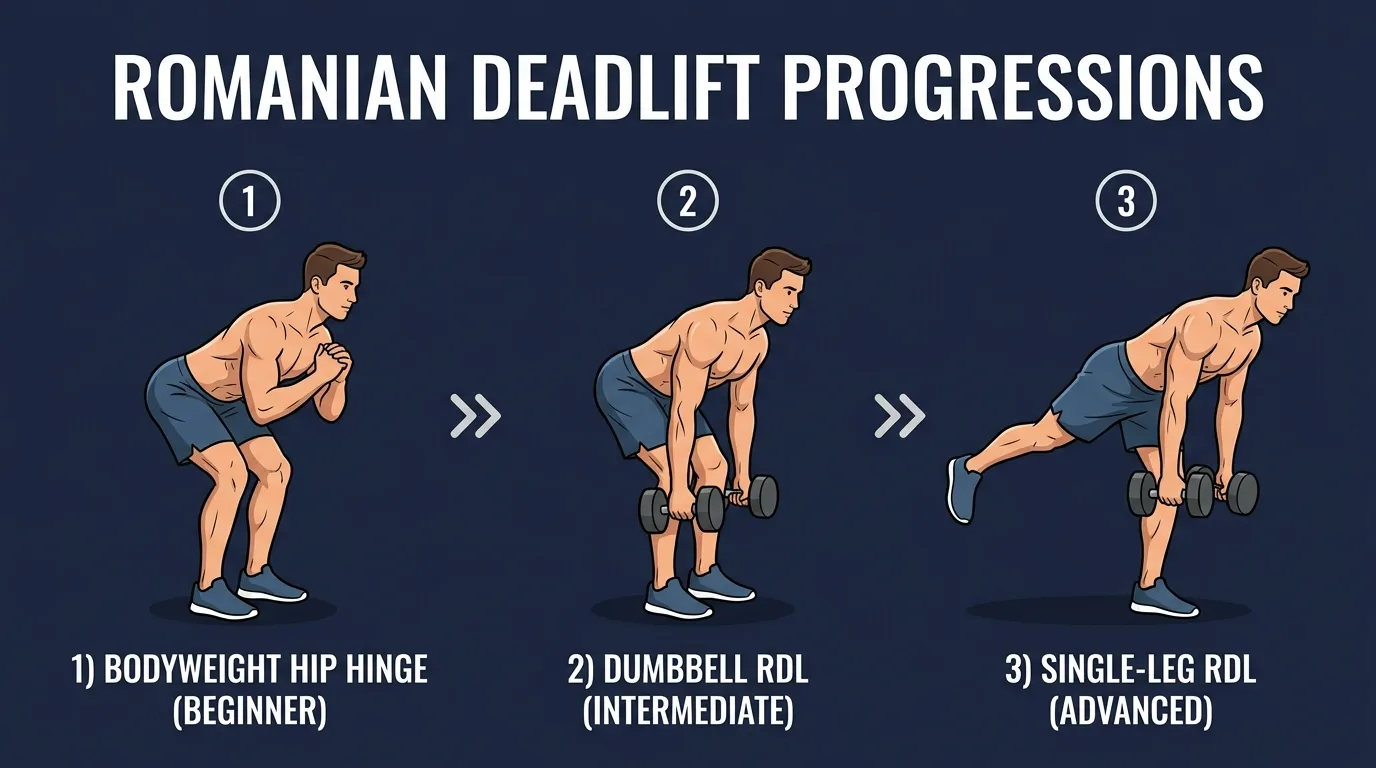
Bodyweight Hip Hinge
Stand a few inches in front of a wall and push your hips back until your glutes tap it. This teaches the back-and-forth hip path before you add load.
Light Dumbbell Romanian Deadlift
This is the standard version for most beginners and intermediate lifters. Start with light dumbbells and use a slow lowering phase until the hinge pattern feels automatic.
Single-Leg Romanian Deadlift
The single-leg version adds balance and hip-stability demand. Start with bodyweight, then hold one dumbbell in the opposite hand from the standing leg.
Good Mornings
Good mornings use the same hip-hinge pattern with the load placed higher on the body. Use a light dumbbell version if you want a hinge variation that emphasizes torso control.
When to Avoid or Modify Romanian Deadlifts
Romanian deadlifts are safe for most healthy adults when the load and range match the lifter, but a few situations call for modification. Always consult your physician or physical therapist for personalized guidance.
- Acute lower-back pain or known disc pathology. Loaded hinges place demand on the lumbar spine. Replace them with bodyweight hinge drills, glute bridges, deadbugs, or bird-dogs until you can brace without symptoms.
- Recent spine, hip, knee, or shoulder surgery. Get clearance before loading the pattern. Start with range-limited bodyweight hinges and follow your rehab timeline.
- Severe hamstring strain or high hamstring tendon pain. The RDL lengthens the hamstrings under load. Use shorter range, lighter load, or rehab-specific isometrics until stretching pain settles.
- Uncontrolled hypertension or known cardiovascular disease. Heavy bracing can spike blood pressure. Use lighter dumbbells, breathe steadily, avoid max-effort sets, and follow your clinician's exercise guidance.
- Pregnancy or early postpartum return. Loaded hinges can challenge balance, bracing, and intra-abdominal pressure. Use lighter loads, shorten the range, and rebuild deep-core control with deadbugs and forearm planks.
Related Exercises
These exercises build the same hinge pattern, posterior-chain strength, or bracing foundation:
- Same movement pattern: Single-Leg Deadlift adds unilateral hip stability, while Good Mornings train the same hinge with a different load position.
- Glute and hamstring accessory: Glute Bridges train hip extension with minimal spinal loading.
- Squat pattern complement: Squats and Sumo Squats balance the hinge with more knee-dominant lower-body work.
- Core foundation for spinal bracing: Deadbugs, Bird-Dogs, and Forearm Planks build the trunk control a loaded hinge needs.
- Upper-back hinge companion: Bent-Over Rows use a similar hinged torso position with an added pulling pattern.
How to Program Romanian Deadlifts
Romanian deadlift programming should respect hinge skill, grip strength, and recovery. The American College of Sports Medicine resistance-training position stand gives evidence-based loading ranges for beginner through advanced lifters (Ratamess et al., 2009).
| Level | Sets × Reps | Rest between sets | Frequency |
|---|---|---|---|
| Beginner | 2-3 × 8-12 | 90-120 seconds | 2-3 sessions/week |
| Intermediate | 3-4 × 6-12 | 120-180 seconds | 2-4 sessions/week |
| Advanced | 3-5 × 6-10 | 180-300 seconds | 3-5 sessions/week |
Where in your workout: Place Romanian deadlifts first or second in a lower-body session, before your grip and trunk are fatigued. They pair well with squats, split squats, glute bridges, and core bracing work.
Form floor over rep targets: stop the set when your spine rounds, your knees start squatting the weight down, or the dumbbells drift forward. Clean reps matter more than reaching a planned number.
How FitCraft Programs This Exercise
FitCraft uses a personalized diagnostic to match hinge work to your level, goals, and equipment. Ty can place dumbbell Romanian deadlifts, lighter hinge drills, or related posterior-chain work into a balanced strength program.
As your movement quality and consistency improve, Ty adjusts the variation and volume to match your level. The goal is steady progress without forcing a load or range your hinge cannot control yet.
Frequently Asked Questions
What muscles does the Romanian deadlift work?
The Romanian deadlift primarily trains the hamstrings and gluteus maximus. The erector spinae, deep core, adductors, lats, upper back, and forearm grip muscles help stabilize the dumbbells and hold a neutral spine.
What is the difference between a Romanian deadlift and a regular deadlift?
A regular deadlift starts from the floor with more knee bend. A Romanian deadlift starts from standing, keeps only a small knee bend, and uses a hip hinge to emphasize the hamstrings and glutes. The dumbbells usually do not touch the floor between reps.
How heavy should a Romanian deadlift be?
Start light enough that your spine stays neutral and the hamstrings clearly limit your range of motion. Most beginners should start with bodyweight hinge drills or light dumbbells before adding load.
Can I do Romanian deadlifts with lower-back pain?
Avoid loaded Romanian deadlifts during acute lower-back pain or known disc irritation unless a qualified clinician has cleared you. Use bodyweight hinge drills, glute bridges, deadbugs, or bird-dogs while you rebuild pain-free bracing and hip-hinge control.
Can I do Romanian deadlifts with dumbbells instead of a barbell?
Yes. Dumbbells are the default version for this guide because they suit home training, allow a natural arm path, and make it easier to keep the load close to the legs. A barbell follows the same hinge pattern if you have gym access.