The good morning has been around for decades, and it has earned a reputation as both one of the most effective and most misunderstood movements in strength training. Done right, it builds bulletproof hamstrings, strong glutes, and a lower back that can handle whatever life throws at it. Done wrong, it is a fast track to a disc injury.
That is not meant to scare you off. It is meant to make you pay attention to the form section below. The good morning is categorized as advanced not because the movement is complicated. A hip hinge is one of the most fundamental human movement patterns. It is advanced because it places the load on your shoulders, which creates a long lever arm and significant demand on your spinal erectors. The spinal loading means your form has to be non-negotiable.
The dumbbell version is a smart entry point. You cannot load dumbbells as heavy as a barbell, which naturally limits the spinal compression while still training the hinge pattern under resistance. If you are new to good mornings, this is where you start.
Quick Facts: Good Mornings
- Equipment needed: Dumbbells (bodyweight version requires nothing; learn the pattern unloaded first)
- Difficulty: Intermediate to advanced (bodyweight version is beginner-accessible)
- Modality: Compound, bilateral, hip-hinge pattern
- Body region: Posterior chain (hamstrings, glutes, lower back)
- FitCraft quest category: Strength
Muscles Worked
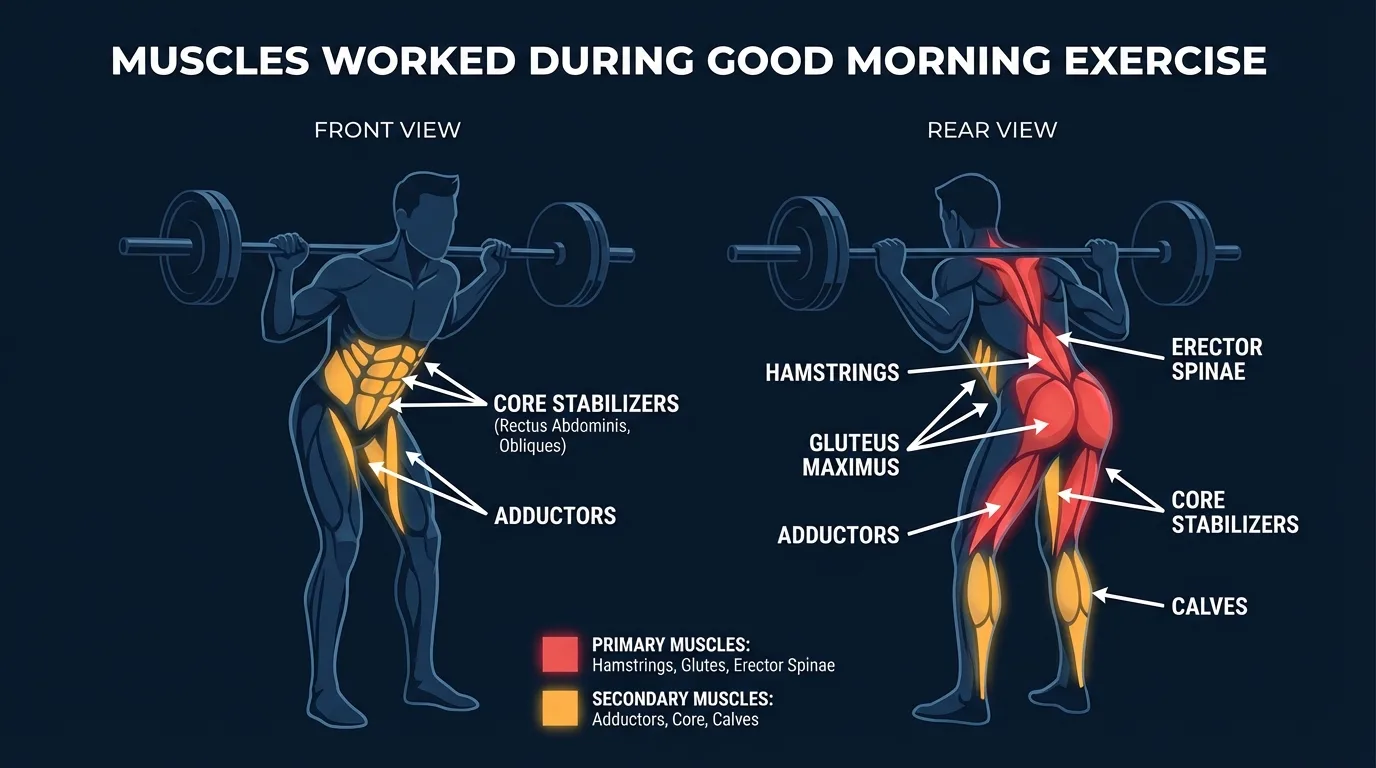
Primary movers. The hamstrings (biceps femoris, semitendinosus, semimembranosus) and the gluteus maximus drive the movement. They work eccentrically to control the descent as you hinge forward and concentrically to extend the hips and stand back up. The erector spinae group (spinalis, longissimus, iliocostalis) also acts as a primary mover in the sense that they work isometrically under heavy load to hold a neutral spine against the forward-tilted torso. This is why the exercise is so demanding on the lower back even though the lower back is not "moving."
Secondary movers. The adductor magnus contributes to hip extension, especially in the deeper portion of the hinge. The hamstrings also cross the knee, so they receive some load from the slight knee bend, though the fixed knee angle keeps this contribution small compared to a squat.
Stabilizers. The deep core (transverse abdominis, internal obliques, diaphragm) braces against intra-abdominal pressure to protect the lumbar spine. The multifidus and quadratus lumborum fire isometrically to keep individual spinal segments stacked. The calves and tibialis anterior balance the body over the mid-foot to heel as the hips travel backward. Grip and forearm musculature work to hold the dumbbells in place on the shoulders.
Mechanism. The load sits on the shoulders, which creates a long moment arm between the load and the hip joint (the axis of rotation in a hinge). That long lever is why even moderate dumbbells feel heavy: the further the load is from the hip, the more torque the hip extensors and spinal erectors must produce to control the movement. Compared to the Romanian deadlift, where the load hangs in front of the body, the good morning shifts more of the demand onto the erector spinae. That is the trade-off: less absolute load tolerance, but a stronger spinal-erector training stimulus.
How to Do the Good Morning (Step-by-Step)
- Stand tall with dumbbells on your shoulders. Stand with your feet hip-width apart, toes pointing forward or turned out very slightly. Hold a dumbbell on each shoulder, one head behind the shoulder and one in front, with your hands holding them in place. Brace your core like someone is about to push you. Keep a slight bend in your knees, around 15-20 degrees. This bend stays the same throughout the entire movement.
Coach Ty's cue: "Soft knees, not bending knees. Freeze that angle and don't let it change." - Hinge at the hips. Push your hips straight back, like you are trying to touch the wall behind you with your butt. Your torso tilts forward as your hips travel back. Keep your spine completely neutral. No rounding at the lower back, no overarching either. Your chest stays proud and your gaze stays a few feet ahead of you on the floor. Keep your weight centered over your mid-foot to heels. Never let it shift to your toes.
Coach Ty's cue: "Hips back, not chest forward. This is a hip exercise, not a back exercise." - Hinge until you feel the stretch. Lower until you feel a clear stretch in your hamstrings or until your torso reaches roughly parallel to the floor. Whichever comes first is your endpoint. If your lower back starts to round before you reach parallel, stop right there. Your hamstring flexibility is the limiting factor, and going past it compromises your spine. Most people reach about 45-70 degrees of torso lean.
- Drive back up with your glutes. Reverse the movement by squeezing your glutes hard and driving your hips forward. The power comes from your glutes and hamstrings, not your lower back. Do not think about pulling your torso up. Think about pushing your hips through. Return to the tall standing position and squeeze your glutes at the top without thrusting forward past neutral.
Coach Ty's cue: "Stand tall and squeeze. Don't thrust at the top. Hyperextending under load compresses the lumbar discs from the other direction." - Breathe and repeat. Inhale as you hinge forward. Exhale as you drive back up. Keep your core braced the entire time. The slight knee bend should not change. If your knees straighten or bend more during the hinge, you are losing the pattern. Always do at least one warm-up set with bodyweight or very light dumbbells before loading up.
Common Mistakes to Avoid
The good morning has the smallest margin for error of the exercises in this guide. These mistakes are common and some of them are legitimately dangerous under load.
- Rounding the lower back. This is the most dangerous mistake and the one that gives good mornings their bad reputation. When your lower back rounds under a loaded hinge, the shear forces on your lumbar discs spike. Your spine should stay in its natural position from start to finish. If it rounds, stop, reduce the weight, and work on hamstring flexibility separately before adding depth. Ty flags any rep where your spinal position breaks.
- Going too deep. Your hamstring flexibility determines your safe range. Going past that point forces your spine to compensate by flexing. And there is zero benefit to hinging deeper than your hamstrings allow. Touch the stretch and come back up. Depth will increase naturally as your flexibility improves over weeks and months.
- Using too much weight too soon. The load sits on your shoulders, creating a long lever arm above your hips. Even moderate dumbbell weight feels heavy in this position. Start with bodyweight. Then light dumbbells. Build up over weeks, not days. Your ego will survive. Your discs might not if you rush it.
- Straightening the knees. When your knees lock out during the hinge, the hamstrings go on slack at their knee attachment and the load transfers entirely to the lower back. Keep that soft knee bend. It allows the hamstrings to work as hip extensors throughout the full range.
- Leading with the chest rather than the hips. If you think about bowing forward, your brain defaults to spinal flexion. Think about pushing your hips back instead. The chest goes forward because the hips go back. It is a subtle mental shift, but it changes everything about the movement pattern.
Get this exercise in a personalized workout
FitCraft, our mobile fitness app, uses its AI coach Ty to program compound strength exercises like this into your plan at the right volume and intensity, based on your level, goals, and equipment. Ty was designed and trained by Domenic Angelino, MPH (Brown University) and NSCA-CSCS, with research published in the Journal of Strength and Conditioning Research and Medicine & Science in Sports & Exercise.
Take the Free Assessment Free · 2 minutes · No credit card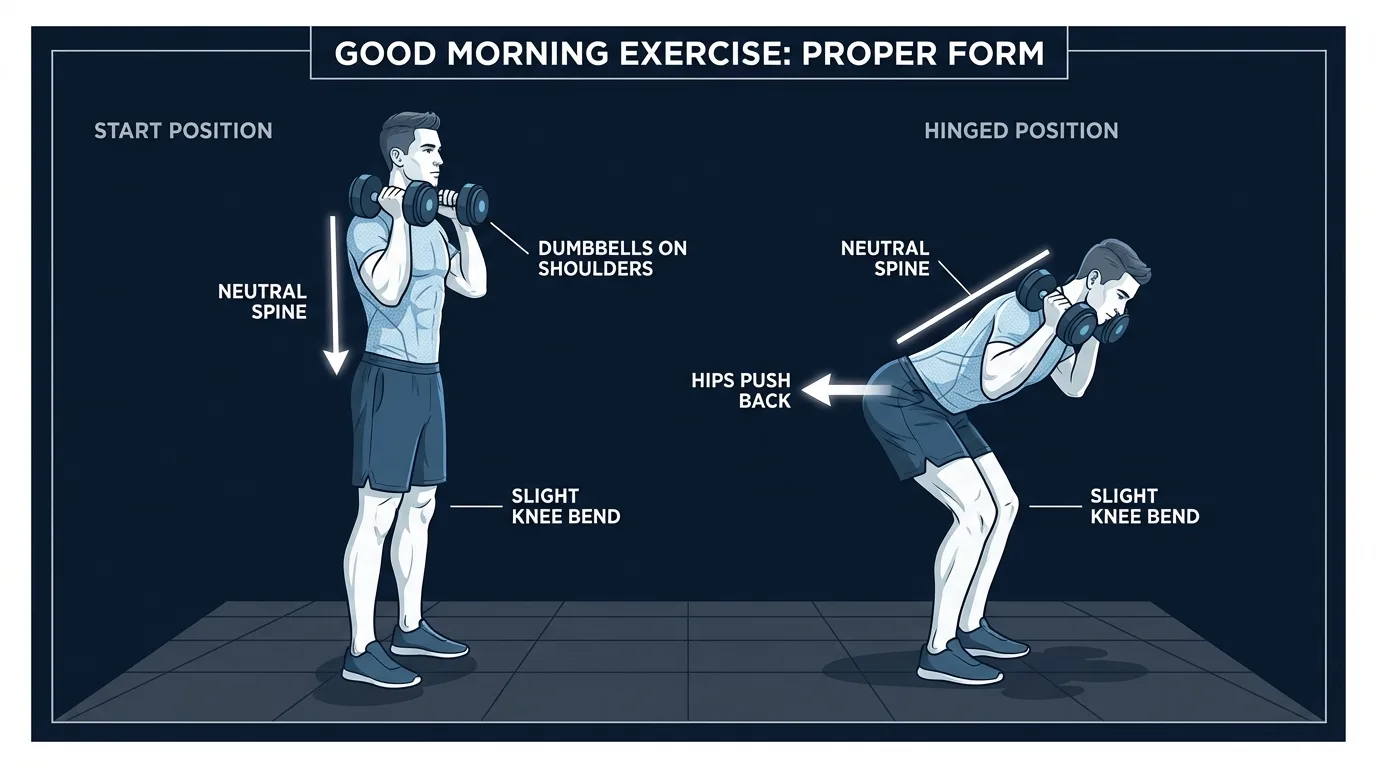
Variations: From Bodyweight to Loaded
Bodyweight Good Morning (Beginner)
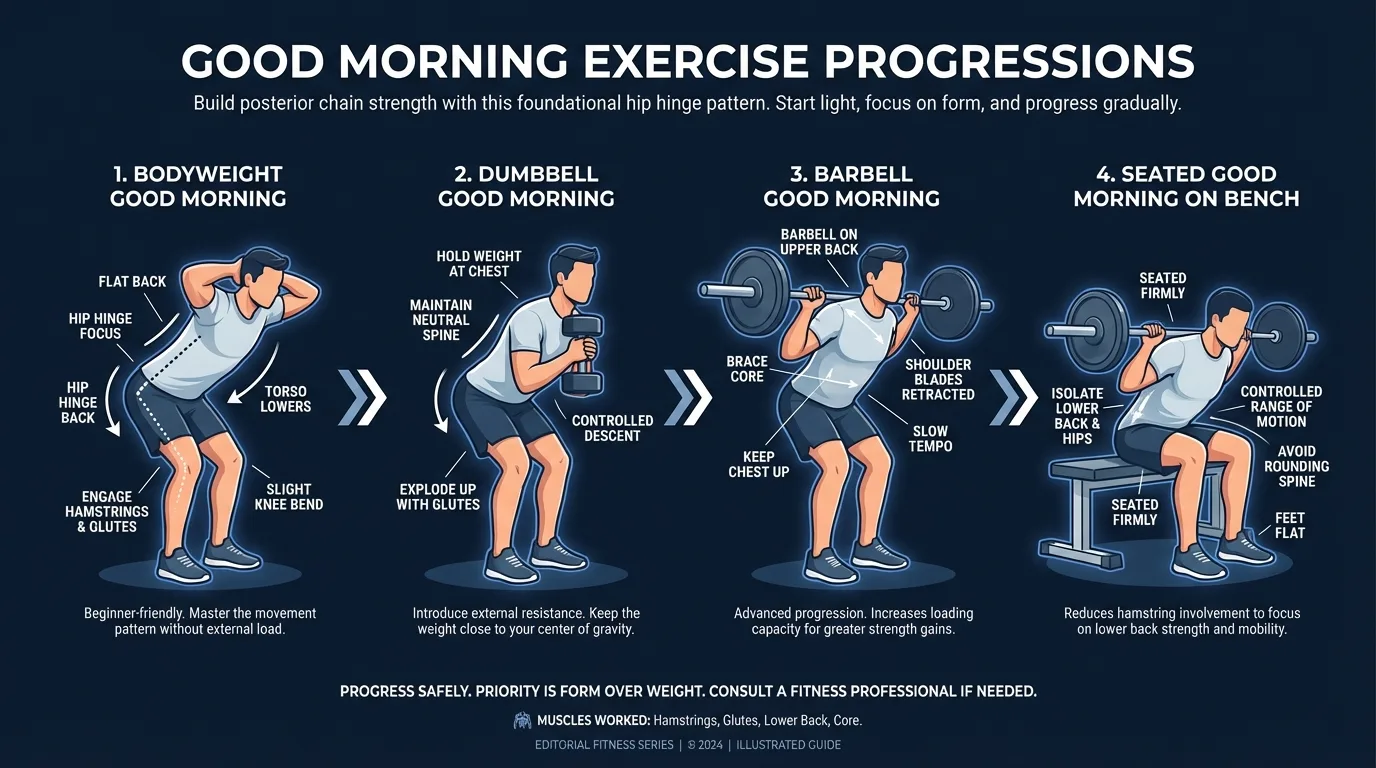
Hands behind your head or crossed over your chest, no weight. This is how everyone should learn the movement. The bodyweight version lets you focus entirely on the hip-hinge pattern, spinal position, and hamstring stretch without worrying about load. Practice this until you can do 3 sets of 15 reps with a perfectly neutral spine and a consistent knee angle before adding any weight.
Dumbbell Good Morning (Intermediate to Advanced)
The standard version described above. Dumbbells on the shoulders add moderate load while naturally limiting how heavy you can go. This is the sweet spot for most home and gym workouts. It trains the same movement pattern as barbell good mornings with a built-in safety ceiling.
Seated Good Morning (Intermediate)
Sit on a bench with your feet flat and hinge forward. Sitting removes the hamstrings from the equation (they are already shortened at the knee) and isolates the erector spinae and glutes. This is worth trying if you specifically want to strengthen the lower back, or if tight hamstrings are limiting your standing range of motion.
Alternative Exercises
If good mornings are not appropriate for your current level or cause discomfort, these train the same muscles through different patterns:
- Romanian deadlift: Trains the same hip-hinge pattern but with the weight in your hands instead of on your shoulders. Less spinal loading, allowing heavier weight. Start here if you are building up to good mornings.
- Glute bridges: Target the glutes and hamstrings without any spinal loading at all. A safe foundational exercise for building posterior-chain strength before progressing to hinge movements.
- Single-leg deadlift: Unilateral hinge variation with much lighter spinal load and a strong balance and hip-stability component. Excellent if you cannot tolerate bilateral loaded hinges yet.
When to Avoid or Modify Good Mornings
Good mornings load the lumbar spine under a long lever arm and demand a competent hip hinge. The dumbbell version is forgiving compared to the barbell, but a few conditions still warrant modification or substitution. Always consult a qualified physician, physical therapist, or other healthcare provider before starting or returning to any exercise program, especially if you fit one of the categories below.
- Acute lower-back pain or known disc pathology. Skip loaded hinges during a flare. Regress to deadbugs, bird-dogs, and forearm planks to rebuild deep-core control without spinal loading. Return to bodyweight good mornings only after your symptoms resolve and a clinician clears you.
- Recent spine, hip, or shoulder surgery or injury. The loaded shoulders combined with hip flexion stress every joint along the kinetic chain. Get clearance from your surgeon or physical therapist before resuming hinge work.
- Uncontrolled hypertension or known cardiovascular disease. Bracing under load spikes intrathoracic and intra-arterial pressure. Use lighter loads with longer rests, skip max-effort sets, and follow your cardiologist's exercise guidance.
- Pregnancy, especially second and third trimester. Substitute with hip-hinge patterns that do not load the spine, like glute bridges and single-leg deadlifts with light dumbbells, and consult your prenatal provider for clearance and load guidance.
- First 6-8 weeks postpartum or active diastasis recti. Heavy bracing increases intra-abdominal pressure and can widen abdominal separation. Restore deep-core function with deadbugs and bird-dogs first, then reintroduce loaded hinges gradually.
- Tight hamstrings that limit pain-free hinge depth. Not a contraindication so much as a programming note. If you cannot reach 45 degrees of torso lean without your back rounding, stop short of that point and work on hamstring mobility separately before chasing depth.
Related Exercises
- Same movement pattern (hinge): Romanian deadlift (load in the hands, less spinal stress) and single-leg deadlift (unilateral, balance-biased).
- Hinge variation with less spinal load: Glute bridges and iso ham raise as glute- and hamstring-focused accessories that do not load the spine.
- Complementary pull pattern: Bent-over rows, which trains the upper back from the same hinged position the good morning teaches.
- Complementary lower-body pattern: Squats and Bulgarian split squats for the quad-dominant side of a balanced lower-body day.
- Core foundation for spinal bracing: Deadbugs, bird-dogs, and forearm planks to build the trunk stiffness that protects your spine under load.
- Erector-spinae endurance accessory: Superman holds and back extensions for low-load posterior-chain work on lighter days.
How to Program Good Mornings
The good morning is best used as an accessory hinge after your main compound lifts, not as the centerpiece of a session. The ranges below follow the ACSM Position Stand on Resistance Training (Ratamess et al., 2009) and reflect the dumbbell scaling limit (typically 5-50 lb per hand for most home settings).
| Level | Sets × Reps | Rest | Frequency |
|---|---|---|---|
| Beginner (bodyweight) | 2-3 × 10-15 | 60-90s | 2-3 sessions/week |
| Intermediate (10-25 lb dumbbells) | 3 × 10-12 | 90-120s | 1-2 sessions/week |
| Advanced (30-50 lb dumbbells, tempo or paused) | 3-4 × 8-12 | 120-180s | 1-2 sessions/week |
Where in your workout. Place the good morning second or third in a lower-body session, after your main hinge (deadlift or Romanian deadlift) and your main squat pattern. The spinal-erector demand is high enough that running it first will compromise your heavier lifts. On a posterior-chain accessory day, it can lead the session as long as you warm up thoroughly with bodyweight and light dumbbells. Total weekly posterior-chain volume, including deadlifts and Romanian deadlifts, should land in the 12-18 set range for most intermediates.
Form floor over rep targets. Stop a set the moment your spinal position breaks, regardless of the rep count on the page. A set of 8 clean reps trains the posterior chain. A set of 12 with the last 4 reps in lumbar flexion trains an injury. Your hamstring flexibility and trunk-bracing endurance set the real ceiling, not the load on the dumbbells.
FitCraft's AI coach Ty adjusts the variation and volume to match your level, your hamstring flexibility, and the equipment you have on hand. The 3D demonstrations show the hip-hinge path and spinal position from side-view angles so you can see exactly what neutral looks like.
Frequently Asked Questions
Can I do good mornings with lower back pain?
Not during an acute episode. Good mornings load the lumbar spine under a long lever arm, which can re-aggravate disc and erector-spinae issues. While you are symptomatic, regress to deadbugs, bird-dogs, and forearm planks to rebuild deep-core control without spinal loading. Once you are pain-free and your physical therapist has cleared you to return to hinge work, restart at the bodyweight good morning and progress to dumbbells over several weeks. If your back pain persists, recurs with mild loading, or radiates into the legs, see a qualified clinician before reintroducing this exercise.
What muscles does the good morning exercise work?
The good morning primarily works the hamstrings, gluteus maximus, and erector spinae (lower back). It is a hip-hinge movement that loads the entire posterior chain. Secondary muscles include the adductors, core stabilizers (transverse abdominis, obliques), and calves. The hamstrings work eccentrically as you hinge forward and concentrically as you return to standing. The erector spinae work isometrically to hold a neutral spine.
Are good mornings safe for your back?
Good mornings are safe when performed with proper form: a neutral spine and a hip-hinge pattern rather than spinal flexion. The exercise strengthens the erector spinae and core stabilizers that protect your back. The danger comes from rounding the lower back under load or using too much weight. Start with bodyweight to master the hinge pattern before adding dumbbells, and never sacrifice spinal position for extra depth.
How deep should I go on good mornings?
Hinge forward until you feel a distinct stretch in your hamstrings or until your torso reaches roughly parallel to the floor, whichever comes first. Your hamstring flexibility dictates your safe range of motion. Going deeper than your hamstrings allow forces your lower back to round, which is where injuries happen. Depth improves naturally over time as flexibility increases.
Can I do good mornings with dumbbells instead of a barbell?
Yes. Dumbbell good mornings are a legitimate and in some ways safer variation. Dumbbells limit the total load compared to a barbell, which reduces spinal compression while still training the hip-hinge pattern and posterior chain effectively. They are an excellent option for home workouts and for intermediate lifters building toward barbell good mornings.
What is the difference between good mornings and Romanian deadlifts?
Both are hip-hinge movements targeting the hamstrings, glutes, and lower back. The main difference is where the load sits. In the good morning, weight is on your shoulders, which creates a longer moment arm and more demand on the erector spinae. In the Romanian deadlift, weight hangs from your hands in front of your body. Good mornings tend to challenge the lower back more, while Romanian deadlifts allow heavier loading with slightly less spinal stress.