The single leg deadlift is humbling because strength is only one part of the rep. The second you lift one foot, your hip stabilizers, foot muscles, trunk, and balance system all have to agree on where your body is in space.
That is why a lifter who can handle heavy Romanian deadlifts may wobble on the bodyweight version. The hinge pattern is familiar. The single-leg control is new.
Use this guide to build the exercise in layers: supported hinge first, bodyweight control second, dumbbell loading third. Rushing the sequence usually turns a useful posterior-chain exercise into a balance contest.
Quick Facts: Single Leg Deadlift
- Equipment needed: One dumbbell optional; bodyweight and wall-supported versions work first
- Difficulty: Intermediate to Advanced
- Modality: Strength
- Body region: Lower body and posterior chain
- FitCraft quest category: Strength
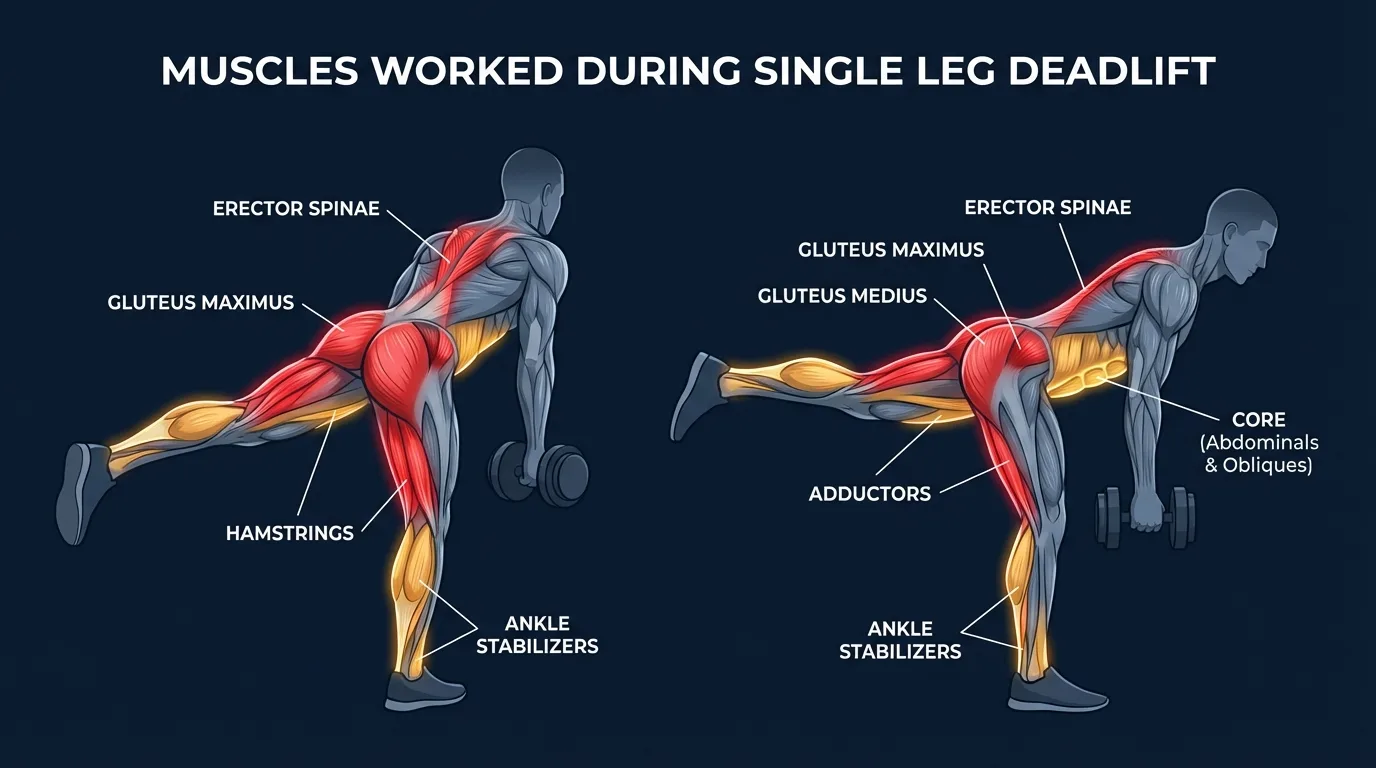
Muscles Worked
Primary movers: the hamstrings and gluteus maximus on the standing leg. They lengthen under control as you hinge down and shorten to bring the hip back to standing. The hamstrings also help keep the knee softly bent without letting it drift forward like a squat.
Secondary movers: the gluteus medius, adductors, deep hip rotators, calves, and foot intrinsics. The gluteus medius keeps the pelvis from dropping or rotating open, while the adductors and deep rotators help keep the femur centered as the trunk moves.
Stabilizers: the erector spinae, obliques, transverse abdominis, rectus abdominis, grip, and forearm muscles. The trunk works isometrically so the spine stays neutral, and the hand holding the dumbbell adds a small anti-rotation demand through the torso.
Why it feels so different from a two-leg hinge: the single-leg setup shrinks your base of support and asks one hip to control flexion, extension, and rotation at the same time. The useful training effect comes from keeping the pelvis square while the hip moves. If the pelvis opens, the lower back and standing knee start solving a problem the hip should own.
Step-by-Step: How to Perform a Single Leg Deadlift
Start lighter than you think. If you have never trained this hinge before, use a wall, rail, or fingertips on a rack for support until the line of motion feels repeatable.
Step 1: Set Your Stance
Stand tall on your right leg with a soft knee. Hold a dumbbell in your left hand if you are adding load. Keep the left foot hovering just behind you, or lightly touch the toes down in a kickstand stance if balance is still limiting.
Coach Ty's cue: "Root the standing foot. Heel, big toe, little toe. Keep all three points heavy."
Step 2: Brace and Fix Your Gaze
Brace lightly through your midsection and look at one spot on the floor about 6 feet ahead. A moving gaze usually creates a moving torso, and a moving torso makes the hip work harder than it needs to.
Ty's cue: "Pick one spot and keep your eyes there for the whole rep."
Step 3: Hinge From the Hip
Push your hips straight back as your chest lowers and your free leg reaches behind you. Think of your head, ribs, pelvis, and back leg moving as one long seesaw. The dumbbell should hang under your shoulder, close to the standing leg.
Ty's key cue: "Hip back first. The chest follows because the hip moved."
Step 4: Stop at Your Clean Range
Lower until you feel a strong stretch in the standing hamstring or until your torso approaches parallel with the floor. Stop earlier if your back rounds, your pelvis opens toward the ceiling, or your standing knee collapses inward.
Ty's cue: "Your range ends where your back stays flat and your hips stay square."
Step 5: Drive Back to Standing
Press the standing foot into the floor and squeeze the standing-side glute to reverse the hinge. Stand tall without snapping the ribs up or swinging the free leg forward. Finish all reps on one side, then switch and match the same load, range, and tempo.
Ty's reminder: "Come up slow enough that you could pause anywhere."
Get this exercise in a personalized workout
FitCraft, our mobile fitness app, uses its AI coach Ty to program compound strength exercises like this into your plan at the right volume and intensity, based on your level, goals, and equipment. Ty was designed and trained by Domenic Angelino, MPH (Brown University) and NSCA-CSCS, with research published in the Journal of Strength and Conditioning Research and Medicine & Science in Sports & Exercise.
Take the Free Assessment Free · 2 minutes · No credit card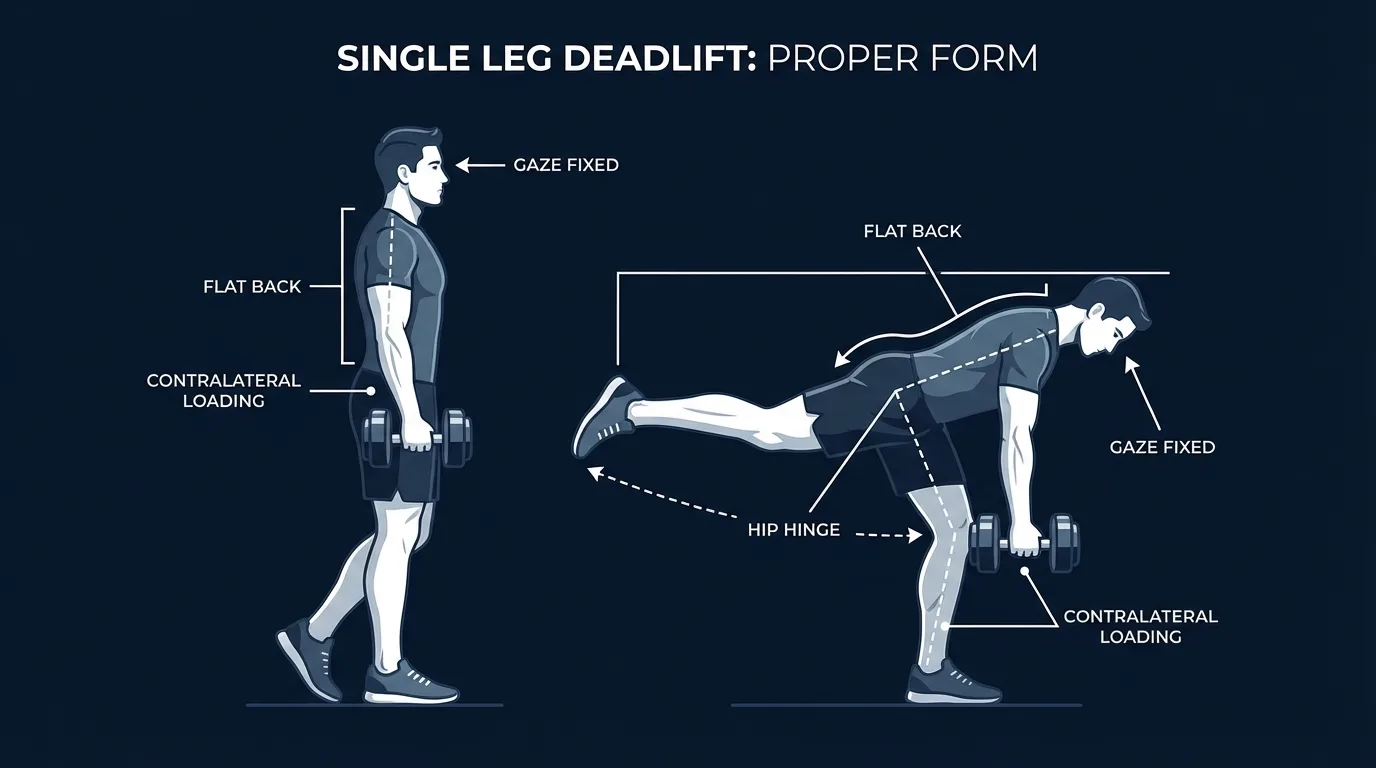
Common Mistakes (and How to Fix Them)
This exercise gets messy when the body tries to find depth before it can control the standing hip. Fix the control first. Load comes later.
- Opening the hip. The free-leg side wants to roll toward the ceiling. Fix it by imagining both front pockets pointing at the floor the whole time.
- Rounding the back. A rounded spine usually means the lifter is chasing the floor instead of stopping at hamstring range. Fix it by cutting the depth and keeping the dumbbell close to the standing leg.
- Going too heavy too soon. Your bilateral hinge strength does not transfer directly to single-leg balance. Start with bodyweight or one light dumbbell, then add load after the rep looks the same from start to finish.
- Rushing the descent. Fast reps hide wobble until the bottom, where recovery is hardest. Use a 3-second lowering phase and pause briefly before standing.
- Locking the standing knee. A stiff knee pushes tension into the lower back and makes balance worse. Keep a soft bend and let the hip move behind you.
- Reaching the dumbbell forward. The weight should travel down near the standing leg. If it drifts forward, the low back has to fight a longer lever.
Single Leg Deadlift Variations: Regressions and Progressions
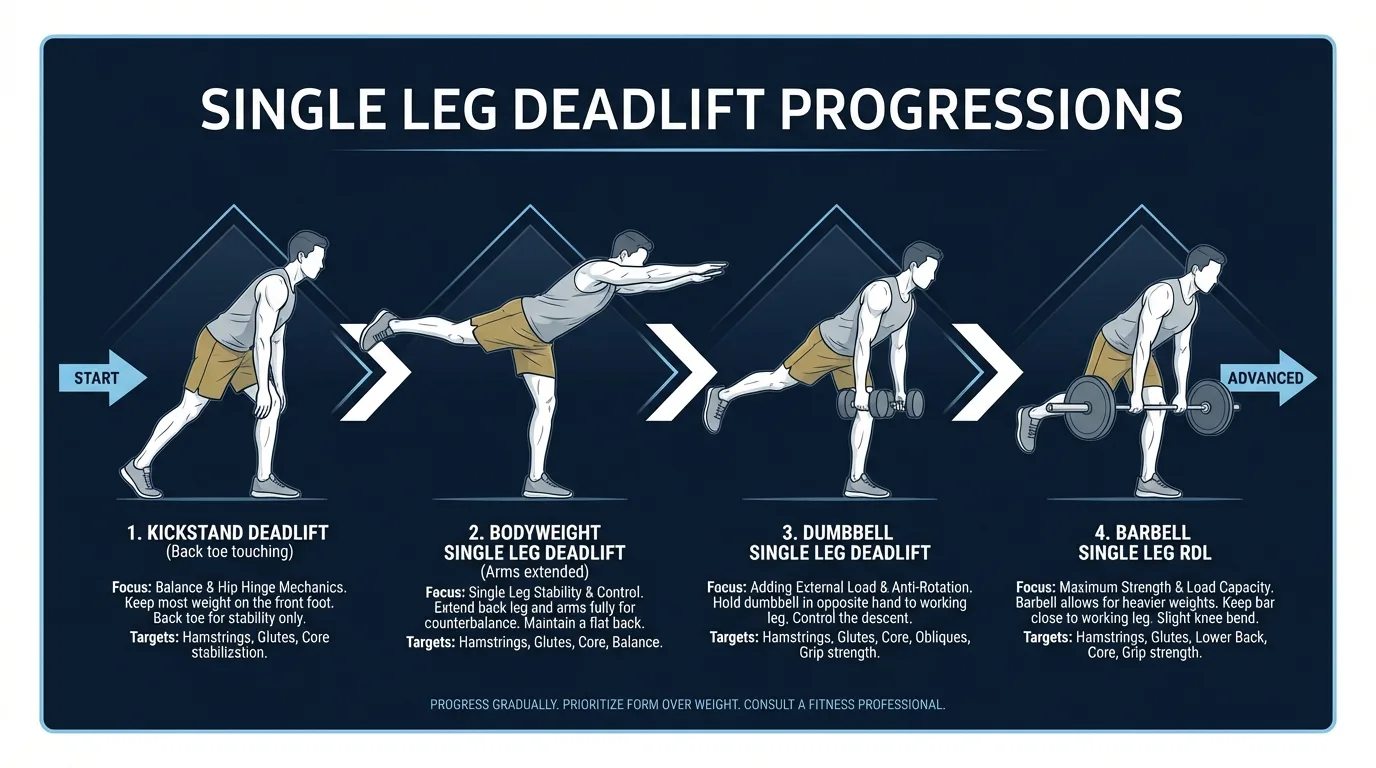
Progress by removing support first, then adding load, then increasing tempo or range. That order keeps the exercise honest.
Wall-Supported Single Leg Deadlift
Keep one hand on a wall, rack, or rail while you hinge. This takes the panic out of the balance demand and lets you learn where the pelvis should point.
Kickstand Deadlift
Keep the back toes lightly touching the floor behind you. The front leg still does most of the work, but the toe support gives your balance system a wider base.
Bodyweight Single Leg Deadlift
Use the full single-leg stance with no dumbbell. Reach the arms forward or out to the sides if that helps you stay square. Spend time here if your hips rotate or your foot grips the floor aggressively.
Dumbbell Single Leg Deadlift
Hold one dumbbell in the hand opposite the standing leg. Start light enough that you can use a slow descent, clean pause, and controlled return without touching the free foot down.
Two-Dumbbell Single Leg Deadlift
Hold a dumbbell in each hand once the one-dumbbell version is stable. The symmetrical load lets you train heavier, but it also removes some of the anti-rotation challenge.
When to Avoid or Modify Single Leg Deadlifts
Single leg deadlifts are safe for most healthy adults, but external load plus single-leg balance deserves respect. A few situations call for a lighter variation, more support, or a temporary swap. Always consult your physician or physical therapist for personalized guidance.
- Acute lower-back pain, sciatica, or known disc pathology. Loaded hinging can irritate symptoms if the spine cannot stay neutral. Use glute bridges, bird-dogs, or deadbugs until pain-free bracing returns.
- Recent spine, knee, hip, or ankle surgery. Get clearance from your surgeon or physical therapist before loaded single-leg work. Start with bodyweight hinges and wall support when you return.
- Balance disorders or frequent falls. The single-leg stance can create a fall risk. Use a wall-supported version, a kickstand stance, or a two-leg Romanian deadlift instead.
- Uncontrolled hypertension or known cardiovascular disease. Heavy bracing can spike pressure during compound lifts. Keep loads light, breathe through the rep, avoid max-effort sets, and follow your clinician's guidance.
- Pregnancy, early postpartum, or active diastasis recti. Balance changes and heavy bracing raise the risk profile. Use supported bodyweight hinges, shorter range, and clinician-cleared core work before loaded reps.
- Hamstring strain or high-proximal hamstring irritation. The bottom position lengthens the hamstrings under load. Use shorter range, lower load, and pain-free glute bridge variations until symptoms settle.
Related Exercises
If single leg deadlifts are part of your plan, these exercises build the same hinge pattern, hip stability, or bracing foundation:
- Same movement pattern: Romanian Deadlift and Good Mornings train the hinge with both feet down, useful before single-leg loading.
- Unilateral lower-body strength: Bulgarian Split Squats and Split Squats challenge one leg at a time without the same hip-hinge balance demand.
- Glute accessory: Glute Bridges train hip extension from the floor when balance or hamstring range limits the hinge.
- Core foundation for spinal bracing: Deadbugs, Bird-Dogs, and Forearm Planks build the trunk control single leg deadlifts rely on.
- Squat-pattern complement: Squats pair well with single leg deadlifts because they train knee-dominant strength while the deadlift trains the hip-dominant side.
How to Program Single Leg Deadlifts
Single leg deadlifts fit best as a compound hinge or unilateral accessory. The American College of Sports Medicine position stand on progression models for resistance training supports training across moderate rep ranges, multiple sets, and progressive loading based on experience level (Ratamess et al., 2009).
| Level | Sets × Reps | Rest between sets | Frequency |
|---|---|---|---|
| Beginner (supported or kickstand) | 2-3 × 8-12 per side | 90-120 seconds | 2-3 sessions/week |
| Intermediate (bodyweight or light dumbbell) | 3-4 × 6-12 per side | 120-180 seconds | 2-4 sessions/week |
| Advanced (loaded dumbbell) | 3-5 × 6-10 per side | 180-300 seconds | 3-5 sessions/week |
Where in your workout: place single leg deadlifts early in a lower-body or full-body session if you are loading them heavily. If you are using them as a balance or hip-control drill, place them after your main squat or hinge work with lighter weight.
Form floor over rep targets: stop the set when your pelvis opens, the standing knee caves, the back rounds, or you need to touch the free foot down on every rep. Fewer clean reps beat a full set of recovered wobbles.
How FitCraft Programs This Exercise
Single leg deadlifts need the right version at the right time. Too much load too soon turns them into a balance fight, while too little progression leaves the posterior chain undertrained.
FitCraft's AI coach Ty uses your personalized diagnostic, goals, level, and available equipment to place compound strength exercises into a balanced program. For a hinge pattern like this, that means the plan can match the variation and volume to your current control instead of forcing every lifter into the same version.
Ty was designed and trained by Domenic Angelino, MPH (Brown University) and NSCA-CSCS, with research published in the Journal of Strength and Conditioning Research and Medicine & Science in Sports & Exercise.
Frequently Asked Questions
Can I do single leg deadlifts with lower back pain?
Avoid loaded single leg deadlifts during acute lower-back pain, sciatica, or known disc symptoms unless a clinician has cleared you. Use bodyweight hinges, wall support, glute bridges, bird-dogs, or deadbugs first. Return to loaded reps only when you can hinge without pain, rounding, or pelvic rotation.
What muscles do single leg deadlifts work?
Single leg deadlifts primarily train the hamstrings and gluteus maximus of the standing leg. The gluteus medius, adductors, deep hip rotators, erector spinae, obliques, transverse abdominis, calves, foot muscles, and grip help stabilize the pelvis, spine, ankle, and dumbbell.
What is the difference between a single leg deadlift and a Romanian deadlift?
A Romanian deadlift uses both legs and lets you load the hinge pattern more heavily. A single leg deadlift uses one standing leg, which lowers the absolute load but adds balance, hip stability, and anti-rotation demand.
Why do I lose balance during single leg deadlifts?
Most balance problems come from moving too fast, looking around, opening the hip, or using more range than you can control. Slow the descent, fix your gaze, keep both hip bones facing the floor, and use a wall or kickstand stance until the pattern steadies.
Which hand should hold the dumbbell?
Start with contralateral loading: hold the dumbbell in the hand opposite your standing leg. If you are standing on your right leg, hold the dumbbell in your left hand. This cross-body load challenges anti-rotation control without needing a heavy dumbbell.