- Body recomposition (simultaneously losing fat and gaining muscle) is confirmed by peer-reviewed research, not just fitness marketing.
- Untrained individuals, returning exercisers, and people with higher body fat are the best candidates. Barakat et al. (2020) identified these as the groups most likely to recomp successfully.
- Bodyweight training produces sufficient mechanical tension for recomposition when exercises are progressed consistently and taken close to failure.
- Protein intake of 0.7 to 1 g per pound of body weight per day is the single most important nutritional variable. It's the difference between losing fat-with-muscle and losing fat-only.
- Results take 8 to 12 weeks, and the scale may barely move. Use measurements, photos, and strength progress as your markers, not body weight alone.
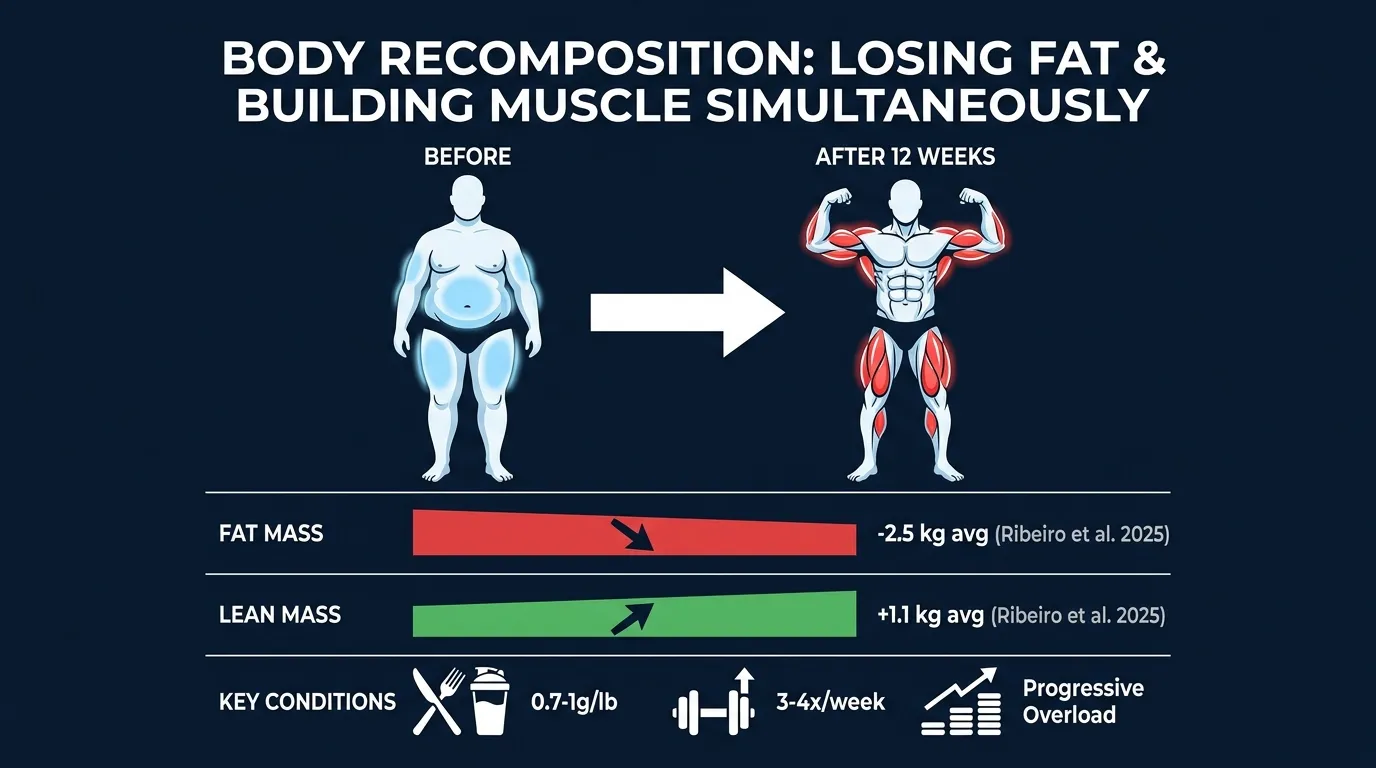
Build muscle or lose fat. That's the trade-off everyone assumes. Pick a lane. Bulk first, then cut. Starve yourself, lose the weight, then try to add the muscle back. It's fitness culture's equivalent of "you can't have everything." Suffer through the cut, then suffer through the bulk, and eventually, after many months, maybe arrive somewhere close to your goal.
But what if that binary is simply wrong?
Body recomposition (losing fat and gaining muscle simultaneously) sounds like the kind of thing supplement companies print on their packaging. But there's a growing body of peer-reviewed research showing it's not only real, it's the default outcome for a specific group of people who train correctly and eat enough protein. This article covers what the research actually says, who it works for, and how to do it at home without setting foot in a gym.
How Body Recomposition Works
Want the one-line version first? Our glossary defines body recomposition in plain English. This section explains the mechanism behind it.
Body recomposition refers to the simultaneous decrease in fat mass and increase in fat-free mass, primarily muscle. Conventional fitness wisdom held that these goals were mutually exclusive:
- Building muscle requires a caloric surplus. More energy in than out, providing raw material for growth.
- Losing fat requires a caloric deficit. Fewer calories in, forcing the body to oxidize stored fat for energy.
The logic seems airtight. You can't run a surplus and a deficit simultaneously. So pick one.
Except the body doesn't operate like a simple financial ledger. Energy partitioning (how your body allocates incoming fuel between fat storage, fat oxidation, muscle protein synthesis, and muscle protein breakdown) shifts based on training status, protein intake, body composition, and the type of exercise performed. Under the right conditions, the body simultaneously builds protein structures in trained muscle tissue while oxidizing stored fat to supply the energy for that building process.
This is body recomposition. And research published in the NSCA's Strength and Conditioning Journal confirms it's real.
If you want the version with your own numbers in it, the body recomposition calculator tells you whether recomp fits your body fat and training history, then returns the calorie target, protein target and lifting frequency to run it.
What the Research Actually Shows
Peer-reviewed research confirms body recomposition is real, and it happens most readily in three groups: people new to training, exercisers returning after time off, and people carrying higher body fat. Resistance training plus adequate protein is the reliable recipe. Here is what the key studies found.
The Barakat 2020 Review
The most comprehensive summary of the evidence comes from a 2020 review by Barakat et al. in the NSCA's Strength and Conditioning Journal: "Body Recomposition: Can Trained Individuals Build Muscle and Lose Fat at the Same Time?"
The review examined multiple resistance training studies and concluded that body recomposition is achievable, and occurs most readily in three populations:
- Untrained individuals. People new to resistance training experience simultaneous fat loss and muscle gain in their first 3 to 6 months, driven by heightened anabolic sensitivity and neuromotor adaptations unique to early-stage training.
- Trained individuals returning after a period of inactivity. Muscle memory (retained myonuclei) allows faster regrowth while the temporarily detrained metabolism supports fat oxidation.
- People with higher body fat levels. Greater stored energy reserves allow the body to fund muscle protein synthesis through fat oxidation during a caloric deficit.
For these three groups, the traditional bulk/cut cycle may actually be suboptimal. You can achieve both simultaneously from the start.
The 2024 Frontiers Editorial
A 2024 editorial in Frontiers in Nutrition (Bonilla et al., PMC11405322) synthesized recent advances in recomposition research and confirmed several findings:
- Recomposition isn't exclusively a beginner phenomenon. Trained individuals can achieve it with appropriate high-volume programming.
- Protein intake is the primary nutritional lever. Research consistently links adequate protein (0.7 to 1 g/lb body weight) with preserved or increased lean mass during fat loss.
- Resistance training is the modality most reliably associated with recomposition, regardless of specific equipment used.
Who Gets the Strongest Results?
Research on resistance training for weight loss (Ribeiro et al., 2025, PMC12851882) found that resistance training participants gained a mean of 1.15 kg of fat-free mass in men and 0.94 kg in women over the intervention period, all while simultaneously losing fat. These were not elite athletes. They were sedentary adults who started a structured resistance training program.
Studies on older women (Ribeiro et al., 2023, PMID 36526940) show similarly consistent findings: resistance training produces body recomposition in populations many would assume to be past the window for it. The mechanism scales across age and fitness level. What it requires is consistent progressive loading and adequate protein.
If you've quit fitness apps before, spent months inactive, and feel like your starting point is lower than you'd like, you're precisely the candidate the research identifies as most likely to recomp successfully. The lower your training baseline, the stronger the signal.
| Study | Population | Key recomposition finding |
|---|---|---|
| Barakat et al. 2020 (review) | Trained and untrained | Recomp is achievable; strongest in untrained, returning, and higher-body-fat groups |
| Bonilla et al. 2024 (editorial) | Trained individuals | Achievable in trained lifters with high-volume programming; protein is the primary lever |
| Ribeiro et al. 2025 | Sedentary adults | Gained 1.15 kg fat-free mass (men) and 0.94 kg (women) while losing fat |
| Ribeiro et al. 2023 | Older women | Resistance training produced recomposition across different fat-mass levels |
Why does bodyweight training work for recomposition?
Bodyweight training works because muscle responds to mechanical tension and metabolic stress, not to where the resistance comes from. Progress the difficulty of the movements and the muscle cannot tell the difference between an iron plate and a steeper body angle. Here is how that plays out in practice.
Progressive Overload Without a Barbell
The core stimulus for muscle growth is progressive overload: progressively increasing the mechanical challenge placed on muscle tissue over time. Most people associate this with adding weight to a barbell. But the mechanism doesn't discriminate by resistance source. Muscle responds to:
- Increased load. Harder exercise variation, added time under tension, or greater range of motion.
- Increased volume. More total sets and reps over the week.
- Reduced rest. Shorter rest periods increase metabolic stress.
- Changed leverage. Altered body position changes the effective resistance of any bodyweight exercise.
Bodyweight training provides all four levers. A structured push-up progression from modified to standard to diamond to decline to pike to pseudo-planche creates a continuous mechanical challenge that no fixed-weight machine can replicate at this cost or floor space. The muscle doesn't know whether load comes from an iron plate or from a body positioned at a steeper angle. It responds to tension and metabolic stress, both of which bodyweight movements deliver when programmed progressively.
The Caloric Expenditure Advantage
Full-body compound bodyweight movements like burpees, jump squats, mountain climbers, and push-up variations create significant caloric expenditure while simultaneously stimulating muscle protein synthesis. This combination lands squarely in the recomposition sweet spot: a mild caloric deficit driven by movement, paired with the mechanical stimulus needed for muscle growth.
Full-body bodyweight circuits burn roughly 7 to 9 calories per minute, comparable to moderate cycling and substantially higher than machine-based isolation exercises. For recomposition, this caloric burn matters: you need a mild negative energy balance so the body draws on stored fat, while protein intake and resistance training preserve and build lean tissue.
The Evidence on Bodyweight Hypertrophy
The question of whether bodyweight training can actually build muscle has been answered. The studies reviewed in the Barakat 2020 paper included bodyweight and resistance band protocols alongside free weight interventions, and showed equivalent hypertrophy and recomposition outcomes to barbell training when four conditions were met:
- Progressive overload was applied consistently (harder variations each 2 to 3 weeks)
- Volume was sufficient (15 to 20+ working sets per muscle group per week)
- Protein intake was adequate (0.7 to 1 g per pound of body weight)
- Training approached failure (last 2 to 3 reps genuinely difficult, not just uncomfortable)
These aren't conditions that require a gym. They require a plan that progresses and the discipline (or the system) to follow it. If you need a starting template, our free AI workout generator builds a weekly plan from your equipment, available days, and session length.
Ready to put this into practice?
Take the free FitCraft assessment and get a personalized bodyweight plan built for recomposition. Progressive, consistent, and designed so you won't quit.
Take the Free Assessment Free · 2 minutes · No credit cardThe Protein Equation: The Single Most Important Variable
Why Protein Is Non-Negotiable
Of all the variables in body recomposition, protein intake has the strongest and most consistent evidence base. The mechanism is clear:
- Fat loss requires a caloric deficit. The body needs to be burning more than it consumes.
- Muscle preservation and growth requires amino acids: the building blocks that make muscle protein synthesis possible.
Without adequate protein, a caloric deficit erodes muscle alongside fat. The scale drops, but so does lean mass. You end up lighter but not leaner. A smaller version of the same body composition. With adequate protein, the body draws on stored fat for energy while preserving or building lean tissue. That's the recomposition outcome.
Practical Protein Targets
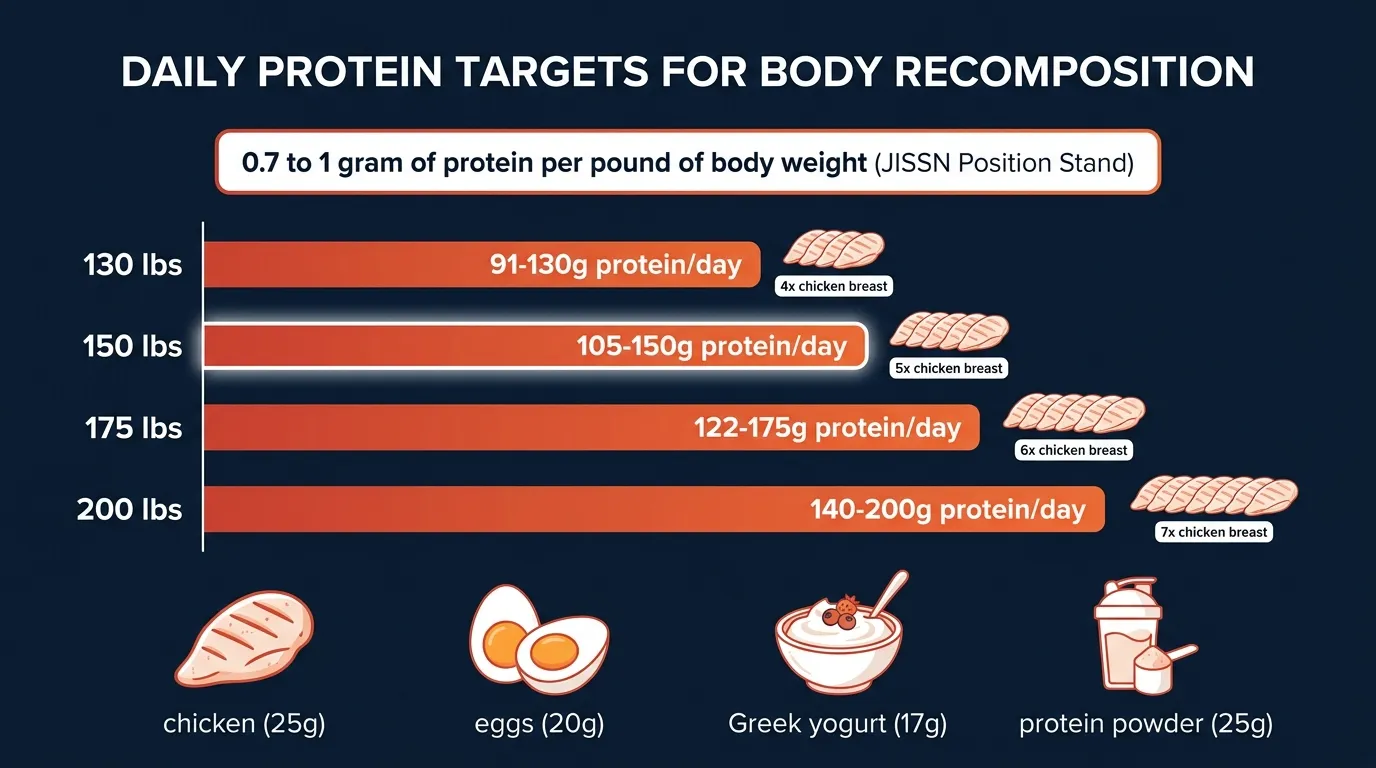
The Journal of the International Society of Sports Nutrition's position stand (Stokes et al., 2018) recommends 0.7 to 1 g of protein per pound of body weight per day (1.6 to 2.2 g/kg) for maximizing muscle protein synthesis.
For a 150-pound person: 105 to 150 g of protein per day. Achievable through ordinary foods:
- 4 to 5 oz chicken, turkey, or fish per meal: 25 to 30 g per serving
- 2 whole eggs plus 2 to 3 egg whites: 20 to 25 g
- Greek yogurt or cottage cheese: 15 to 20 g per cup
- Protein powder if whole food is difficult: 20 to 25 g per scoop
Distribution matters as much as total. Research on leucine thresholds shows that muscle protein synthesis responds better to 30 to 40 g per meal across 3 to 4 eating occasions than to a single large dose. Spread intake through the day, anchor it around training sessions, and hit your total number. That's the nutritional foundation of body recomposition.
A Practical Home Recomposition Protocol
Training Structure (8 to 12 Weeks)
Research supports the following structure for home-based recomposition:
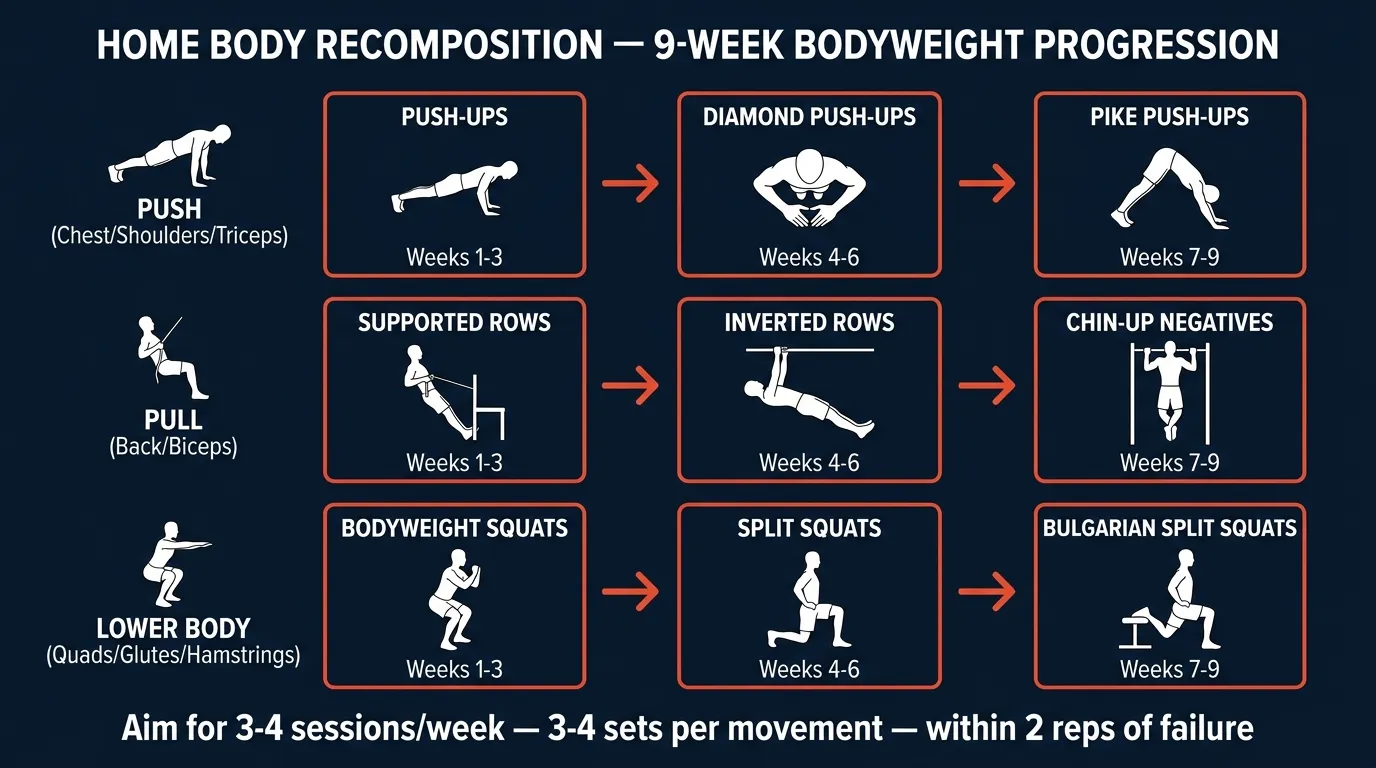
- Frequency: 3 to 4 resistance sessions per week, minimum 48 hours between training the same muscle group
- Session structure: Full-body compound movements or an upper/lower split
- Volume: 3 to 4 working sets per movement, 8 to 15 reps, taken within 2 reps of muscular failure
- Cardio: 2 to 3 light-to-moderate sessions on rest days (20 to 30 minutes of Zone 2 walking, cycling, or light movement) to increase total energy expenditure without impairing recovery
Creating Progressive Overload at Home
The most common failure mode in home bodyweight training is performing identical exercises at identical difficulty for months. Progression is what drives adaptation. A structured pathway by movement pattern:
Push (chest/shoulders/triceps):
- Weeks 1 to 3: Modified to standard push-ups
- Weeks 4 to 6: Diamond push-ups to pike push-ups
- Weeks 7 to 9: Decline push-ups to pseudo-planche push-ups
Pull (back/biceps), using a sturdy table edge, low bar, or door-frame anchor:
- Weeks 1 to 3: Supported rows to inverted rows
- Weeks 4 to 6: Higher-incline inverted rows to chin-up negatives
- Weeks 7 to 9: Full inverted rows to assisted chin-ups
Lower body:
- Weeks 1 to 3: Bodyweight squats to split squats
- Weeks 4 to 6: Bulgarian split squats to jump squats
- Weeks 7 to 9: single-leg deadlifts to Romanian deadlifts
Common Recomposition Mistakes
- Watching the scale too closely. Fat loss and muscle gain partially cancel each other in body weight. The scale may barely move for weeks while recomposition is actively occurring. Rely on measurements, photos, and strength performance instead.
- Under-eating protein in a caloric deficit. The most common failure mode. Cutting calories without prioritizing protein turns fat loss into fat-and-muscle loss.
- Stopping at week 3 or 4. Recomposition produces visible results around weeks 8 to 10. Most people quit during the lag period between effort and visible outcome.
- Failing to progress exercises. Doing identical workouts at identical difficulty for 12 weeks produces 12 weeks of stalled adaptation. Progression is the mechanism. Without it, there's no stimulus.
The Consistency Equation: Why Most People Fail Before the Results Arrive
Here's the piece the research doesn't highlight but practitioners know intimately: body recomposition is a long game. It requires more sustained consistency than a standard fat-loss cut (which produces rapid scale movement that fuels motivation) or a standard muscle-building phase (which produces quick strength gains as visible feedback).
Recomposition's feedback loop is slow. The scale barely moves. Visible changes take 8 to 10 weeks. And without an external motivation system, most people abandon a sound protocol before the results materialize, not because the approach was wrong, but because the gap between effort and visible reward was too wide.
Research on exercise adherence consistently identifies the same pattern: willpower is not a reliable mechanism for long-term consistency. The studies that show the best adherence outcomes use behavioral design (streaks, progression tracking, external accountability, reward loops) rather than motivation alone. The goal is to make 8 to 12 weeks feel like a game you're winning rather than a grind you're enduring. If you would rather pick an app than build that system yourself, our roundup of the best workout apps for weight loss ranks them on adherence first.
Jim, 26, described exactly this cycle: "I kept starting routines and quitting by week 3. Nothing stuck." After building a consistent streak in a gamified training app, he stuck with the protocol long enough to lose 24 pounds in three months. His words: "FitCraft made me start on a Wednesday and I haven't stopped." The workout didn't change. The consistency system did.
What This Means for You
If you're starting from a deconditioned baseline (or returning to fitness after months away), you have something elite athletes don't: a massive recomposition advantage. Your body is primed to respond to training stimulus in a way that produces simultaneous fat loss and muscle gain. The mechanism is real, the evidence is clear, and the tools are accessible.
What the research also confirms is that this advantage has a time window. The "beginner gains" phase of recomposition is most pronounced in the first 3 to 6 months. After that, progress requires more deliberate training specialization. The time to act on this is now. Not after another restart, not after waiting until conditions feel perfect.
What you'll observe over 8 to 12 weeks of consistent bodyweight training and adequate protein:
- Clothes fitting differently even when the scale holds steady
- New muscle definition emerging in areas that previously felt soft
- Progressive strength gains as harder exercise variations become accessible
- Energy levels improving as body composition shifts
Mike, 23, didn't set out to track macros or periodize a training block. He just wanted to look like he worked out. Four months of consistent bodyweight training later: visibly stronger. "The streak system got me hooked. I didn't want to break my chain." That's body recomposition at home. No gym. No special equipment. Progressive bodyweight training, adequate protein, and enough consistency to let the adaptation work. If you want an app to run that progression for you, our ranking of the best workout apps for men scores the field on exactly that: whether it keeps you showing up long enough to see the change.
A pair of dumbbells goes further than most people expect, which is the case we make on our dumbbell workout app page.
Frequently Asked Questions
Can beginners really build muscle and lose fat at the same time?
Yes. Untrained individuals are the best candidates for body recomposition. A 2020 review by Barakat et al. in the NSCA Strength and Conditioning Journal confirmed that people new to resistance training show simultaneous fat loss and muscle gain in their first 3 to 6 months, driven by heightened anabolic sensitivity and neuromotor adaptations unique to early-stage training. The less trained you are going in, the more pronounced the recomposition response.
How long does body recomposition take to see visible results?
Most people see measurable changes after 8 to 12 weeks of consistent resistance training and adequate protein. Visible results (clothes fitting differently, new muscle definition) typically appear around weeks 8 to 10. The scale may barely move, since fat loss and muscle gain partially cancel each other in body weight terms. Progress photos and body measurements are more reliable indicators than scale weight.
Do I need gym equipment for body recomposition?
No. The research on body recomposition specifies progressive resistance training, not barbell training specifically. Bodyweight training delivers sufficient mechanical tension and metabolic stress when exercises are progressed consistently and taken close to muscular failure. Studies included in the body recomposition literature use resistance band and bodyweight protocols with comparable outcomes to free weight training.
How much protein do I need for body recomposition?
The Journal of the International Society of Sports Nutrition recommends 0.7 to 1 g of protein per pound of body weight per day (1.6 to 2.2 g/kg) for maximizing muscle protein synthesis during recomposition. For a 150-pound person, that's 105 to 150 g daily, spread across 3 to 4 meals. Protein is the primary nutritional lever. Inadequate protein turns a caloric deficit into a scenario where fat and muscle are both lost.
How do I know if body recomposition is working if the scale doesn't change?
Track three indicators: body measurements (waist, hips, arms, thighs), progress photos taken every two weeks in consistent lighting, and strength performance on key exercises. If waist measurement is decreasing, strength is increasing, and definition is improving in photos, recomposition is working, even if body weight is stable. The scale combines fat mass and lean mass, so simultaneous changes in both can produce a stable or slowly declining number.