Most push-up variations get harder by changing hand width, tempo, or foot height. The pseudo planche push-up gets harder by changing leverage. You move your hands toward your hips, rotate them back or out, then lean your shoulders forward until your upper body carries much more of the load.
That small setup change turns a normal push-up pattern into a shoulder-dominant press. It also makes the wrists work harder. If you cannot hold a clean plank, control regular push-ups, and tolerate wrist extension, build those pieces first.
Quick Facts: Pseudo Planche Push-Up
- Equipment needed: None (push-up handles or parallettes optional)
- Difficulty: Advanced
- Modality: Strength
- Body region: Upper body and core
- FitCraft quest category: Strength
Muscles Worked
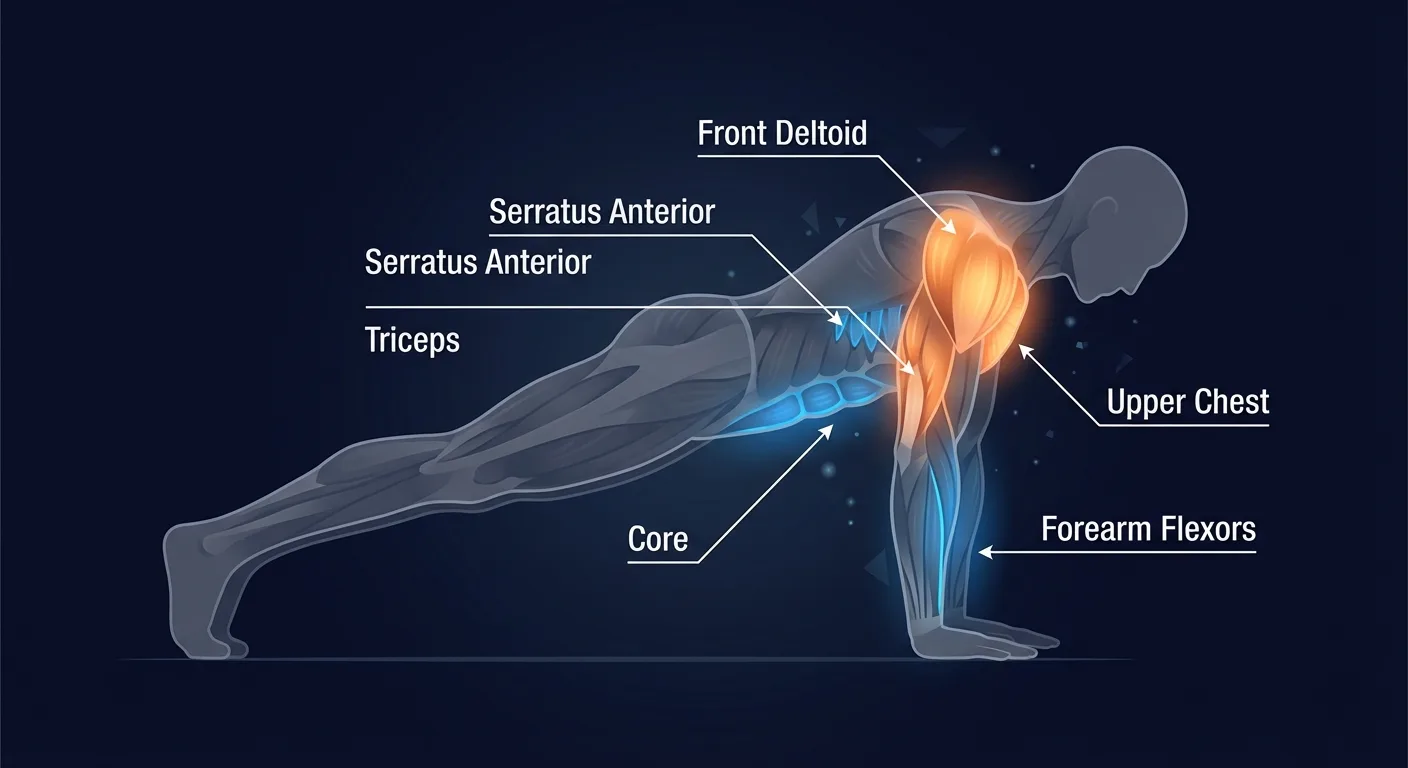
Primary movers: the anterior deltoids, pectoralis major, and triceps brachii. The forward lean increases shoulder flexion demand, so the front delts carry more work than they do in a standard push-up. These muscles shorten as you press up and lengthen under control as you lower.
Secondary movers: the serratus anterior helps protract and control the shoulder blades, while the upper chest assists the press as your shoulders travel forward. The forearm flexors and wrist stabilizers also work hard because the hands sit farther back and often rotate toward the feet.
Stabilizers: the entire anterior core (rectus abdominis, transverse abdominis, obliques), glutes, posterior deltoids, and rotator cuff work isometrically to maintain the rigid plank position throughout every rep. If the hips sag or pike, the exercise loses the planche-style loading.
Why the lean changes the exercise: moving the shoulders forward increases the moment arm between the hands and the body's center of mass. That means the shoulders, upper chest, triceps, wrists, and core must create more force to keep the body from rocking backward. The bigger the lean, the harder the rep.
Step-by-Step: How to Do a Pseudo Planche Push-Up
- Warm up your wrists. Do wrist circles, finger extensions, gentle palm pulses, and light weight-bearing on all fours for at least one minute. Coach Ty's cue: "Earn the wrist position before you load it."
- Set your hand position. Start in a push-up position, then rotate your hands so your fingers point back toward your feet or slightly outward. Place your hands near hip or lower-rib level, farther back than a normal push-up.
- Lean your shoulders forward. Shift your shoulders until they sit over, or slightly past, your wrists. Coach Ty's cue: "The rep starts when your shoulders move forward, not when your elbows bend."
- Lock the body line. Squeeze your glutes, brace your abs, and keep a straight line from head to heels. Avoid sagging, piking, or shifting backward as you lower.
- Lower with control. Keep your elbows close to your ribs and descend only as far as you can while keeping the lean. A shorter range is normal at first.
- Press back up. Drive your hands into the floor and press to the top without letting your shoulders drift behind your wrists. Exhale as you press and inhale as you lower.
Get this exercise in a personalized workout
FitCraft, our mobile fitness app, uses its AI coach Ty to program pressing exercises like this into your plan at the right volume and intensity, based on your level, goals, and equipment. Ty was designed and trained by Domenic Angelino, MPH (Brown University) and NSCA-CSCS, with research published in the Journal of Strength and Conditioning Research and Medicine & Science in Sports & Exercise.
Take the Free Assessment Free • 2 minutes • No credit card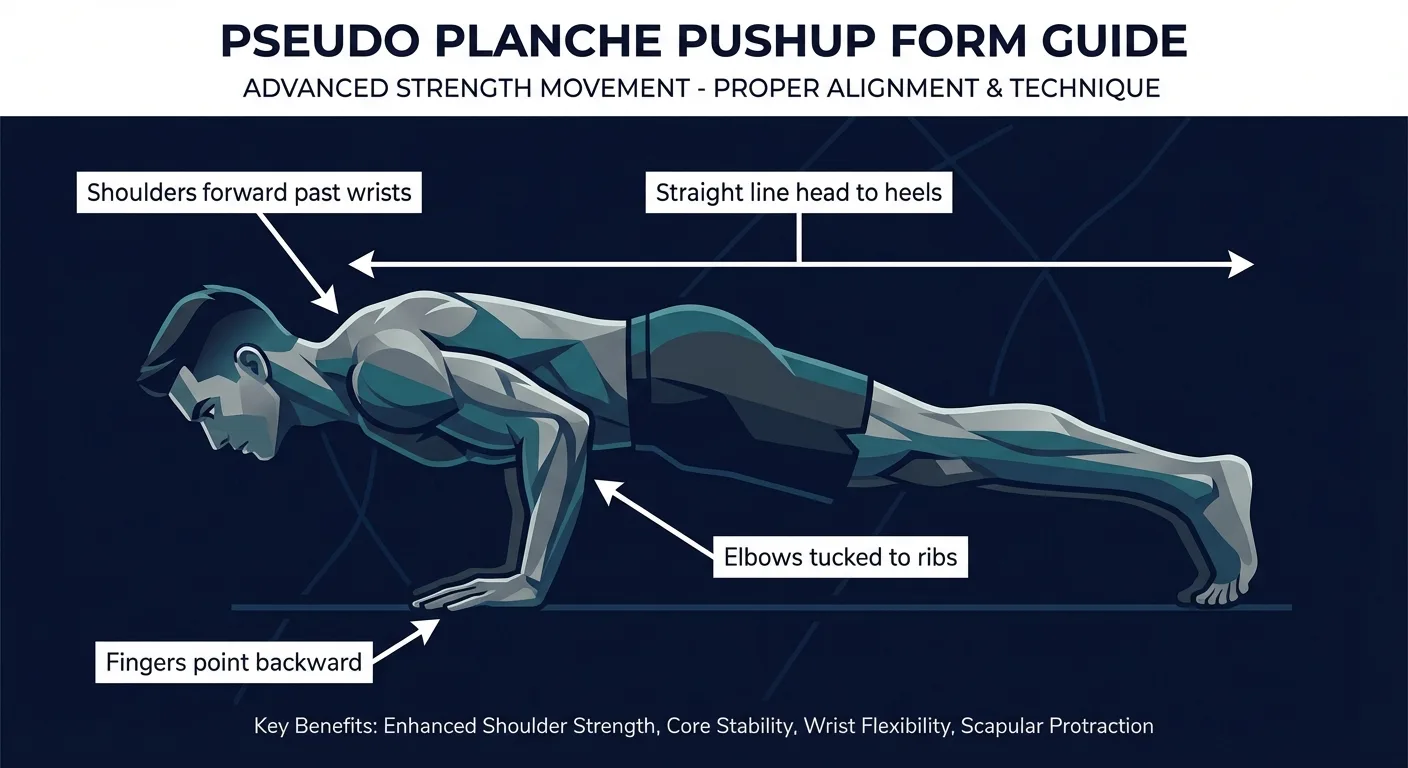
Common Mistakes (And How to Fix Them)
Not Leaning Forward Enough
What it looks like: your hands are turned backward, but your shoulders still sit behind or directly over your wrists. The rep turns into a regular push-up with unusual hand placement.
Why it's a problem: the forward lean is what creates the pseudo planche stimulus. Without it, the anterior deltoids and upper chest lose the extra leverage demand.
The fix: set the lean before the first rep. Film from the side and look for the shoulder joint sitting ahead of the wrist at the bottom.
Letting the Hips Sag or Pike
What it looks like: the hips drop toward the floor or lift toward the ceiling as soon as the shoulders feel loaded.
Why it's a problem: sagging stresses the lower back, while piking shifts load away from the planche-style position.
The fix: squeeze the glutes before you bend the elbows. If you cannot keep a straight line, regress to forearm planks, deadbugs, and standard push-ups.
Flaring the Elbows
What it looks like: the elbows drift wide as you lower, often because the forward lean feels too heavy.
Why it's a problem: wide elbows make the shoulder position less stable and reduce useful triceps tension.
The fix: keep the elbows close to your ribs and reduce the lean until you can control the path.
Ignoring Wrist Pain
What it looks like: sharp, pinching, or burning pain during or after the set.
Why it's a problem: pseudo planche push-ups load the wrists in an extended position. Pain here is a signal to modify before the joint gets irritated.
The fix: use push-up handles, parallettes, dumbbell grips, fists, or a high-incline surface. Build wrist tolerance over 2 to 4 weeks before pushing the lean.
Pseudo Planche Push-Up Variations: Regressions and Progressions
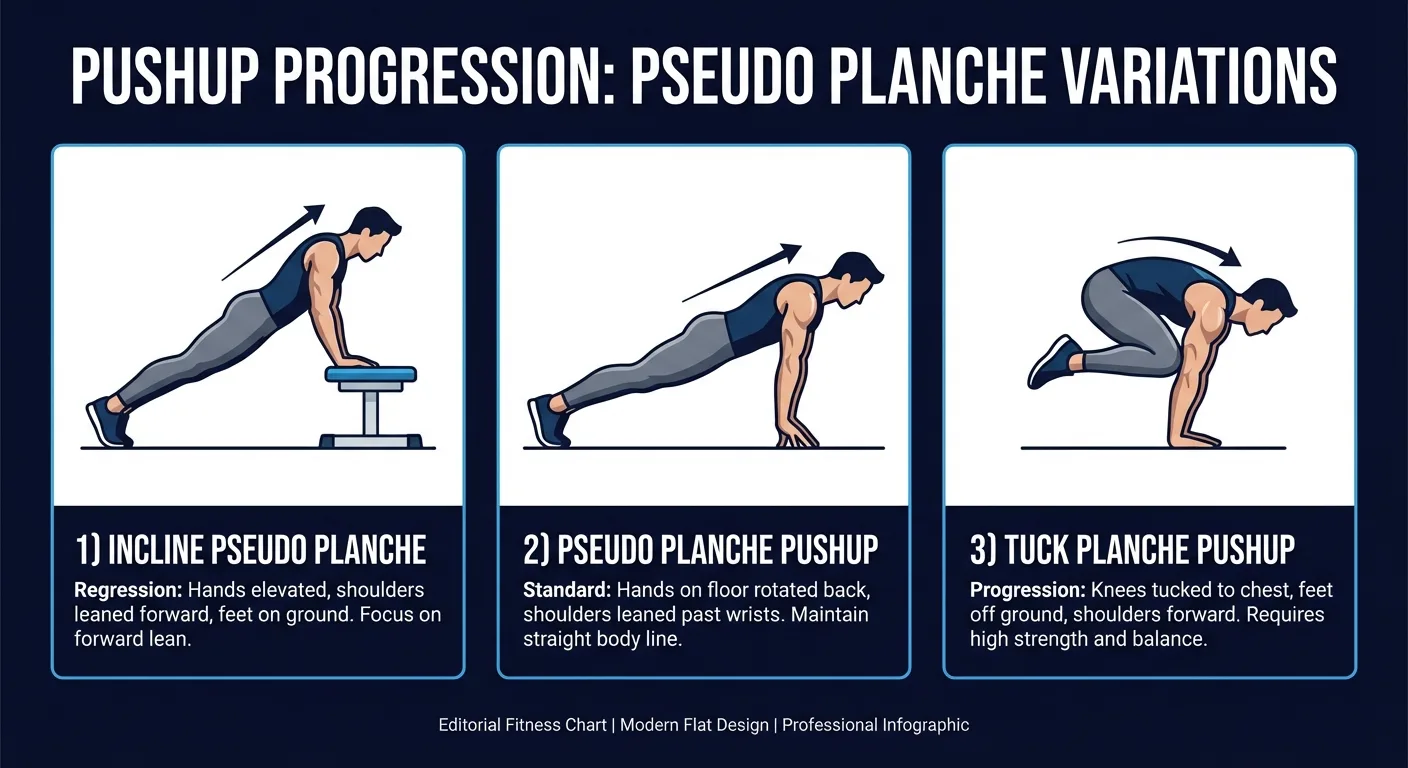
Incline Pseudo Planche Push-Up
Place your hands on a bench, box, or sturdy counter and use the same backward hand angle and forward lean. The higher surface reduces load while you learn the wrist and shoulder position.
Planche Lean Hold
Hold the top position without bending the elbows. Start with 10 to 20 seconds, then increase the lean as your wrists, shoulders, and core adapt.
Pike Push-Ups
Pike push-ups build shoulder-dominant pressing strength without the same backward hand position. Use them as a shoulder-strength bridge if the pseudo planche lean irritates your wrists.
Decline Pseudo Planche Push-Up
Elevate the feet to shift more load toward the hands. This progression is only useful if you can keep the shoulders forward and body line rigid on the floor version first.
Tuck Planche Push-Up
Draw the knees toward the chest and support more of your bodyweight through your hands. This is a major jump in difficulty and belongs after strong planche leans, not before.
When to Avoid or Modify Pseudo Planche Push-Ups
Pseudo planche push-ups are safe for well-prepared lifters, but the wrist angle and forward shoulder loading make them a poor choice when pain, recent injury, or bracing problems are already present. Always consult your physician or physical therapist if you are returning from injury, surgery, pregnancy, or a medical condition that affects training tolerance.
- Wrist pain or carpal tunnel symptoms. Floor variations load the wrists in extension. Modify with push-up handles, dumbbell grips, fists, parallettes, or a high incline.
- Acute shoulder impingement or rotator cuff irritation. Stay with push-ups, incline pressing, or pain-free pike push-ups until the shoulder tolerates pressing without symptoms.
- Recent shoulder, wrist, or elbow surgery. Get medical clearance first. Most return-to-training timelines move from isometrics to wall work, incline work, and then floor pressing.
- First 6 to 8 weeks postpartum or active diastasis recti. Start with wall pressing and core rebuilding through deadbugs and bird-dogs before long-lever plank pressing.
- Lower-back pain that worsens with bracing. If your hips sag during the rep, use forearm planks and incline push-ups to rebuild the plank position first.
- Unprepared wrist mobility. Spend 2 to 4 weeks on wrist mobility, planche leans, and light weight-bearing before attempting full floor reps.
Related Exercises
- Same muscle group: push-ups and chest press build general pressing strength before the forward-lean variation.
- Tricep-focused progression: diamond push-ups and skullcrusher push-ups make elbow extension the limiting factor.
- Shoulder-focused progression: pike push-ups train shoulder-dominant pressing with less wrist extension.
- Core foundation: hand planks, forearm planks, deadbugs, and bird-dogs help you hold the rigid body line.
- Advanced chest variation: lateral push-ups challenge pressing control through a different leverage pattern.
How to Program Pseudo Planche Push-Ups
Ratamess et al. (2009) outline resistance-training progressions that scale volume, rest, and frequency by training level. Treat pseudo planche push-ups like a high-tension strength movement. The wrists and shoulders need enough recovery to keep reps clean.
| Level | Sets x Reps | Rest between sets | Frequency |
|---|---|---|---|
| Beginner (incline or lean hold) | 2-3 x 5-10 reps or 10-20-second holds | 60-90 seconds | 2-3 sessions/week |
| Intermediate (floor) | 3-4 x 4-8 reps | 60-90 seconds | 2-3 sessions/week |
| Advanced (harder variations) | 3-5 x 3-6 reps | 90-120 seconds | 2-3 sessions/week |
Place pseudo planche push-ups early in an upper-body or push session, after wrist prep and lighter pressing. They pair well with standard push-ups, chest press, or pike push-ups, but they should not be buried at the end of a fatigued circuit.
Keep a form floor over a rep target. If the shoulders drift back, the hips sag, or wrist pain shows up, the set is over. Reduce the lean, raise the hands, or switch to planche lean holds.
FitCraft's AI coach Ty adjusts pressing variations and volume to match your level, equipment, and goals. For an advanced movement like this, that means earning the prerequisite strength before pushing the leverage.
Frequently Asked Questions
What muscles do pseudo planche push-ups work?
Pseudo planche push-ups primarily target the anterior deltoids, pectoralis major, and triceps. The serratus anterior, rotator cuff, forearms, glutes, and anterior core help stabilize the shoulder blades, wrists, and plank line.
Are pseudo planche push-ups harder than regular push-ups?
Yes. The forward shoulder lean shifts more bodyweight toward the hands and increases the demand on the wrists, shoulders, upper chest, and core. Start with a small lean or an incline version before using the floor version.
Can beginners do pseudo planche push-ups?
Most beginners should build toward them first. A practical baseline is clean standard push-ups, controlled pike push-ups, and pain-free wrist loading. If those are not in place yet, use incline pseudo planche leans instead.
Do pseudo planche push-ups help build a full planche?
They can help because they train forward-lean pressing, scapular protraction, wrist tolerance, and a rigid hollow-body-style plank. They are one piece of planche training, alongside planche leans, tuck holds, core work, and progressive straight-arm strength.
Can I do pseudo planche push-ups with wrist pain?
Do not push through sharp wrist pain. Modify with push-up handles, parallettes, dumbbell grips, fists, or a high incline so the wrist stays more neutral. If pain persists, stop the movement and get assessed by a qualified healthcare provider or physical therapist.