If you're going to pick one exercise to build your chest, the dumbbell chest press is hard to beat. It trains your pecs through a full range of motion, forces each side to carry its own weight (literally), and doesn't require a spotter the way a barbell bench press does. It's the bread and butter of upper-body training.
Here's what makes the dumbbell version worth your time. When you press with a barbell, your stronger arm can compensate for the weaker one. You don't even notice it happening. Dumbbells eliminate that cheat. Each arm has to press its own weight, which exposes and corrects strength imbalances over time. And the range of motion is bigger. Your elbows can drop below chest level at the bottom, which puts your pecs under a deeper stretch.
But the dumbbell chest press only works if your form is dialed in. Bad form turns a chest exercise into a shoulder exercise. Or worse, a shoulder injury. So let's break it down.
Quick Facts: Dumbbell Chest Press
- Equipment needed: Pair of dumbbells (bench optional; the floor works for the floor-press variation)
- Difficulty: Beginner (floor press) to Intermediate (flat bench, incline, single-arm)
- Modality: Strength
- Body region: Upper body (horizontal push)
- FitCraft quest category: Strength
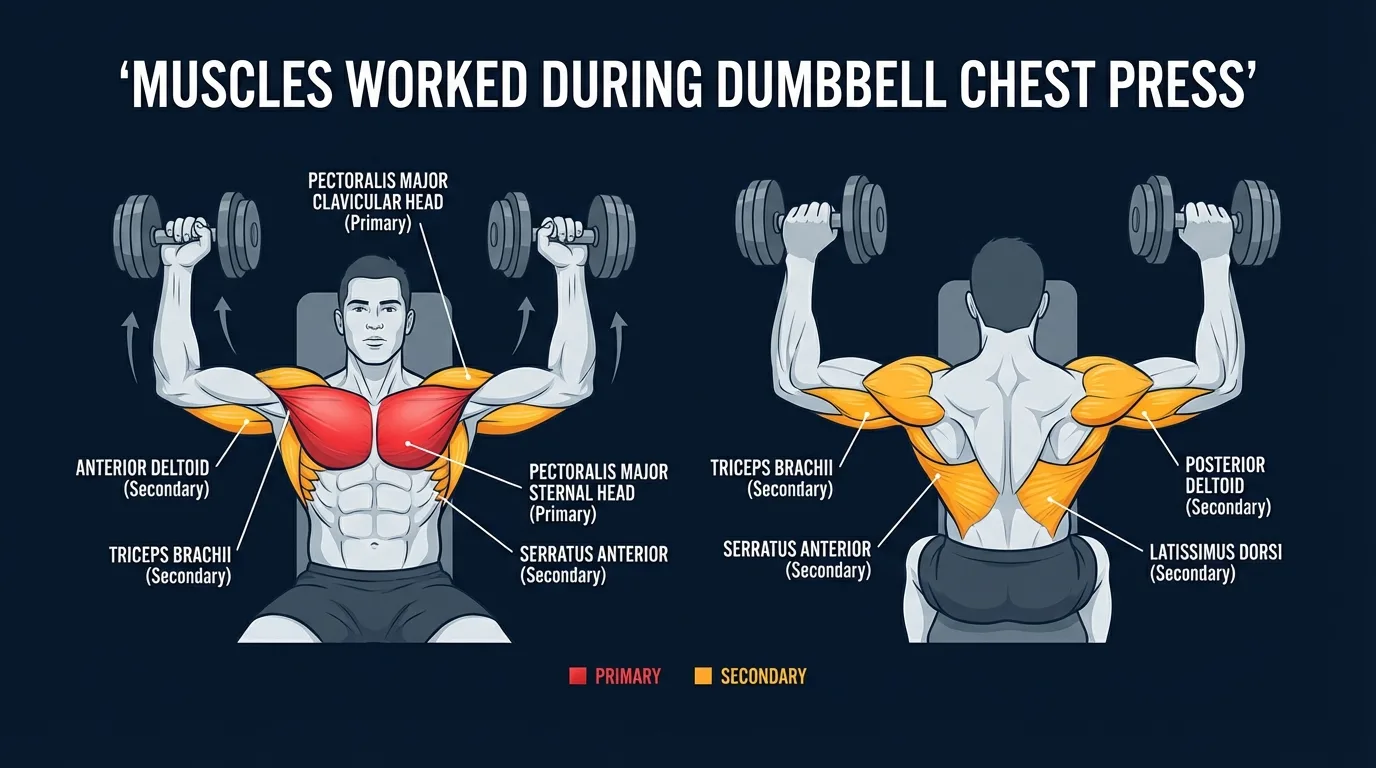
Muscles Worked
Primary movers: the pectoralis major (both the sternal head, which makes up the bulk of the chest, and the clavicular head, the upper portion that crosses the collarbone), the anterior deltoid (front of the shoulder), and the triceps brachii (back of the upper arm). These muscles shorten as you press the dumbbells up (concentric phase) and lengthen under load as you lower them (eccentric phase). Both phases produce the strength and hypertrophy stimulus.
Secondary movers: the serratus anterior, which lives along the side of your ribcage and protracts the shoulder blade at the top of every rep, and the coracobrachialis, a small upper-arm muscle that contributes to shoulder flexion during the press path.
Stabilizers: the rotator cuff (supraspinatus, infraspinatus, teres minor, subscapularis) holds the head of the humerus centered in the shoulder socket throughout every rep, which is why the dumbbell version recruits more stabilizer demand than the barbell version. The middle and lower trapezius and the rhomboids hold the scapulae retracted against the bench. The entire anterior core (rectus abdominis, transverse abdominis, obliques) and the glutes brace the torso to keep the lower back stable.
How the dumbbell version differs mechanically: with a barbell, the bar locks both hands at a fixed distance and a single press path. Dumbbells let each hand travel independently. That independence is why dumbbells expose left-right strength imbalances (your weaker arm can no longer hide behind your stronger one) and why the rotator cuff and serratus anterior work harder to control each dumbbell's trajectory. The tradeoff: maximum load tops out lower than a barbell, because each side has to stabilize its own weight. For most home and small-equipment training, that tradeoff favors the dumbbell version.
How to Do the Dumbbell Chest Press (Step-by-Step)
Step 1: Set Up on the Bench
Sit on a flat bench with a dumbbell in each hand resting on your thighs. Lie back slowly, using your knees to help kick the dumbbells up to chest level. Plant your feet flat on the floor, roughly under or slightly behind your knees. Pull your shoulder blades together and press them into the bench. There should be a slight natural arch in your lower back. Don't flatten it, don't exaggerate it.
Coach Ty's cue: "Blades back, chest up. Lock your shoulder blades into the bench before you press a single rep."
Step 2: Position the Dumbbells at the Top
Press the dumbbells up so your arms are extended above your chest. Not above your face. That's too far back. Palms face away from you, toward your feet. Wrists should be straight and stacked directly over your forearms. If your wrists bend backward, the dumbbells are too heavy or your grip position is off.
Ty's cue: "Stack the dumbbells over your nipple line, not your nose."
Step 3: Lower with Control
Bend your elbows and lower the dumbbells toward the sides of your mid-chest. Keep your elbows at roughly 45 degrees from your torso. Picture making an arrow shape with your arms and body when viewed from above. Don't let them flare to 90 degrees (shoulder stress) or tuck them tight to your ribs (shifts work to triceps). Lower until the dumbbells are level with your chest or you feel a stretch across your pecs. Take 2 to 3 seconds on the way down.
Ty's key cue: "Arrow, not T. Forty-five degrees, every rep."
Step 4: Press Back Up
Drive the dumbbells up by squeezing your chest and pushing through the base of your palms. The dumbbells should travel in a slight arc, coming slightly closer together at the top rather than going perfectly straight up and down. Squeeze your pecs at the top for a one-count. Don't clank the dumbbells together at the top.
Ty's cue: "Press through your feet, too. Leg drive into the floor helps you maintain your arch and press more weight with better control."
Step 5: Breathe and Repeat
Inhale on the way down. Exhale as you press up. Keep your shoulder blades pinched together for every single rep. If your shoulders roll forward or your blades flatten against the bench, you've lost your setup. Reset before continuing. Beginners aim for 3 sets of 8 to 12 reps with moderate weight.
Ty's reminder: "Stop just short of full elbow lockout. Locking out shifts tension from your chest to your triceps and skeleton."
Get this exercise in a personalized workout
FitCraft, our mobile fitness app, uses its AI coach Ty to program compound strength exercises like this into your plan at the right volume and intensity, based on your level, goals, and equipment. Ty was designed and trained by Domenic Angelino, MPH (Brown University) and NSCA-CSCS, with research published in the Journal of Strength and Conditioning Research and Medicine & Science in Sports & Exercise.
Take the Free Assessment Free · 2 minutes · No credit card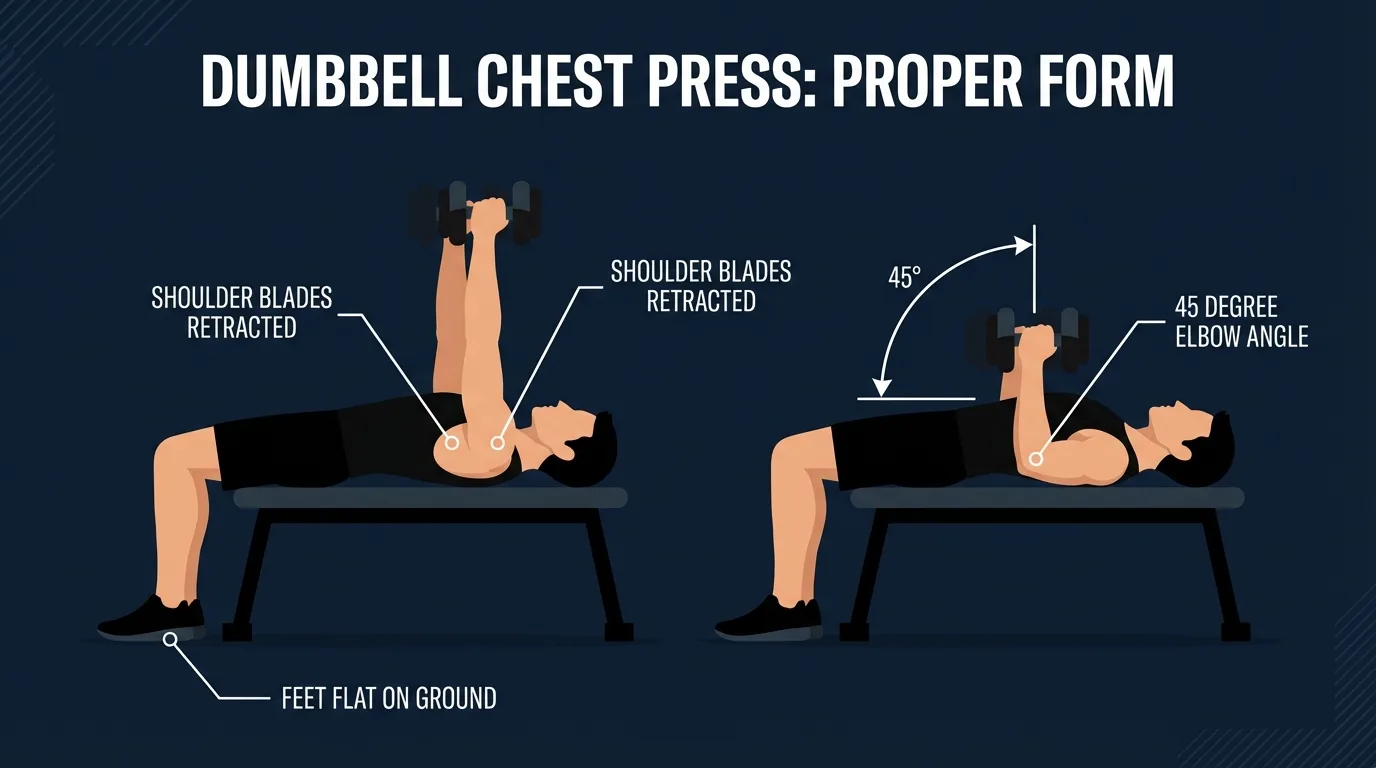
Common Mistakes (and How to Fix Them)
The dumbbell chest press looks straightforward, but small form errors change which muscles do the work and how much stress hits your shoulder joint. Here's what to watch for.
- Flaring the elbows to 90 degrees. When your elbows point straight out from your shoulders, the anterior shoulder capsule takes massive stress at the bottom of the press. This is the number one cause of bench press shoulder pain. Tuck your elbows to 45 degrees. It feels less "powerful" at first, but your shoulders will last decades longer.
- Losing your shoulder blade retraction. When your shoulder blades flatten against the bench mid-set, your shoulders roll forward. Now you're pressing with your front delts instead of your chest, in a position that grinds the shoulder joint. If you can't keep your blades set, the weight is too heavy. Drop it.
- Pressing above your face. The dumbbells should travel above your chest, not above your head or neck. Pressing too far back shifts the load onto your front delts and puts the shoulder in an unstable position. At the top of the press, the dumbbells should sit roughly over your nipple line.
- Arching your back off the bench. A slight natural arch is fine and desirable. But if your entire lower back lifts off the bench, you're using your spine as a lever to move weight your chest can't handle. Drop the weight and keep your glutes on the bench.
- Rushing the reps. Speed kills the chest press the same way it kills every other lift. If you're whipping the dumbbells up in half a second, momentum is doing the work. Your muscles need time under tension to grow. Two to three seconds down, one second pause, one to two seconds up.
- Locking out aggressively at the top. Pressing all the way to full elbow lockout transfers tension from your chest to your triceps and skeleton. Stop just short of full extension to keep constant tension on the pecs. Your arms should be nearly straight, never locked.
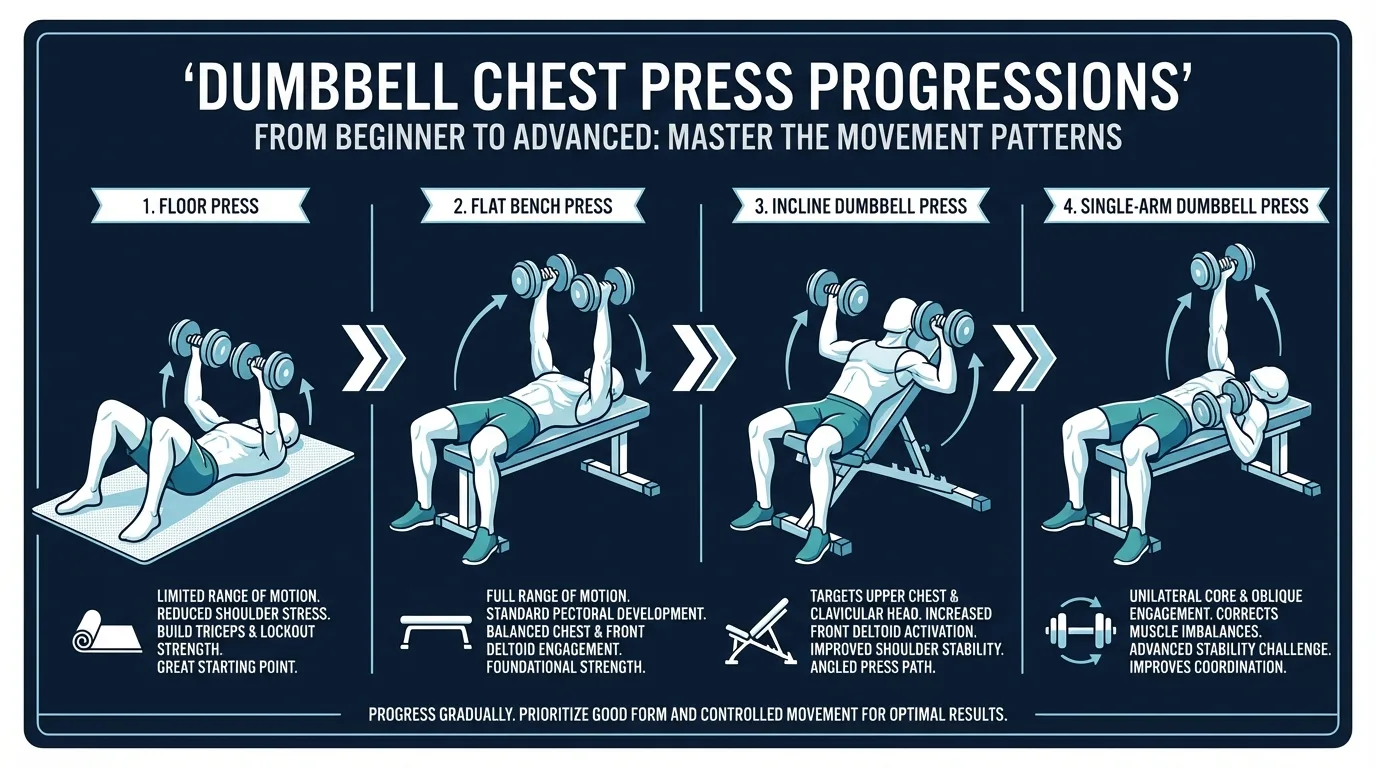
Variations: From Floor to Incline
Floor Press (Beginner Regression)
No bench? No problem. Lie on the floor with your knees bent and feet flat. The floor acts as a natural range-of-motion limiter. Your elbows stop at ground level, which eliminates the deepest (and most shoulder-stressful) portion of the press. This is a great starting point for beginners or anyone rehabbing shoulder issues. Once you can do 3 sets of 12 reps with good form on the floor, you're ready for the bench.
Flat Dumbbell Bench Press (Standard)
Standard form on a flat bench, as described in the step-by-step above. The default variation for most lifters once they've outgrown the floor press. Trains the full pec under stretch with maximum range of motion.
Incline Dumbbell Press (Intermediate Progression)
Set the bench to 30 to 45 degrees. This shifts emphasis toward the clavicular (upper) head of the pectoralis major. Incline angles in the 30 to 45 degree range increase upper pec activation compared to flat pressing, while higher angles (60 degrees and up) start shifting too much load onto the anterior deltoid. You'll use about 15 to 20% less weight than your flat press. The same form rules apply: blades back, elbows at 45 degrees, controlled descent.
Single-Arm Dumbbell Press (Intermediate to Advanced)
Press one dumbbell at a time while the other arm holds its dumbbell at the top. This adds an anti-rotation core demand and doubles the time under tension per side. It's excellent for fixing left-right strength imbalances, and the unilateral loading recruits your obliques and deep core stabilizers harder than the bilateral version. Use about 80% of your normal weight per arm.
When to Avoid or Modify Dumbbell Chest Press
The dumbbell chest press is safe for most healthy adults, but a few conditions warrant modification or a temporary swap to easier variations. Always consult your physician or physical therapist for personalized guidance.
- Recent shoulder, wrist, or elbow surgery or injury. Pressing under load can re-aggravate healing tissue. Get clearance from your surgeon or PT before pressing. Most post-surgical protocols start with scapular isometrics, then floor press with very light dumbbells, before introducing bench variations on a controlled timeline.
- Active shoulder impingement or rotator cuff irritation. Full-range bench pressing can compress the supraspinatus tendon at the bottom of the rep. Stay with the floor press, keep elbows at 45 degrees (not flared), and work only within a pain-free range. If symptoms persist for more than a week or two, see a physical therapist before progressing back to the bench.
- Uncontrolled hypertension or known cardiovascular disease. The Valsalva maneuver during heavy pressing spikes intrathoracic and blood pressure. Use lighter loads, longer rest periods, avoid 1-rep-max attempts, and follow your cardiologist's exercise guidance.
- Pregnancy, especially second and third trimester. The supine bench position can compress the vena cava and reduce blood return after the first trimester. Substitute with an incline-bench variation (head and torso elevated above 30 degrees) or seated machine chest press. Use lighter loads and follow your obstetrician's resistance-training guidance.
- First 6 to 8 weeks postpartum or active diastasis recti. Heavy bracing during the press increases intra-abdominal pressure and can widen abdominal separation. Restore deep-core function first with deadbugs and bird-dogs, then return with very light dumbbells and a focus on connected, breathing-led pressing.
- Lower-back pain that worsens with back arch. If you can't keep your lower back in a slight neutral arch without pain, the bench position is loading the lumbar spine. Drop to the floor press (which forces a flatter lower-back position) and rebuild bracing strength with forearm planks, deadbugs, and bird-dogs.
Related Exercises
If the dumbbell chest press is part of your routine, these movements complement or extend the same training pattern:
- Same muscle group (chest isolation): the Chest Fly isolates the pecs through horizontal adduction, pairing well with the press for complete chest development. Press for strength, fly for isolation and stretch. The Pec Squeeze Crossover works as a bodyweight or low-load alternative.
- Same pressing pattern (bodyweight): Push-Ups train the same horizontal-press pattern with bodyweight, which makes them a perfect warm-up, accessory, or travel substitute when dumbbells aren't available.
- Same muscle group (vertical push): the Dumbbell Shoulder Press and the Arnold Press press vertically rather than horizontally, biasing the anterior deltoid and upper pec. Pair with the chest press in a balanced upper-body session.
- Opposing pull pattern (programming balance): Bent-Over Rows pull horizontally to balance the horizontal press. Match push and pull volume across the week to keep shoulders healthy.
- Tricep accessory: the Overhead Tricep Press or Tricep Kickbacks isolate the triceps after the compound press has handled the chest. Useful as the final movement of an upper-body day.
- Core foundation for spinal bracing: Deadbugs, Bird-Dogs, and Forearm Planks teach the bracing pattern that keeps the lower back stable under pressing load.
How to Program Dumbbell Chest Press
Dumbbell chest press programming follows the same evidence-based ranges as any compound pressing exercise. The American College of Sports Medicine (ACSM) Position Stand on resistance training recommends roughly 8 to 12 reps per set for hypertrophy and 3 to 6 reps for maximum strength, with at least 48 to 72 hours between sessions training the same muscle group (Ratamess et al., 2009).
| Level | Sets × Reps | Rest between sets | Frequency |
|---|---|---|---|
| Beginner (floor press, light weight) | 2-3 × 8-12 | 90-120 seconds | 1-2 sessions/week |
| Intermediate (flat bench) | 3-4 × 8-12 | 120-180 seconds | 2 sessions/week |
| Advanced (incline, single-arm, heavier loads) | 3-5 × 6-10 | 180-240 seconds | 2-3 sessions/week |
Where in your workout: the dumbbell chest press belongs early in an upper-body session, when you're fresh. It's a compound movement that needs maximum motor unit recruitment, so don't push it to the end of a fatigued workout. Pair it with an opposing horizontal pull (rows) in the same session to balance push and pull volume. Follow up with chest isolation (chest fly) and a tricep accessory if you're running a chest-and-triceps split.
Form floor over rep targets: if your last 2 reps of a set break form (elbow flare, shoulder blades flattening, lower back arching off the bench), stop the set there. Hitting a target rep count with broken form trains worse movement patterns and risks the shoulder joint. Cleanly hitting fewer reps beats grinding out ugly extras every time.
How FitCraft Programs This Exercise
Knowing how to do a dumbbell chest press is step one. Knowing when to do it, what variation suits your level, and how to progress is where most people get stuck.
FitCraft's AI coach Ty handles that. During your personalized diagnostic assessment, Ty maps your fitness level, goals, and available equipment. Then Ty builds a personalized program that slots the dumbbell chest press into a balanced training plan at the right variation, whether that's floor press to start, flat bench at intermediate, or incline and single-arm work as you progress.
As you get stronger, Ty adjusts the variation and volume to match your level. Volume adjusts based on your recovery and consistency. Every program is designed by an Ivy League-trained exercise scientist and NSCA-certified strength coach using evidence-based periodization, then adapted to you by the AI.
Frequently Asked Questions
What muscles does the dumbbell chest press work?
The dumbbell chest press primarily works the pectoralis major (both the sternal and clavicular heads), with significant contribution from the anterior deltoid (front shoulder) and triceps brachii (back of the upper arm). Secondary stabilizing muscles include the rotator cuff, serratus anterior, and the entire anterior core. It is a compound pushing movement that trains multiple upper-body muscles in one pattern.
Can I do the dumbbell chest press if I have shoulder pain?
Often yes, with modification. The two most common culprits behind chest press shoulder pain are elbow flare (elbows opening past 45 degrees from the torso) and pressing the dumbbells above your face rather than above your chest. Tuck your elbows to a 45-degree angle, keep the press path stacked over your nipple line, and try the floor press variation, which stops the descent at ground level and removes the deepest range where the shoulder joint is most loaded. If pain persists for more than a week or two, see a physical therapist before continuing.
Is the dumbbell chest press better than the barbell bench press?
Each has tradeoffs. Dumbbells allow a greater range of motion at the bottom of the press, which increases pec stretch and recruits more stabilizers. They also force each arm to work independently, which helps identify and correct strength imbalances. The barbell lets you lift heavier loads overall, which is better for maximal strength development. For home and small-equipment training, the dumbbell chest press is the more practical and shoulder-friendly default.
How heavy should dumbbells be for chest press?
Start with a weight you can press for 8 to 12 reps with controlled form. For most beginners, that means 10 to 20 lb dumbbells. Intermediate lifters typically use 25 to 50 lb dumbbells. The right weight lets you lower for 2 to 3 seconds with control and press without arching your lower back off the bench. If you need momentum or your lower back lifts, drop the weight.
Can I do the chest press on the floor without a bench?
Yes. The floor press is a legitimate variation of the dumbbell chest press. The floor limits your range of motion by stopping your elbows at ground level, which reduces shoulder stress and makes it a safer option for beginners or anyone with shoulder sensitivity. You give up a small amount of pec stretch at the bottom, but the pressing mechanics are otherwise identical.
How often should I do the dumbbell chest press?
Most people benefit from chest pressing 1 to 2 times per week with at least 48 to 72 hours between sessions for recovery. Beginners can start with once per week and add a second session as they adapt. Total weekly volume of 10 to 20 sets for chest, counting all chest exercises, is the evidence-based range for hypertrophy.