The chest fly is one of those exercises people either skip entirely or do with terrible form. And honestly? The terrible-form crowd might be worse off than the skippers. A chest fly done wrong is basically a shoulder injury waiting to happen. But done right, it is one of the most effective pec isolation exercises you can do with a pair of dumbbells. Full stop.
Here is why it matters. The bench press gets all the glory for chest development, but the fly trains a movement pattern the press physically cannot: horizontal adduction with a stretched starting position. A 2020 study in the Journal of Strength and Conditioning Research found that the dumbbell fly produced pectoralis major activation comparable to the bench press, with significantly less triceps involvement (Solstad et al., 2020). So more of the work goes directly to your chest.
And the stretch component? It matters more than most people realize. Research on muscle hypertrophy consistently shows that training a muscle through a full range of motion, especially in the lengthened position, produces superior muscle growth compared to partial-range training. A 2023 meta-analysis in Sports Medicine confirmed that exercises emphasizing the stretched position led to greater hypertrophy (Maeo et al., 2023). The chest fly puts your pecs under load in exactly that stretched position. That is sort of the whole point.
Quick Facts: Dumbbell Chest Fly
- Equipment needed: Pair of dumbbells (10-35 lb per hand depending on level); flat or adjustable bench optional (floor works for beginners)
- Difficulty: Beginner to Intermediate (Advanced with single-arm, tempo, or drop-set variations)
- Modality: Isolation, bilateral, horizontal adduction pattern
- Body region: Chest (with shoulder and core support)
- FitCraft quest category: Strength
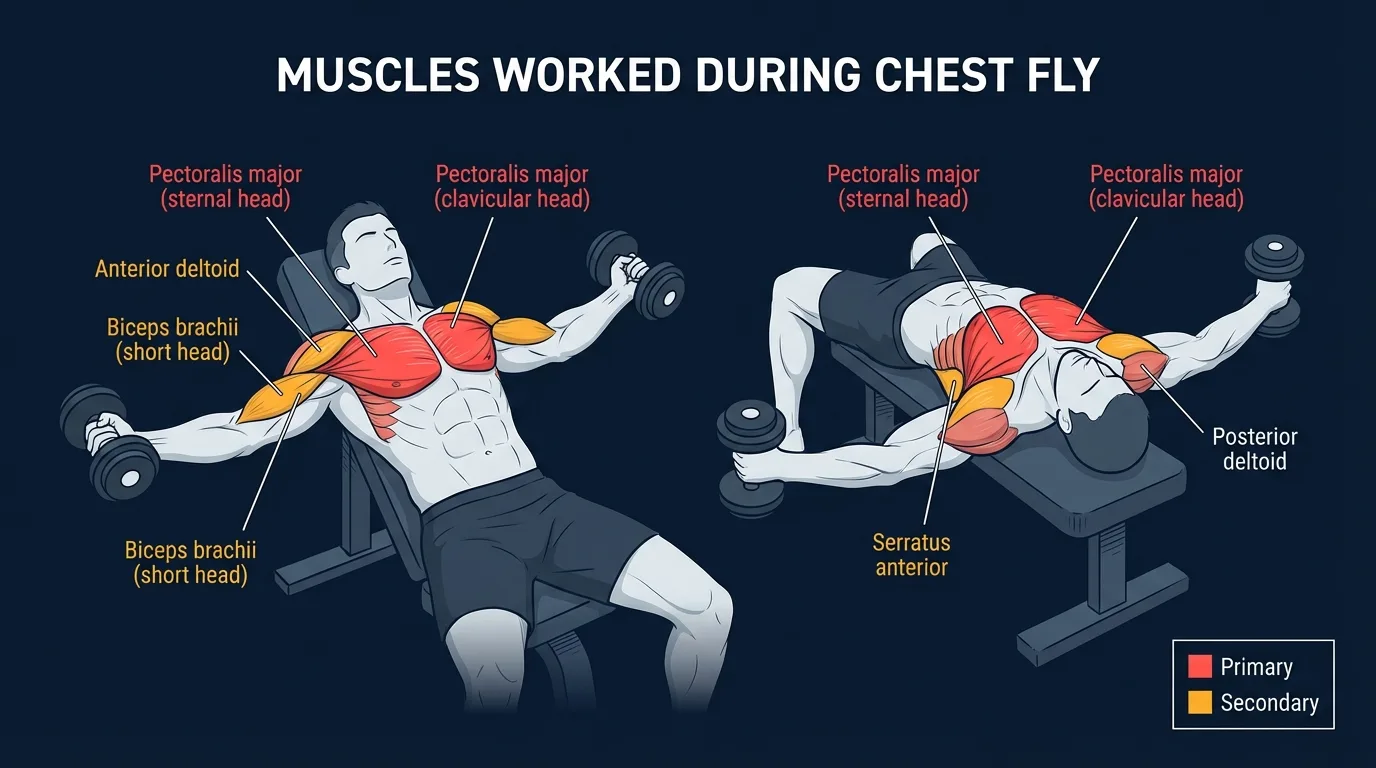
Muscles Worked
Primary movers. The pectoralis major does the work, both its sternal (lower, larger) head and its clavicular (upper) head. Concentrically, the pec contracts to drive horizontal adduction, sweeping the upper arms back across the front of the chest. Eccentrically, the same muscle lengthens under load as the arms open out to the sides, which is the part of the rep where most of the hypertrophy stimulus actually lives.
Secondary movers. The anterior deltoid assists with horizontal adduction at the top of the arc, especially as the dumbbells approach the midline. The short head of the biceps brachii contributes a small amount of horizontal adduction at the shoulder because it crosses the joint. The serratus anterior helps protract the scapula at the very top, allowing the dumbbells to travel that last few inches together. These muscles support, but the pec is doing the heavy lifting.
Stabilizers. The rotator cuff (supraspinatus, infraspinatus, teres minor, subscapularis) works isometrically to keep the humeral head centered in the glenoid, which is critical at the stretched bottom position. The rhomboids and middle trapezius hold the scapulae retracted against the bench, which is what shifts the workload onto the pec instead of the front of the shoulder. The core (rectus abdominis, transverse abdominis, obliques) braces to keep the rib cage stacked over the pelvis so the lumbar arch stays neutral.
Evidence. Solstad et al. (2020) measured EMG activity in the pectoralis major, anterior deltoid, and triceps brachii during dumbbell flys, dumbbell bench presses, and barbell bench presses. The dumbbell fly produced pec activation statistically equivalent to the bench press but with significantly lower triceps involvement, confirming the fly's role as a chest-isolated alternative. For programming, Maeo et al. (2023) reviewed studies on training muscles in the lengthened versus shortened position and found that lengthened-position training (which the fly emphasizes at the bottom of the arc) produced greater hypertrophy than partial-range work, which matters because the fly's defining feature is the loaded stretch.
How to Do a Dumbbell Chest Fly (Step-by-Step)
-
Lie back and set your grip. Lie flat on a bench or on the floor with a dumbbell in each hand. Press the dumbbells up so your arms are extended above your chest, palms facing each other. Now pull your shoulder blades together and press them into the bench. This part is critical. If your shoulder blades are flat, you have basically turned the fly into a front delt exercise. Keep a slight bend in your elbows, about 15-20 degrees. Lock that angle in place. It does not change for the entire set.
Coach Ty's cue: "Set your blades before every set. If they flatten, your shoulders take over."
-
Open your arms wide. Lower the dumbbells out to the sides in a wide arc, keeping that slight elbow bend frozen. Think about opening your arms like you are hugging a big tree in reverse. Lower until your upper arms are roughly level with your torso or you feel a solid stretch across your chest. Do not go deeper than your shoulders comfortably allow. If you feel a pinch in the front of your shoulder? Too far.
Coach Ty's cue: "Lock your elbow angle. Same 15-20 degree bend at the top, the bottom, and every inch in between."
-
Squeeze the dumbbells back together. Reverse the arc, driving through your chest to bring the dumbbells back above your sternum. Imagine you are wrapping your arms around a barrel. The dumbbells should nearly touch at the top. Squeeze your pecs hard for a one-count at the peak. You should feel it deep in your chest, not in your shoulders or arms.
Coach Ty's cue: "Squeeze like you are trying to crack a walnut between your pecs. The squeeze is half the exercise."
-
Control your breathing. Inhale as you open your arms and lower the weights. Exhale as you squeeze them back together. Keep your core braced throughout. Your lower back should maintain its natural arch. Do not let it peel off the bench, and do not jam it flat either.
-
Reset and repeat. At the top, check that your shoulder blades are still retracted and your elbows still have that slight bend. If your elbows start straightening out, you are turning the fly into a press. If they are bending more, the weight is too heavy. Beginners: 3 sets of 10-12 reps with light dumbbells (10-15 lbs). Control the weight. Do not rush.
Coach Ty's cue: "Two to three seconds down, one-second squeeze, one to two seconds up. Slow is the whole point."
Get this exercise in a personalized workout
FitCraft, our mobile fitness app, uses its AI coach Ty to program compound strength exercises like this into your plan at the right volume and intensity, based on your level, goals, and equipment. Ty was designed and trained by Domenic Angelino, MPH (Brown University) and NSCA-CSCS, with research published in the Journal of Strength and Conditioning Research and Medicine & Science in Sports & Exercise.
Take the Free Assessment Free · 2 minutes · No credit card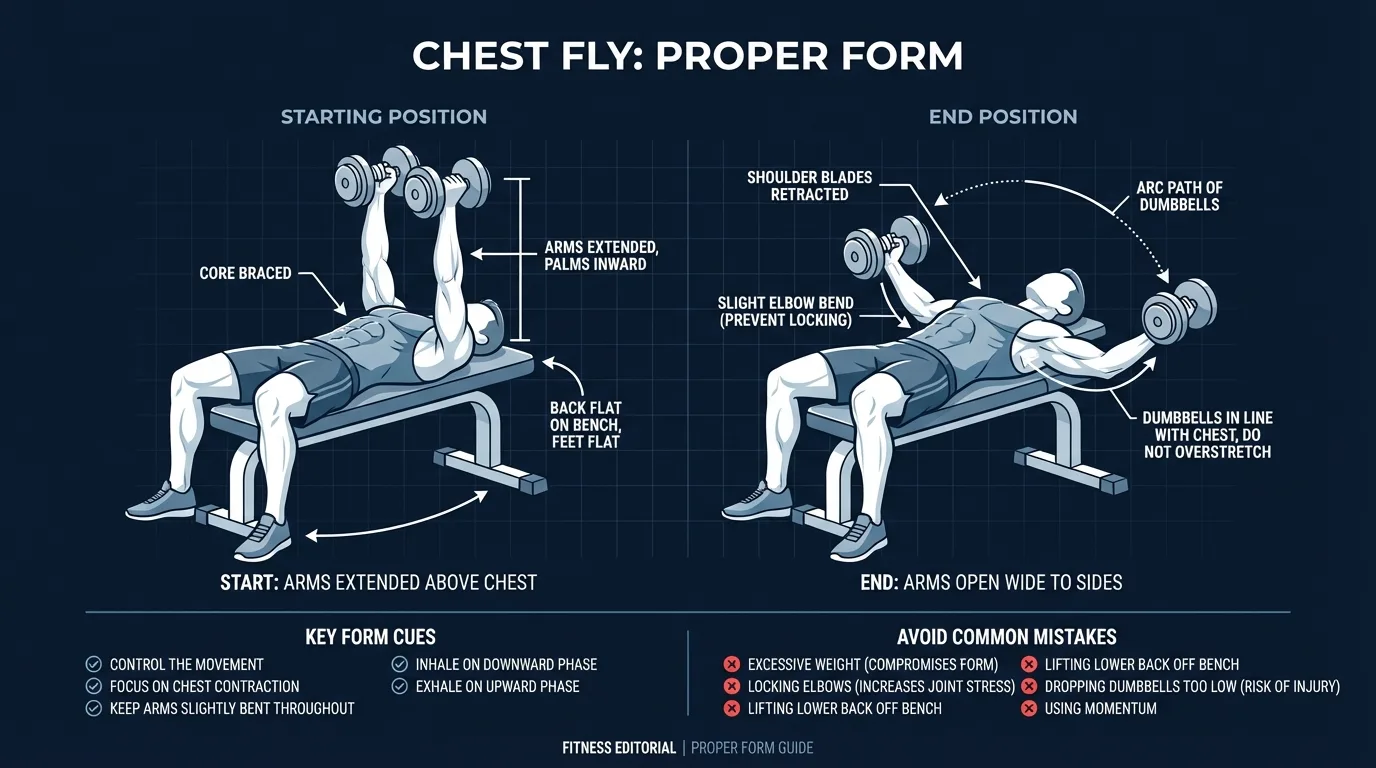
Common Mistakes to Avoid
The chest fly has a deceptively small margin for error. Your shoulder joint is in a vulnerable position throughout the movement, and small form breakdowns can turn a great exercise into a bad time. Here is what to watch for.
- Going too deep at the bottom. This is the number one injury risk. When you lower the dumbbells past the point where your upper arms are level with your torso, the anterior shoulder capsule takes excessive stress. Most shoulder injuries from chest flies happen right there, at the bottom. The fix: stop when you feel a stretch, not when you feel a pull. If you are doing floor flies, the floor naturally limits your range and makes this a non-issue.
- Straightening the elbows. When your elbows lock out, the fly becomes a press and all the isolation benefit disappears. And straight arms create a much longer lever, which puts way more torque on the shoulder joint. Keep that 15-20 degree bend. Non-negotiable.
- Using too much weight. The fly uses a long lever arm. Physics does not care about your ego. Even 20 lb dumbbells create substantial torque when your arms are extended wide. If you cannot control the eccentric (lowering) phase for at least 2 seconds, the weight is too heavy. Drop it. A lighter weight with perfect form will build more chest than a heavy weight with sloppy form. Every single time.
- Flat shoulder blades. When your shoulder blades are not retracted, the anterior deltoid and front of the shoulder take over the movement. You end up training your shoulders instead of your chest, in a position that is not even great for your shoulders anyway. Pin your blades back before you start and keep them there.
- Rushing the reps. Momentum kills the fly. The entire value of this exercise is the controlled stretch and the peak contraction. If you are whipping the dumbbells up and down, you are getting almost nothing from the movement. Honestly, slow is the whole point. Two to three seconds down, one-second squeeze, one to two seconds up.
- Pressing instead of arcing. The dumbbell path should be a wide, sweeping half-circle. If the dumbbells are moving straight up and down, you are doing a press. Arc out, arc back. The wider the path, the more isolated the chest work.
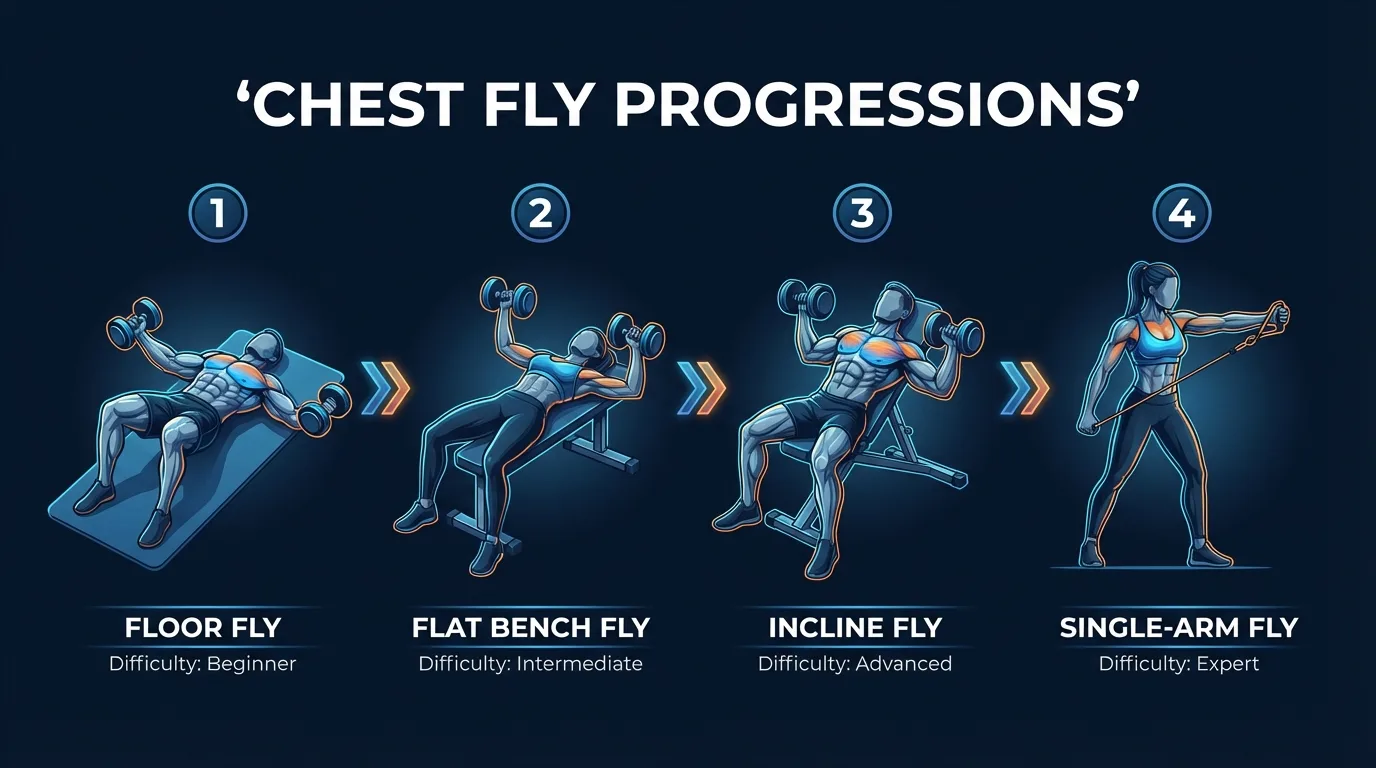
Variations: From Floor to Single-Arm
Floor Chest Fly (Beginner)
This is where everyone should start. Lie on the floor instead of a bench, and the floor acts as a natural range-of-motion limiter. Your elbows physically cannot drop below your torso. That removes the most dangerous part of the movement (the deep stretch) while you learn the arc pattern and build shoulder stability. Once you can do 3 sets of 12 reps on the floor with controlled form, you are ready for the bench.
Flat Bench Chest Fly (Beginner-Intermediate)
The standard version. The bench allows a deeper stretch at the bottom, which increases the hypertrophy stimulus. But with that deeper range comes more shoulder demand, so you have to earn it. Control the descent, do not go past where you feel a comfortable stretch, and keep those shoulder blades pinched. This is the version Coach Ty programs most often in FitCraft.
Incline Dumbbell Fly (Intermediate)
Set the bench to 30-45 degrees. The incline shifts emphasis toward the clavicular (upper) head of the pectoralis major. EMG research shows that incline angles between 30 and 45 degrees increase upper pec activation compared to flat variations (Rodríguez-Ridao et al., 2020). You will use less weight than flat flies because the upper pec is a smaller muscle group. Start with about 70% of your flat fly weight.
Single-Arm Floor Fly (Advanced)
One dumbbell, one arm, lying on the floor. This adds an anti-rotation core demand and forces each side of your chest to work independently. It is great for finding and fixing strength imbalances between your left and right pecs. Use about 80% of the weight you would use for bilateral flies and brace your core hard to prevent rolling.
Alternative Exercises
If chest flies are not in the cards right now (limited shoulder mobility, no dumbbells, or the movement just causes discomfort), try these instead:
- Push-ups: Train the pecs through a horizontal press pattern. The bottom of a push-up provides some of the same stretched-position stimulus as a fly. Wider hand placement increases pec involvement.
- Pec Squeeze Crossovers: A standing isolation movement that mimics the squeeze portion of the fly without loading the shoulder in the stretched position. Useful while a shoulder issue clears up.
- Hand planks: Build the shoulder stability you need before attempting flies with load. A strong plank position transfers directly to the shoulder blade control needed during the fly.
When to Avoid or Modify Chest Flys
Chest flies are safe for most healthy adults, but the stretched bottom position is unforgiving if anything is wrong with the shoulder, spine, or cardiovascular system. None of these are permanent restrictions. Always consult your physician or physical therapist for personalized guidance, especially before returning to load after pain or injury.
- Acute shoulder pain, impingement, or rotator cuff irritation. The bottom of the fly loads the anterior shoulder capsule in its most vulnerable position. Restrict range so upper arms never drop below torso level, switch to floor flies (the floor caps range), or substitute the chest press while the shoulder settles. If pain persists past a week, see a PT before progressing.
- Recent shoulder, elbow, or thoracic-spine surgery. Get clearance from your surgeon. Most post-surgical protocols start with isometric scapular work and supine pec stretches before introducing loaded horizontal adduction. Do not freelance the return to flies.
- Uncontrolled hypertension or known cardiovascular disease. The supine position plus chest-loaded breath holds can spike intrathoracic pressure. Use lighter loads with longer rest, breathe through every rep, avoid attempting max sets, and follow your cardiologist's exercise guidance.
- Pregnancy, especially second and third trimester. Supine positions after the first trimester can compress the vena cava and reduce venous return. Substitute standing cable flies or seated machine flies (if available), or use an incline bench to keep the torso elevated and avoid full supine loading.
- First 6-8 weeks postpartum or active diastasis recti. Heavy bracing on the bench can widen abdominal separation. Restore deep-core function first with deadbugs and bird-dogs, and skip flies until you can hold a plank without doming.
- Tight pec minor or rounded shoulder posture. If your shoulders cannot retract flat to the bench without your rib cage flaring, you will compensate at the shoulder. Open up the pec minor first with stretching, then return to floor flies before loading the bench version.
Related Exercises
If chest flies are part of your routine, these movements complement, prepare for, or extend the same training pattern:
- Same muscle group (compound press): Chest Press and Push-Ups train the pec through a press pattern that lets you move more total load than the fly can. Most chest programs benefit from pairing one press with one fly.
- Same isolation pattern (squeeze): Pec Squeeze Crossovers hit the same horizontal-adduction pattern from a standing position without the supine bench position, useful as a finisher or for circuits.
- Antagonist pull (shoulder balance): Bent-Over Rows and Pull-Apart balance the front-loaded pressing volume of a chest day and keep the shoulder joint healthy long-term.
- Stretched-position pec accessory: Overhead Pullover loads the pec and lat in a deeply stretched overhead position, a useful complement to the fly's horizontal stretch.
- Core foundation for supine bracing: Deadbugs and Forearm Planks teach the rib-cage-over-pelvis bracing pattern the fly depends on, useful if your lower back peels off the bench during sets.
- Shoulder-press progression: Once flies and presses feel solid, Shoulder Press and Arnold Press extend the pressing pattern overhead for full upper-body development.
How to Program Chest Flys
Chest fly programming follows the same evidence-based ranges as any compound strength accessory. The American College of Sports Medicine (ACSM) Position Stand on resistance training recommends roughly 8-12 reps per set for hypertrophy and 12-15+ for muscular endurance, with at least 48 hours between sessions training the same muscle group (Ratamess et al., 2009). Because the fly creates substantial eccentric muscle damage in the stretched position, recovery time matters more than for most pressing movements.
| Level | Sets × Reps | Rest between sets | Frequency |
|---|---|---|---|
| Beginner (floor, 10-15 lb) | 2-3 × 10-12 | 60-90 seconds | 1-2 sessions/week |
| Intermediate (flat or incline bench, 15-25 lb) | 3-4 × 10-15 | 90-120 seconds | 1-2 sessions/week |
| Advanced (tempo, single-arm, drop sets, 25-35 lb) | 3-4 × 12-15 | 90-120 seconds | 2 sessions/week |
Where in your workout: Chest flies belong second or third in a chest session, after your main pressing movement (push-ups, chest press, or bench press). The fly is an accessory built around the loaded stretch, so doing it first wastes the chance to move heavier loads on the press while you are fresh. A typical chest day order: pressing compound first, fly second, optional tricep work third. In a full-body session, place the fly after the day's main upper-body push.
Form floor over rep targets: if your elbows start bending more, your shoulder blades flatten, or your range collapses inward in the last 2 reps of a set, stop the set there. The fly is a hypertrophy accessory built on the loaded stretch. Hitting a target rep count by cheating the range eliminates the only reason the exercise works.
How FitCraft Programs This Exercise
Knowing how to do a chest fly is step one. Knowing when to do it, how heavy, and which variation matches your current shoulder stability is where most people get stuck.
FitCraft's AI coach Ty handles that. During your personalized diagnostic assessment, Ty maps your fitness level, goals, available equipment, and any injury history. Then Ty builds a personalized program that slots chest flies into a balanced chest day at the right variation: floor for beginners, flat bench as shoulder stability improves, incline once you want more upper-pec emphasis, single-arm once you can hold the position without rolling.
As you get stronger, Ty adjusts the variation, weight, and volume to match your level. Every program is designed by an Ivy League-trained exercise scientist and NSCA-certified strength coach using evidence-based periodization, then adapted to you by the AI. The 3D demonstrations show the exact arc path from multiple angles, which helps the movement pattern click faster than reading about it.
Frequently Asked Questions
Can I do chest flies if I have shoulder pain?
Not while pain is acute. The chest fly puts the anterior shoulder capsule in a vulnerable stretched position at the bottom of the rep, which is exactly where most fly-related injuries happen. Restrict the bottom range so your upper arms never drop below your torso, use much lighter dumbbells (5-10 lb), and consider switching to floor flies (the floor caps the range automatically). If pain persists for more than a week or worsens during the eccentric phase, see a physical therapist before progressing. The chest press or push-up may be a safer pressing pattern while the shoulder recovers.
What muscles does the chest fly work?
The chest fly primarily targets the pectoralis major, both the sternal (lower) and clavicular (upper) heads. Secondary muscles include the anterior deltoid, the short head of the biceps brachii, and the serratus anterior. Because the fly is an isolation movement, the chest does the vast majority of the work without significant triceps involvement.
Is the chest fly better than the bench press?
They serve different purposes. The bench press is a compound movement that lets you move more weight and trains the chest, shoulders, and triceps together. The chest fly isolates the pectoralis major through horizontal adduction, which produces a deeper stretch and stronger peak contraction in the chest specifically. Most programs benefit from including both.
How heavy should I go on chest flies?
Lighter than you think. The chest fly uses a long lever arm (your extended arm acts as the lever), which means even moderate weight creates significant torque on the shoulder joint. Most beginners should start with 10-15 lb dumbbells. Intermediate lifters typically use 20-35 lb dumbbells. If you can't control the weight through the full range of motion without your elbows bending more, it's too heavy.
Should I do chest flies on the floor or a bench?
Floor flies are a great starting point, especially for beginners. The floor limits your range of motion so your shoulders can't go past parallel, which reduces injury risk. Bench flies allow a deeper stretch at the bottom, which increases muscle fiber recruitment in the pecs. Start on the floor to learn the pattern, then progress to a bench when your shoulder stability improves.
Can chest flies cause shoulder injury?
Yes, if done incorrectly. The most common injury risk comes from going too deep at the bottom of the movement, which places excessive stress on the anterior shoulder capsule. Using too much weight and losing control of the eccentric phase is the second biggest risk factor. Keep a slight elbow bend, don't lower past your shoulder's comfortable range, and use weight you can control for the full range of motion.