Regular push-ups are symmetrical. Both arms share the load evenly, your body stays centered, and the movement is straightforward. The lateral push-up breaks that symmetry on purpose. You walk one hand out to the side, perform a push-up with an offset stance, walk back to center, then repeat on the other side. That small change makes a big difference.
The offset hand position forces one arm to handle more of your bodyweight than the other. It also means your core has to fight rotation throughout the entire rep because the uneven loading wants to twist you. Your obliques, transverse abdominis, and spinal stabilizers work overtime just to keep your hips level. You get more from each rep without adding any external load.
If you've built a solid base with standard push-ups and want a progression that challenges both your pressing strength and core stability at the same time, the lateral push-up is a strong choice. It bridges the gap between bilateral push-ups and true single-arm work.
Quick Facts: Lateral Push-Up
- Equipment needed: None (optional bench or counter for the incline variation)
- Difficulty: Intermediate (incline) to Advanced (floor)
- Modality: Strength
- Body region: Upper body + core
- FitCraft quest category: Strength
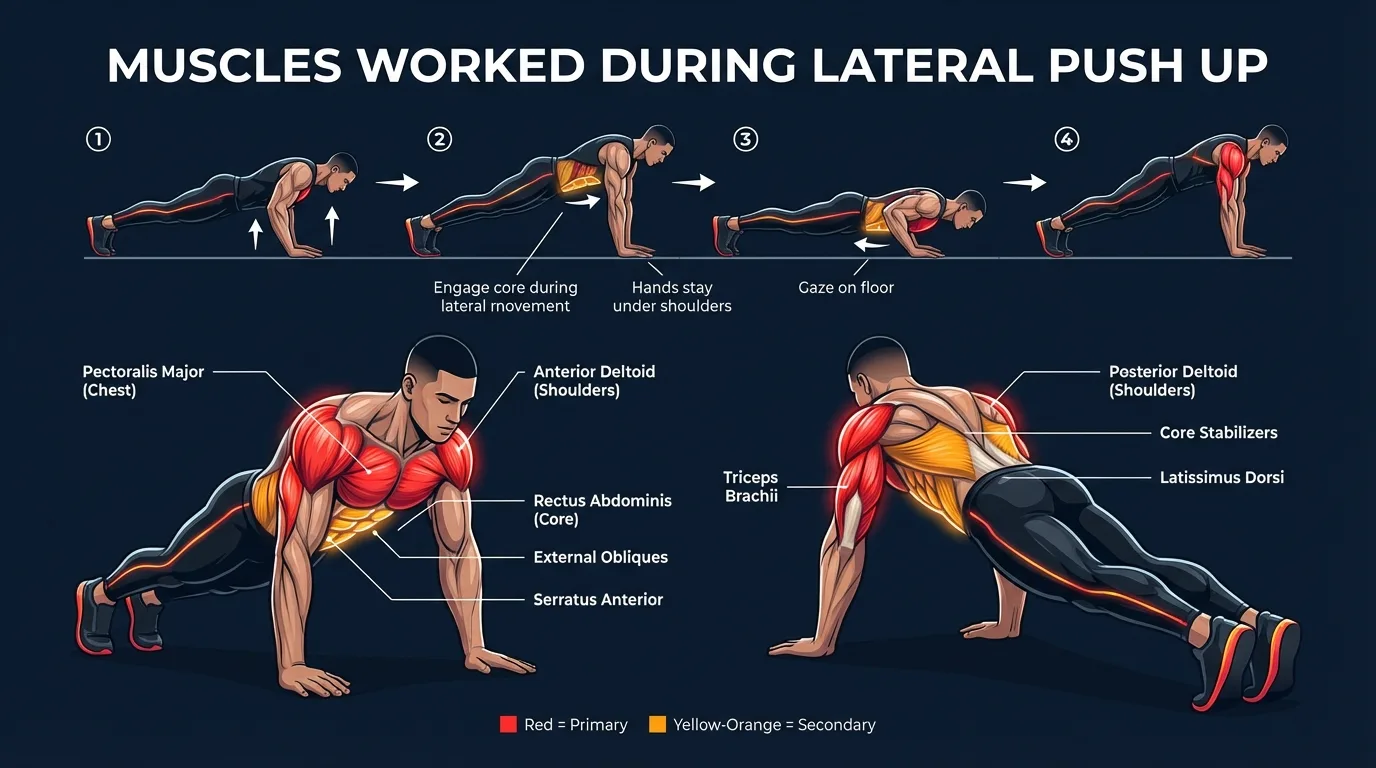
Muscles Worked
Primary movers: the pectoralis major (chest), anterior deltoids (front shoulders), and triceps brachii. These drive the pressing motion on both sides. The asymmetric hand position shifts the bias: the closer (narrower) arm works more through the triceps and inner chest, while the wider arm works more through the outer chest and front shoulder. They shorten on the way up (concentric phase) and lengthen under tension on the way down (eccentric phase), which is what produces the strength stimulus.
Secondary movers: the serratus anterior (the muscle along the side of your ribcage that protracts the shoulder blade at the top of each rep) and the long head of the biceps brachii (a minor stabilizer at the elbow). The serratus works extra hard on lateral push-ups because the offset position threatens scapular stability on the wider side.
Stabilizers: the entire anterior core (rectus abdominis, transverse abdominis, obliques), glutes, posterior deltoids, and rotator cuff. All work isometrically to maintain the rigid plank position throughout every rep. The obliques and transverse abdominis carry an unusually heavy load on lateral push-ups because the asymmetric hand placement creates a constant rotational torque on the torso. Resisting that torque is where most of the anti-rotation core benefit comes from.
How the offset hand position changes the loading: when one hand is wider than the other, the body weight is no longer evenly distributed across the upper limbs. The wider arm acts as a longer lever and bears a different share of the load through a different muscle bias. The narrower arm acts as a shorter lever with more direct vertical force, biasing the triceps. Combined with the constant anti-rotation demand on the core, the lateral push-up produces a pressing stimulus that bilateral push-ups cannot match without external load. The mechanism is leverage, not magic. Walking the hand farther out increases the asymmetry but also increases the shoulder-joint stress on the wider side, which is why 6 to 8 inches is the sweet spot.
Step-by-Step: How to Perform a Lateral Push-Up
The movement has four phases per rep: set position, lateral walk, offset press, return. The cues below apply whether you're on the floor or on an incline.
Step 1: Start in a Standard Push-Up Position
Hands directly under your shoulders, arms extended, body in a straight line from head to heels. Feet about hip-width apart. Brace your core and squeeze your glutes. This is your home base. You'll return here between every rep.
Coach Ty's cue: "Lock your plank before you move. The walk is where bad reps are born."
Step 2: Walk One Hand Out to the Side
Move your right hand roughly 6 to 8 inches outward so your hands are no longer symmetrical. Your right hand is now wider than shoulder-width while your left stays directly under or slightly inside your left shoulder. Keep your hips level and your body straight during the walk. Don't let your hips shift or sag.
Ty's cue: "Keep it small. Six to eight inches is plenty."
Step 3: Perform a Push-Up in the Offset Position
Bend your elbows and lower your chest toward the floor. The asymmetric placement loads the closer arm (left) more heavily through the triceps and the wider arm (right) more through the chest and shoulder. Lower until your chest is an inch or two from the floor, then press back up powerfully. Keep your core tight to prevent your torso from rotating.
Ty's key cue: "Hips stay dead level. If they tip toward the wider side, squeeze the glutes harder and brace the abs like someone's about to tap your stomach."
Step 4: Own the Bottom Position
The hardest part of a lateral push-up is the bottom where your chest is near the floor and your weight is unevenly distributed. Pause for a beat at the bottom. If you can control that position, you own the exercise. If you can't, you need to regress to incline.
Ty's cue: "Pause and prove you own it. Then press."
Step 5: Return to Center and Switch Sides
Walk your right hand back to the starting position so both hands are under your shoulders. Then walk your left hand out 6 to 8 inches to the side and perform a push-up on that side. That's one full rep. Alternate sides each rep.
Ty's reminder: "Same depth on both sides. The weaker side doesn't get to cheat the range."
Get this exercise in a personalized workout
FitCraft, our mobile fitness app, uses its AI coach Ty to program pressing exercises like this into your plan at the right volume and intensity, based on your level, goals, and equipment. Ty was designed and trained by Domenic Angelino, MPH (Brown University) and NSCA-CSCS, with research published in the Journal of Strength and Conditioning Research and Medicine & Science in Sports & Exercise.
Take the Free Assessment Free · 2 minutes · No credit card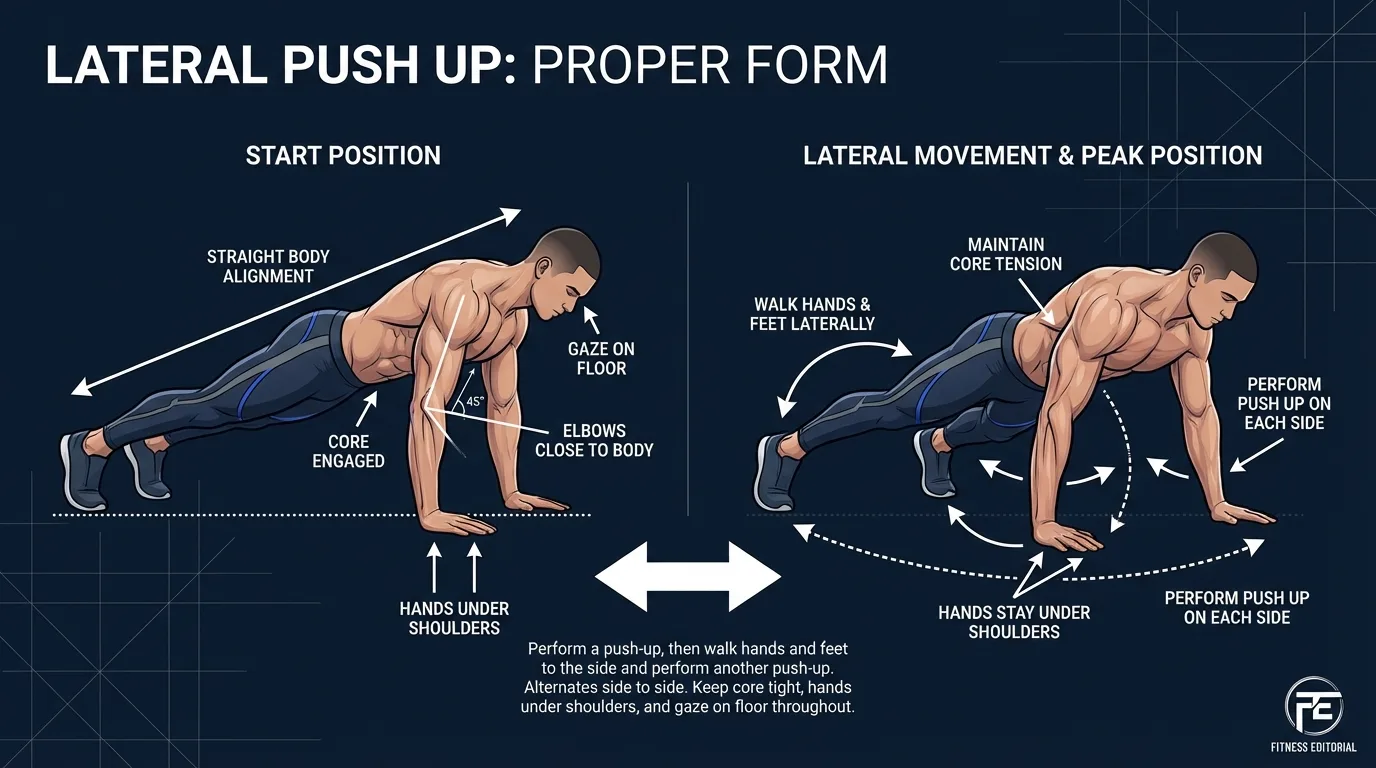
Common Mistakes (and How to Fix Them)
The lateral push-up has more moving parts than a standard push-up, which means more opportunities for form to break down. Here are the mistakes Ty corrects most often.
- Hip rotation. The biggest and most common mistake. When one hand is wider, your body wants to rotate toward the loaded side. Your hips twist, your torso tilts, and the core stability benefit vanishes. Fix: squeeze your glutes harder and press both feet into the floor. If you can't stop the rotation, you're not ready for this variation yet.
- Walking too wide. Moving the hand way out past shoulder-width feels harder, and it is, but in a bad way. Excessive width puts the shoulder into abduction and internal rotation under load, which is a recipe for impingement. Stay within 6 to 8 inches from your starting position. The asymmetry doesn't need to be dramatic to be effective.
- Rushing the lateral walk. The walk phase isn't a transition to skip through. It's part of the exercise. When you rush the hand placement, you end up with sloppy positioning and inconsistent loading from rep to rep. Move deliberately. Place your hand with intention.
- Sagging hips. Same as any push-up: when the core fatigues before the pressing muscles, the hips drop toward the floor. This is even more likely in lateral push-ups because the anti-rotation demand tires the core faster. End the set when your hips start to sag. Continuing with bad form trains the wrong pattern.
- Unequal range of motion on each side. People go deeper on their dominant side and cheat the range on their weaker side. Pay attention to both sides. Your chest should reach the same depth on the left offset and the right offset. If one side is weaker, that side needs the full range even more.
- Elbow flare. Same rule as any push-up variation: elbows angle back at roughly 45 degrees from your torso, not flared out to 90. The flared position puts too much stress on the shoulder joint, especially when the loading is already asymmetric.
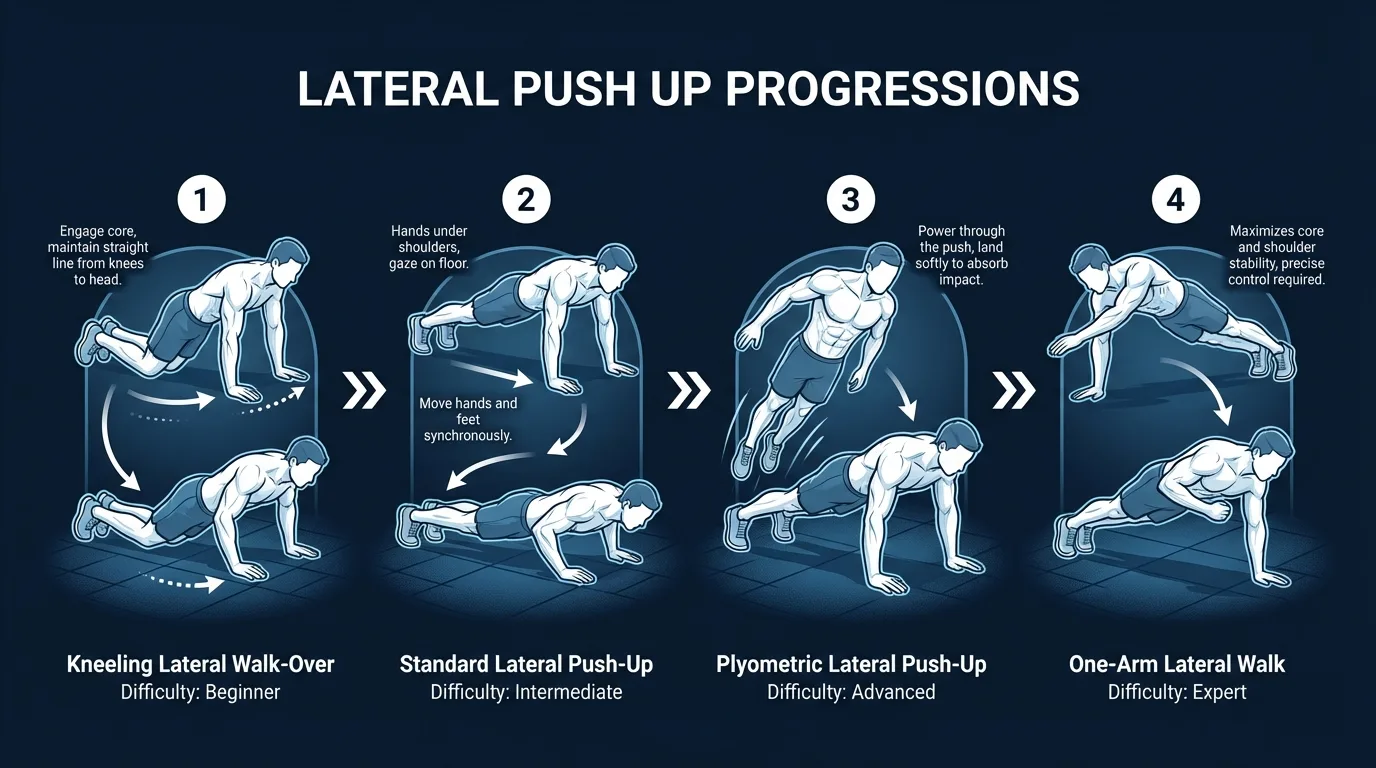
Lateral Push-Up Variations: Regressions and Progressions
Incline Lateral Push-Up (Intermediate Regression)
Hands on a bench, countertop, or wall, performing the same lateral walk and offset press. The incline reduces the percentage of bodyweight you're handling, making the anti-rotation demand more manageable. Start with a surface about waist height and work your way down. Once you can do 3 sets of 10 per side at knee height with level hips, you're ready for the floor version.
Floor Lateral Push-Up (Advanced)
The standard version described above. Hands on the floor, lateral walk, offset press, return to center. This is the version Coach Ty programs most for users who have graduated from regular push-ups and diamond push-ups. Master this with clean form and level hips before adding difficulty.
Feet-Elevated Lateral Push-Up (Expert)
Feet on a bench or step, performing the lateral push-up on the floor. The elevation increases the bodyweight load on your arms and shifts emphasis toward the upper chest and front delts. The anti-rotation demand also increases because the higher center of gravity makes the asymmetric position less stable. Use a surface 12 to 18 inches high.
Lateral Push-Up with Slide (Expert)
Place a furniture slider or towel under one hand on a smooth floor. Slide the hand out laterally as you lower into the push-up, then pull it back as you press up. This makes the movement continuous, eliminates the stop-and-go pacing, and adds a horizontal pulling component for the sliding arm.
When to Avoid or Modify Lateral Push-Ups
Lateral push-ups are safe for most healthy adults with an existing pressing base, but a few conditions call for modification or temporarily swapping the floor variation for an easier one. None of these are permanent restrictions. They're starting points. Always consult your physician or physical therapist for personalized guidance.
- Wrist pain or carpal tunnel. Floor lateral push-ups load the wrists at roughly 90 degrees of extension, and the offset hand position concentrates more load on one wrist at a time. Modify with push-up handles, dumbbell grips, or a fist position to keep the wrist neutral. A high-incline setup against a bench or counter also dramatically reduces wrist load.
- Acute shoulder impingement or rotator cuff irritation. Full-range floor lateral push-ups can compress the supraspinatus tendon at the bottom of the rep, and the wider hand position amplifies that stress on the loaded side. Stay with high-incline lateral push-ups, keep your offset conservative (4 to 6 inches), and work only within a pain-free range. If symptoms persist for more than a week or two, see a physical therapist before progressing.
- Recent shoulder, wrist, or elbow surgery. Get clearance from your surgeon before any pressing exercise, and especially before asymmetric loading. Most post-surgical protocols start with symmetric pressing for several weeks before any unilateral or offset work.
- First 6–8 weeks postpartum or active diastasis recti. The lateral push-up demands deep anti-rotation core engagement that exceeds the threshold most postpartum cores can produce safely. Start with wall push-ups, prioritize transverse abdominis activation with deadbugs and bird-dogs, and progress to symmetric floor push-ups before introducing offset work.
- Lower-back pain that worsens with bracing. If your hips visibly sag or rotate during standard push-ups, the lateral variation will be worse, not better. Drop to incline lateral push-ups and rebuild bracing strength with forearm planks, deadbugs, and bird-dogs before returning to the floor.
- Significant shoulder strength asymmetry. If one shoulder is markedly weaker than the other due to a prior injury, the lateral push-up will exaggerate the asymmetry rather than correct it. Work on bilateral pressing with strict form first, and consider unilateral dumbbell pressing to address the asymmetry directly.
Related Exercises
If lateral push-ups are part of your routine, these movements complement or extend the same training pattern:
- Foundational pressing pattern: Push-Ups build the bilateral base every lateral push-up depends on. If you can't do 15 to 20 standard push-ups cleanly, prioritize this before the lateral variation.
- Tricep-focused progression: Diamond Push-Ups and Bench Dips shift load to the triceps with a more controlled position than the lateral variation. Useful when you want the tricep stimulus without the anti-rotation demand.
- Shoulder-focused progression: Pike Push-Ups bias the anterior deltoid and upper chest. Pairs well with lateral push-ups in a shoulder-focused block.
- Core foundation for the plank position: Hand Planks and Forearm Planks isolate the bracing pattern lateral push-ups rely on. If your hips rotate or sag, build the foundation here first.
- Anti-rotation core work: Spider Planks and Bird-Dogs train the same anti-rotation pattern without the pressing demand, making them strong accessory work for the lateral push-up.
- Same muscle group with dumbbells: Chest Press and Chest Fly load the same pectoral and tricep pattern with external resistance, useful for adding load when bodyweight feels easy.
How to Program Lateral Push-Ups
Lateral push-up programming follows the same evidence-based ranges as any pressing exercise. The American College of Sports Medicine (ACSM) Position Stand on resistance training recommends roughly 8–12 reps per set for strength and 12–20 for muscular endurance, with at least 48 hours between sessions training the same muscle group (Ratamess et al., 2009). For an exercise with this much core demand, the lower end of those ranges usually fits better.
| Level | Sets × Reps per side | Rest between sets | Frequency |
|---|---|---|---|
| Intermediate (incline, waist to knee height) | 2–3 × 5–10 | 60–90 seconds | 2 sessions/week |
| Advanced (floor) | 3–4 × 6–10 | 60–90 seconds | 2–3 sessions/week |
| Expert (feet-elevated or sliding) | 3–5 × 5–8 | 90–120 seconds | 2 sessions/week |
Where in your workout: lateral push-ups belong early in an upper-body session, when you're fresh. The coordination and anti-rotation demands make this a poor choice when fatigued. Pair with a pulling exercise like bent-over rows for balanced development. In a circuit or full-body context, place at the start of a "push" block. Avoid stacking lateral push-ups on the same day as heavy oblique work, because the anti-rotation core fatigue compounds quickly.
Form floor over rep targets: if your hips start to rotate or sag in the last 2 reps of a set, stop the set there. Hitting a target rep count with a rotating torso defeats the entire point of choosing this variation over standard push-ups.
How FitCraft Programs This Exercise
Knowing how to do a lateral push-up is step one. Knowing when to do it, how many reps, and when to progress is where most people get stuck.
FitCraft's AI coach Ty handles that. During your personalized diagnostic assessment, Ty maps your pressing strength, core stability, goals, and available equipment. Then Ty builds a personalized program that slots lateral push-ups into a balanced training plan at the right variation for your level. The 3D demonstrations show you exactly how far to walk the hand and how to keep your hips level, which are the details that separate a productive rep from a wasted one.
As you get stronger, Ty adjusts the variation and volume to match your level. Incline becomes floor. Floor gets paired with harder progressions. Volume adjusts based on your recovery and consistency. Every program is designed by an Ivy League-trained exercise scientist and NSCA-certified strength coach using evidence-based periodization, then adapted to you by the AI.
Frequently Asked Questions
Can I do lateral push-ups with wrist pain?
Floor lateral push-ups load the wrists at roughly 90 degrees of extension, and the asymmetric hand position concentrates more load on one wrist at a time. If you have carpal tunnel, wrist strain, or arthritic wrists, modify with push-up handles, dumbbell grips, or a fist position to keep the wrist neutral. High-incline lateral push-ups against a bench or counter also dramatically reduce wrist load. If pain persists, see a physical therapist or occupational therapist.
What muscles do lateral push-ups work?
Lateral push-ups primarily target the pectoralis major, anterior deltoids, and triceps brachii, with significant core activation including the obliques and transverse abdominis. The asymmetric hand position creates uneven loading that challenges anti-rotation stability far more than a standard push-up.
Are lateral push-ups harder than regular push-ups?
Yes. The offset hand position means each arm handles a different proportion of your bodyweight, and the side with the narrower position works substantially harder. The lateral walk between reps also demands core stability and coordination that standard push-ups don't require. Most people who can do 20 regular push-ups manage 8 to 12 lateral push-ups with good form.
What is the difference between a lateral push-up and a regular push-up?
In a regular push-up, both hands are symmetrically placed under the shoulders. In a lateral push-up, you walk one hand out to the side before each rep, creating an asymmetric position. This shifts more load to the closer arm's triceps and the wider arm's chest, and it adds a significant anti-rotation core challenge. You alternate sides each rep.
Can beginners do lateral push-ups?
Lateral push-ups are an advanced exercise. Beginners should first build a solid base of 15 to 20 regular push-ups with good form. An incline variation, with hands on a bench, makes lateral push-ups accessible while you build pressing strength and core stability.
How many lateral push-ups should I do?
For strength building, 3 sets of 6 to 10 reps per side is a good target. Because each rep includes a lateral walk and an asymmetric press, the total time under tension per set is higher than regular push-ups. Quality matters more than volume with this exercise.