The skullcrusher push-up is for people who can already hold a solid plank and want a harder triceps challenge without dumbbells or a cable stack. You start in a forearm plank, press through your hands, and finish in a straight-arm push-up position.
The movement looks simple, but it gets honest fast. If your shoulders drift, hips sag, or elbows flare, the triceps stop being the main limiter. Keep the body quiet and make the elbows do the work.
If standard push-ups mostly feel like chest work, skullcrusher push-ups give you a cleaner way to bias the back of the arms. They also demand enough core stiffness that the set ends the moment your plank falls apart.
Quick Facts: Skullcrusher Push-Up
- Equipment needed: None
- Difficulty: Intermediate to advanced
- Modality: Strength
- Body region: Upper body
- FitCraft quest category: Strength
Muscles Worked
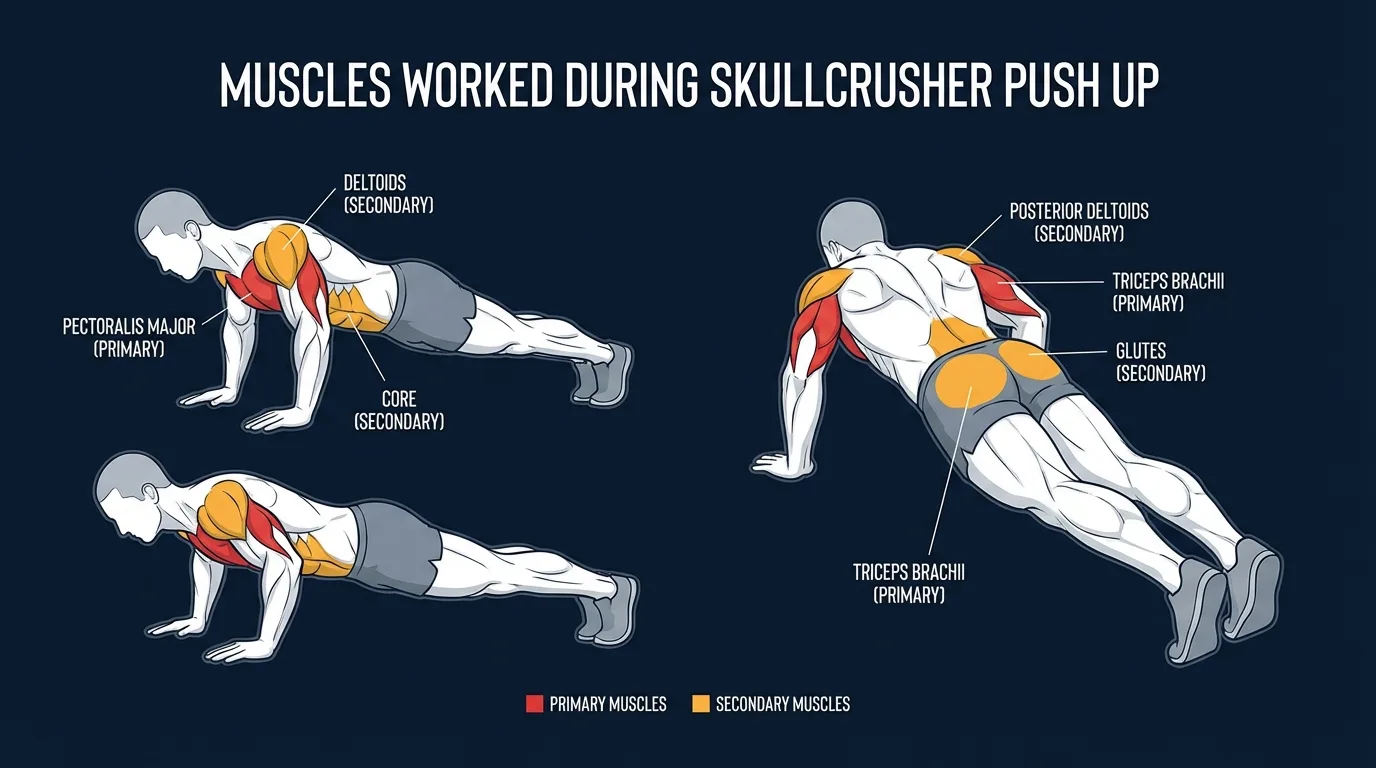
Primary movers: the triceps brachii drive the exercise by extending the elbows. They shorten as you press from the forearms to the top position and lengthen under tension as you lower back down.
Secondary movers: the anterior deltoids and pectoralis major assist the press, especially near the top of the rep. The serratus anterior helps keep the shoulder blades controlled against the rib cage instead of letting the upper back collapse.
Stabilizers: the entire anterior core (rectus abdominis, transverse abdominis, obliques), glutes, posterior deltoids, and rotator cuff work isometrically to maintain the rigid plank position throughout every rep.
Mechanism: No exercise-specific PubMed, PMC, or DOI citation is included for skullcrusher push-ups in the verified FitCraft citation library. The movement biases the triceps because the main visible joint action is elbow extension while the shoulder and hip joints stay fixed. If those joints start moving, the exercise turns into a short-range press and loses its triceps focus.
How to Do a Skullcrusher Push-Up Step by Step
Step 1: Set Up in a Forearm Plank
Start with your forearms on the floor, elbows bent about 90 degrees, and hands under or slightly in front of your shoulders. Extend your legs, squeeze your glutes, and brace your abs so your body forms one straight line.
Coach Ty's cue: "Lock the plank before you press. If the plank is loose, the rep is already gone."
Step 2: Press Through Your Hands
Drive your palms into the floor and extend your elbows until your arms are straight. Your head, shoulders, hips, knees, and heels rise together as one unit.
Coach Ty's cue: "Only the elbows move. Keep the shoulders and hips quiet."
Step 3: Finish Tall at the Top
Reach the top push-up position with straight arms, ribs tucked, and shoulders pulled away from your ears. Keep your head behind your hands instead of jutting forward.
Coach Ty's cue: "Long body, strong arms, no shoulder drift."
Step 4: Lower With Control
Bend at the elbows and return to your forearms over 2 to 3 seconds. Your elbows track forward, your hips stay level, and your forearms touch down softly.
Coach Ty's cue: "Own the way down. The slow negative is the rep."
Step 5: Reset Before Repeating
Pause in the forearm plank, re-brace, and start the next rep only if your alignment is still clean. Stop the set when your elbows flare, hips sag, or shoulders roll forward.
Coach Ty's cue: "Clean reps beat extra reps every time."
Get this exercise in a personalized workout
FitCraft, our mobile fitness app, uses its AI coach Ty to program pressing exercises like this into your plan at the right volume and intensity, based on your level, goals, and equipment. Ty was designed and trained by Domenic Angelino, MPH (Brown University) and NSCA-CSCS, with research published in the Journal of Strength and Conditioning Research and Medicine & Science in Sports & Exercise.
Take the Free Assessment Free · 2 minutes · No credit card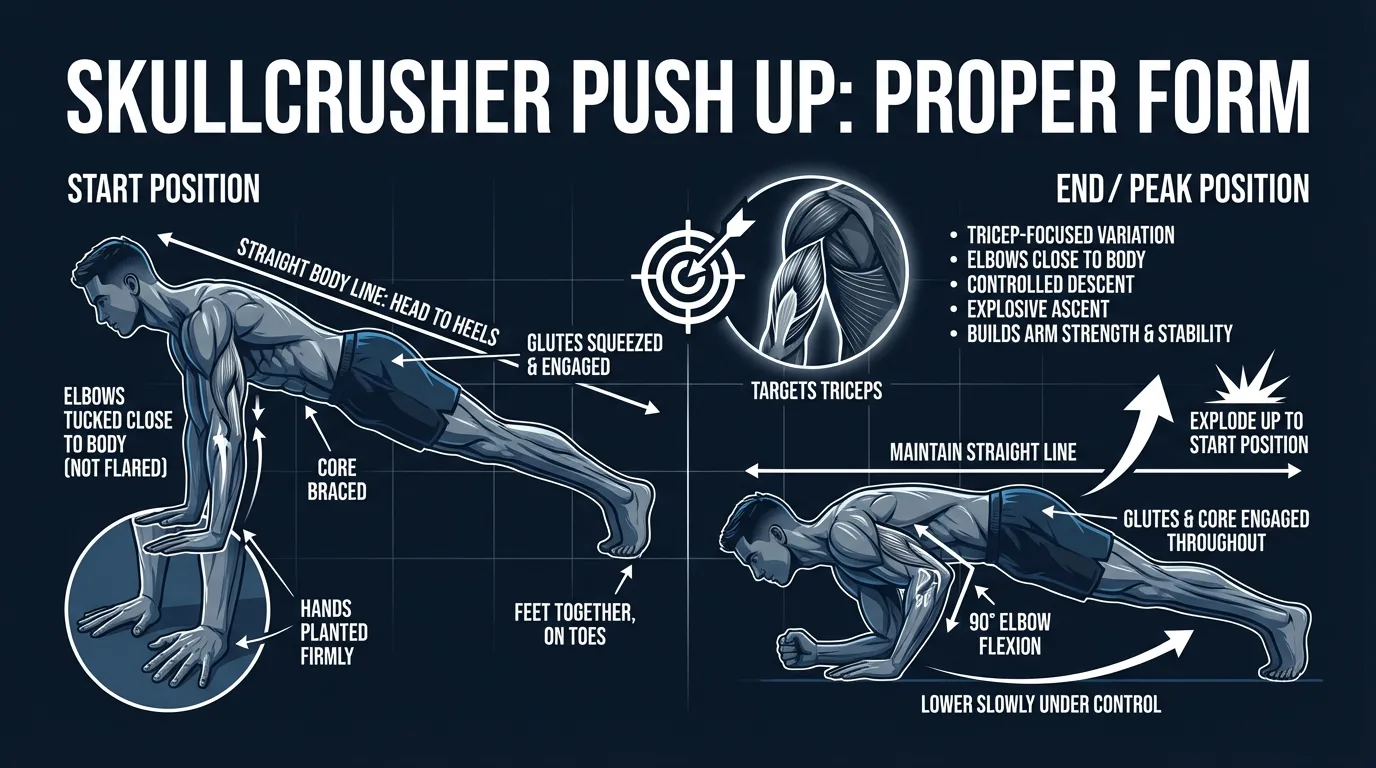
Common Mistakes to Avoid
- Shoulders rolling forward. This turns the exercise into a short, messy press. Pull the shoulders away from your ears and keep the upper arm angle steady while the elbows extend.
- Hips sagging or piking. A broken plank shifts stress into the low back and makes the triceps work less cleanly. Squeeze your glutes and end the set once your hips move.
- Elbows flaring wide. Wide elbows spread the load into the shoulders and chest. Keep the elbows tracking forward or only slightly outward.
- Bouncing off the forearms. Dropping fast uses momentum and irritates the elbows. Lower for 2 to 3 seconds, pause, then press.
- Cutting the range short. Half reps miss the hardest part. Touch the forearms down and reach full elbow extension at the top, or use the kneeling version until full range is possible.
- Pushing through elbow pain. Triceps fatigue is fine. Sharp joint pain is a stop sign. Regress or swap exercises before a tendon flare turns into a longer problem.
Skullcrusher Push-Up Variations: Regressions and Progressions
Kneeling Skullcrusher Push-Up
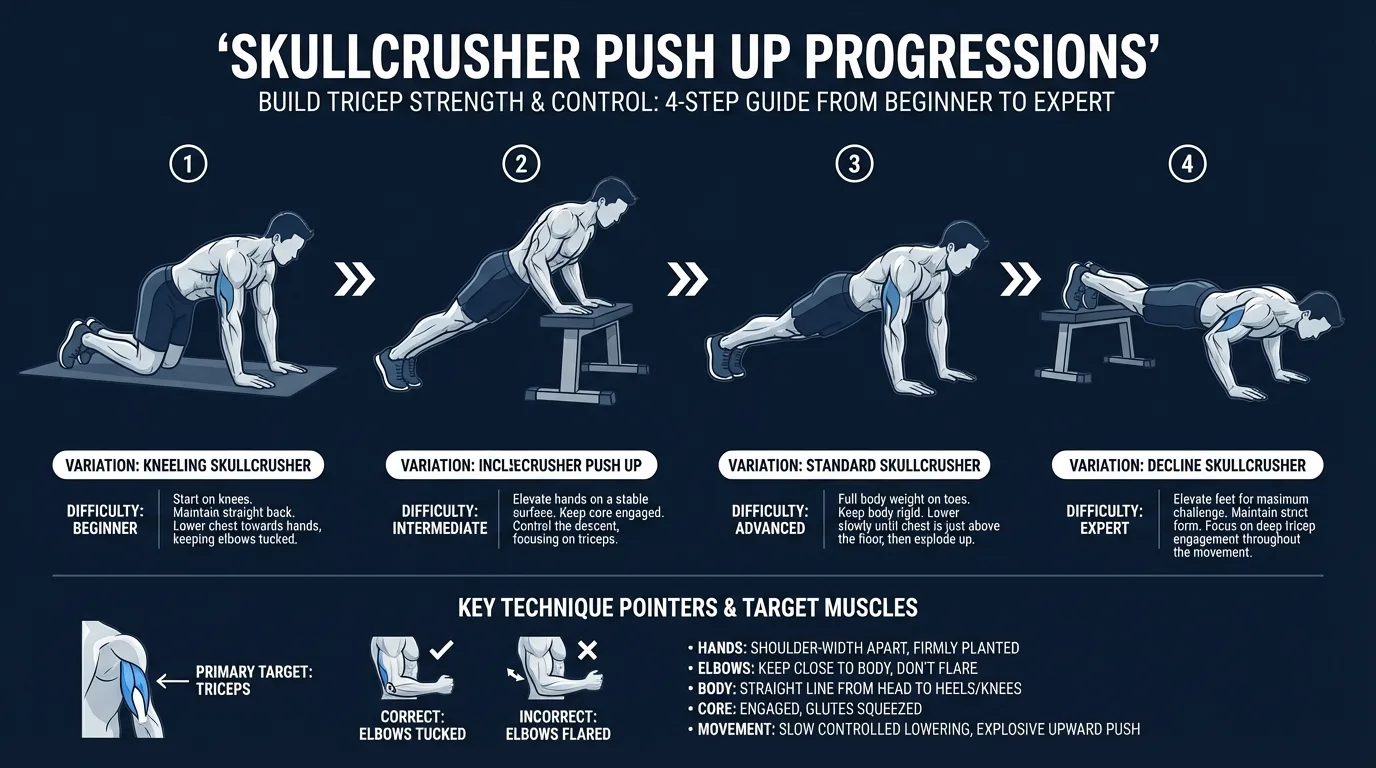
Perform the same elbow-extension pattern from your knees. This shortens the lever and reduces load so you can learn the movement without losing plank tension.
Negative-Only Skullcrusher Push-Up
Start at the top push-up position and lower slowly to your forearms over 4 seconds. Reset as needed. This builds eccentric triceps strength before you can press back up cleanly.
Standard Skullcrusher Push-Up
Use the full version from the toes once you can perform kneeling reps with no elbow flare or hip movement. Aim for smooth reps before adding tempo or range.
Feet-Elevated Skullcrusher Push-Up
Place your feet on a low step or bench. The higher foot position loads more bodyweight through the arms and makes the shoulder stabilizers work harder.
Deficit Skullcrusher Push-Up
Place your hands on low handles or yoga blocks while your forearms still return to the floor. The added range makes the top half harder and should only come after strong standard reps.
When to Avoid or Modify Skullcrusher Push-Ups
Skullcrusher push-ups are safe for many healthy adults, but the strict elbow-extension pattern can be too much when joints or bracing are already irritated. Use the easiest pain-free version and always consult your physician or physical therapist for personalized guidance.
- Elbow pain, triceps tendon irritation, or tennis elbow history. This exercise concentrates load around the elbow. Regress to kneeling negatives, reduce range, or use lighter tricep extensions until symptoms are calm.
- Wrist pain or carpal tunnel. The top position loads the wrists in extension. Use push-up handles, dumbbell grips, fist position, or swap to high-incline pressing while the wrist settles.
- Acute shoulder impingement or rotator cuff irritation. Shoulder drift during skullcrusher push-ups can aggravate the front of the shoulder. Keep the elbows tucked, shorten the range, or build back with diamond push-ups first.
- Recent shoulder, wrist, or elbow surgery. Get clearance from your surgeon. Most return-to-pressing plans move from isometric work to wall, incline, and floor variations on a controlled timeline.
- First 6-8 weeks postpartum or active diastasis recti. The plank position demands deep-core control. Start with wall pressing and rebuild bracing with deadbugs and bird-dogs before floor work.
- Lower-back pain that worsens with bracing. If your hips sag and cueing doesn't fix it, drop the exercise and rebuild plank strength with forearm planks and hand planks.
Related Exercises
These exercises build the same pressing pattern or support the plank strength skullcrusher push-ups need:
- Same muscle group: Diamond Push-Ups and Bench Dips both bias the triceps with bodyweight pressing.
- Tricep isolation: Skull Crushers, Tricep Extensions, and Tate Press train elbow extension with external load.
- Shoulder-focused progression: Pike Push-Ups shift more work toward the anterior deltoids while keeping the bodyweight pressing pattern.
- Core foundation: Forearm Planks, Hand Planks, Deadbugs, and Bird-Dogs build the bracing needed for strict reps.
- Advanced pressing: Pseudo Planche Push-Up increases wrist, shoulder, chest, and triceps demand after standard bodyweight pressing feels easy.
How to Program Skullcrusher Push-Ups
Skullcrusher push-up programming follows the same evidence-based progression model as other resistance exercises. The American College of Sports Medicine position stand from Ratamess et al., 2009 supports matching volume, rest, frequency, and progression to training status.
| Level | Sets × Reps | Rest between sets | Frequency |
|---|---|---|---|
| Beginner (kneeling or negatives) | 2-3 × 5-10 | 60-90 seconds | 2-3 sessions/week |
| Intermediate (floor) | 3-4 × 8-15 | 60-90 seconds | 2-4 sessions/week |
| Advanced (feet-elevated or deficit) | 3-5 × 6-12 | 90-120 seconds | 3-4 sessions/week |
Where in your workout: put skullcrusher push-ups early in a triceps or upper-body accessory block, after your main pressing work if heavy presses are the priority. In bodyweight-only sessions, place them near the start of the push block while your plank is fresh.
Form floor over rep targets: stop the set when elbows flare, hips move, shoulders roll forward, or the lowering phase turns into a drop. Cleaner reps create a better triceps stimulus than extra reps with a broken plank.
How FitCraft Programs This Exercise
FitCraft uses the free assessment to match your program to your current level, goals, and available equipment. Ty can demonstrate pressing patterns, cue your form, and keep the variation appropriate for your strength level.
For skullcrusher-style work, that usually means earning the pattern through simpler pressing and bracing first. The goal is controlled progression: kneeling or negative reps before floor reps, floor reps before feet-elevated or deficit reps.
Frequently Asked Questions
What muscles do skullcrusher push-ups work?
Skullcrusher push-ups primarily target the triceps brachii. The anterior deltoids and pectoralis major assist the press, while the serratus anterior, rotator cuff, core, and glutes keep the body in a rigid plank.
How are skullcrusher push-ups different from regular push-ups?
A regular push-up lowers the chest toward the floor with shoulder and elbow motion. A skullcrusher push-up starts from the forearms and asks the elbows to extend while the shoulder and hip joints stay quiet, which makes the triceps do more of the work.
Are skullcrusher push-ups harder than diamond push-ups?
For most people, yes. Diamond push-ups still let the chest and shoulders help. Skullcrusher push-ups isolate elbow extension more strictly, so reps usually drop even when your regular push-up strength is solid.
How many skullcrusher push-ups should I do?
Start with 2 to 3 sets of 5 to 10 kneeling reps. Intermediate lifters can use 3 to 4 sets of 8 to 15 floor reps. Advanced lifters can use 3 to 5 sets of 6 to 12 harder reps with feet elevation, deficit range, or slower tempo.
Can I do skullcrusher push-ups with elbow pain?
Use caution. Skullcrusher push-ups place concentrated stress through the elbow extensors. Regress to kneeling reps, reduce range, slow the descent, or swap to lighter triceps extensions. If pain is sharp, worsening, or linked to a prior tendon issue, stop and get guidance from a qualified clinician.