Most arm training gets crowded with curls. Tricep extensions put attention on the back of the upper arm, where the triceps create elbow lockout and contribute heavily to the size of the arm.
The overhead dumbbell version has one big advantage: it trains elbow extension while the shoulder is flexed overhead. That stretched arm position loads the long head of the triceps more directly than neutral-arm variations. It also asks for honest shoulder mobility and trunk control, so the exercise rewards clean technique more than heavy weight.
Use tricep extensions as accessory work after your main pressing exercise. Keep the goal on controlled triceps tension instead of turning the rep into a heavy behind-the-head press.
Quick Facts: Tricep Extensions
- Equipment needed: Dumbbell or pair of dumbbells
- Difficulty: Beginner to Advanced
- Modality: Strength
- Body region: Upper body
- FitCraft quest category: Strength
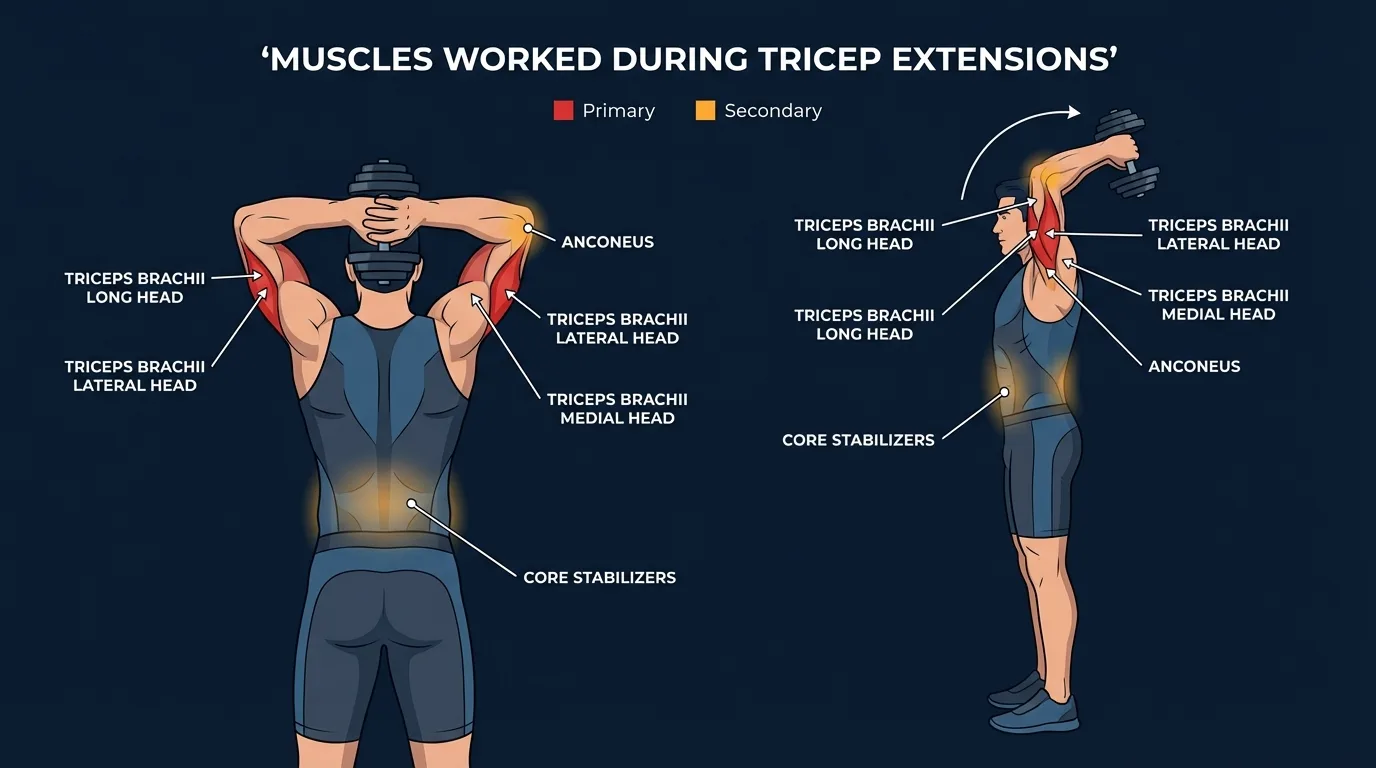
Muscles Worked
Primary movers: the long head, lateral head, and medial head of the triceps brachii. These muscles straighten the elbow during the lifting phase and lengthen under control as the dumbbell lowers behind the head.
Secondary movers: the anconeus assists elbow extension near lockout, while the posterior deltoid and upper-back muscles help keep the upper arm from drifting too far forward or backward.
Stabilizers: the rotator cuff, deltoids, scapular retractors, rectus abdominis, transverse abdominis, and obliques. In the overhead version, these muscles keep the shoulder centered, the ribs stacked, and the movement isolated to the elbow.
Evidence: Maeo et al. (2022) compared overhead and neutral-arm elbow-extension training and found greater triceps brachii hypertrophy in the overhead condition. That supports the practical reason lifters use overhead extensions: the shoulder position loads the long head through a longer muscle length.
Step-by-Step: How to Do Overhead Tricep Extensions
Step 1: Set the Dumbbell Overhead
Stand tall or sit on a bench with your feet planted. Hold one dumbbell with both hands around the top end and press it overhead until your arms are extended.
Coach Ty's cue: "Ribs down, elbows forward, arms close to your ears."
Step 2: Lock In Your Upper Arms
Point your elbows forward and keep your upper arms close to vertical. Your shoulders set the frame, but your elbows do the moving.
Coach Ty's cue: "Freeze your upper arms. Only your forearms move."
Step 3: Lower Into the Stretch
Inhale and bend at the elbows to lower the dumbbell behind your head. Stop when you feel a strong triceps stretch without shoulder pinching or elbow pain.
Coach Ty's cue: "Lower slow enough that you could stop at any inch."
Step 4: Extend Back to Lockout
Exhale and straighten your elbows to bring the dumbbell back overhead. Squeeze the triceps at the top, but avoid shrugging your shoulders toward your ears.
Coach Ty's cue: "Finish with straight arms, quiet shoulders."
Step 5: Repeat With Control
Use a steady rhythm for every rep. If your elbows flare wide, your lower back arches, or the dumbbell starts bouncing out of the bottom, end the set or reduce the load.
Coach Ty's cue: "Clean reps beat heavier reps here."
Get this exercise in a personalized workout
FitCraft, our mobile fitness app, uses its AI coach Ty to program isolation exercises like this into your plan at the right volume and intensity, based on your level, goals, and equipment. Ty was designed and trained by Domenic Angelino, MPH (Brown University) and NSCA-CSCS, with research published in the Journal of Strength and Conditioning Research and Medicine & Science in Sports & Exercise.
Take the Free Assessment Free · 2 minutes · No credit card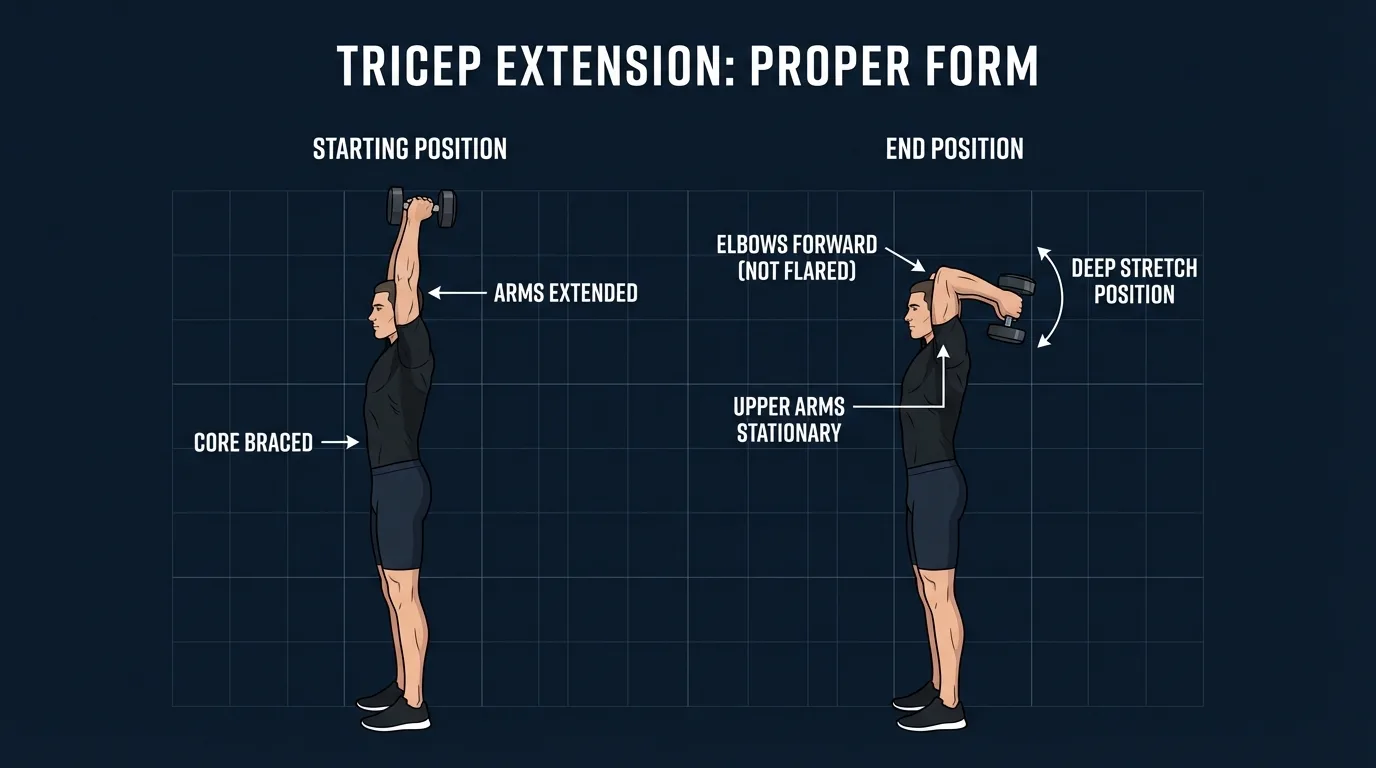
Common Mistakes (and How to Fix Them)
Tricep extensions work best when the movement stays strict. These are the mistakes that usually steal tension from the triceps or irritate the elbows.
- Flaring the elbows. Wide elbows turn the rep into a messy press and can irritate the elbow joint. Fix it by pointing the elbows forward and using a lighter dumbbell if they drift.
- Moving the upper arms. When the upper arms swing, the shoulders help too much. Fix it by filming from the side and keeping the shoulder-to-elbow segment nearly still.
- Arching the lower back. A big rib flare usually means the weight is pulling you into spinal extension. Fix it by bracing harder, sitting on a bench, or using a slightly lighter load.
- Bouncing out of the bottom. Momentum at the stretched position can spike stress on the elbow tendons. Fix it with a brief pause and a smooth press out of the bottom.
- Going too heavy. This is an isolation exercise. If the set turns into a behind-the-head shoulder press, reduce the weight and keep the tempo controlled.
- Forcing painful shoulder range. Overhead extensions require shoulder flexion. If you feel pinching, shorten the range or switch to tricep kickbacks or skull crushers.
Tricep Extension Variations: Regressions and Progressions
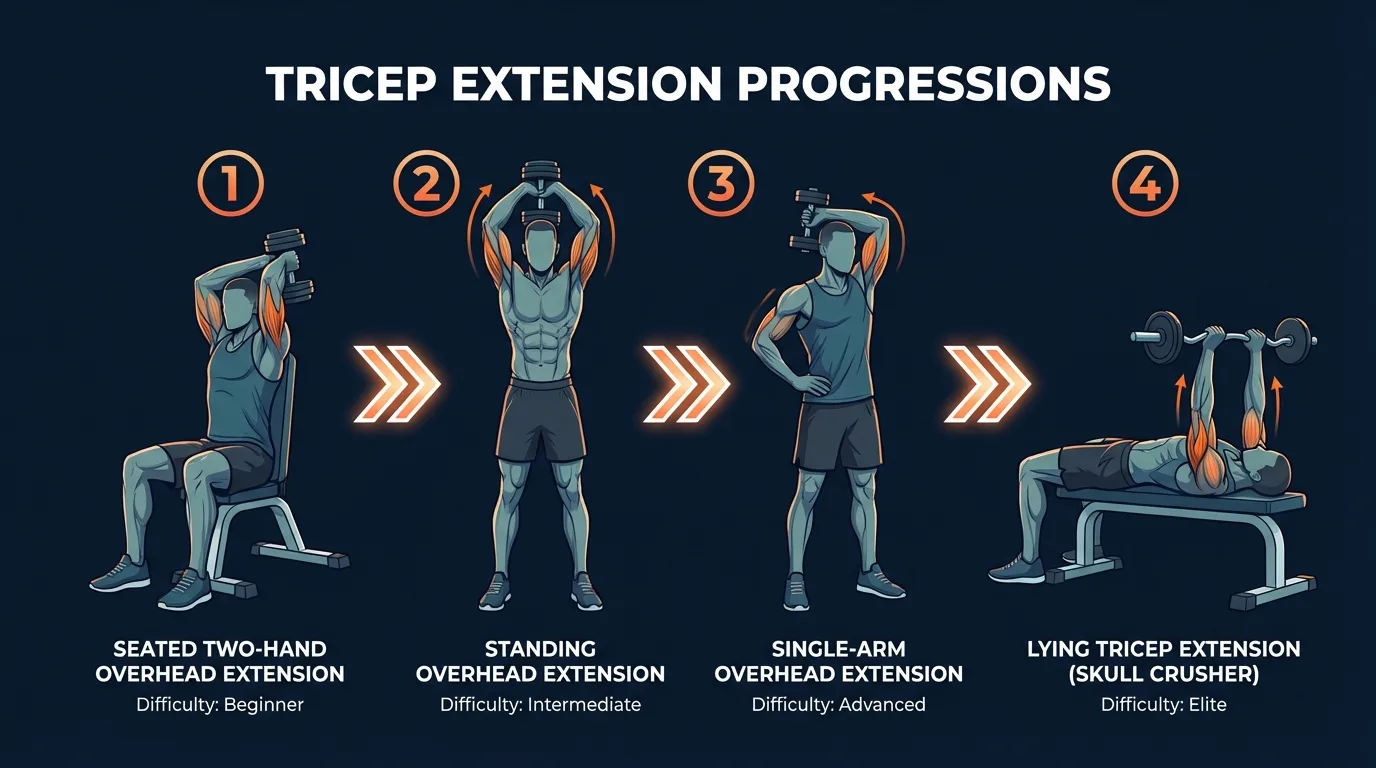
Seated Overhead Extension (Beginner)
Sit on a bench with back support and use one dumbbell held in both hands. The bench reduces lower-back compensation and makes it easier to learn the elbow path.
Standing Overhead Extension (Standard)
Perform the same two-hand movement while standing. This adds more trunk demand, so keep your ribs down and avoid leaning back as the dumbbell lowers.
Single-Arm Overhead Extension (Intermediate)
Use one lighter dumbbell in one hand. This variation exposes left-right differences quickly and works well when one arm tends to dominate two-hand reps.
Lying Tricep Extension / Skull Crusher (Intermediate-Advanced)
Lie on a bench and lower one or two dumbbells toward your forehead by bending only at the elbows. The shoulder angle changes, which can feel better for people who dislike overhead work.
Two-Dumbbell Overhead Extension (Advanced)
Hold one dumbbell in each hand overhead. Each arm has to stabilize its own path, so use less total load than the two-hand, one-dumbbell version.
When to Avoid or Modify Tricep Extensions
Tricep extensions are safe for most healthy adults, but the overhead version can expose elbow irritation, shoulder mobility limits, or poor trunk control. Use these modifications as starting points, and consult your physician or physical therapist for personalized guidance.
- Active elbow tendinopathy, joint inflammation, or sharp elbow pain. Reduce load, slow the tempo, shorten the range, or switch to lighter cable/band work if available. Stop if symptoms increase during the set.
- Recent elbow or shoulder surgery. Get surgeon clearance before loaded elbow-extension isolation. Rehab usually progresses from isometrics to active range, then to light external load.
- Shoulder impingement history or painful overhead range. Do not force the dumbbell behind your head. Try tricep kickbacks, skull crushers, or a shorter overhead range.
- Neck or upper-trap tension during overhead work. Use a seated variation, keep the shoulders down, and choose a lighter dumbbell. If you cannot keep the neck relaxed, use a non-overhead triceps option.
- Lower-back arching you cannot control. Sit with back support and rebuild bracing with deadbugs, bird-dogs, and forearm planks.
- Pregnancy, postpartum return, or chronic conditions affecting blood pressure or joints. Keep loads light, avoid breath-holding, and get individualized guidance before adding overhead loaded work.
Related Exercises
Use these movements to round out triceps training, balance the elbow joint, and support the shoulder position overhead extensions require.
- Same target muscle: Tricep Kickbacks, Overhead Tricep Press, Skull Crushers, and Tate Press train elbow extension with different shoulder angles and loading paths.
- Compound triceps work: Diamond Push-Ups, Close-Grip Push-Ups, Bench Dips, and Chest Press build pressing strength that uses the triceps under heavier whole-body or dumbbell loading.
- Antagonist isolation: Bicep Curls and Hammer Curls train the elbow flexors that balance arm work across the joint.
- Shoulder and scapular support: W-Raise, Y-Raise, and Pull-Apart build the shoulder-control base that helps overhead extensions feel smoother.
How to Program Tricep Extensions
Tricep extension programming follows standard accessory-lift ranges. The American College of Sports Medicine position stand on resistance training recommends matching load, repetitions, rest, and weekly frequency to training status and goal (Ratamess et al., 2009).
| Level | Sets × Reps | Rest between sets | Frequency |
|---|---|---|---|
| Beginner | 2-3 × 10-15 | 45-60 seconds | 2-3 sessions/week |
| Intermediate | 3-4 × 8-15 | 60-90 seconds | 2-4 sessions/week |
| Advanced | 3-4 × 6-15 | 60-120 seconds | 2-4 sessions/week |
Where in your workout: place tricep extensions late in an upper-body or push session, after compound pressing like chest press, shoulder press, or push-up variations. Isolation work is accessory. Doing it first can fatigue the triceps and reduce the quality of your main lifts.
Form floor over rep targets: stop the set when your elbows flare, your shoulders shrug, your lower back arches, or the rep loses its controlled stretch. Fewer clean reps beat more sloppy reps.
How FitCraft Programs This Exercise
Knowing the movement is step one. Knowing where it belongs in a week of pressing, pulling, and recovery is the part most people skip.
FitCraft's AI coach Ty uses your personalized diagnostic assessment to match your training level, goals, and equipment. Then Ty can place triceps accessory work into a balanced program at the right volume for your current strength.
As you build consistency, Ty adjusts the variation and volume to match your level. You might start seated with a lighter dumbbell, then move to standing or single-arm variations once the reps stay clean.
Frequently Asked Questions
What muscles do tricep extensions work?
Tricep extensions primarily train all three heads of the triceps brachii: the long head, lateral head, and medial head. The overhead version places the long head under a deeper stretch because the shoulder is flexed while the elbow bends and extends.
Can I do tricep extensions with elbow pain?
Do not push through sharp elbow pain. Reduce the load, slow the lowering phase, shorten the range to pain-free motion, or switch to tricep kickbacks. If elbow pain persists or you have active tendinopathy, get guidance from a physical therapist.
Should I do tricep extensions with one dumbbell or two?
Both work. The two-hand, one-dumbbell overhead extension is easiest to learn and usually allows more stable loading. Single-arm extensions use less weight and help you spot side-to-side strength differences.
How heavy should I go on tricep extensions?
Use a load you can control for 8 to 15 clean reps without elbow flare, back arching, bouncing, or shoulder discomfort. For many beginners, that means a lighter dumbbell than they expect.
What is better for triceps: extensions or dips?
They solve different jobs. Dips are a compound pressing exercise that trains the triceps with chest and shoulders. Extensions isolate elbow extension and are especially useful as an accessory after compound pressing.