The shoulder press looks simple from across the room: hold dumbbells at shoulder height and press them overhead. The useful version is more specific. Your elbows stay under the weights, your ribs stay down, and the dumbbells finish over your shoulder joints instead of drifting in front of your face.
A verified shoulder-press study supports why the dumbbell version belongs in a home strength plan. Saeterbakken and Fimland (2013) compared seated and standing shoulder presses with barbells and dumbbells, then measured muscle activity and strength demands across the variations. Dumbbells reduce the load you can use, but they make each arm stabilize and press on its own.
Quick Facts: Shoulder Press
- Equipment needed: Pair of dumbbells; bench optional for the seated version
- Difficulty: Beginner to Intermediate
- Modality: Strength
- Body region: Upper body
- FitCraft quest category: Strength
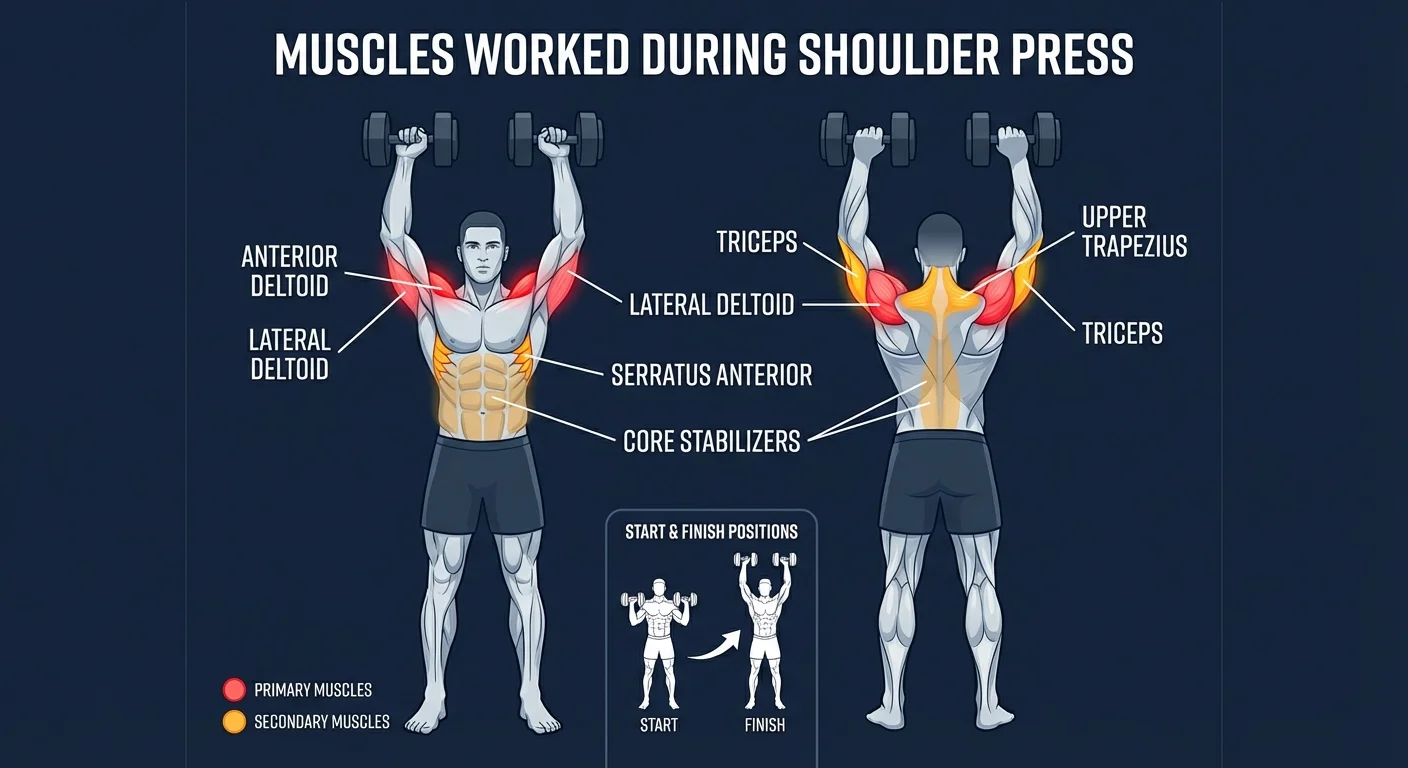
Muscles Worked
The primary movers are the anterior deltoids and lateral deltoids. They drive shoulder flexion and abduction as the dumbbells move overhead, then control the eccentric lowering phase as the weights return to shoulder height.
The triceps brachii extend the elbows near the top of each rep. The upper trapezius and serratus anterior help upwardly rotate the shoulder blades so the arms can travel overhead without the shoulder joint feeling jammed.
The rotator cuff works hard as a stabilizer because each dumbbell can drift on its own. The rectus abdominis, transverse abdominis, obliques, glutes, and spinal erectors brace isometrically so the torso does not turn the press into a standing backbend.
The mechanism is straightforward: the farther the dumbbells move from the shoulder joint, the more your deltoids have to create force while the shoulder blade rotates upward. A neutral or slightly forward elbow angle usually feels better than forcing the elbows straight out to the sides, especially for lifters with cranky shoulders.
How to Do a Dumbbell Shoulder Press Step by Step
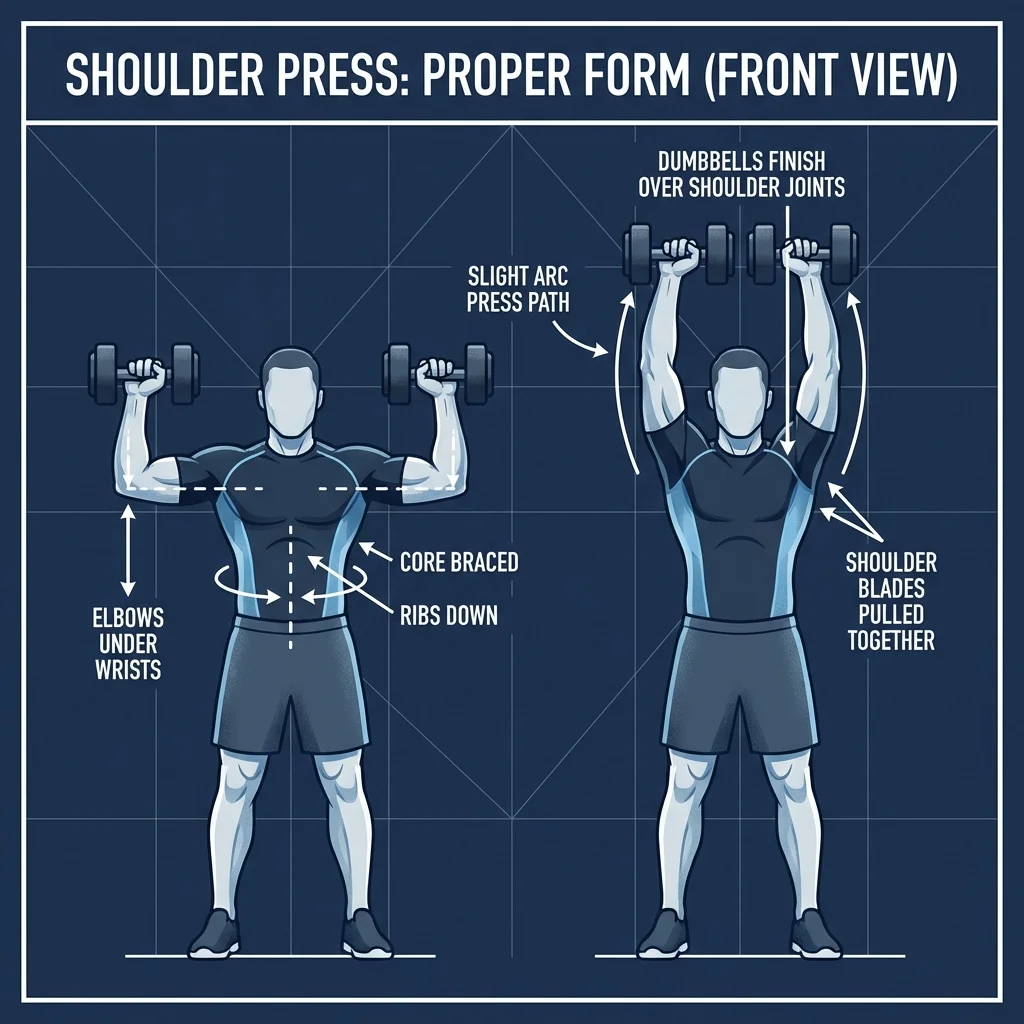
- Set your starting position. Sit on a supported bench or stand with feet about shoulder-width apart. Hold a dumbbell in each hand at shoulder height with the elbows under the wrists and the palms facing forward or slightly inward. Pull your ribs down, brace your core, and keep your head stacked over your torso.
Coach Ty's cue: "Ribs down before the first rep. If the ribs flare, the back starts helping."
- Press the dumbbells overhead. Drive the weights up in a slight arc until they finish over your shoulder joints. Keep the wrists stacked and avoid letting the dumbbells drift forward in front of your face. Exhale as you pass the hardest part of the press.
Coach Ty's cue: "Press up through the ceiling, then keep the weights over your shoulders."
- Own the top position. Stop with your arms extended overhead without forcing your elbows into a hard lockout. Your biceps should be near your ears, your neck should stay relaxed, and your lower back should stay neutral. If you have to lean back to finish, the weight is too heavy.
Coach Ty's cue: "Tall body, quiet ribs, no backbend."
- Lower with control. Bring the dumbbells back to shoulder height on a smooth two-second descent. Use the same path down that you used on the way up. Stop the set if your elbows flare wide, your wrists bend back, or your shoulders pinch.
Coach Ty's cue: "Make the lowering phase look like a replay of the press."
- Reset and repeat. Re-brace before every rep. Keep one to three reps in reserve so the final reps still look like the first reps. End the set before momentum, leaning, or a lower-back arch takes over.
Coach Ty's cue: "Clean reps count. Backbend reps don't."
Common Mistakes to Avoid
The shoulder has huge range of motion, which means the press has less room for sloppy mechanics than most people expect. Fix these before you add load.
- Arching the lower back. This shifts the lift away from a vertical press and turns it into a strained incline press. Brace harder, squeeze the glutes lightly, and reduce the load if the ribs keep flaring.
- Pressing the dumbbells forward. The weights should finish over the shoulders. If they finish over your face or chest, the front shoulder takes more stress and the press path gets weaker.
- Flaring the elbows straight out. A hard 90-degree elbow flare can make the shoulder feel pinched. Let the elbows sit slightly in front of the body and keep them stacked under the wrists.
- Dropping the descent. The lowering phase builds control and keeps the shoulder honest. Take about two seconds down instead of letting the dumbbells fall back to the start.
- Going too heavy too soon. The deltoids fatigue quickly. If the last reps require leg drive, a shrug, or a backbend, drop the weight and rebuild the set with cleaner reps.
Get this exercise in a personalized workout
FitCraft, our mobile fitness app, uses its AI coach Ty to program compound strength exercises like this into your plan at the right volume and intensity, based on your level, goals, and equipment. Ty was designed and trained by Domenic Angelino, MPH (Brown University) and NSCA-CSCS, with research published in the Journal of Strength and Conditioning Research and Medicine & Science in Sports & Exercise.
Take the Free Assessment Free · 2 minutes · No credit cardShoulder Press Variations: Regressions and Progressions
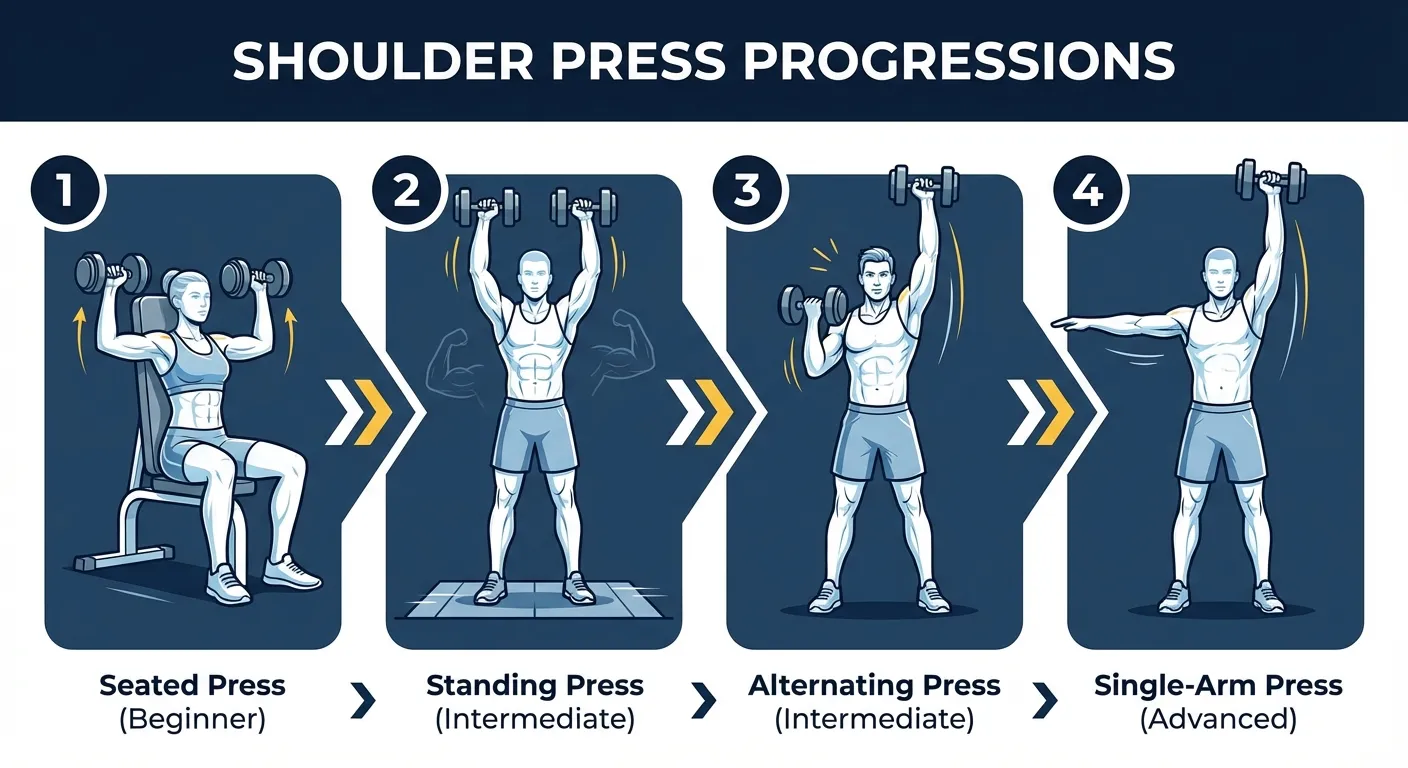
Seated Dumbbell Shoulder Press
Use a bench with back support and keep both feet flat. This version removes much of the balance demand, so it is the best starting point if you are learning the press path or returning after time away.
Standing Dumbbell Shoulder Press
Stand tall and press both dumbbells at the same time. This version adds more core and hip stability because your trunk has to resist leaning back as the dumbbells move overhead.
Alternating Dumbbell Shoulder Press
Press one dumbbell while the other stays at shoulder height. The pause on the non-pressing side increases time under tension and exposes left-right strength differences quickly.
Single-Arm Standing Press
Press one dumbbell from a standing position while the other arm stays free. Your obliques and hips have to resist side bending, so start lighter than your regular two-arm press.
Shoulder-Friendly Alternatives
If overhead pressing is not a good fit right now, use lateral raises for side-delt work, front raises for anterior-delt work, or push-ups for a lower-overhead-stress pressing pattern.
When to Avoid or Modify Shoulder Press
Shoulder presses are safe for many healthy adults, but overhead loading is not the right choice for every shoulder on every day. Always consult your physician or physical therapist if you have symptoms, medical restrictions, or a recent injury history.
- Sharp shoulder pain, pinching, or numbness. Stop overhead pressing and use a shorter range, neutral grip, or non-overhead option such as lateral raises until you are assessed.
- Recent neck, shoulder, or spine injury or surgery. Loaded overhead work can irritate healing tissue. Get clearance before returning, then start seated with very light dumbbells.
- Uncontrolled hypertension or known cardiovascular disease. Heavy bracing can spike blood pressure. Use lighter loads, avoid breath-holding, and follow your clinician's exercise guidance.
- Pregnancy or early postpartum return. The press increases bracing and balance demands. Use lighter loads, seated support, and a conservative range while your provider guides the return to loading.
- Poor overhead mobility. If you cannot raise your arms overhead without rib flare or neck tension, build shoulder control with rotator cuff stretch, shoulder rolls, and lighter pressing angles first.
- Core bracing limits. If your back arches on every rep, build the brace with deadbugs, bird-dogs, and forearm planks before pushing heavier overhead.
Related Exercises
- Same shoulder press family: Arnold press adds rotation and more shoulder-control demand.
- Horizontal press partner: Chest press trains pressing strength with less overhead mobility demand.
- Deltoid accessories: Lateral raises and front raises isolate the side and front delts after compound pressing.
- Pulling balance: Bent-over rows help keep upper-back strength in the same plan as pressing work.
- Core foundation: Deadbugs, bird-dogs, and forearm planks build the brace that keeps overhead pressing strict.
How to Program Shoulder Press
Ratamess et al., 2009, the ACSM Position Stand on resistance training progression, supports using different loading, volume, rest, and frequency targets as lifters move from beginner to advanced training. For dumbbell shoulder presses, the form floor matters more than chasing heavy low-rep sets.
| Level | Sets × Reps | Rest between sets | Frequency |
|---|---|---|---|
| Beginner | 2-3 × 8-12 | 90-120 seconds | 2-3 sessions/week |
| Intermediate | 3-4 × 6-12 | 120-180 seconds | 2-4 sessions/week |
| Advanced | 3-5 × 6-10 | 180-300 seconds | 2-4 sessions/week |
Place shoulder presses early in an upper-body or full-body session, before smaller shoulder accessories. Pair them with pulling work such as rows so the shoulder blades get strong in both directions.
Use the form floor over rep targets: once the ribs flare, the dumbbells drift forward, or the lowering phase gets loose, the set is over. Cleaner reps beat extra reps that your lower back finishes for you.
Frequently Asked Questions
What muscles does the shoulder press work?
The shoulder press mainly trains the anterior and lateral deltoids. The triceps extend the elbows, the upper trapezius and serratus anterior help rotate and support the shoulder blades, and the core keeps the torso from arching during the press.
Is the seated or standing shoulder press better?
The seated version is better for learning the pressing path because the bench removes much of the balance demand. The standing version adds more trunk and hip stability work, so it's a useful progression once the lifter can keep the ribs down and press without leaning back.
How heavy should I go on shoulder press?
Use a pair of dumbbells that lets you complete every rep with the wrists stacked, ribs down, and no lower-back arch. Most beginners should start lighter than they expect and build load only after they can control the two-second descent for every rep.
Should I do alternating or simultaneous dumbbell shoulder presses?
Both are useful. Simultaneous presses let you train the basic vertical push efficiently. Alternating presses make each side work independently and add an anti-rotation demand through the trunk, so they're a good progression after the standard press feels controlled.
Can I do shoulder presses with shoulder pain?
Don't press overhead through sharp shoulder pain, pinching, numbness, or symptoms that change your normal arm motion. Try a lighter load, a neutral grip, a shorter range, or a non-overhead option such as lateral raises, and get assessed by a qualified clinician if pain persists.