The Tate press looks odd the first time you see it. The dumbbells stay close together, the elbows flare out, and the weights lower toward the chest instead of the forehead.
That unusual path is the point. It gives your triceps a different accessory stimulus than standard skull crushers, especially if your lockout strength is the weak link in pressing work.
Quick Facts: Tate Presses
- Equipment needed: Pair of dumbbells and a flat bench
- Difficulty: Intermediate to Advanced
- Modality: Strength
- Body region: Upper body
- FitCraft quest category: Strength
Muscles Worked
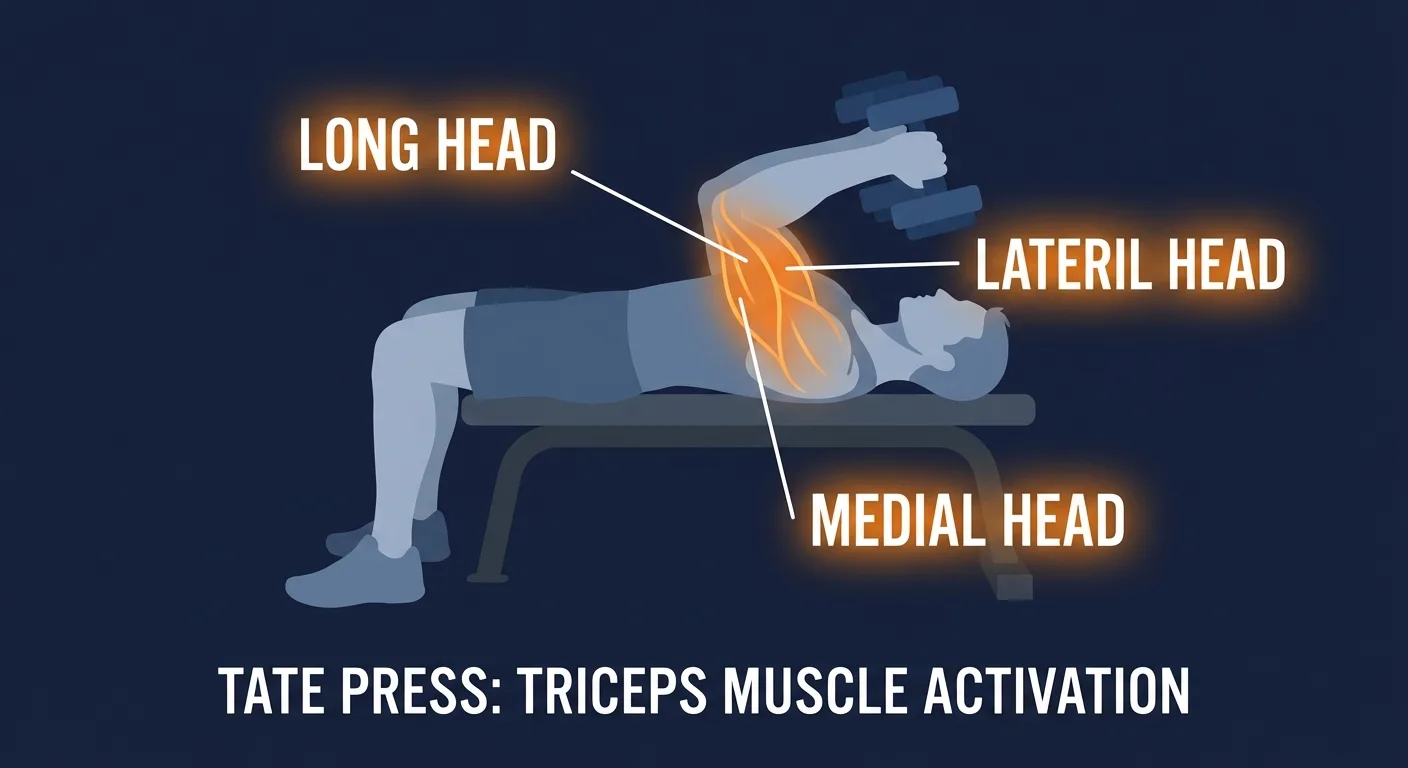
Primary movers: the triceps brachii long head, lateral head, and medial head. These muscles extend the elbow as you press the dumbbells back to the top. They shorten during the press and lengthen under control as you lower the weights toward your chest.
Secondary movers: the anterior deltoids and pectoralis major assist by holding the shoulder in a stable flexed position. They should not turn the movement into a dumbbell chest press, but they do help keep the upper arm controlled.
Stabilizers: the rotator cuff, scapular retractors, forearm flexors, and trunk stabilizers work isometrically. Their job is to keep your shoulders packed, wrists stacked, and rib cage quiet while the elbows do the moving.
Mechanism: the Tate press changes the triceps stimulus by combining elbow extension with a close dumbbell position and flared upper-arm angle. FitCraft does not include an exercise-specific PubMed, PMC, or DOI citation for Tate presses in the verified citation library, so this section uses mechanism-based anatomy instead of a proxy citation.
Step-by-Step: How to Do a Tate Press
- Set up on the bench. Lie flat on a bench with your feet firmly planted. Press two dumbbells over your chest with palms facing your feet and the dumbbells close together.
- Start the descent. Bend your elbows and lower the dumbbells in a short arc. Coach Ty's cue: "Let your elbows move out to the sides while the dumbbells stay close."
- Target mid-chest. Lower until the dumbbells line up around your mid-chest. Stop well before they drift toward your face.
- Press back up and squeeze. Extend your elbows to return to the top. Drive the dumbbells gently toward each other and squeeze your triceps at lockout.
- Breathe with the movement. Inhale as you lower. Exhale as you press. Keep the tempo smooth enough that every rep follows the same path.
Get this exercise in a personalized workout
FitCraft, our mobile fitness app, uses its AI coach Ty to program isolation exercises like this into your plan at the right volume and intensity, based on your level, goals, and equipment. Ty was designed and trained by Domenic Angelino, MPH (Brown University) and NSCA-CSCS, with research published in the Journal of Strength and Conditioning Research and Medicine & Science in Sports & Exercise.
Take the Free Assessment Free • 2 minutes • No credit card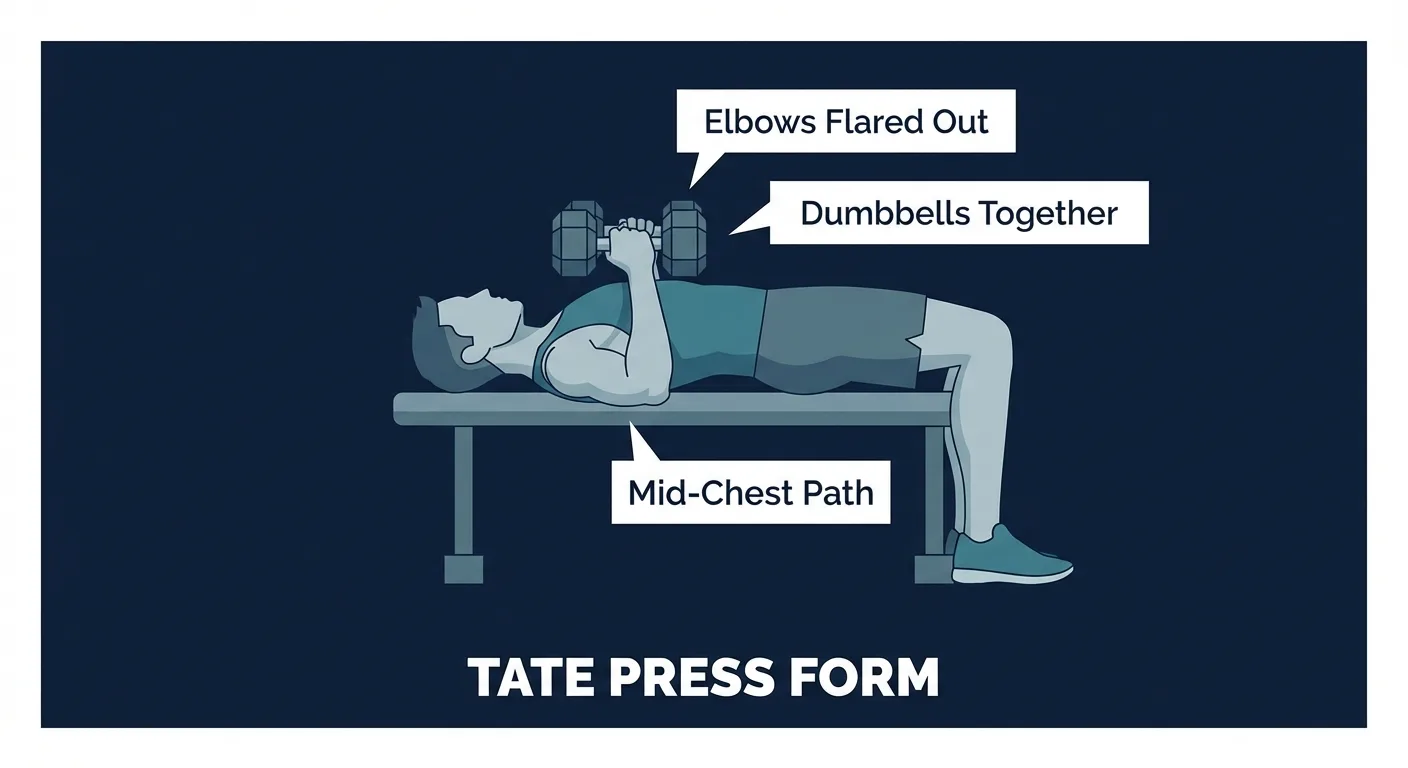
Common Mistakes (and How to Fix Them)
Elbows Pulling Toward the Ribs
What it looks like: your elbows drift inward during the descent and the rep turns into a close-grip dumbbell press.
Why it is a problem: the triceps still work, but you lose the flared-elbow stimulus that makes the Tate press distinct.
The fix: lower slowly and let your elbows point outward. Use a lighter load if your body keeps turning the rep into a press.
Letting the Weights Separate
What it looks like: the dumbbells drift apart as you lower or press.
Why it is a problem: separation usually means the shoulders and chest are taking over while the triceps lose tension.
The fix: keep the dumbbells close enough that you could tap them together at the top. Do not smash them together or let the wrists collapse.
Lowering Toward the Face
What it looks like: the weights travel toward your forehead like a skull crusher.
Why it is a problem: that changes the exercise and can make the elbows feel cranky when the load gets heavy.
The fix: aim the bottom position at your mid-chest. If you want a forehead path, use skull crushers instead.
Going Too Heavy
What it looks like: the tempo speeds up, the dumbbells separate, and every rep becomes a grind.
Why it is a problem: Tate presses reward control and position more than load. Heavy reps often irritate elbows before they build better triceps.
The fix: start lighter than your ego wants. Add load only after you can own the lowering phase and the lockout squeeze.
Tate Press Variations: Regressions and Progressions
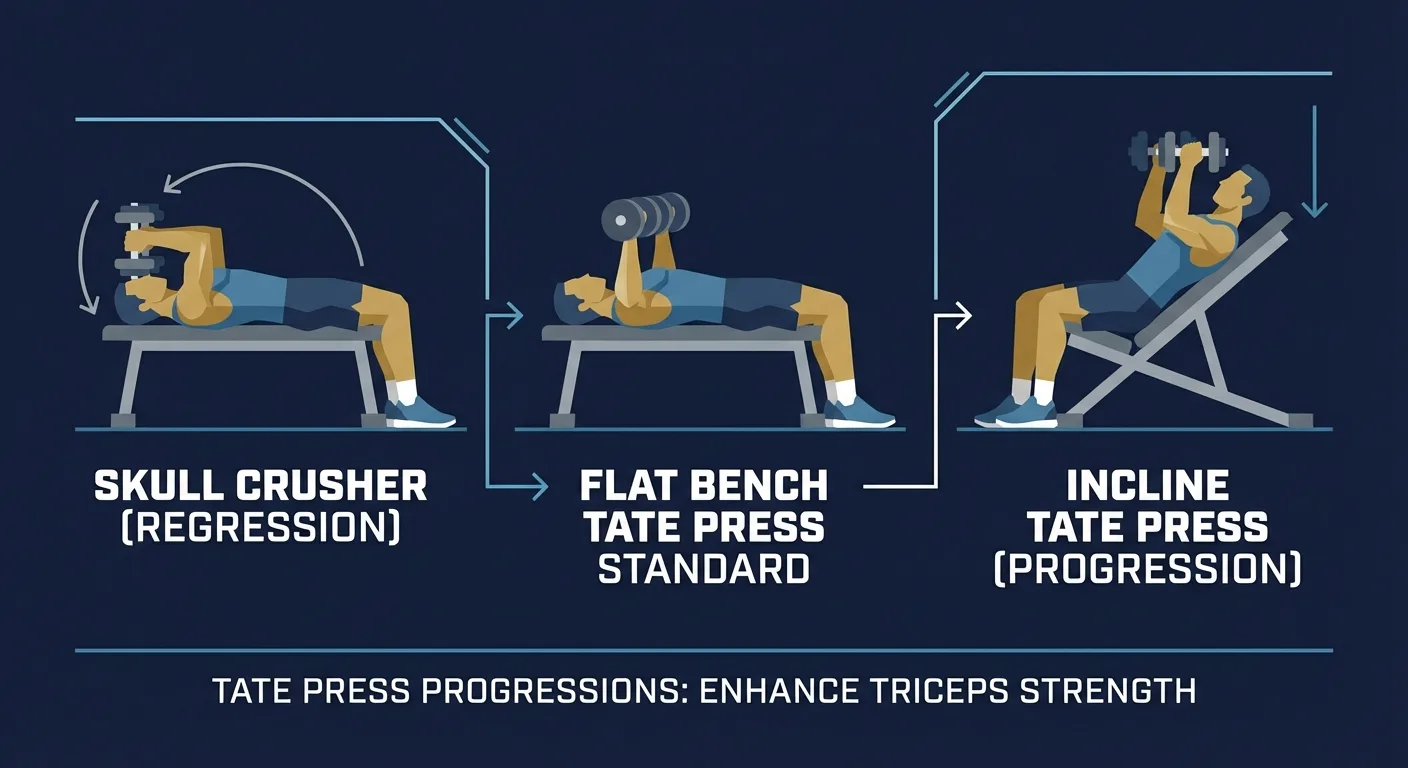
Dumbbell Skull Crushers (Regression)
Use skull crushers first if the Tate press path feels confusing. The movement is easier to learn because the upper arm stays more predictable.
Overhead Triceps Extensions (Long-Head Builder)
Overhead extensions train the triceps long head through a different shoulder angle. They are useful if you need simpler loading before adding the flared-elbow Tate press path.
Paused Tate Press (Progression)
Pause for one to two seconds at the bottom before pressing. The pause removes bounce and makes the triceps own the hardest position.
Incline Bench Tate Press (Progression)
Set the bench to a low incline. The shoulder angle changes the feel of the movement and can increase the stretch on the triceps for lifters who already control the flat-bench version.
When to Avoid or Modify Tate Presses
Tate presses are safe for healthy lifters who can control light dumbbells, but the elbow path is not beginner-friendly. Modify the movement, reduce load, or choose a simpler triceps exercise when your joints do not tolerate the setup. Always consult your physician or physical therapist for personalized guidance.
- Active elbow tendinopathy or sharp elbow pain. Tate presses directly load elbow extension. Switch to pain-free range, lighter triceps kickbacks, or isometric triceps work until symptoms calm down.
- Recent elbow, shoulder, or wrist surgery. Get surgeon or physical therapist clearance before loaded isolation work. Rehab usually progresses from isometrics to active range, then to light load.
- Shoulder impingement or unstable shoulders. The flared-elbow position can feel aggressive if your shoulder cannot stay centered. Use overhead triceps presses or cable-style extensions if those are pain-free.
- Wrist discomfort under dumbbells. Keep wrists stacked and neutral. If you cannot stop the wrists from bending backward, reduce weight or use a different triceps variation.
- Brand-new strength training. Build control first with bench dips, skull crushers, and light extensions before adding the Tate press.
Related Exercises
If Tate presses fit your routine, these movements cover the same triceps lane from easier skill work to stronger pressing carryover:
- Same target muscle: Triceps Kickbacks and Overhead Triceps Presses train elbow extension with simpler paths.
- Regression pattern: Skull Crushers teach loaded elbow extension before the flared Tate press angle.
- Compound that includes the triceps: Bench Dips, Close-Grip Push-Ups, and Chest Presses build pressing strength with more total upper-body involvement.
- Antagonist and shoulder balance: Bicep Curls train the opposite side of the elbow, while Lateral Raises support shoulder development around pressing work.
How to Program Tate Presses
Tate press programming follows the same broad progression principles as other resistance-training accessories. The American College of Sports Medicine position stand recommends matching sets, reps, rest, and frequency to training level while progressing gradually over time (Ratamess et al., 2009).
| Level | Sets × Reps | Rest between sets | Frequency |
|---|---|---|---|
| Beginner regression | 2-3 × 10-15 skull crushers or light extensions | 45-60 seconds | 2-3 sessions/week |
| Intermediate | 3-4 × 8-15 Tate presses | 60-90 seconds | 2-4 sessions/week |
| Advanced | 3-4 × 6-15 paused or incline reps | 60-120 seconds | 2-4 sessions/week |
Where in your workout: place Tate presses late in an upper-body or push session, after bench press, chest press, overhead press, or other main pressing work. They are accessory isolation work, so doing them first can fatigue the triceps and reduce output on bigger lifts.
Form floor over rep targets: stop the set when the dumbbells separate, the wrists bend, the elbows ache, or the rep turns into a chest press. Fewer clean reps beat a target number reached with sloppy mechanics.
How FitCraft Programs This Exercise
FitCraft uses your assessment answers to place triceps isolation work at a level that matches your current strength and available equipment. Ty can demonstrate exercises in 3D, then the plan adjusts exercise difficulty and volume as your progress changes.
For a movement like the Tate press, that usually means earning the pattern through simpler triceps work first, then using it as an accessory after the larger pressing exercises that drive most of the training effect.
Frequently Asked Questions
What muscles does the Tate press work?
The Tate press primarily trains the triceps brachii: long head, lateral head, and medial head. The anterior deltoids, chest, rotator cuff, and scapular stabilizers help keep the upper arm and shoulder steady.
Who invented the Tate press?
The Tate press is named after powerlifter Dave Tate, who popularized it as a bench press accessory for triceps size and lockout strength.
Can I do Tate presses with elbow pain?
Do not push through sharp elbow pain on Tate presses. Reduce the load, shorten the range, use slower reps, or switch to a pain-free triceps variation such as kickbacks or light overhead triceps extensions. If pain persists, get assessed by a qualified clinician.
Are Tate presses better than skull crushers?
They solve different problems. Skull crushers use a simpler elbow-extension path and are easier to learn. Tate presses use a flared-elbow path and hard dumbbell squeeze that can be useful for lifters who want a different triceps accessory after they already control skull crushers well.
How heavy should I go on Tate presses?
Use lighter dumbbells than you would for standard dumbbell pressing. Most lifters get more from controlled sets of 8 to 15 reps than from heavy grinding reps. If the dumbbells separate or your elbows ache, the load is too heavy.