Tricep kickbacks look simple, which is why they get sloppy so fast. The exercise works when your elbow acts like a hinge and your upper arm stays fixed beside your torso. Once the shoulder starts swinging, the triceps lose the job.
Use this as a high-control accessory after your bigger pressing work. It is not the lift for max weight. It is the lift for a clean lockout, a steady torso, and a deliberate squeeze at the back of the arm.
Quick Facts: Tricep Kickbacks
- Equipment needed: Dumbbell or resistance band; bench optional for support
- Difficulty: Beginner to Intermediate
- Modality: Strength
- Body region: Upper body
- FitCraft quest category: Strength
Muscles Worked
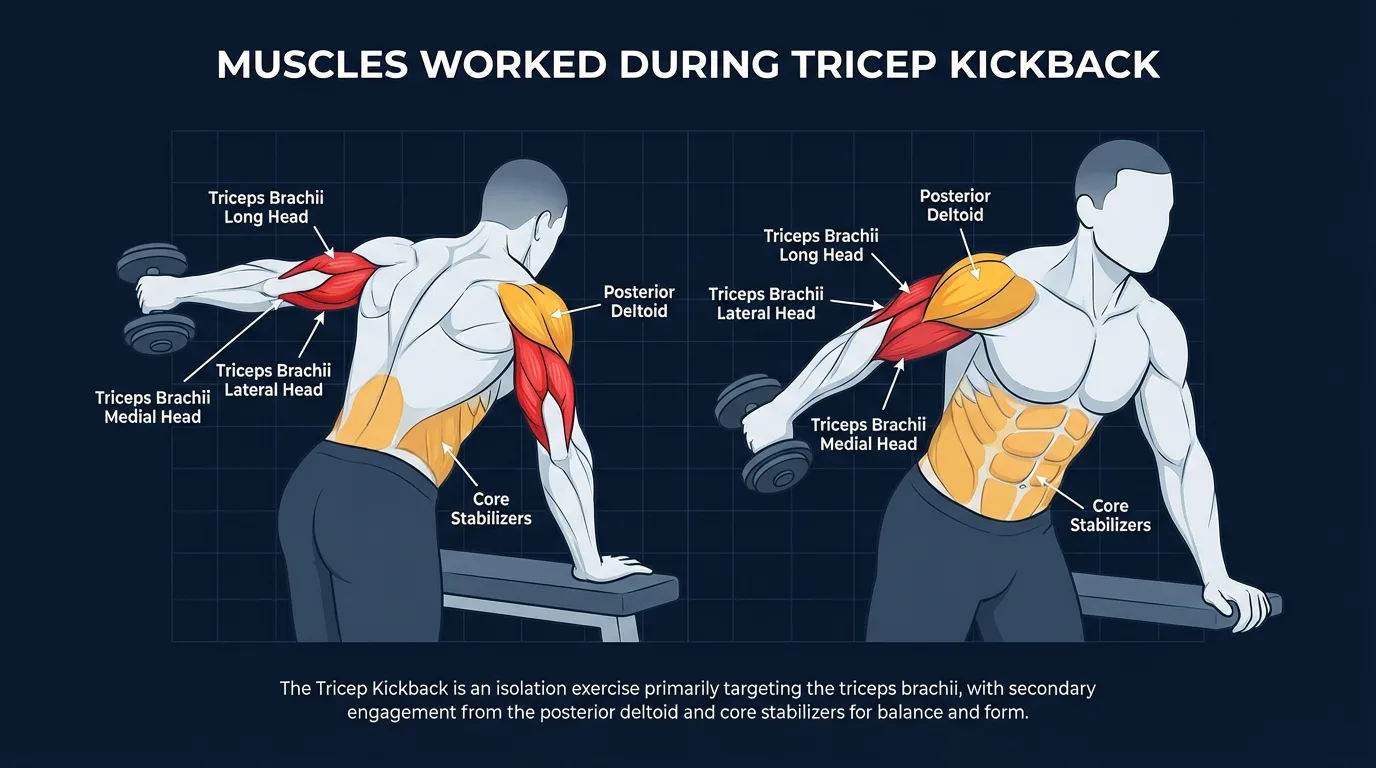
Primary movers: the triceps brachii. All three heads help straighten the elbow during the concentric phase, then control elbow flexion as the dumbbell returns during the eccentric phase. The long head also crosses the shoulder, so keeping the upper arm behind the torso changes how the contraction feels at lockout.
Secondary movers: the posterior deltoid and rear shoulder muscles help hold the upper arm in line with the torso. They should stabilize, not swing the weight. If your shoulder is doing the lifting, the dumbbell is too heavy.
Stabilizers: the rotator cuff, scapular retractors, spinal erectors, and abdominal wall hold the shoulder blade, ribcage, and trunk steady. Bench support reduces the trunk demand and makes the triceps isolation easier to feel.
Why the exercise feels hardest at the top: the dumbbell creates its biggest challenge when the forearm reaches full extension behind you. That is where gravity creates the longest lever and where the triceps are fully shortened. Light weight, strict elbow position, and a clear pause at lockout matter more than chasing a heavy dumbbell.
How to Do the Tricep Kickback Step by Step
Step 1: Set Your Support and Hinge
Hold one dumbbell with a neutral grip. Brace your free hand on a bench, sturdy chair, or your thigh, then hinge from the hips until your torso is angled forward with a flat back.
Coach Ty's cue: "Set your back first. If your torso moves, the rep gets noisy."
Step 2: Pin Your Upper Arm
Pull the working upper arm alongside your ribs until it is roughly parallel with your torso. Bend the elbow to about 90 degrees and keep your shoulder quiet.
Coach Ty's cue: "Glue your elbow to your side before you move the weight."
Step 3: Extend the Elbow
Exhale and straighten your elbow until your arm reaches full extension behind you. Only the forearm moves. The upper arm stays fixed from shoulder to elbow.
Coach Ty's cue: "Use your elbow as the hinge and keep your shoulder quiet."
Step 4: Squeeze and Lower
Pause briefly at full extension and squeeze the back of your arm. Inhale as you bend the elbow and return the dumbbell to the 90-degree start position under control.
Coach Ty's cue: "Own the top, then lower like you mean it."
Step 5: Repeat Without Momentum
Complete all reps on one side before switching arms. Stop the set when your upper arm drifts, your back rounds, or you need body movement to finish the rep.
Coach Ty's cue: "If the weight makes you cheat, the weight picked the workout for you."
Get this exercise in a personalized workout
FitCraft, our mobile fitness app, uses its AI coach Ty to program isolation exercises like this into your plan at the right volume and intensity, based on your level, goals, and equipment. Ty was designed and trained by Domenic Angelino, MPH (Brown University) and NSCA-CSCS, with research published in the Journal of Strength and Conditioning Research and Medicine & Science in Sports & Exercise.
Take the Free Assessment Free · 2 minutes · No credit card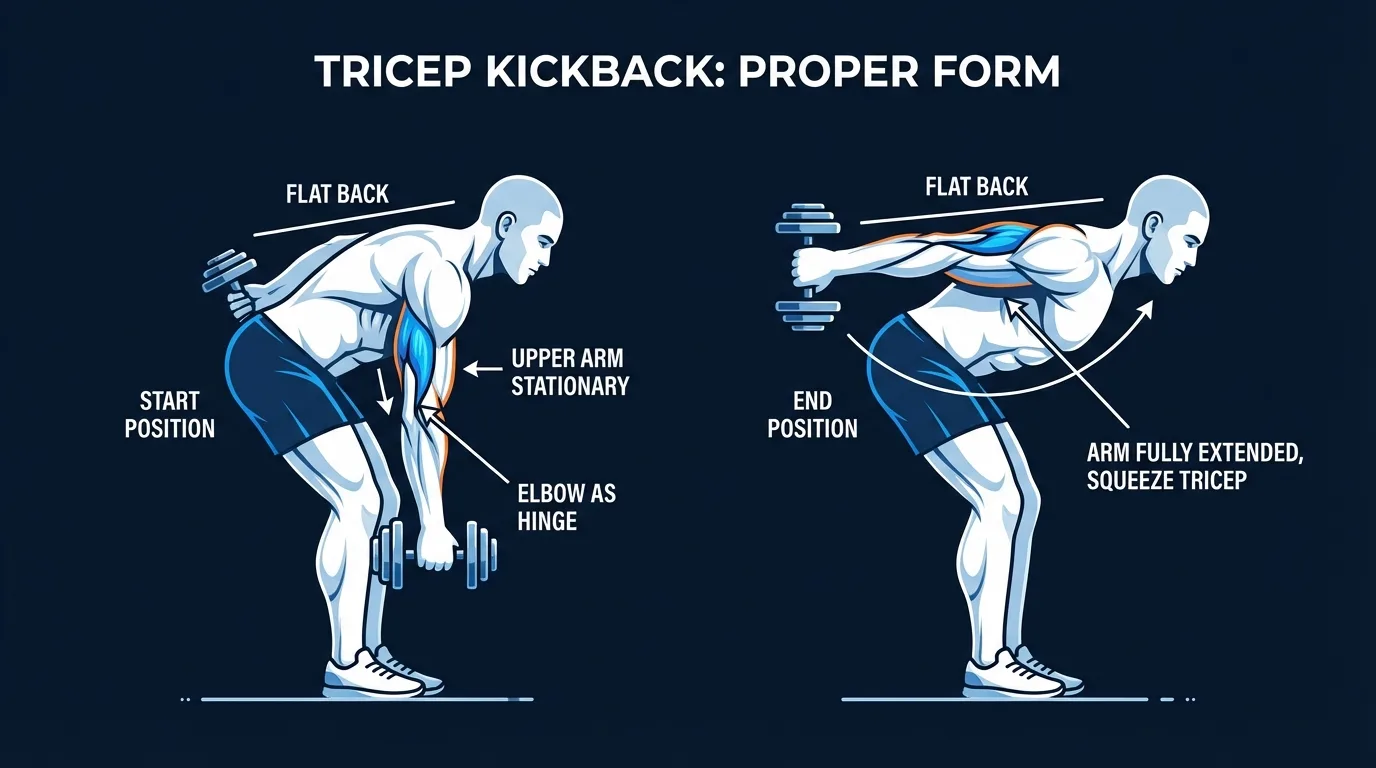
Common Mistakes and How to Fix Them
The kickback is a precision exercise. Small errors take the load away from the triceps and turn the set into shoulder swing practice.
- Swinging the dumbbell. Momentum lets the shoulder and torso throw the weight. Fix it by cutting the load and pausing for one count at full extension.
- Letting the upper arm drift. If the elbow drops toward the floor, the triceps lose tension. Pin the upper arm beside your ribs and reset when it moves.
- Rounding the back. A rounded hinge can irritate the lower back. Brace your abs, keep the spine neutral, or use a bench-supported setup.
- Stopping short of lockout. The top position is where the kickback is most useful. Use a weight that lets you straighten the elbow without snapping or shrugging.
- Going too heavy too soon. Heavy kickbacks usually become partial reps. Build with slow 10 to 15 rep sets before adding load.
- Rushing the return. Dropping the dumbbell wastes the eccentric phase. Lower for about two seconds and keep the same elbow angle path every rep.
Tricep Kickback Variations: Regressions and Progressions
Bench-Supported Kickback
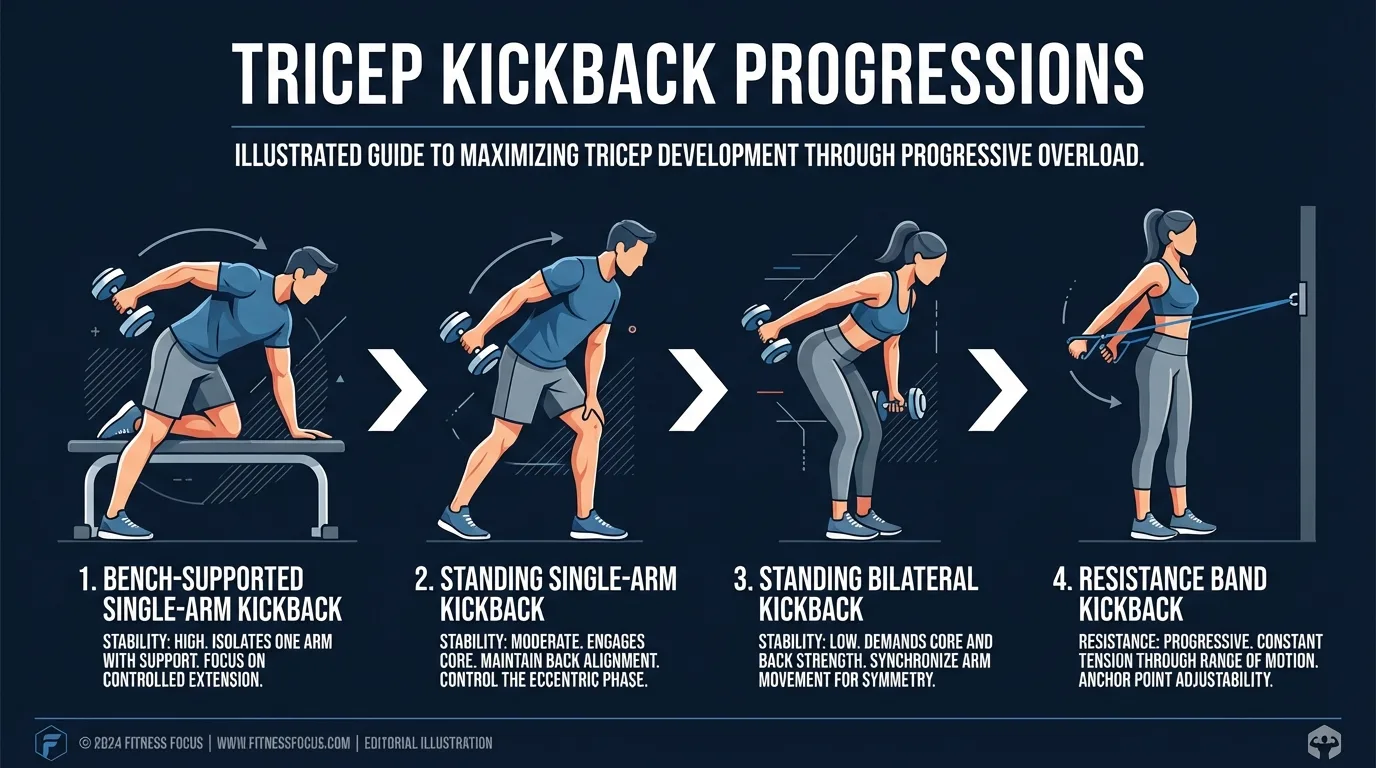
Brace one hand and one knee on a bench while the working arm performs the kickback. This is the best starting version because it removes most balance demand and makes upper-arm drift easier to catch.
Standing Bilateral Kickback
Hinge forward with a dumbbell in each hand and extend both elbows at the same time. Use this once the single-arm version feels automatic, because the torso has to stabilize without bench support.
Resistance Band Kickback
Step on a band or anchor it low behind you. The band adds more resistance as you approach full extension, so the top squeeze becomes the hardest part of the rep.
Cable Kickback
Use a low cable with a single handle or no handle. Cable tension stays smoother than a dumbbell through the range, which makes it useful for higher-rep finishers and advanced control work.
When to Avoid or Modify Tricep Kickbacks
Tricep kickbacks are safe for most healthy adults, but a few situations call for a lighter load, shorter range, or a different triceps exercise. Always consult your physician or physical therapist for personalized guidance.
- Active elbow pain, tendinopathy, or joint inflammation. Kickbacks directly load elbow extension. Use a pain-free range, lighter load, slower tempo, or pause direct triceps work until symptoms calm down.
- Recent elbow, shoulder, or wrist surgery. Get surgeon clearance before loaded elbow-extension work. Rehab usually moves from isometrics to active range, then to light external load.
- Shoulder impingement or posterior shoulder irritation. The arm sits behind the torso. If that position pinches, switch to tricep extensions or keep the upper arm closer to the ribs with a smaller range.
- Wrist or grip symptoms. Use a neutral grip, a lighter dumbbell, or a cable/band setup that lets the wrist stay quiet. Stop if numbness or tingling increases.
- Lower-back discomfort in the hinged position. Use the bench-supported version, shorten the set, or build bracing with deadbugs and bird-dogs before returning to standing kickbacks.
Related Exercises
Use these exercises to build the same arm pattern, pair the antagonist side, or support the shoulder position kickbacks need:
- Same target muscle: Tricep Extensions and Overhead Tricep Press train elbow extension through different shoulder positions.
- Compound triceps work: Diamond Push-Ups and Chest Press load the triceps inside bigger pressing patterns.
- Antagonist isolation: Bicep Curls balance arm training by loading elbow flexion instead of extension.
- Shoulder and scapular support: W-Raise and Pull-Apart build the rear-shoulder and upper-back control that keeps kickbacks strict.
How to Program Tricep Kickbacks
Program kickbacks as accessory isolation work. The American College of Sports Medicine Position Stand on resistance training gives broad loading ranges for healthy adults, from moderate-rep strength work to higher-rep muscular endurance work (Ratamess et al., 2009).
| Level | Sets × Reps | Rest between sets | Frequency |
|---|---|---|---|
| Beginner | 2-3 × 10-15 | 45-60 seconds | 2-3 sessions/week |
| Intermediate | 3-4 × 8-15 | 60-90 seconds | 2-4 sessions/week |
| Advanced | 3-4 × 6-15, intensity-dependent | 60-120 seconds | 2-4 sessions/week |
Where in your workout: place kickbacks late in an upper-body or push session, after compound pressing such as chest press or push-ups. Isolation work is accessory. Doing it first can fatigue the triceps and reduce the quality of your main lifts.
Form floor over rep targets: stop the set when the upper arm starts moving, your torso starts swinging, or the elbow no longer reaches full extension. Fewer clean reps beat more loose reps.
How FitCraft Programs This Exercise
FitCraft's AI coach Ty uses your assessment results, goals, and available equipment to place isolation work at the right point in a balanced program. For triceps work, that usually means kickbacks show up after bigger pressing patterns or as a controlled finisher.
Ty adjusts the variation and volume to match your level. Bench-supported reps can come first, then standing or band versions can follow as control improves. The goal is simple: strict reps that fit the rest of your training, without guessing what to do next.
Frequently Asked Questions
What muscles do tricep kickbacks work?
Tricep kickbacks primarily train the triceps brachii, including the long head, lateral head, and medial head. The posterior deltoid, rotator cuff, scapular retractors, and trunk stabilizers help hold the shoulder and torso steady.
Are tricep kickbacks good for beginners?
Yes, tricep kickbacks are beginner-friendly when the load is light and the upper arm stays fixed. Start with a bench-supported single-arm version so your torso stays stable and your triceps do the work.
How heavy should I go on tricep kickbacks?
Use a weight you can control without swinging. For most beginners that means a light dumbbell, often 5 to 10 pounds, because the long lever at full elbow extension makes the exercise feel harder than it looks.
Should I do tricep kickbacks one arm or both arms at a time?
One arm at a time is usually better for learning. You can brace the free hand on a bench, keep the torso quiet, and notice when the working elbow drifts. Two-arm kickbacks are faster but easier to cheat.
Can I do tricep kickbacks with elbow pain?
Active elbow pain, triceps tendinopathy, or recent elbow strain should be modified. Use lighter load, shorter pain-free range, slower tempo, or swap to a different triceps exercise. If pain increases during or after sets, stop and consult a physical therapist or qualified healthcare provider.