Skull crushers look more intimidating than they need to be. You lie on your back, hold dumbbells above your shoulders, and bend only at the elbows. Done well, the exercise gives your triceps a hard direct stimulus without needing a cable stack or barbell.
The exercise gets sloppy when the upper arms swing. Once the shoulders start helping, it turns into a pullover-press blend and the triceps lose the clean isolation that makes skull crushers useful. Keep the upper arms still, keep the wrists stacked, and let the elbows do the work.
Dumbbells also give you a neutral grip, which many lifters tolerate better than a straight bar. Each arm has to control its own path, so your stronger side can't quietly rescue the weaker side.
Quick Facts: Skull Crushers
- Equipment needed: Dumbbells
- Difficulty: Intermediate, with a beginner-friendly floor regression
- Modality: Strength
- Body region: Upper body
- FitCraft quest category: Strength
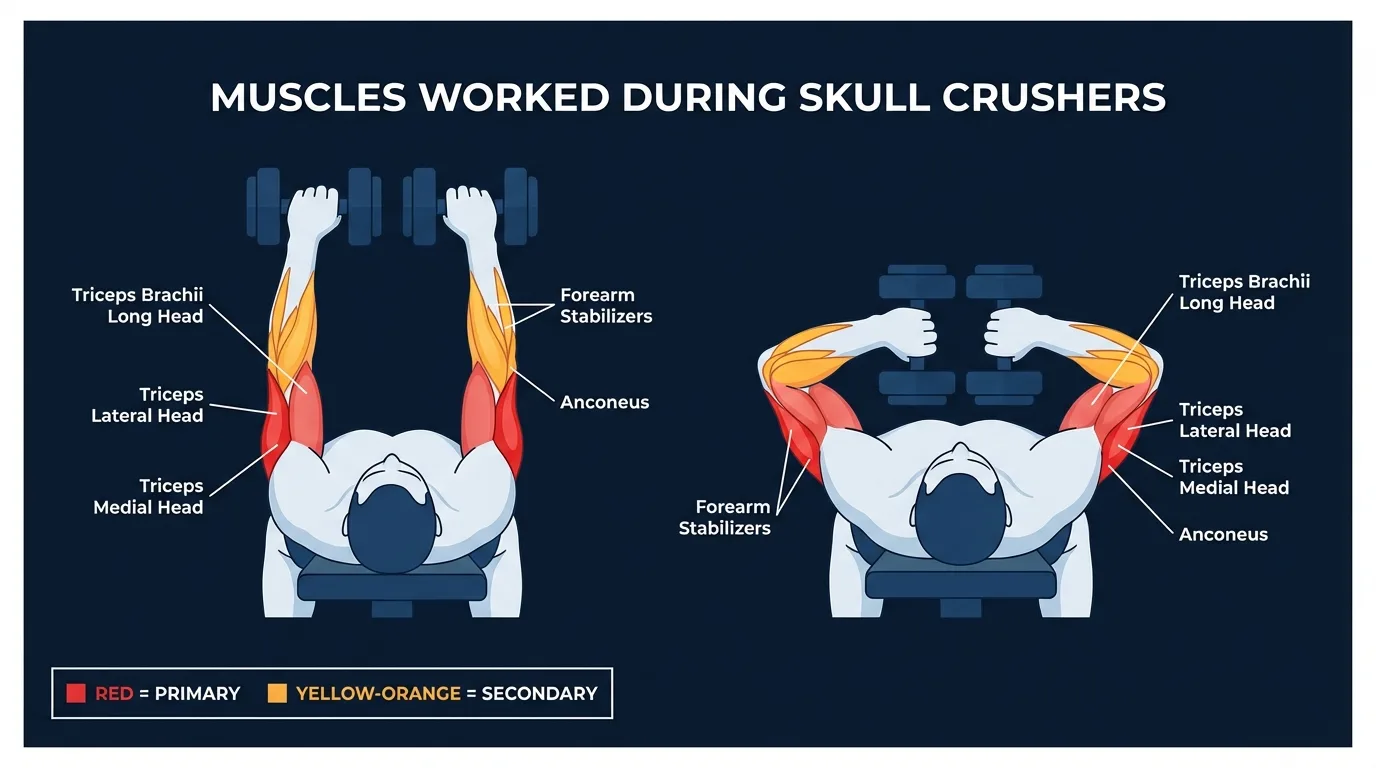
Muscles Worked
Primary movers: the triceps brachii long head, lateral head, and medial head. They lengthen during the lowering phase as the elbows bend, then shorten during the lifting phase as you extend the elbows back to the top.
Secondary movers: the anconeus assists elbow extension near the joint. The posterior shoulder and upper-back muscles help keep the upper arms from drifting, especially when you lower the dumbbells slightly behind the head.
Stabilizers: the forearm flexors and extensors keep the wrists neutral, while the rotator cuff, deltoids, and scapular retractors hold the shoulder position. Your trunk is not the main training target, but bracing keeps the ribs from flaring and the bench position stable.
Why the exercise feels different from pushdowns: skull crushers train elbow extension with the upper arm fixed and the resistance moving through a long lever. Lowering behind the head can create more stretch through the triceps long head because that head crosses both the shoulder and elbow joints. Keep that extra range controlled and pain-free.
How to Do Skull Crushers (Step-by-Step)
Step 1: Set Up on Your Back
Lie on a flat bench or the floor with one dumbbell in each hand. Press the dumbbells above your shoulders with palms facing each other, wrists neutral, feet planted, and ribs down.
Coach Ty's cue: "Stack the dumbbells over your shoulders before you start. Don't begin with the weights drifting toward your face."
Step 2: Lock the Upper Arms
Point your upper arms toward the ceiling and keep them still. The shoulder angle stays quiet so the movement comes from elbow flexion and extension.
Coach Ty's cue: "Your upper arms are posts. The forearms are the only part that moves."
Step 3: Lower with Control
Inhale and bend the elbows to lower the dumbbells toward the sides of your forehead or slightly behind your head. Move slowly enough that you could stop the weights at any point.
Coach Ty's cue: "Two seconds down. If the dumbbells fall, they're too heavy."
Step 4: Extend Back to the Top
Exhale as you straighten the elbows and bring the dumbbells back above your shoulders. Squeeze the triceps at the top without letting the elbows flare wide.
Coach Ty's cue: "Drive through the backs of your arms, then stop before your shoulders take over."
Step 5: Repeat Only Clean Reps
Keep the same elbow width, wrist position, and tempo on every rep. Stop the set when the upper arms start swinging, the wrists bend back, or elbow discomfort changes your path.
Coach Ty's cue: "The rep count ends when the form changes."
Get this exercise in a personalized workout
FitCraft, our mobile fitness app, uses its AI coach Ty to program isolation exercises like this into your plan at the right volume and intensity, based on your level, goals, and equipment. Ty was designed and trained by Domenic Angelino, MPH (Brown University) and NSCA-CSCS, with research published in the Journal of Strength and Conditioning Research and Medicine & Science in Sports & Exercise.
Take the Free Assessment Free · 2 minutes · No credit card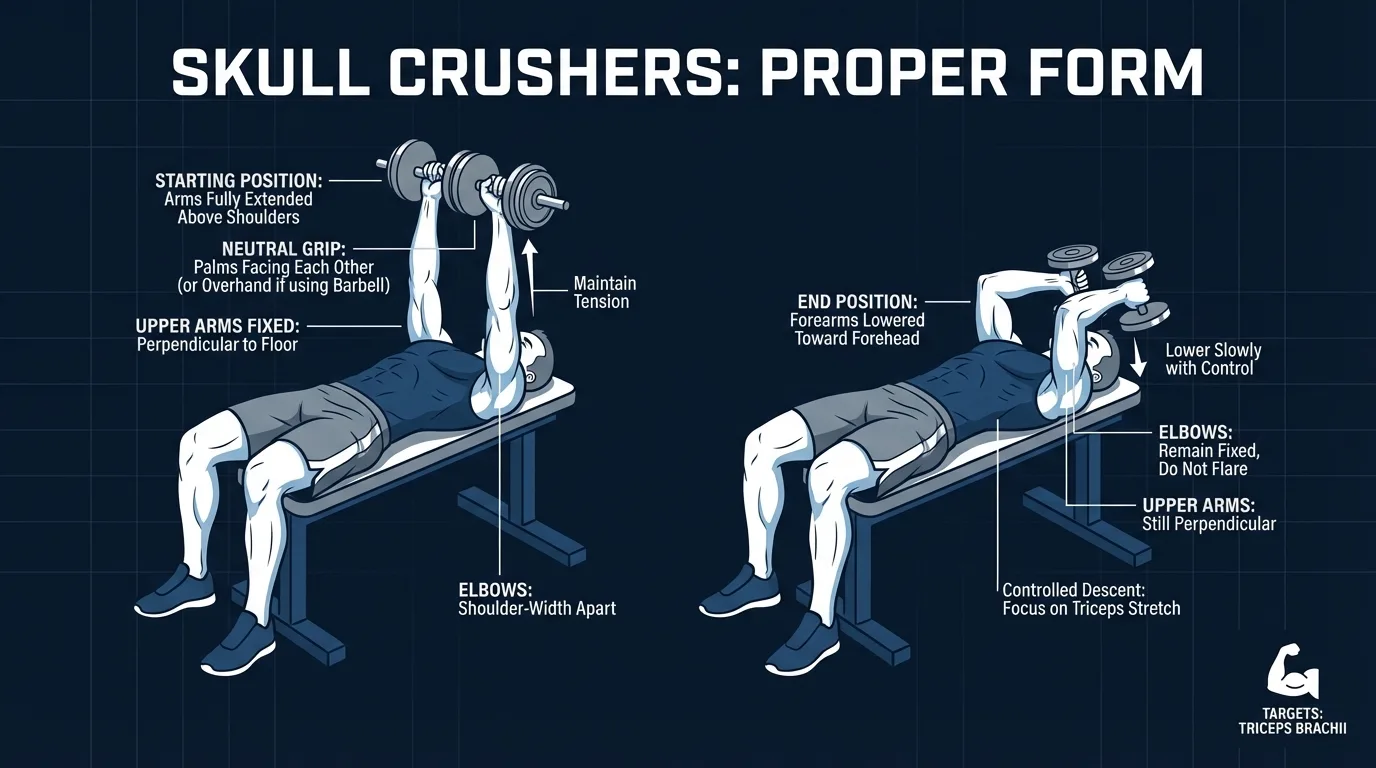
Common Mistakes to Avoid
Skull crushers are honest. Small form leaks show up quickly because the lever is long and the dumbbells are close to your head.
- Moving the upper arms. If the upper arms swing, the shoulders are taking over. Fix it by lowering the weight and treating the upper arms like vertical posts.
- Flaring the elbows. Wide elbows add side stress to the joint and make the path harder to control. Keep elbows roughly shoulder-width and pointed toward the same ceiling line.
- Going too heavy. A load you can press is often too heavy for clean skull crushers. Choose dumbbells you can lower for two controlled seconds.
- Bouncing out of the bottom. A fast reversal can irritate the elbow. Pause lightly at the bottom, then extend with control.
- Letting the wrists bend back. Hyperextended wrists leak force and make the dumbbells feel unstable. Keep knuckles stacked over forearms.
- Chasing excessive depth. Lower only as far as you can control without elbow or shoulder discomfort. More range helps only when you own it.
Skull Crusher Variations: Regressions and Progressions
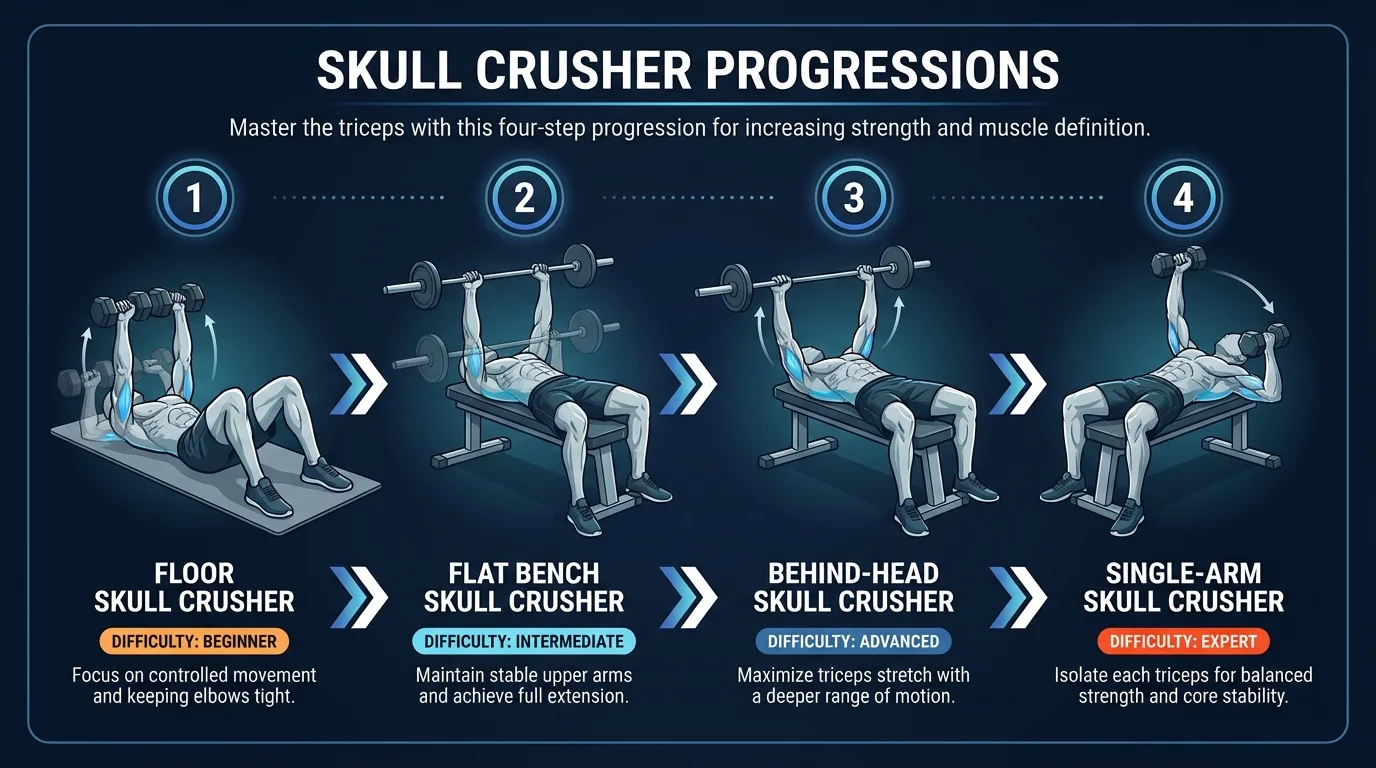
Start with the version that lets you control the dumbbells and keep your elbows calm. Progress when every rep looks the same.
Floor Skull Crushers (Beginner Regression)
The floor shortens the bottom range and gives you a clear stopping point. This is the best entry point if you're learning the pattern or managing mild elbow sensitivity.
Flat Bench Skull Crushers (Standard)
The bench allows a little more range than the floor and is the standard dumbbell version. Keep the neutral grip and use a smooth lowering phase.
Behind-the-Head Skull Crushers (Long-Head Bias)
Lower the dumbbells slightly past the top of your head instead of directly toward your forehead. This increases stretch on the triceps long head, but it asks more from shoulder mobility and elbow control.
Single-Arm Skull Crushers (Advanced)
Train one arm at a time with a lighter dumbbell. Your free hand can hover near the working elbow as a guide, which helps keep the upper arm from drifting.
Alternative Triceps Exercises
- Tricep Extensions: overhead dumbbell work that trains the triceps long head through a different shoulder angle.
- Tricep Kickbacks: a lighter shortened-position option when elbows need a break from lying extensions.
- Diamond Push-Ups: a bodyweight triceps-focused press when dumbbells are not available.
When to Avoid or Modify Skull Crushers
Skull crushers are safe for most healthy adults, but the elbow position and long lever make a few situations worth modifying. Always consult your physician or physical therapist for personalized guidance.
- Active elbow pain, tendinopathy, or joint inflammation. Skull crushers load elbow extension directly. Reduce load, shorten range, use the floor version, or switch to tricep kickbacks until symptoms calm down.
- Recent elbow, wrist, or shoulder surgery. Get clearance from your surgeon or physical therapist before adding loaded isolation work. Rehab usually moves from isometrics to active range before external loading.
- Shoulder mobility limits. If lowering behind the head causes shoulder pinch, stay with the forehead path or use tricep extensions only in a pain-free range.
- Wrist irritation or carpal tunnel symptoms. Keep a neutral grip and a stacked wrist. If gripping dumbbells worsens symptoms, pause loaded triceps isolation and choose pain-free pressing work.
- Poor dumbbell control near the face. Start on the floor with very light dumbbells, or use diamond push-ups and bench dips while you build triceps strength.
Related Exercises
Use these movements to build a complete arm and pressing plan around skull crushers.
- Same target muscle: Tricep Extensions, Overhead Tricep Press, Tricep Kickbacks, and Tate Press train elbow extension from different angles.
- Compound triceps work: Diamond Push-Ups, Close-Grip Push-Ups, Bench Dips, and Chest Press blend triceps strength with pressing mechanics.
- Antagonist isolation: Bicep Curls and Hammer Curls balance elbow flexion work with your triceps training.
- Shoulder and scapular support: W-Raise, Y-Raise, and Pull-Apart help build the shoulder control that keeps the upper arm quiet.
How to Program Skull Crushers
Skull crushers fit best as accessory isolation work after your main pressing. The American College of Sports Medicine position stand on resistance training recommends progressive loading across rep ranges, rest periods, and weekly frequency based on training status (Ratamess et al., 2009).
| Level | Sets x Reps | Rest between sets | Frequency |
|---|---|---|---|
| Beginner | 2-3 x 10-15 | 45-60 seconds | 2-3 sessions/week |
| Intermediate | 3-4 x 8-15 | 60-90 seconds | 2-4 sessions/week |
| Advanced | 3-4 x 6-15 | 60-120 seconds | 2-4 sessions/week |
Where in your workout: place skull crushers after compound pressing such as chest press, push-ups, or shoulder press. Isolation work is accessory. If you put it first, your triceps may fatigue before the bigger lifts that need them.
Form floor over rep targets: stop the set when your elbows flare, upper arms swing, wrists bend back, or the lowering phase speeds up. Fewer clean reps beat a full set that irritates your elbows.
How FitCraft Programs This Exercise
FitCraft uses the free assessment to match your training plan to your level, goals, and available equipment. Ty, FitCraft's 3D AI coach, then demonstrates movements and guides workouts inside the app.
For isolation exercises like skull crushers, the useful starting point is control. A personalized plan can keep the load light, put the exercise after pressing work, and adjust the variation and volume as your triceps strength improves.
Frequently Asked Questions
What muscles do skull crushers work?
Skull crushers primarily train the triceps brachii: long head, lateral head, and medial head. The anconeus assists elbow extension, while the forearms, rotator cuff, and shoulder girdle stabilize the dumbbells.
Can I do skull crushers with elbow pain?
Do not push through sharp elbow pain. Reduce the load, shorten the range, slow the lowering phase, and try the floor variation first. If symptoms persist or you have active tendinopathy, use a pain-free triceps variation and speak with a physical therapist.
Should I lower skull crushers to my forehead or behind my head?
Lowering toward the forehead is easier to control and is the best starting path. Lowering slightly behind the head increases the stretch on the triceps long head, but it requires better shoulder mobility and more control.
How heavy should dumbbell skull crushers be?
Use a weight you can lower for about two seconds without the upper arms swinging. Most lifters need less load than they expect because the lever arm is long and the weights move near the face.
Are floor skull crushers effective?
Yes. Floor skull crushers shorten the bottom range, which can make the exercise easier to learn and easier on sensitive elbows. Progress to a bench when you can keep the upper arms still and control every rep.