If you've been chasing bigger arms with curls alone, you're working on the smaller half of the equation. The triceps make up roughly 60-65% of your upper arm mass. That means the back of your arm (the part you see in the mirror when you turn sideways) is where the real size lives. And the overhead tricep press is one of the most effective ways to build it.
What makes the overhead version special is the stretch. When your arm is overhead, the long head of the triceps (the largest of the three heads) is placed in a fully lengthened position. The 2022 Maeo paper cited above ran a 12-week training study with one arm trained overhead and the other trained at neutral arm position, and the overhead arm produced substantially greater long-head growth despite lifting lighter weight. That's a big deal. It means the overhead tricep press targets the triceps in the position where muscle growth is maximized.
The overhead tricep press is also one of those exercises that transfers directly to real life. Putting luggage in an overhead bin, pushing yourself up from the floor, throwing a ball: every one of those movements relies on tricep strength. So training them in isolation isn't purely cosmetic. It makes every pressing movement in and out of the gym stronger.
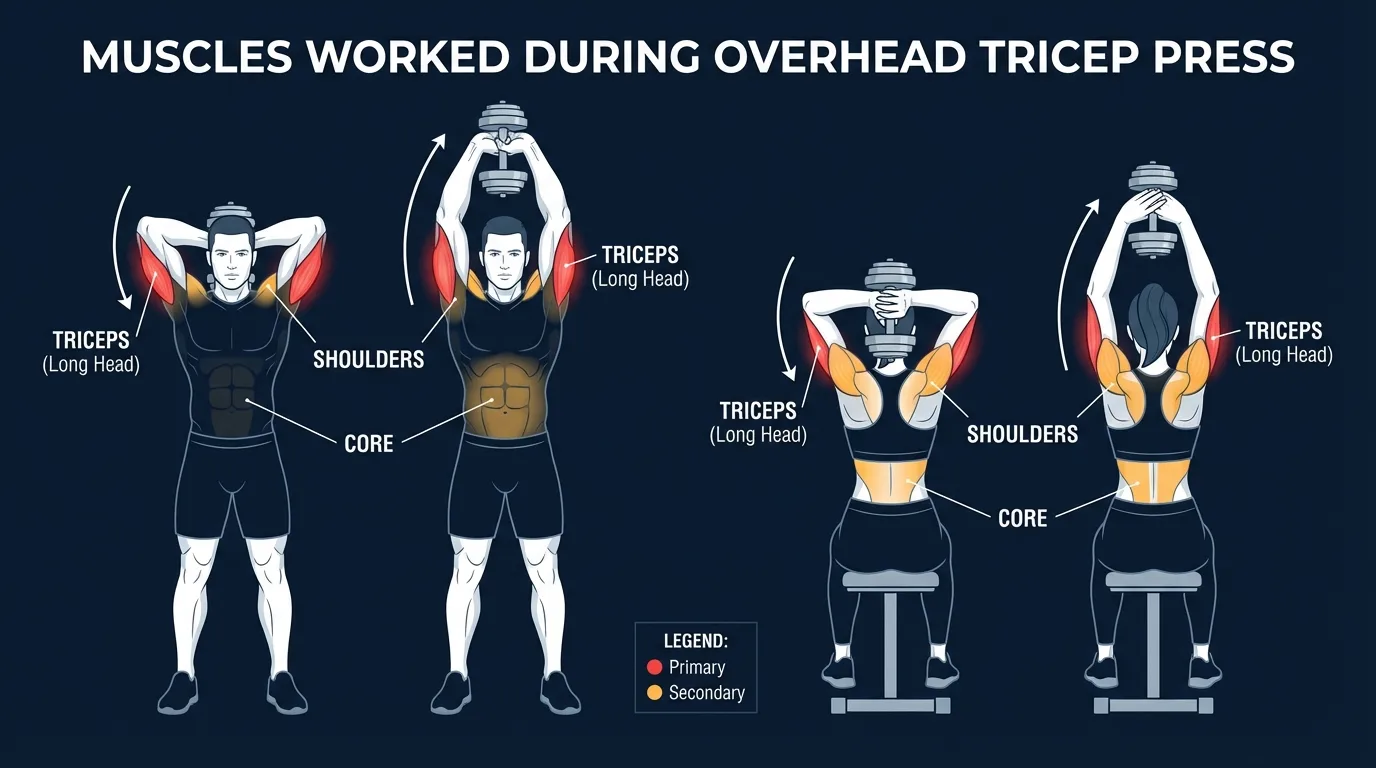
Muscles Worked
Primary movers. The triceps brachii drives every rep. All three heads (long, lateral, and medial) extend the elbow from the bent position back to lockout, with the long head doing extra work because it crosses the shoulder joint and is placed in a deeply stretched position when your arm is overhead. The concentric phase (pressing up) is where peak contraction lives. The eccentric phase (lowering behind your head) is where the stretch-loaded growth stimulus lives.
Secondary movers. The anconeus, a small muscle that crosses the elbow joint on the outside, assists the triceps in extending the elbow and helps stabilize the joint through the range. It contributes a small percentage of force but tends to fire on every rep.
Stabilizers. The shoulder girdle works isometrically to hold the upper arms in a fixed vertical position next to your ears. The anterior deltoid, rotator cuff, and serratus anterior keep the shoulder blade and humerus stacked overhead. The core (rectus abdominis, obliques, and erectors) braces against the tendency of the spine to extend (arch) as the load goes behind your head. Without that core engagement, the lower back takes the load instead of the triceps.
Evidence. Maeo et al. (2022) ran a 12-week within-subject training study in which one arm performed elbow extensions overhead and the other arm performed identical work at neutral arm position. The overhead-trained arm produced roughly 1.5-fold greater hypertrophy in the long head and meaningfully greater growth across the lateral and medial heads, despite using lighter loads. The mechanism: training a muscle in its lengthened position appears to produce more growth per unit of work than training in the shortened position, particularly for bi-articular muscles like the triceps long head.
Quick Facts: Overhead Tricep Press
Quick Facts
- Equipment needed: One dumbbell (two-hand grip) or a pair of dumbbells (single-arm version)
- Difficulty: Beginner to intermediate (single-arm version pushes into advanced)
- Modality: Single-joint isolation, elbow extension
- Body region: Upper body, posterior arm
- FitCraft quest category: Strength
How to Do the Overhead Tricep Press (Step-by-Step)
- Set up with the dumbbell overhead. Stand with feet shoulder-width apart, core braced. Grab one dumbbell with both hands, cupping the inside of the top plate with your palms overlapping. Press the dumbbell overhead until your arms are fully extended. Your upper arms should sit right next to your ears, elbows pointing forward, not out to the sides. This starting position sets the whole exercise up. Get it right before your first rep.
Coach Ty's cue: "Elbows are headlights. Both should point at the wall in front of you, not the walls beside you."
- Lower the dumbbell behind your head. Keeping your upper arms completely still, bend only at the elbows to lower the dumbbell behind your head. Lower until your forearms reach at least parallel to the floor, or slightly past. You should feel a deep stretch in the back of your upper arms. That stretch is the whole reason you're doing this exercise overhead instead of lying down. It puts the long head of the triceps in its most growth-favorable position.
Coach Ty's cue: "Upper arms are a fixed beam. Only your forearm rotates around the elbow joint."
- Press back to full extension. Drive the dumbbell back up by straightening your arms. Squeeze the triceps hard at lockout. Full extension, arms straight, elbows still pointing forward. Your upper arms should not have moved during the rep. If they swung forward or back, you're using your shoulders to help. Drop the weight and try again.
- Control the descent and repeat. Take 2-3 seconds on the way down. Keep your core tight and resist the urge to arch your back. Your body wants to arch because it makes the movement easier, but it shifts load from your triceps to your lower back. Breathe in on the descent, out as you press. Beginners: 3 sets of 10-12 reps with a light dumbbell.
Coach Ty's cue: "Brace your core like someone's about to poke your stomach. A flat, neutral spine the whole rep."
Common Mistakes to Avoid
The overhead tricep press is a simple movement, but a few errors turn it into a less effective or riskier exercise:
- Flaring the elbows outward. When your elbows drift wide, the exercise becomes a hybrid between a tricep press and a behind-the-neck press. This loads the elbow joint at a bad angle and shifts tension off the long head. Fix: keep elbows narrow, pointing straight forward. If they flare involuntarily, the dumbbell is too heavy.
- Moving the upper arms. Swinging the upper arms forward and back turns this into a partial shoulder press. You might move more weight, but the triceps aren't doing the work. Fix: film yourself from the side. Your upper arms should stay vertical and motionless through every rep.
- Arching the lower back. Your body compensating for a weight that's too heavy. The arch takes tension off the triceps and puts compressive force on the lumbar spine. Fix: brace your core aggressively, or switch to a seated version with back support. The seated version removes the temptation entirely.
- Bouncing out of the bottom. Using momentum at the bottom (the stretched position) puts sudden force on the elbow tendons. This is how overhead tricep press injuries happen. Fix: pause for a half-second at the bottom. Controlled stretch, controlled press. No bouncing.
- Going too heavy too soon. The overhead position already places the long head in a mechanically disadvantaged stretched state, so the absolute load you can handle is much lower than what you'd lift on a close-grip press or bench press. Pick a weight you can control for 10-12 clean reps with a 2-3 second eccentric. If the last rep looks like the first, the weight is right.
Get this exercise in a personalized workout
FitCraft, our mobile fitness app, uses its AI coach Ty to program isolation exercises like this into your plan at the right volume and intensity, based on your level, goals, and equipment. Ty was designed and trained by Domenic Angelino, MPH (Brown University) and NSCA-CSCS, with research published in the Journal of Strength and Conditioning Research and Medicine & Science in Sports & Exercise.
Take the Free Assessment Free · 2 minutes · No credit card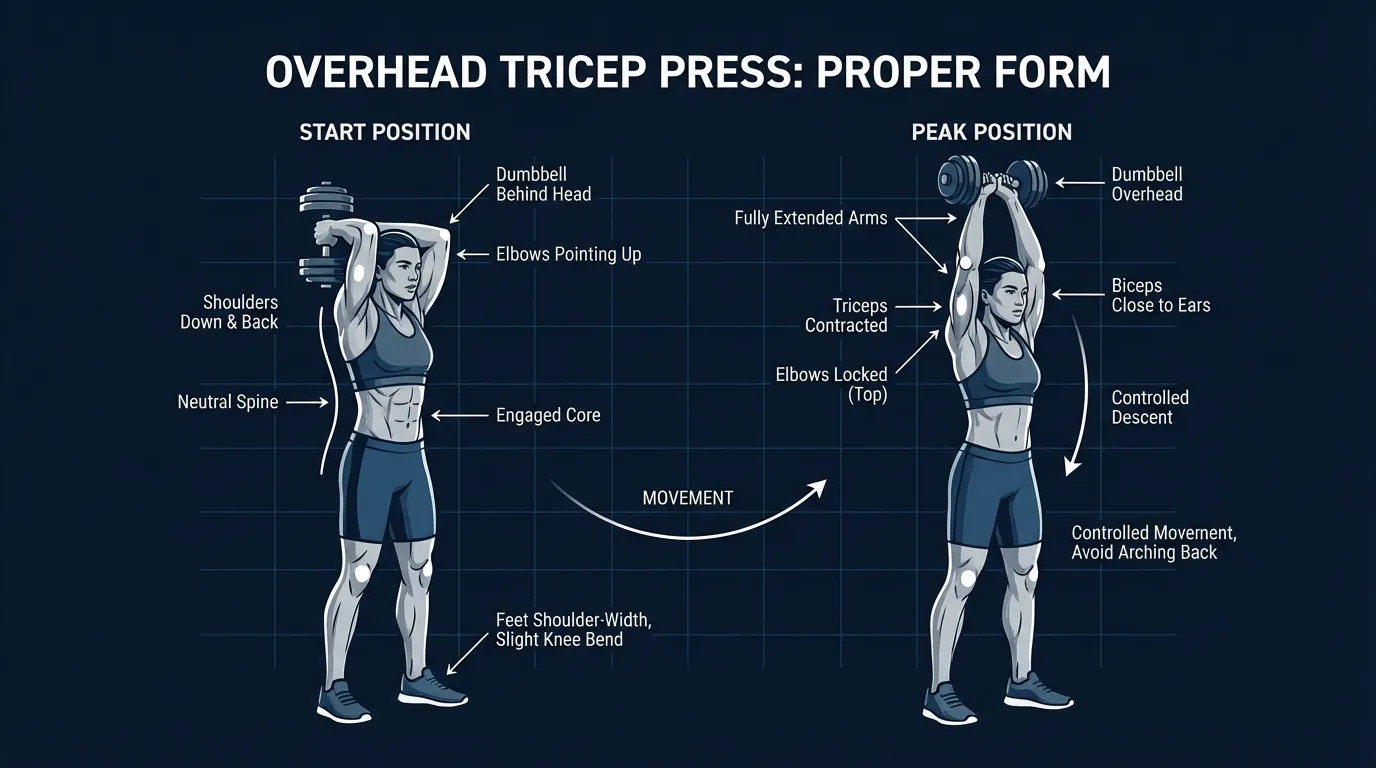
Variations: From Seated to Single-Arm
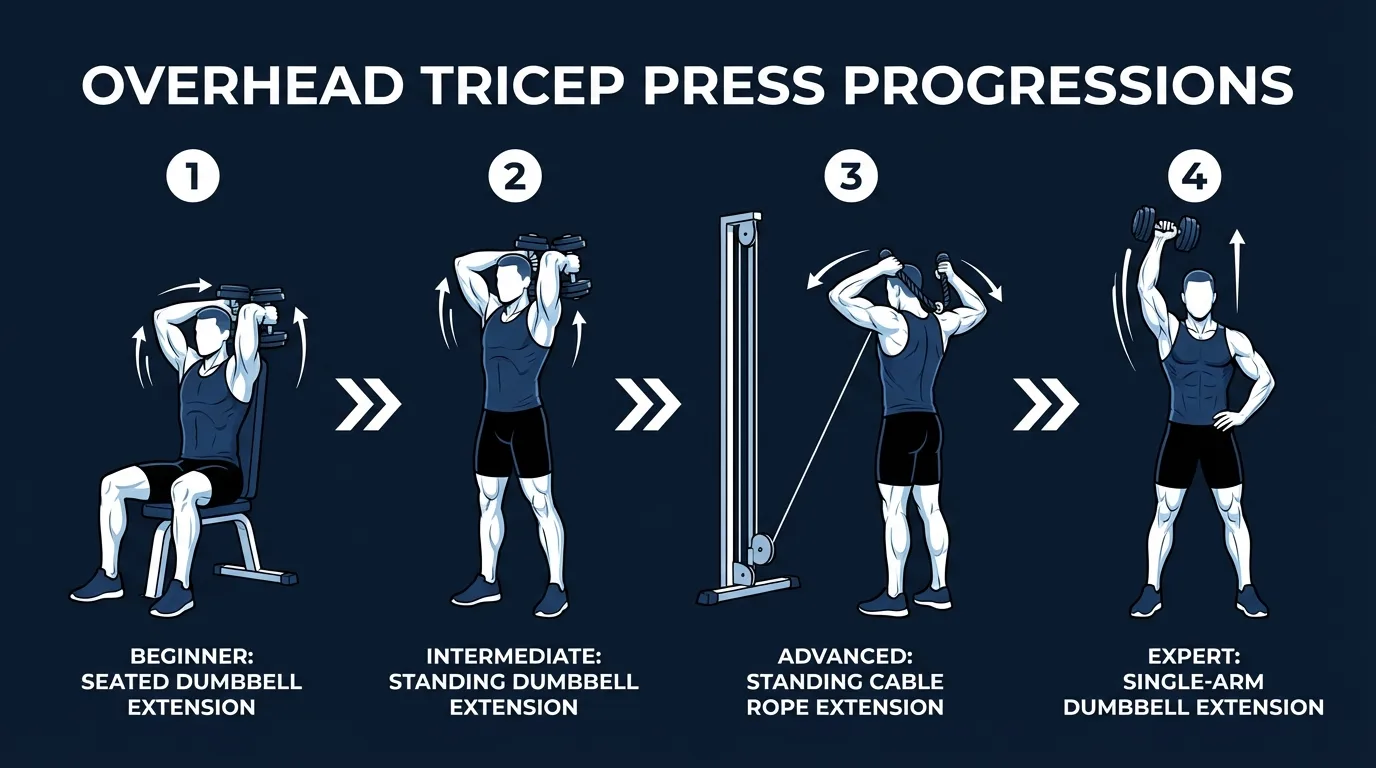
Seated Overhead Press (Beginner)
Sit on a bench with back support and perform the same movement. The bench eliminates the balance challenge and prevents your lower back from arching. If you're new to this exercise or you notice your back arching during the standing version, start here. The seated variation forces stricter form because your body can't compensate.
Standing Overhead Press (Beginner-Intermediate)
The standard version described in the step-by-step above. Standing requires more core engagement to keep your torso stable, which makes it a slightly harder variation than seated. Once you can do 3 sets of 12 seated with good form, move to standing.
Single-Arm Overhead Press (Intermediate to Advanced)
Hold a lighter dumbbell in one hand, extend overhead, and perform the same lowering and pressing motion. This version exposes left-right imbalances immediately. Most people's non-dominant arm is noticeably weaker, and single-arm work lets you address that directly. Use a weight that's about 40-50% of your two-hand weight.
When to Avoid or Modify Overhead Tricep Press
The overhead tricep press is safe for most healthy adults, but a few conditions warrant modification or substitution. Always consult a qualified healthcare provider or physical therapist before starting or returning to any exercise program, especially if any of the conditions below apply to you.
- Active shoulder pain, impingement, or rotator cuff issues. The overhead arm position requires roughly 180 degrees of shoulder flexion, which can compress an irritated subacromial space. Substitute with tricep extensions done at lower arm angles, bench dips, or close-grip push-ups until a PT clears the shoulder, then return to the seated overhead variation first.
- Elbow tendinopathy or recent elbow strain. The deep stretch at the bottom of every rep places direct load on the triceps tendon at the elbow. With active tendinopathy, this can flare symptoms. Work in a smaller pain-free range, drop the load substantially, or temporarily switch to lower-tendon-stress isolation like tricep kickbacks.
- Lower back pain or recent disc injury. The instinct to arch your back as the weight goes behind your head loads the lumbar spine. If your core can't reliably hold a neutral spine, switch to the seated version with full back support and use a lighter load until trunk control returns.
- Limited shoulder mobility (cannot reach arms fully overhead without arching). If you can't get to a clean overhead position with a neutral spine, the exercise becomes a low-back exercise instead of a triceps exercise. Address mobility first with overhead stretching work like tricep and lat stretch, then return to a partial-range seated version, then progress.
- Pregnancy, especially second and third trimester. Overhead loaded work increases the demand on core stabilization at a time when the abdominal wall is stretched. Work with a perinatal fitness specialist who can scale load and select a body position that respects pelvic floor and abdominal pressure considerations.
- Recent shoulder or elbow surgery. Get surgeon clearance. Most post-surgical protocols start with isometric work, progress to active range, and only later add load. The overhead position is typically gated until midway through the rehab timeline.
Related Exercises
- Same target muscle (long-head focus): Skull crushers (lying variation that hits the same long head from a different angle) and tricep extensions (overlapping family; many trainers use the terms interchangeably).
- Same target muscle (other heads): Tricep kickbacks (biases the lateral and medial heads in the shortened position; a complement to overhead work, not a substitute).
- Compound that includes the triceps: Close-grip push-ups, diamond push-ups, bench dips, and chest press all involve elbow extension under load.
- Antagonist isolation: Pair tricep work with biceps isolation like bicep curls or hammer curls for balanced arm development.
- Vertical pressing partner: Shoulder press shares the overhead position and trains the deltoids that stabilize you during the tricep press.
- Core foundation for overhead loading: Deadbugs and bird-dogs build the anti-extension core control that keeps your lower back safe when the weight goes behind your head.
How to Program Overhead Tricep Press
Programming guidance follows the ACSM Position Stand on Resistance Training (Ratamess et al., 2009), adapted to single-joint isolation work for the triceps.
| Level | Sets × Reps | Rest between sets | Frequency |
|---|---|---|---|
| Beginner | 2-3 × 10-15 | 45-60s | 2 sessions/week |
| Intermediate | 3-4 × 8-15 | 60-90s | 2-3 sessions/week |
| Advanced | 3-4 × 6-15 (intensity-dependent) | 60-120s | 2-4 sessions/week |
Where in your workout. Place overhead tricep press late in the session, after your main compound pressing work like push-ups, chest press, or shoulder press. Isolation work is an accessory; running it first will fatigue the triceps and underload your main compound lifts. A common pairing is supersetting overhead tricep press with biceps isolation like hammer curls for efficient arm training.
Form floor over rep targets. If your elbows start flaring, your back starts arching, or you can't control the descent for the full 2-3 seconds, end the set. Two clean sets of 8 are worth more than three sloppy sets of 12. The growth stimulus on this exercise lives in the deep stretch at the bottom and the controlled lockout at the top; momentum-driven reps skip both.
FitCraft's AI coach Ty adjusts the variation and volume to match your level. He picks between seated, standing, and single-arm based on your assessment results and progresses load and rep ranges over time. The 3D exercise demonstrations show elbow positioning and range of motion from multiple angles, which helps you nail the "elbows forward" cue that's nearly impossible to feel on your own without visual feedback.
Frequently Asked Questions
Can I do overhead tricep press with shoulder pain or impingement?
Often no, at least not in the overhead version. The fully overhead arm position requires roughly 180 degrees of shoulder flexion, which can compress an irritated subacromial space and aggravate impingement, rotator cuff issues, or AC joint problems. If you have active shoulder pain, substitute with tricep kickbacks, close-grip push-ups, or bench dips, all of which load the triceps without putting the shoulder at end-range flexion. Once a physical therapist clears the shoulder, return to the seated overhead variation first because the back support reduces shoulder torque.
What is the difference between overhead tricep press and tricep extension?
The overhead tricep press and the overhead tricep extension are essentially the same movement. Both involve holding a dumbbell overhead and lowering it behind the head by bending at the elbows. Some trainers use "press" to emphasize the pushing action and "extension" to emphasize the straightening of the arm, but the mechanics, muscles worked, and form cues are identical.
Is the overhead tricep press good for beginners?
Yes. The overhead tricep press is one of the most beginner-friendly triceps isolation exercises. Start with a light dumbbell (8-15 lb) and the seated variation, which removes the balance challenge. The two-hand grip on a single dumbbell is stable and easy to learn. Focus on keeping your elbows pointed forward and using a slow, controlled tempo.
What muscles does the overhead tricep press work?
The overhead tricep press primarily targets all three heads of the triceps brachii, with special emphasis on the long head due to the overhead arm position. Supporting muscles include the anconeus (a small elbow extensor) and the core that keeps you upright. The shoulder girdle, including the rotator cuff and anterior deltoid, works isometrically to hold the upper arms next to the ears throughout each rep.
How heavy should I go on overhead tricep press?
Lighter than you expect. The overhead position places the long head of the triceps in a stretched, mechanically disadvantaged position. Beginners typically start with 8-15 lb dumbbells. If your elbows flare outward, your back arches, or you can't control the descent for 2 seconds, the weight is too heavy. The exercise responds well to moderate loads with controlled tempo rather than maximal weight.
Can I do overhead tricep press every day?
Not recommended. The triceps need 48-72 hours to recover between direct training sessions. Daily direct work leads to accumulated fatigue and potential tendon irritation at the elbow. Two sessions per week with at least two rest days between them is the sweet spot for most people. The triceps also get indirect work from any pressing exercise like push-ups, shoulder press, or chest press.