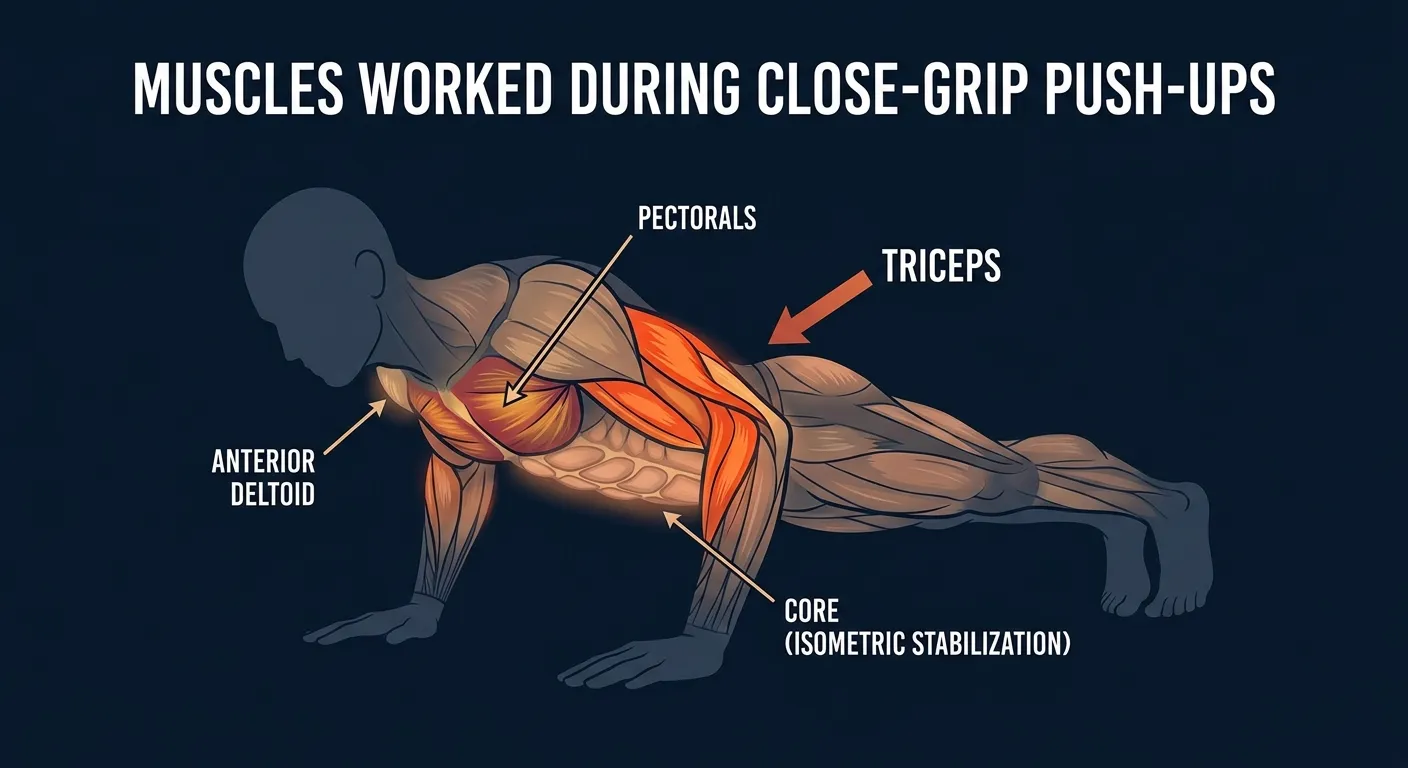
Muscles Worked
Primary movers. The triceps brachii (long, lateral, and medial heads) is the dominant muscle in a close-grip push-up. All three heads contribute to elbow extension on the press, with the medial head taking on more work near the bottom of the rep where the elbow is deeply flexed. The narrow hand position and tucked elbows lengthen the line of pull through the triceps and shorten it through the pectorals, which is why the triceps work harder here than in a wide-grip push-up at the same depth.
Secondary movers. The pectoralis major contributes, with the inner/sternal fibers taking on more relative work than they do in a wide-grip push-up because the narrow hand placement pulls the line of force toward the midline of the body. The anterior deltoids assist with shoulder flexion during the press. Both muscles do real work, but neither carries the rep the way the triceps do.
Stabilizers. The entire anterior core (rectus abdominis, transverse abdominis, obliques) and the glutes work isometrically to hold the rigid plank position. The scapular stabilizers (rhomboids, middle and lower trapezius) and serratus anterior fire continuously to keep the shoulder blades pulled down, back, and protracted at the top, protecting the shoulder joint and transferring force cleanly through the arm.
Mechanism. The close-grip push-up is a closed-chain elbow-extension exercise loaded by a fraction of bodyweight (varying with foot/hand height and body angle). At shoulder-width hand placement with tucked elbows, the moment arm from the elbow joint to the line of bodyweight is shorter, which means each individual triceps fiber has to produce more force to extend the elbow. That higher per-fiber demand is the mechanism behind the triceps emphasis.
The close-grip push-up is what regular push-ups should probably be called when you want to actually train the triceps without going to a dip bar. Same plank. Same controlled descent. The only thing that changes is where your hands sit on the floor and where your elbows travel as you lower.
That small change does a lot of work. Pulling the hands in by a few inches and tucking the elbows against the ribs shifts the load from the outer chest to the triceps and the inner fibers of the pec. It's also gentler on most shoulders than the wide-flared elbow path that a lot of people default to with regular push-ups.
The catch is that close-grip push-ups are harder. Most people who can rep out 15 wide-grip push-ups can only do 8-10 with elbows tucked, because the triceps are smaller and weaker than the chest. That's the point. If you want bigger, stronger triceps, you have to load them, and this is one of the cleanest bodyweight ways to do it.
Quick Facts: Close-Grip Push-Ups
- Equipment needed: None. Optional push-up handles or dumbbells for neutral-grip wrist relief; optional bench for incline regression or feet-elevated progression
- Difficulty: Beginner (incline) to Advanced (decline, weighted, one-arm)
- Modality: Compound · Bilateral · Horizontal-push pattern · Closed-chain elbow extension
- Body region: Upper body (triceps-dominant pressing)
- FitCraft quest category: Strength
How to Do Close-Grip Push-Ups (Step-by-Step)
- Set up your hand position. Get into a plank position with hands directly under your shoulders or slightly narrower (shoulder-width or just inside). Fingers point forward. Body forms a rigid line from head to heels. Pack your shoulders down and back. Brace your core.
Coach Ty's cue: "Hands at shoulder-width or just inside. Not stacked together like a diamond. The narrow stance is the elbow path, not the hand spacing."
- Lower with elbows tucked. Bend your elbows and lower your chest toward the floor, keeping your elbows tucked tight against your ribcage at roughly a 30-degree angle (not flared out to 90 degrees). Take 2-3 seconds to descend. Stop when your chest is roughly a fist's height above the floor.
Coach Ty's cue: "Drag your elbows along the side of your ribs. If they flare out toward the walls, the load slides off the triceps and onto the shoulder."
- Press back up. Drive through your palms and extend your elbows to return to the starting position. Squeeze your triceps at the top. Don't lock the elbows aggressively. A soft extension keeps the load on the muscle and off the joint.
Coach Ty's cue: "Push the floor away. Drive through the heel of the palm. Triceps do the work on the way up. Chest is a passenger."
- Maintain the plank. Throughout every rep, the hips stay level with the shoulders. No sagging, no piking up. The glutes and core stay braced. If the plank breaks, end the set.
Coach Ty's cue: "Tail tucked. Glutes squeezed. The hips travel the same distance as the shoulders. If your hips sag, your core is the weak link, not your triceps."
- Reset and repeat. Re-check elbow tuck and plank alignment, then go again. Beginners: 3 sets of 6-10 reps from an incline. Progress to floor reps when you can complete 3 × 10 with clean elbow tuck.
Coach Ty's cue: "Form floor over rep targets. A clean 6 with elbows tucked beats a sloppy 12 with elbows flared. The triceps don't grow from the sloppy ones."
Common Mistakes to Avoid
Most of the value in this exercise comes from getting the elbow path right. These are the errors that show up most often.
- Flaring the elbows to 90 degrees. The most common mistake. When the elbows drift out toward the walls during the descent, the exercise becomes a regular push-up and the triceps stop driving the rep. Fix: actively pull the elbows in toward the ribs as you lower. They should brush the side of your ribcage at the bottom.
- Diamond hand placement. Stacking the hands together with thumbs and index fingers touching (the diamond shape) is a different exercise. It's a more aggressive triceps loader but also harder on wrists, elbows, and front-of-shoulder. For close-grip push-ups, keep the hands at shoulder-width or just inside. Not stacked.
- Sagging hips. Letting the hips drop below the line of the shoulders during reps. This shortens the lever arm and turns the exercise into a partial movement that loads the lower back. Fix: squeeze the glutes hard before the first rep and keep them squeezed through the set.
- Piking the hips up. The opposite of sagging. The hips ride higher than the shoulders, which shifts the load toward the front of the shoulder (closer to a pike push-up). Fix: think about driving the chest, not the head, toward the floor on the descent. The hips follow.
- Half reps. Stopping the descent four to six inches above the floor and pressing back up. Reduces the range of motion, reduces the triceps stretch, reduces the training stimulus. Fix: chest comes within a fist's height of the floor on every rep. If you can't hit that depth, regress to incline.
- Locking out aggressively. Slamming into a hard elbow extension at the top of every rep. The elbow joint doesn't like that. Use a controlled extension with a brief triceps squeeze at the top.
Get this exercise in a personalized workout
FitCraft, our mobile fitness app, uses its AI coach Ty to program pressing exercises like this into your plan at the right volume and intensity, based on your level, goals, and equipment. Ty was designed and trained by Domenic Angelino, MPH (Brown University) and NSCA-CSCS, with research published in the Journal of Strength and Conditioning Research and Medicine & Science in Sports & Exercise.
Take the Free Assessment Free · 2 minutes · No credit card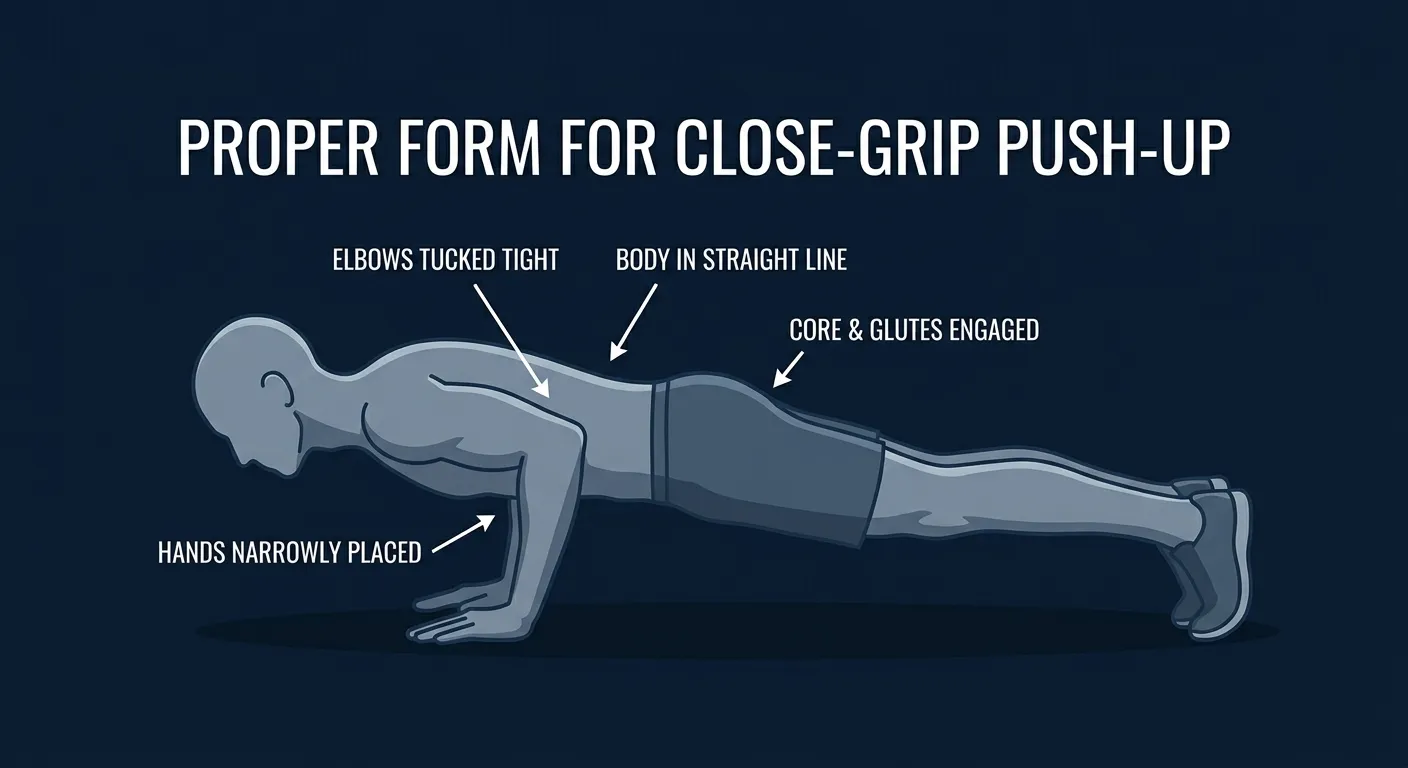
Variations: From Incline to Weighted
Incline Close-Grip Push-Up (Beginner)
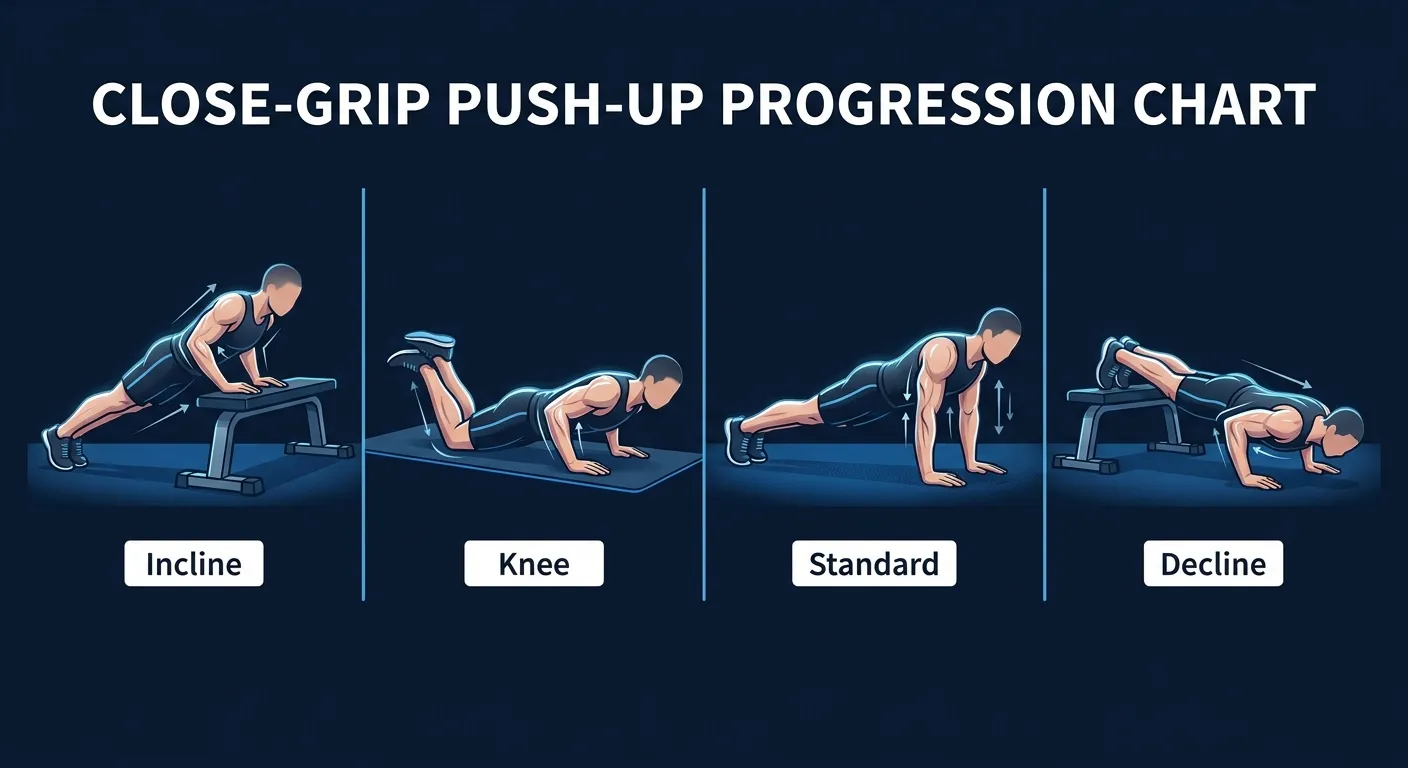
Hands on a sturdy bench, kitchen counter, or low wall. The higher the surface, the less of your bodyweight loads the arms. Start with the most height that still feels challenging for 6-10 reps and work down to lower surfaces over weeks. See incline push-ups for the wider-grip version of the same regression.
Knee Close-Grip Push-Up (Beginner-Intermediate)
Floor push-up with knees down instead of toes. Reduces the load by roughly 20-30%. Same elbow tuck applies. The hips still travel in a straight line from knees to shoulders. No piking.
Standard Close-Grip Push-Up (Intermediate)
Full plank on the toes, hands at shoulder-width or just inside, elbows tucked tight. The benchmark version. Most people spend the longest at this stage.
Feet-Elevated Decline Close-Grip Push-Up (Advanced)
Feet on a bench, hands on the floor in close-grip position. Shifts more bodyweight onto the arms and increases the triceps demand. The form cues don't change. The elbow tuck still matters.
Weighted Close-Grip Push-Up (Advanced)
Standard close-grip push-up with a weight plate, sandbag, or weighted vest on the upper back. Start light. Even 10 pounds adds noticeable difficulty. A training partner can help position the plate; otherwise a weighted vest is easier to manage solo.
Alternative Exercises
- Diamond push-ups: A more aggressive triceps variation with the hands stacked under the chest. Higher triceps EMG, harder on wrists and elbows. Earn it after close-grip push-ups feel easy.
- Tricep extensions: A dumbbell isolation alternative if you want the long head of the triceps in a fully stretched position. Pair with close-grip push-ups for a complete triceps session.
- Bench dips: Another accessible bodyweight triceps option. Choose this if you have a sturdy bench or chair handy and your shoulders tolerate the extension position.
When to Avoid or Modify Close-Grip Push-Ups
Close-grip push-ups are safe for most healthy adults, but a few situations warrant modification or a different exercise. Always consult your physician or a qualified physical therapist before starting or returning to any exercise program, especially if any of the following apply.
- Wrist pain or carpal tunnel symptoms. Standard floor push-ups load the wrist at about 90 degrees of extension. Modify with push-up handles, parallettes, or a pair of dumbbells gripped neutrally to keep the wrist straight. Fist position is an option but requires conditioning. Keep wrists neutral.
- Acute shoulder impingement or rotator cuff irritation. Full-range pressing can compress the supraspinatus near the bottom of the rep. Stay with high-incline variations, work in pain-free range, and don't rush back to floor depth. Substitute tricep extensions at light load while the cuff recovers.
- Triceps tendinopathy or "tennis elbow" symptoms. The high triceps load at the bottom of the rep can flare an irritated triceps tendon. Drop volume, reduce range, and consider tricep kickbacks at light load while symptoms settle.
- Recent shoulder, wrist, or elbow surgery. Get clearance from your surgeon. Most post-surgical protocols progress isometric → wall → incline → floor on a controlled timeline.
- First 6-8 weeks postpartum or active diastasis recti. The plank position demands deep-core engagement that can dome the abdomen if the transverse abdominis isn't ready. Start with deadbugs and bird-dogs for core foundation. Progress to wall close-grip push-ups, then incline, then floor when you can hold a flat plank without doming or coning.
- Lower-back pain that worsens with bracing. If the hips visibly sag and cueing doesn't fix it, the floor variation is loading the lumbar spine. Drop to incline and rebuild bracing strength with forearm planks, deadbugs, and bird-dogs first.
Related Exercises
- Same muscle group (triceps-dominant pressing): diamond push-ups, bench dips, skullcrusher push-ups
- Tricep isolation options: tricep extensions, tricep kickbacks, overhead tricep press, Tate press
- Vertical-push progression: parallel-bar dips (a step up once decline close-grip push-ups feel easy)
- General pressing balance: push-ups, incline push-ups, chest press
- Core foundation (for the plank hold): forearm planks, hand planks, deadbugs, bird-dogs
- Pulling partner (for balanced upper-body programming): bent-over rows, inverted rows
How to Program Close-Grip Push-Ups
Volume, rest, and frequency recommendations come from the ACSM Position Stand on resistance training (Ratamess et al., 2009), applied to a bodyweight pressing pattern. Close-grip push-ups recover quickly relative to heavily loaded pressing, so frequency can be a bit higher than a barbell bench press would allow.
| Level | Sets × Reps | Rest between sets | Frequency |
|---|---|---|---|
| Beginner (incline or knee) | 2-3 × 6-10 | 60-90s | 2-3 sessions/week |
| Intermediate (standard floor) | 3-4 × 8-15 | 60-90s | 2-3 sessions/week |
| Advanced (decline or weighted) | 3-5 × 6-12 | 90-120s | 2-3 sessions/week |
Where in your workout. Place close-grip push-ups early in an upper-body session as the primary triceps movement, or as an accessory after a heavier compound press like bench press or shoulder press. In a full-body or circuit context, pair with a pulling exercise like bent-over rows or inverted rows to keep the upper body balanced.
Form floor over rep targets. If your elbows flare out, your hips sag or pike, or your shoulders shrug up toward your ears, the set is over. End it. A clean 6 with elbows tucked and a rigid plank builds more triceps than a sloppy 15 with the form falling apart.
FitCraft's AI coach Ty programs close-grip push-ups based on your assessment results. Ty selects incline, knee, floor, or decline variations depending on your current pressing strength and adjusts rep targets as you progress. The 3D demonstrations walk you through the elbow tuck and the plank alignment that keep the exercise effective.
Frequently Asked Questions
Can I do close-grip push-ups with wrist pain?
Maybe, with modifications. Standard close-grip push-ups load the wrist at about 90 degrees of extension under bodyweight, which can flare existing wrist pain or carpal tunnel symptoms. Try push-up handles or a pair of dumbbells gripped neutrally to keep the wrist straight, or switch to a fist position with knuckles down (this requires conditioning). If pain persists, swap to tricep extensions with a neutral-grip dumbbell while you address the wrist issue. Consult a physical therapist if symptoms last more than two weeks.
What muscles do close-grip push-ups work?
Close-grip push-ups primarily target the triceps brachii (all three heads). The pectoralis major contributes as a secondary mover, with the inner/sternal fibers taking on more work than they do in wide-grip push-ups because the narrow hand position pulls the line of pull closer to the midline of the body. Anterior deltoids assist, and the core, scapular stabilizers, and serratus anterior fire isometrically to hold the plank.
How are close-grip push-ups different from diamond push-ups?
Both bias the triceps over the chest, but the hand position differs. Diamond push-ups place the hands together with thumbs and index fingers forming a triangle directly under the chest. Close-grip push-ups place the hands shoulder-width or just inside, which is less aggressive on the wrists and elbows than the diamond version. Diamond push-ups produce slightly higher triceps EMG, but close-grip push-ups are the smarter starting point for most lifters because they're tolerated by more shoulders, wrists, and elbows.
How many close-grip push-ups should a beginner do?
Start with 3 sets of 6-10 reps from an incline (hands on a bench, kitchen counter, or sturdy table). Rest 60-90 seconds between sets. Progress to knee close-grip push-ups, then to floor reps on the toes, then to feet-elevated decline as you build strength. The signal that you're ready to progress is 3 sets of 10 clean reps with elbows tucked tight to the ribcage.
Are close-grip push-ups good for building bigger triceps?
Yes. Close-grip push-ups hit all three heads of the triceps under a meaningful bodyweight load and are one of the most accessible triceps-biased pressing exercises. They work well as an accessory after compound presses or as a standalone triceps movement on a home or travel program. For continued hypertrophy progress, layer in feet-elevated, weighted (plate on the back), or one-arm progressions over time.
What is the difference between close-grip push-ups and regular push-ups?
Hand placement and elbow path. Regular push-ups place the hands wider than the shoulders with elbows flaring out to 45-60 degrees, which biases the pectoralis major. Close-grip push-ups place the hands at or just inside shoulder-width with elbows tucked tight to the ribs at about 30 degrees, which biases the triceps and the inner fibers of the chest. The narrow elbow path is what shifts the load to the triceps.