If a full floor push-up feels impossible, or if you can grind out a few but your hips sag and your shoulders ache by rep 3, incline push-ups are the right move. They keep every muscle the floor version trains. They just cut the load enough for your form to hold up.
Most people treat them as the consolation prize. That is a mistake. Used well, incline push-ups are how nearly everyone gets to a real floor push-up.
This guide covers exactly how to set them up, the cues that make them work, the mistakes that quietly stall progress, and the progression path from a wall to a low bench to the floor.
Quick Facts: Incline Push-Up
- Equipment needed: An elevated surface (wall, counter, sturdy table, bench, or step)
- Difficulty: Beginner (height adjusts the difficulty)
- Modality: Strength
- Body region: Upper body
- FitCraft quest category: Strength
Muscles Worked
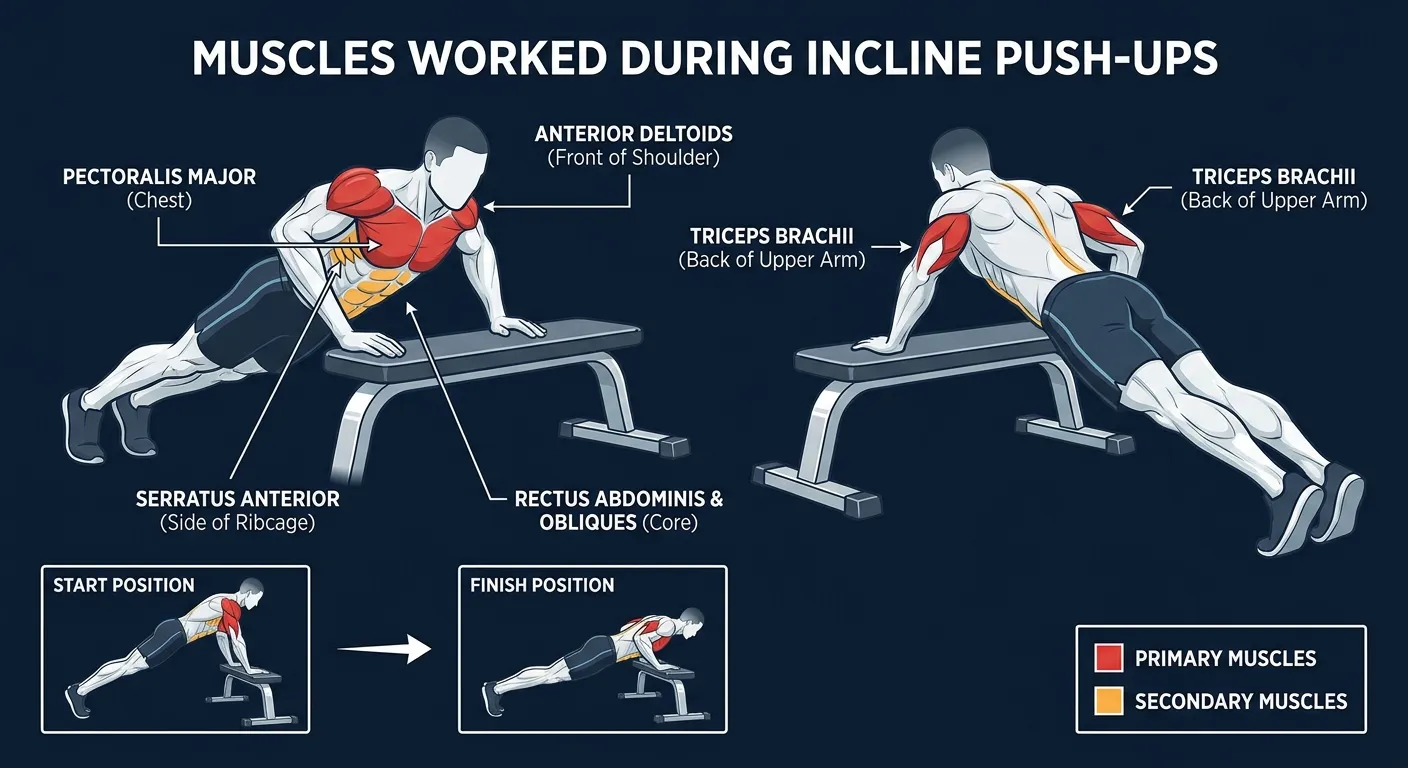
Primary movers: the pectoralis major (chest), triceps brachii, and anterior deltoids. These drive the pressing motion in exactly the same way they do during a floor push-up. They shorten on the way up (concentric phase) and lengthen under tension on the way down (eccentric phase). The only thing the incline changes is how much bodyweight loads them.
Secondary movers: the serratus anterior, which protracts the shoulder blade at the top of every rep, and the long head of the biceps brachii, a minor stabilizer at the elbow joint.
Stabilizers: the entire anterior core (rectus abdominis, transverse abdominis, obliques), the glutes, and the posterior deltoids and rotator cuff. All work isometrically to hold the rigid plank position from head to heels. A common mistake on incline is to relax the brace because the surface feels easy, which lets the hips pike up or sag down. The plank shape is non-negotiable.
How the incline angle changes the load: the higher the surface, the more your bodyweight passes through your feet rather than your hands. A wall push-up is essentially a standing exercise with a small arm contribution. A counter-height push-up loads the arms with substantially less than bodyweight. A low bench or step approaches floor-level demand. This is why the incline progression is so useful: it gives you a continuous dial from "barely loaded" to "almost a floor push-up" without ever changing the movement pattern your muscles have to learn.
Step-by-Step: How to Perform an Incline Push-Up
The pattern is the same as a floor push-up. The only real variable here is bench height.
Step 1: Choose Your Bench Height
Pick an elevated surface that matches your current strength. A wall is the easiest. A kitchen counter, sturdy table, or staircase landing is the common starting point. A low bench or step is the last stop before the floor. The rule: choose the height where 8 to 12 clean reps feel hard on the last 2.
Coach Ty's cue: "Pick the height where your form holds for the whole set. If your hips drop on rep 5, the surface is too low."
Step 2: Set Your Starting Position
Place your hands on the surface slightly wider than shoulder-width apart. Walk your feet back until your body is in a straight line from head to heels. Hands should be roughly under your shoulders, not way out in front of your head.
Ty's cue: "Hands under shoulders, slightly wider than shoulder-width. Fingers can point forward or angle out about 10 to 15 degrees, whichever lets your elbows track back instead of flaring."
Step 3: Brace Your Core and Lock the Plank
Tighten your core. Squeeze your glutes. Even on an incline, the body holds a rigid plank from head to heels. The most common failure here is letting the hips pike up or sag down because the incline feels easy.
Ty's key cue: "Same straight line as a floor push-up. The incline reduces the load, it does not change the shape."
Step 4: Lower Your Chest with Control
Inhale as you bend your elbows and lower your chest toward the surface. Keep your elbows tucked at roughly a 45-degree angle from your torso, not flared out at 90 degrees. Lower until your chest is close to or lightly touches the edge of the bench.
As Ty coaches it: "Two seconds down. Elbows track back, not out. If your shoulders feel pinched, your elbows are flaring."
Step 5: Press Back Up
Exhale and press through your palms to push your body back to the starting position. Keep the same plank line on the way up. Stop just short of fully locking the elbows at the top so the muscles stay under tension.
Ty's reminder: "Push the surface away from you. Same controlled tempo every rep. Quality reps now build floor push-ups later."
Get this exercise in a personalized workout
FitCraft, our mobile fitness app, uses its AI coach Ty to program pressing exercises like this into your plan at the right volume and intensity, based on your level, goals, and equipment. Ty was designed and trained by Domenic Angelino, MPH (Brown University) and NSCA-CSCS, with research published in the Journal of Strength and Conditioning Research and Medicine & Science in Sports & Exercise.
Take the Free Assessment Free · 2 minutes · No credit card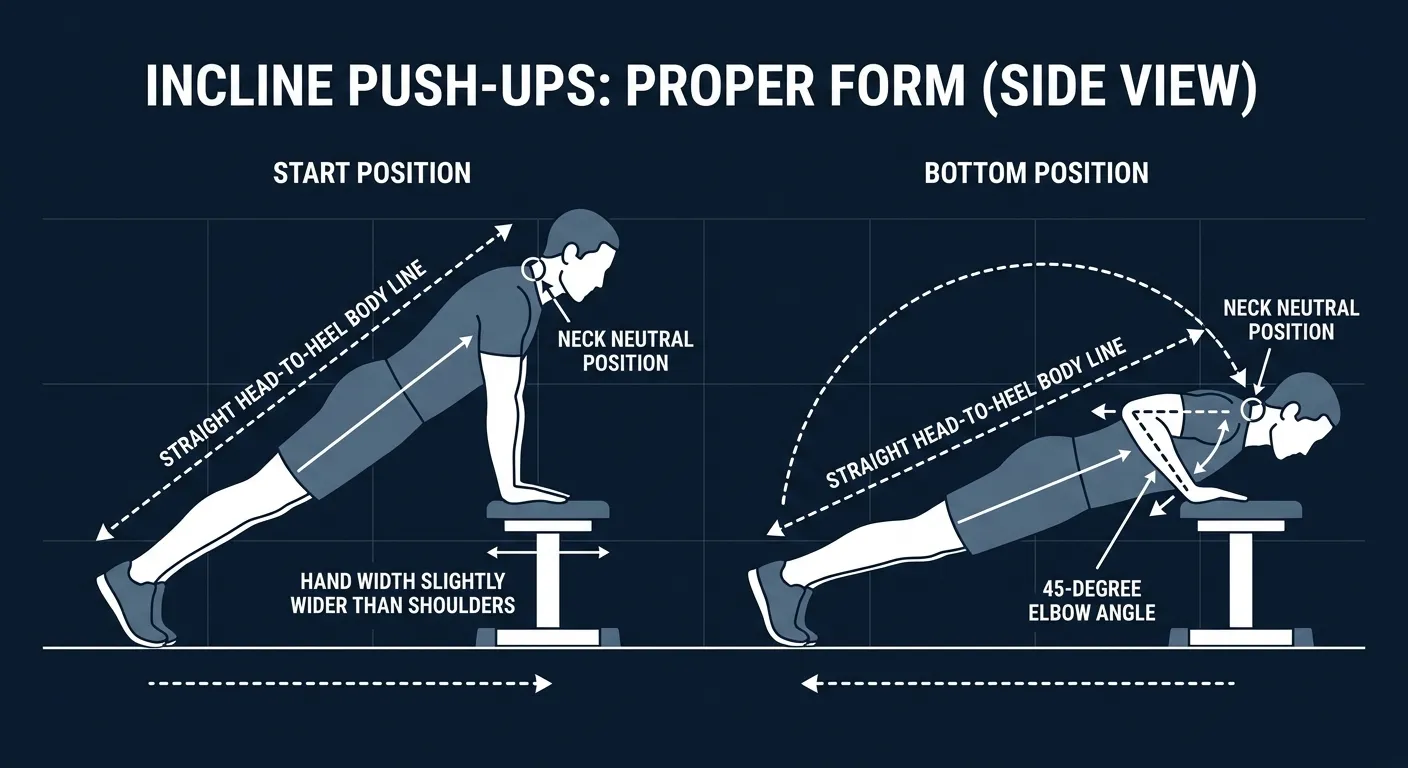
Common Mistakes (and How to Fix Them)
Here are the mistakes Ty corrects most often on incline push-ups.
- Starting at a surface that's too low. The first set looks okay; by set 2 the hips are sagging and the elbows are flaring. Fix: pick a higher surface. You should finish each set with 1 to 2 clean reps in the tank, not grinding through ugly ones.
- Hands placed too far forward. Reaching out in front of your shoulders shifts load to the wrists and front delts and reduces chest involvement. Fix: hands roughly under your shoulders, slightly wider than shoulder-width.
- Elbow flare to 90 degrees. Elbows splaying straight out to the sides puts the shoulder in a vulnerable position and is the top driver of incline push-up shoulder pain. Fix: elbows track back at roughly 45 degrees. Think arrow, not T.
- Hinging at the hips. The body bends in the middle instead of moving as one unit. Often shows up because the surface feels easy and people stop bracing. Fix: squeeze glutes and brace abs before every rep; same straight line as a floor push-up.
- Short range of motion. Stopping 6 inches above the bench halves the work. Fix: lower until your chest is close to or lightly taps the edge of the surface. If full range is impossible, the surface is too low.
- Never lowering the bench. Doing 50 incline push-ups against the kitchen counter forever is not a progression. Fix: when you hit 3 sets of 10 to 12 with clean form, drop one notch lower (counter to table to bench to step to floor).
Incline Push-Up Variations: Regressions and Progressions
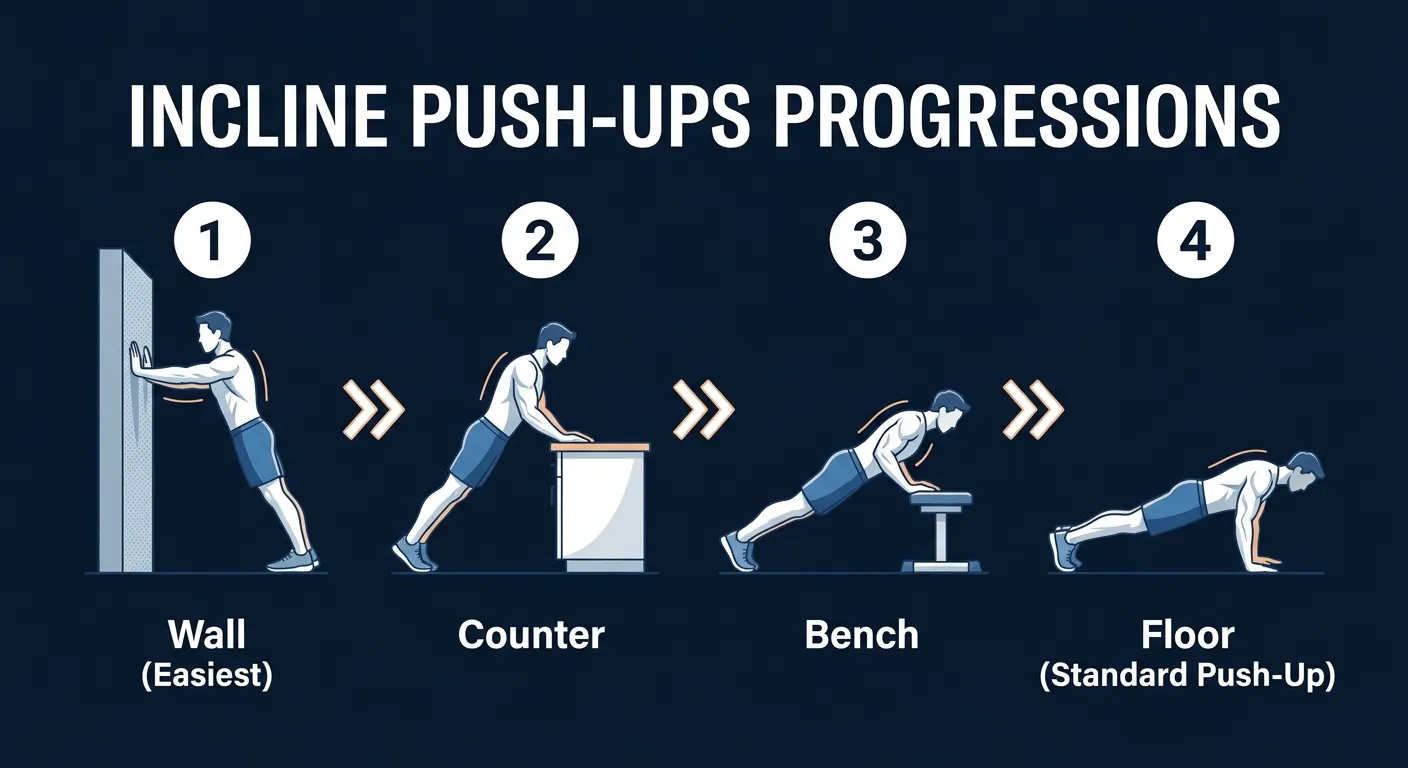
Incline push-ups are themselves a regression of the floor push-up, but the incline family has its own scale from wall (easiest) to low bench (hardest). Use this ladder.
Wall Push-Up (Beginner Regression)
Stand facing a wall, hands at shoulder height, slightly wider than shoulder-width. Step your feet back until your arms are extended. Lower your chest toward the wall with control, then press back. This is the entry point if a counter-height incline already feels too hard.
Counter or Table Incline Push-Up (Standard Beginner)
Hands on a kitchen counter, sturdy table, or staircase landing. This is the most common starting point for someone working toward a floor push-up.
Bench or Low Step Incline Push-Up (Intermediate Progression)
Hands on a workout bench, low step, or coffee table. Significantly harder than counter height because more of your bodyweight loads the arms. This is the last incline stop before the floor.
Floor Push-Up (Standard Progression)
Hands flat on the ground, body in a straight line, full range of motion. The goal of the incline progression. Once you can do 3 sets of 10 to 12 incline push-ups from a low bench with clean form, you are ready to test the floor.
When to Avoid or Modify Incline Push-Ups
Incline push-ups are safe for most healthy adults, and the incline format itself is a modification of the floor variation, so the "when to avoid" list is shorter here than for floor push-ups. A few conditions still call for adjustment. Always consult your physician or physical therapist for personalized guidance.
- Wrist pain or carpal tunnel. Even the incline variation loads the wrists in extension. The good news is that the higher the surface, the less wrist load. If a counter or table still hurts, regress to a wall push-up (almost no wrist load) or use push-up handles, dumbbell grips, or fist position on whichever surface you are using to keep the wrist neutral.
- Acute shoulder impingement or rotator cuff irritation. Stick with the highest incline you have available (counter or wall), keep your elbows at 45 degrees rather than flared, and only work within a pain-free range. The incline format itself reduces compression on the supraspinatus tendon at the bottom of the rep, which is why it is often the first pressing exercise reintroduced in shoulder rehab. If symptoms persist for more than a week or two, see a physical therapist before lowering the surface.
- Recent shoulder, wrist, or elbow surgery. Get clearance from your surgeon before any pressing exercise. Most post-surgical pressing progressions start exactly here: wall, then high incline, then lower incline, then floor, on a controlled timeline.
- First 6-8 weeks postpartum or active diastasis recti. The plank position still demands real deep-core engagement, even on an incline. Start with a wall variation, prioritize diaphragmatic breathing and transverse abdominis activation with deadbugs and bird-dogs, and only lower the surface once you can hold a flat plank without doming or coning along the linea alba.
- Lower-back pain that worsens when bracing. If your hips sag and the cue to brace does not fix it, the surface is loading the lumbar spine. Pick a higher incline and rebuild bracing strength with forearm planks, deadbugs, and bird-dogs before progressing.
Related Exercises
If incline push-ups are part of your routine, these movements complement or extend the same training pattern:
- The next step up: Floor Push-Ups, the standard variation incline push-ups are designed to build toward. Once you can hit 3 sets of 10 to 12 clean reps from a low bench, test the floor.
- Same muscle group with external load: Chest Press and Chest Fly hit the same chest and tricep pattern with dumbbells, useful if you have access to weights and want to load the pattern without the wrist-extension demand of bodyweight pressing.
- Tricep-focused progression once you reach the floor: Diamond Push-Ups and Bench Dips shift more load to the triceps once standard floor push-ups feel easy.
- Shoulder-focused progression once you reach the floor: Pike Push-Ups, a stepping stone toward handstand push-ups that biases the anterior deltoid and upper chest.
- Core foundation for the plank position: Hand Planks and Forearm Planks isolate the bracing pattern push-ups rely on, useful if your hips sag during sets.
How to Program Incline Push-Ups
Incline push-up programming follows the same evidence-based ranges as any pressing exercise. The American College of Sports Medicine (ACSM) Position Stand on resistance training recommends roughly 8 to 12 reps per set for strength and 12 to 20 for muscular endurance, with at least 48 hours between sessions training the same muscle group (Ratamess et al., 2009). For incline push-ups specifically, the surface height is what makes the prescription actually work: the right surface is the one where the last 2 reps of the target set feel hard with clean form.
| Level | Sets × Reps | Rest between sets | Frequency |
|---|---|---|---|
| Beginner (wall or counter height) | 2-3 × 5-10 | 60-90 seconds | 2-3 sessions/week |
| Beginner-Intermediate (table or workout bench) | 3 × 8-12 | 60-90 seconds | 2-3 sessions/week |
| Intermediate (low step, last stop before floor) | 3-4 × 8-15 | 60-90 seconds | 2-4 sessions/week |
Where in your workout: incline push-ups belong early in an upper-body session, when you are fresh. Even though they are a regression, they still recruit the same primary motor units as a floor push-up and benefit from a non-fatigued nervous system. If you are training the full upper body in one session, do incline push-ups before any tricep or shoulder isolation work. In a full-body or circuit context, place them at the start of a "push" block.
Progress the surface, not just the reps: hitting 3 sets of 15 against the same counter every week is the most common way to stall on this exercise. The protocol is: once you can complete 3 sets of 10 to 12 with clean form (rigid plank, elbows at 45 degrees, full range), drop one notch lower the following week. Wall to counter to table to bench to step to floor. The reps reset; the height drops.
Form floor over rep targets: if your last 2 reps of a set break form (elbow flare, sagging hips, half range), stop the set there. Hitting a target rep count with broken form on a too-low surface is worse than hitting fewer reps cleanly on a slightly higher one.
How FitCraft Programs This Exercise
Knowing how to do an incline push-up is step one. Knowing which height to start at, when to lower it, and how to fit it into a balanced week is where most people get stuck.
FitCraft's AI coach Ty handles that. During your personalized diagnostic assessment, Ty maps your fitness level, goals, and available equipment. Then Ty builds a personalized program that slots incline push-ups in at the right height for your current strength.
As you get stronger, Ty lowers the incline and adjusts the volume. Wall becomes counter. Counter becomes bench. Bench becomes the floor. Every program is designed by an Ivy League-trained exercise scientist and NSCA-certified strength coach using evidence-based periodization, then adapted to you by the AI.
Frequently Asked Questions
How many incline push-ups should a beginner do?
Start with 2 to 3 sets of 5 to 10 reps, twice or three times a week. Build up to 3 sets of 10 to 12 with clean form before lowering the bench height. Consistency at a height you can actually own beats a heroic 8 reps at a height that is too low.
What muscles do incline push-ups work?
The same muscles as a floor push-up: chest (pectoralis major), triceps brachii, and anterior deltoids as the primary movers, with the serratus anterior and core working as stabilizers. The incline reduces the load while the muscle pattern stays identical, which is why incline push-ups are the textbook regression.
What height should the bench or surface be?
Pick the height where you can complete 8 to 12 reps with clean form and the last 2 reps feel hard. A wall is easiest; a kitchen counter or sturdy table is the typical starting point; a bench or low step is the last stop before the floor. A staircase works well because you can step down one stair at a time as you get stronger.
When do I progress from incline to floor push-ups?
Once you can complete 3 sets of 10 to 12 reps with clean form (rigid plank, elbows at 45 degrees, full range of motion) at the current height, drop to a lower surface. Repeat the cycle. When you can hit those numbers from a low bench or step, you are ready to try floor push-ups.
Can I do incline push-ups if I have wrist pain?
Yes, and incline is often the right answer for wrist pain. The higher the surface, the less load lands on the wrists, which is why a wall or counter is a common starting point for people who cannot tolerate the roughly 90 degrees of wrist extension that floor push-ups demand. If even a counter aggravates symptoms, try push-up handles or dumbbell grips to keep the wrists neutral. If pain persists after these modifications, see a physical therapist or occupational therapist for an assessment.