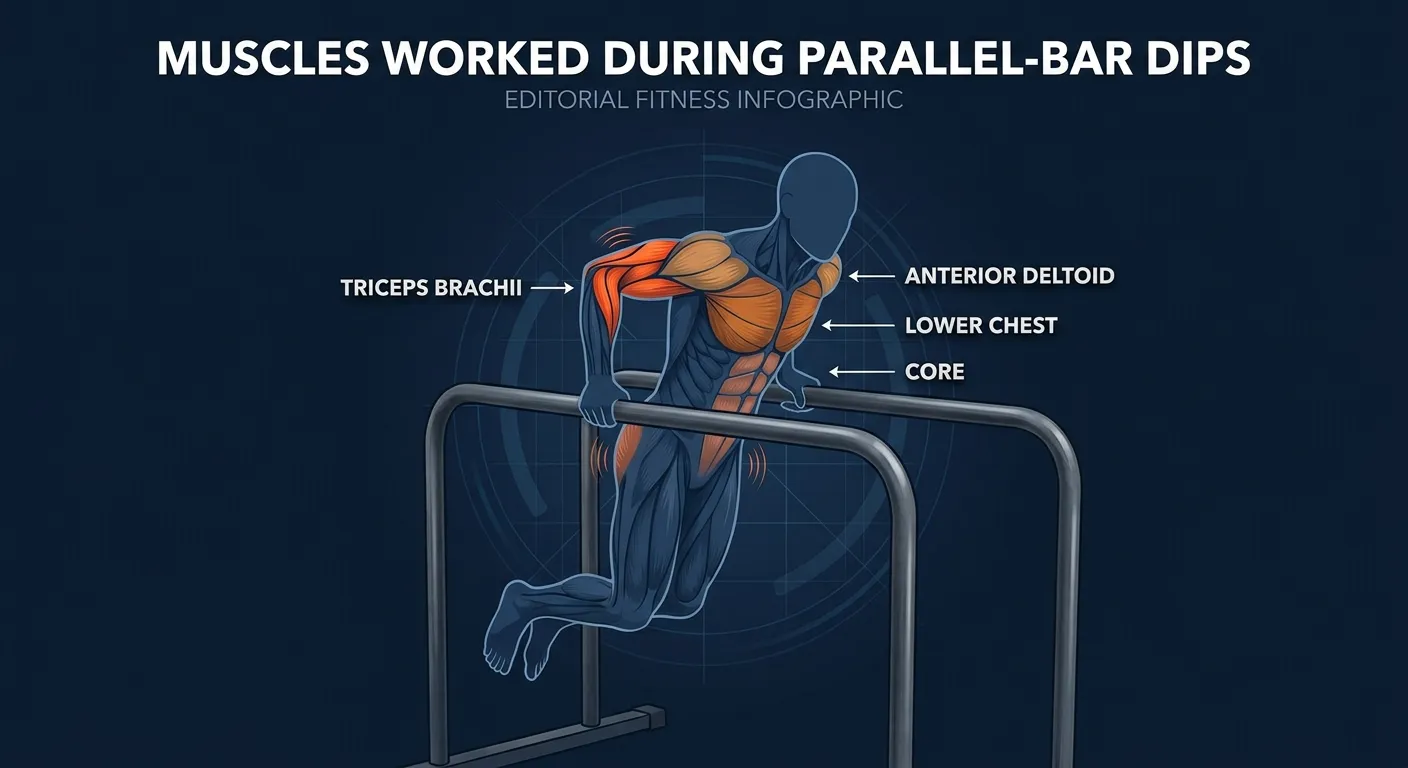
Muscles Worked
Primary movers. The triceps brachii and the lower fibers of the pectoralis major split the load on a parallel-bar dip. Both muscles work concentrically on the press out of the bottom and eccentrically on the descent. The relative emphasis depends on torso angle. A vertical torso biases the triceps (especially the long and lateral heads) because the elbow is the primary joint moving. A 15-30 degree forward lean biases the lower pec because shoulder adduction at the bottom of the rep stretches and then concentrically shortens those sternal fibers.
Secondary movers. The anterior deltoids assist with shoulder flexion during the press. The rhomboids and middle trapezius work to hold the scapulae down and stable, while the serratus anterior helps protract the scapula at the top of the rep. These muscles play supporting roles but make the difference between a smooth, joint-friendly rep and one that pulls the shoulder out of position.
Stabilizers. The entire anterior core (rectus abdominis, transverse abdominis, obliques), the glutes, and the hip flexors work isometrically to hold the legs and torso in a stable position. If the lower body swings, the press becomes inefficient and the shoulder takes uneven loads. The rotator cuff (supraspinatus, infraspinatus, teres minor, subscapularis) fires continuously to keep the head of the humerus centered in the glenoid, which is what protects the joint at the bottom of a deep rep.
Mechanism. The parallel-bar dip is a closed-chain pressing pattern where the body moves relative to fixed handholds. The shoulder stays in front of the torso (in flexion) throughout, which is a safer position than the shoulder extension required by bench dips. The hard part for the joint is the deep bottom position, where the humeral head is most likely to translate forward if the scapula isn't packed. Controlled depth and a packed shoulder are the load-bearing form points.
If bench dips are the entry-level triceps exercise, parallel-bar dips are the graduate course. You're pressing your full bodyweight through two narrow contact points, the shoulder is in deep flexion at the bottom, and there's nowhere to cheat. Either you have the strength to press out, or you don't.
That difficulty is also why they're so valuable. Anything that loads the triceps and lower chest under that much demand is going to drive real adaptation. Most lifters who can do 8-10 clean bodyweight dips have visibly developed triceps and chests, almost regardless of what else they're doing.
The other thing to know upfront. Dips have a reputation as a shoulder-wrecker. That reputation comes from people going to deeper depths than they have shoulder mobility for, holding torso angles their stabilizers can't support, and stacking volume too fast. Done with a controlled depth (upper arms parallel, not lower), a consistent torso angle, and a packed shoulder, parallel-bar dips are safe for most lifters who have the prerequisite strength.
Quick Facts: Parallel-Bar Dips
- Equipment needed: Parallel dip bars (gym dip station, parallettes, or two sturdy chairs at appropriate height). Optional resistance band or dip belt for regression and progression.
- Difficulty: Intermediate (bodyweight) to Advanced (weighted, ring)
- Modality: Compound · Bilateral · Vertical-push pattern · Closed-chain elbow extension and shoulder flexion
- Body region: Upper body (triceps and lower-chest pressing)
- FitCraft quest category: Strength
How to Do Parallel-Bar Dips (Step-by-Step)
- Mount the bars. Grip the parallel bars with palms facing each other (neutral grip). Press up to a fully extended starting position with elbows locked-but-not-jammed and arms supporting your full bodyweight. Knees can bend and cross at the ankles. Pack shoulders down and back away from your ears.
Coach Ty's cue: "Shoulders down. Pull the blades together and press them into your back pockets. If your shoulders ride up to your ears at the top, you have no joint protection at the bottom."
- Set torso angle for goal. For a triceps emphasis, keep your torso nearly vertical with eyes forward. For a chest emphasis, lean your torso 15-30 degrees forward with chin slightly tucked. Pick the angle that matches your goal and hold it throughout the set.
Coach Ty's cue: "Eyes forward for triceps. Chin to chest with a slight forward lean for chest. Don't drift between the two. Pick one and own it for the whole set."
- Lower under control. Bend your elbows and lower until your shoulders reach roughly the same height as your elbows, or until your upper arms are roughly parallel to the floor. Take 2-3 seconds on the descent. Stop if you feel a pinching sensation in the front of the shoulder. Elbows track straight back, not flared.
Coach Ty's cue: "Upper arms parallel. Not lower. Going deeper doesn't add triceps work. It just stresses the shoulder capsule. If your shoulders feel pinched, you've gone past your safe range."
- Press back up. Drive your hands down into the bars to extend your elbows and return to the top. Keep the torso angle locked. Squeeze the triceps at the top. Don't slam into a hard lockout. A soft extension protects the joint.
Coach Ty's cue: "Press the bars down toward the floor. Drive through the heel of the palm. The bars don't move. You move."
- Reset and repeat. Re-set your shoulder position (down and back), confirm the torso angle, and go again. Beginners not strong enough for bodyweight: use a band or do negatives only until you can press out 3 clean reps.
Coach Ty's cue: "Form floor over rep targets. End the set the moment your shoulders shrug up or the bottom of the rep gets uncontrolled. The bodyweight is too high a price for sloppy reps."
Common Mistakes to Avoid
The dip is unforgiving when form breaks down because the shoulder is in a vulnerable position under full bodyweight. These are the errors that show up most often.
- Going too deep. The most common cause of dip-related shoulder pain. When the upper arms drop well below parallel, the humeral head can translate forward and grind against the anterior shoulder capsule and labrum. Upper-arms-parallel is the safe stopping point for almost everyone. Deeper is not better here.
- Shrugging the shoulders at the top. Letting the shoulders ride up toward the ears at the top of every rep. This puts the scapula in an unfavorable position for the next descent and stacks shoulder stress across the set. Fix: actively depress the shoulders before each rep, keep the chest open.
- Flaring the elbows. Elbows drifting out to the sides instead of tracking straight back. Flared elbows shift load to the front of the shoulder and reduce triceps and chest activation. Fix: think about driving the elbows behind you, not out to the walls.
- Inconsistent torso angle. Starting the set with a vertical torso, fatiguing, and gradually leaning forward to recruit the chest as the triceps tire. This is the body's instinct to keep going, but it spreads the stimulus and trains neither muscle well. Fix: pick your torso angle in step 2 and hold it. End the set when you can no longer hold it.
- Kicking or swinging the legs. Using leg momentum to help out of the bottom. This turns a strength exercise into a controlled fall and unloads the working muscles. Fix: cross the ankles, squeeze the glutes, hold the lower body still. If you need momentum, use a band assist instead.
- Going to bodyweight too fast. Attempting full bodyweight dips before you can do 10 clean push-ups, 10 close-grip push-ups, and 10 negative dips. This is the most common reason beginners pick up shoulder pain from this exercise. Earn the bodyweight rep with a regression first.
Get this exercise in a personalized workout
FitCraft, our mobile fitness app, uses its AI coach Ty to program pressing exercises like this into your plan at the right volume and intensity, based on your level, goals, and equipment. Ty was designed and trained by Domenic Angelino, MPH (Brown University) and NSCA-CSCS, with research published in the Journal of Strength and Conditioning Research and Medicine & Science in Sports & Exercise.
Take the Free Assessment Free · 2 minutes · No credit card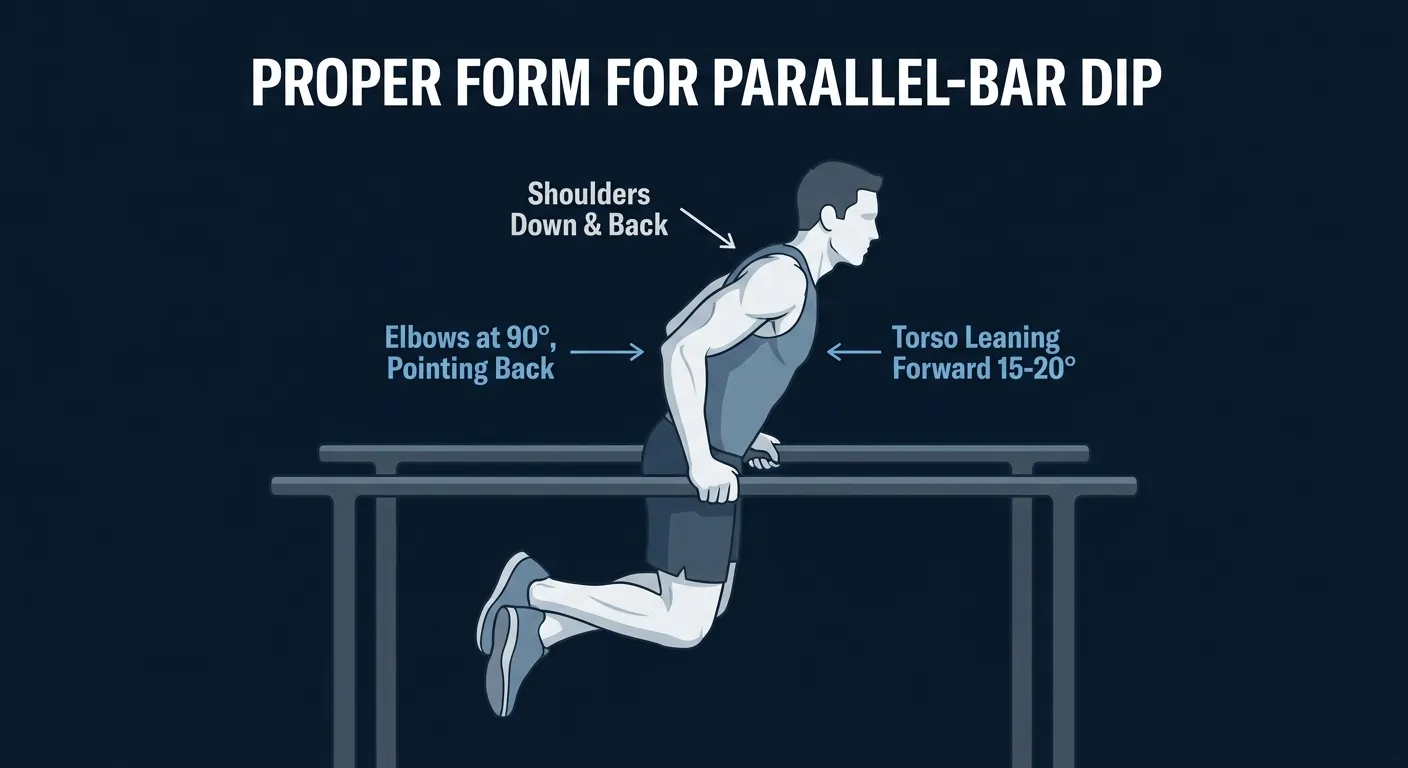
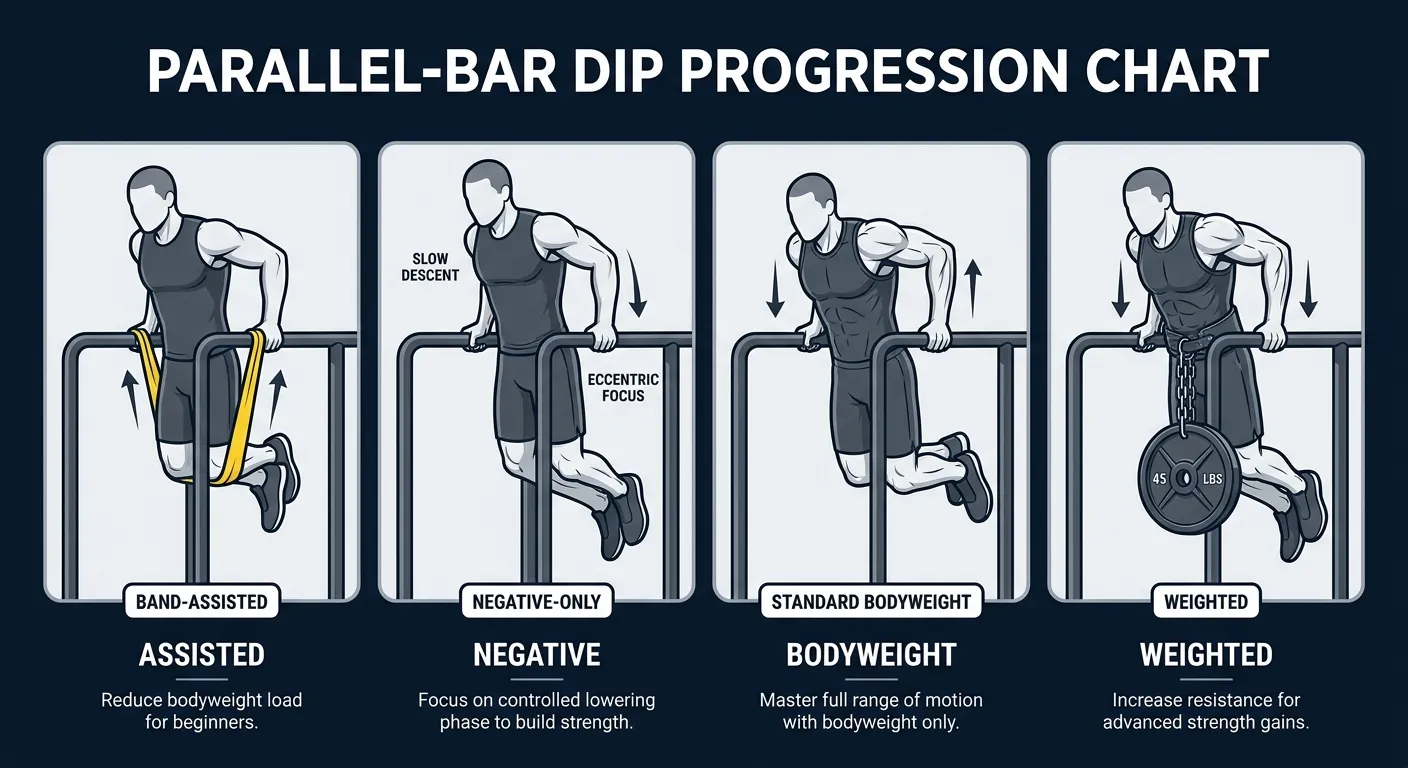
Variations: From Band-Assisted to Weighted
Band-Assisted Parallel-Bar Dip (Beginner)
Loop a long resistance band over both bars and step or kneel into it. The band offloads a portion of your bodyweight at the bottom and offers progressively less help as you rise. Use the lightest band that lets you complete 6-8 clean reps and step down to thinner bands as you get stronger.
Negative-Only Parallel-Bar Dip (Beginner-Intermediate)
Jump or step up to the top position, then lower yourself over 3-5 seconds to the bottom. Step off, reset, repeat. Builds eccentric strength and joint familiarity without requiring the concentric strength to press out. 3 sets of 3-5 reps. Stop when the lowering speed goes above 3 seconds.
Standard Bodyweight Parallel-Bar Dip (Intermediate)
Full bodyweight, controlled depth to upper-arms-parallel, consistent torso angle. The benchmark version. Most lifters spend months at this stage building strength and reps before adding load.
Weighted Parallel-Bar Dip (Advanced)
Add load with a dip belt and weight plate. Start with 10 lb and progress in small increments. Weighted dips are one of the most effective upper-body strength builders that exist. Cap depth at upper-arms-parallel even more strictly with added load. The shoulder doesn't care that you're stronger now.
Alternative Exercises
- Bench dips: The more accessible bodyweight option. Use these to build the pressing strength to attempt parallel-bar dips.
- Close-grip push-ups: A shoulder-friendlier triceps option that doesn't load the deep shoulder-flexion position. Excellent prerequisite or substitute.
- Diamond push-ups: Another bodyweight triceps option. Higher triceps EMG than wide-grip push-ups but easier on the shoulder than dips.
- Chest press: The loaded compound press alternative if you don't have access to dip bars. Cover the same movement pattern with adjustable load.
When to Avoid or Modify Parallel-Bar Dips
Parallel-bar dips are safe for most healthy adults who have the prerequisite pressing strength, but several situations warrant modification or a different exercise. Always consult your physician or a qualified physical therapist before starting or returning to any exercise program, especially if any of the following apply.
- Acute shoulder pain, impingement, or rotator cuff irritation. Dips put the shoulder in deep flexion under full bodyweight, which is exactly where most shoulder pain flares. Skip them entirely until cleared. Use close-grip push-ups or tricep extensions for triceps work in the meantime.
- Anterior shoulder instability or history of dislocation. Deep-flexion-under-load is a high-risk pattern for anterior instability. Get cleared by a sports medicine physician, and even then consider sticking with closed-chain alternatives where the shoulder doesn't reach end-range flexion under bodyweight.
- Insufficient pressing strength. Pressing full bodyweight is hard. If you can't yet do 10 clean push-ups on the toes, you're not ready for bodyweight dips. Use the band-assisted or negative-only regressions and build the strength first.
- Wrist pain. Bodyweight loaded through the heel of the palm with the wrist extended can flare wrist pain. Parallettes with a neutral grip help, or a temporary swap to close-grip push-ups with push-up handles while the wrist recovers.
- Recent shoulder, elbow, or wrist surgery. Get clearance from your surgeon. Dips usually appear late in post-surgical pressing progressions because of the deep-shoulder-flexion component and the full-bodyweight load.
- Triceps tendinopathy or "tennis elbow" symptoms. The high triceps load at the bottom can flare an irritated triceps tendon. Reduce volume and range, drop to bench dips or band-assisted dips, and consider tricep kickbacks at light load while the tendon settles.
Related Exercises
- Same muscle group (triceps and lower-chest pressing): bench dips, close-grip push-ups, diamond push-ups, skullcrusher push-ups
- Tricep isolation options: tricep extensions, tricep kickbacks, overhead tricep press, Tate press
- Lower-chest options: chest press, chest fly
- General pressing balance: push-ups, incline push-ups, shoulder press
- Core foundation (for the leg-hold during dips): forearm planks, hand planks, leg raises, deadbugs
- Pulling partner (for balanced upper-body programming): chin-ups, inverted rows, bent-over rows
How to Program Parallel-Bar Dips
Volume, rest, and frequency recommendations come from the ACSM Position Stand on resistance training (Ratamess et al., 2009), applied to a high-demand bodyweight pressing pattern. Dips load the shoulder under full bodyweight, so frequency stays moderate even for experienced lifters. The shoulder needs recovery time the bench press doesn't.
| Level | Sets × Reps | Rest between sets | Frequency |
|---|---|---|---|
| Beginner (band-assisted or negatives) | 2-3 × 3-8 | 90-120s | 2 sessions/week |
| Intermediate (bodyweight) | 3-4 × 6-12 | 90-120s | 2-3 sessions/week |
| Advanced (weighted or ring) | 3-5 × 5-10 | 2-3 min | 2 sessions/week |
Where in your workout. Place parallel-bar dips early in an upper-body session when you're fresh, as the primary push movement of the day or as a heavy secondary to a barbell bench press. They work well as the second pressing exercise after bench press, or as the primary press on a vertical-push day. In a full-body or upper/lower split, pair with a vertical pull like chin-ups for a complete upper-body session.
Form floor over rep targets. If your shoulders shrug at the top, your depth gets sloppy, or your torso angle drifts, the set is over. End it. The shoulder doesn't reward stubborn extra reps. A clean 6 builds more than a sloppy 10.
FitCraft's AI coach Ty programs parallel-bar dips based on your assessment results, current pressing strength, and shoulder health history. Ty selects band-assisted, negative-only, bodyweight, or weighted variations and adjusts torso angle cues to match your training goal (triceps vs lower chest). The 3D demonstrations walk you through the shoulder packing and depth control that keep the exercise safe.
Frequently Asked Questions
Can I do parallel-bar dips with shoulder pain?
Probably not. Parallel-bar dips put the shoulder in deep flexion under full bodyweight at the bottom of the rep, which is a worst-case scenario for anterior shoulder pain, impingement, or rotator cuff irritation. Skip them entirely until cleared by a physical therapist. In the meantime, use close-grip push-ups, bench dips (if those don't bother the shoulder), or tricep extensions for triceps work. When you return, reduce range of motion (stop with upper arms above parallel) and prioritize a packed shoulder position.
What muscles do parallel-bar dips work?
Parallel-bar dips primarily target the triceps brachii (all three heads) and the lower fibers of the pectoralis major. The emphasis between triceps and chest depends on torso angle: a vertical torso biases the triceps, while a 15-30 degree forward lean biases the lower chest. Anterior deltoids assist, and the core, scapular stabilizers, and rotator cuff fire isometrically to keep the shoulder joint packed and the torso aligned.
How are parallel-bar dips different from bench dips?
Hand position and the load through the shoulder. Parallel-bar dips suspend the body in the air with both hands on bars in front of the torso, while bench dips place the hands on a bench behind the torso with feet supporting some of the weight. Parallel-bar dips load the full bodyweight through the arms and let the shoulder stay in front of the torso (safer joint position). Bench dips put the shoulder into extension behind the torso (more anterior capsule stress) and are easier because the feet take some of the load.
How many parallel-bar dips should a beginner do?
If you can already press your bodyweight: 3 sets of 6-10 reps with a vertical torso and controlled depth (upper arms parallel to the floor at the bottom). Rest 90-120 seconds between sets. If you can't yet press your bodyweight: use a band looped under your knees from the bars for 3 sets of 6-8 reps, or do 3 sets of 3-5 negative-only reps (slow 3-5 second descent, step off and reset). Build to bodyweight dips over 4-8 weeks.
Should I lean forward or stay vertical during dips?
It depends on what you want to train. Stay vertical (eyes forward, torso upright) to bias the triceps brachii. Lean forward 15-30 degrees with chin slightly tucked to bias the lower fibers of the pectoralis major. Both are valid, both are widely used. Pick the angle that matches your goal for that session and hold it consistently across every rep. Switching mid-set spreads the stimulus across both muscles and tends to underdose both.
What is the difference between parallel-bar dips and ring dips?
Parallel-bar dips use solid, fixed bars. Ring dips use gymnastic rings that move freely in all directions. Rings add a significant stability demand, which recruits more stabilizer activity in the scapula, rotator cuff, and forearms, but they also reduce the maximum load you can press. Most lifters get stronger on bars first, then add rings as an advanced variation.