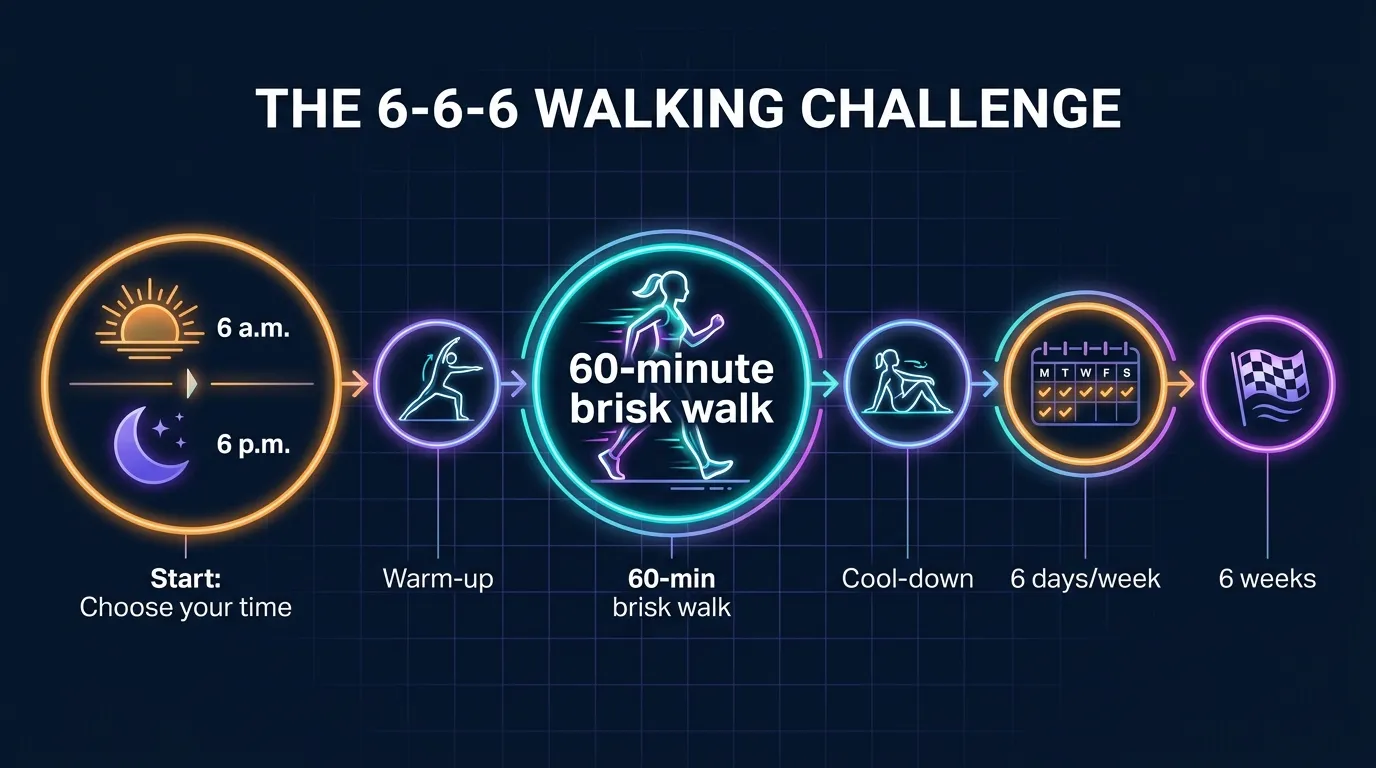
- The 6-6-6 walking challenge is a 6-week protocol: 6-minute warm-up, 60 minutes of brisk walking at 6 a.m. or 6 p.m., 6-minute cool-down, 6 days a week.
- 360 weekly minutes more than doubles the U.S. Physical Activity Guidelines minimum of 150 minutes of moderate aerobic activity (Piercy et al., 2018, JAMA).
- The 6 a.m./6 p.m. timing has no proven physiological advantage. Whichever slot you'll defend on a normal Tuesday is the right one.
- The 6-week framing is the smartest part of the design. Time-bound challenges consistently outperform open-ended "for life" advice on adherence.
If you opened TikTok or Instagram in late 2025, the 6-6-6 walking challenge probably found you. Coverage in TODAY, Healthline, Tom's Guide, and Patient.info pushed it from a regional Indian fitness trend into one of the fastest-rising health searches of the year. The fitness analytics firm Glimpse logged a 2,414 percent increase in walking-challenge searches over a 12-month window, with 6-6-6 sitting near the top of that surge.
And yet, if you sit with the protocol for a minute, it's not actually new. It's a 60-minute brisk walk, dressed up with a memorable rule of sixes and a 6-week finish line. The interesting question isn't "is walking good for you?" (it is). The interesting questions are: does the specific 6-6-6 structure matter, does the 6 a.m./6 p.m. timing change anything, and is 6 weeks a useful frame or a marketing gimmick?
This article walks through each piece against the actual research. We'll cover what the protocol prescribes, what 60 minutes of brisk walking does to your body, whether the timing matters, why the 6-week framing is the most psychologically clever part, and how to actually finish a 6-week walking commitment when you've abandoned every other one.
What the 6-6-6 Walking Challenge Actually Is
The full protocol, as it spread through social media in 2025-2026:
- 6-minute warm-up. Easy walking pace to raise heart rate gradually and warm joints.
- 60-minute brisk walk. Moderate, sustained pace. Roughly 3.0 to 3.5 mph for most adults. Effort: 5 to 6 out of 10.
- 6 a.m. or 6 p.m. Same time each day. Pick one and stick with it.
- 6-minute cool-down. Slow walking and light stretching for calves, hamstrings, and hips.
- 6 days per week. One rest day, your choice.
- 6 weeks total. Then reassess.
That's it. No equipment beyond shoes. No gym. No app required (though one helps with consistency, more on that). Some variations swap the 60 minutes for "6 kilometres," which works out to roughly the same distance for a brisk walker. A few influencers add a fifth six (six-week meal-tracking alongside) but that's frosting, not the cake.
The whole thing is a packaging exercise around an old, well-supported idea: most adults need more sustained moderate activity, and walking is the lowest-friction way to get it. The repeated sixes turn it into a memorable brand. The 6-week finish line turns "walk more" (vague) into a definable commitment with a clear endpoint.
What 60 Minutes of Brisk Walking Actually Does
The Cardiovascular and Metabolic Side
The Physical Activity Guidelines for Americans, summarized by Piercy et al. (2018) in JAMA, recommend 150 to 300 minutes of moderate-intensity aerobic activity per week for substantial health benefits. The 6-6-6 protocol delivers 360 weekly minutes of brisk walking, comfortably above the upper guideline. That dose is associated with reduced risk of cardiovascular disease, type 2 diabetes, several cancers, and all-cause mortality.
The walking-specific evidence is robust. A meta-analysis by Murphy and colleagues (2007) in Preventive Medicine pooled 24 randomized controlled trials of walking interventions in previously sedentary adults. Walking raised aerobic fitness (VO2max) and lowered body weight, BMI, percent body fat and resting diastolic blood pressure in previously sedentary adults. Modest per-marker, but stacked across markers it's the kind of broad-spectrum effect drugs would be approved for.
A more recent systematic review by Hanson and Jones (2015) in the British Journal of Sports Medicine looked specifically at outdoor walking groups across 1,843 participants in 42 studies. Walkers showed significant reductions in systolic and diastolic blood pressure, resting heart rate, body fat, BMI, total cholesterol, and depression scores, plus improvements in VO2max and quality of life. Adherence to walking interventions in the meta-analysis was high, which is not the case for most exercise prescriptions.
The Longevity Side
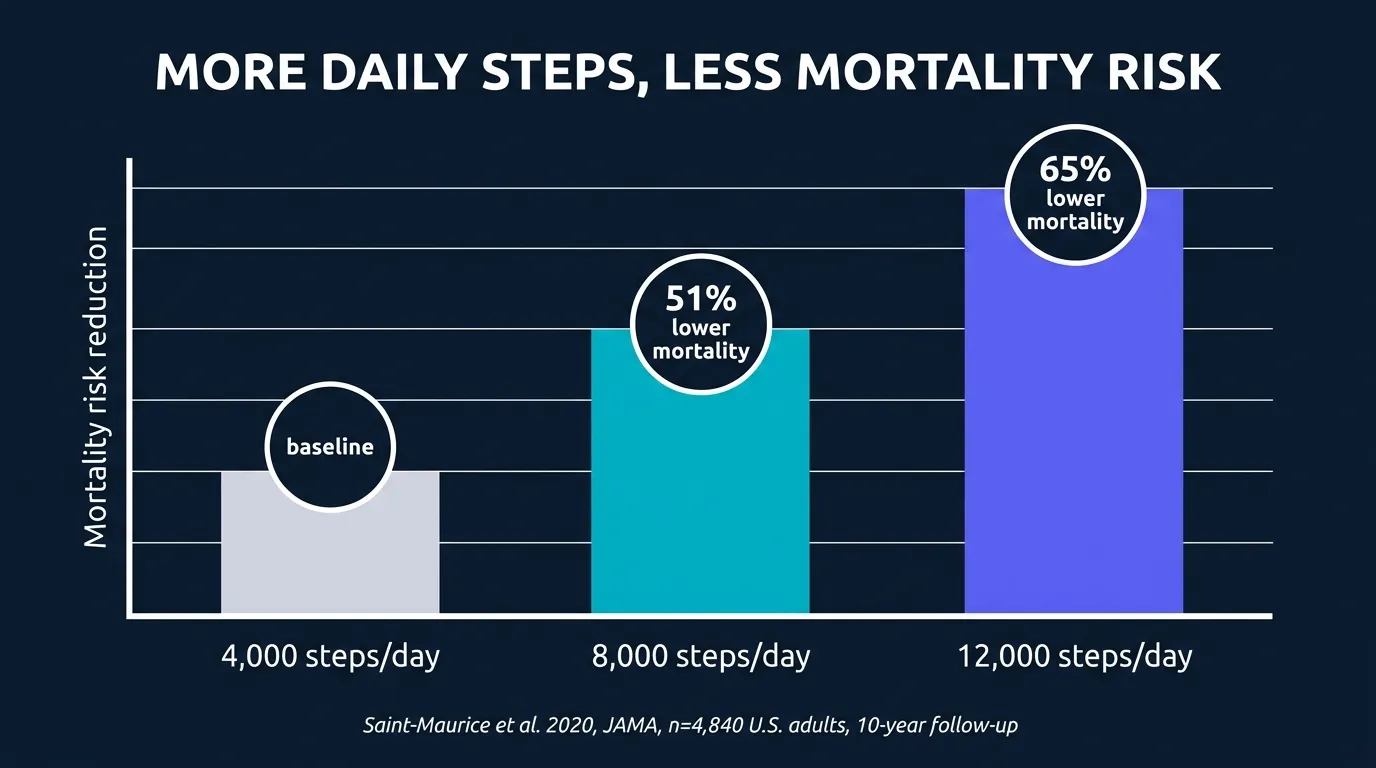
The cleanest data on walking and lifespan comes from accelerometer-based studies that count actual steps rather than self-reported activity. Saint-Maurice et al. (2020) in JAMA followed 4,840 U.S. adults for an average of 10 years and found a clear stepwise reduction in all-cause mortality as daily step counts rose. Compared to 4,000 steps per day, walking 8,000 steps was associated with a 51 percent lower mortality rate. 12,000 steps was associated with 65 percent lower mortality. The dose-response curve flattened past about 12,000 steps, but the benefits accrued well before reaching 10,000.
For older women specifically, Lee et al. (2019) in JAMA Internal Medicine followed 16,741 women with a mean age of 72 over 4.3 years. Compared to walking around 2,700 steps per day, women averaging 4,400 steps had a 41 percent lower mortality rate. The curve continued to drop until about 7,500 steps, then plateaued. The number that mattered was much lower than the cultural 10,000-step rule of thumb.
A 2023 meta-analysis by Banach et al. in the European Journal of Preventive Cardiology pooled 17 cohort studies covering 226,889 participants over a median 7.1 years. Each 1,000-step increase in daily count was associated with a 15 percent lower risk of all-cause mortality. Each 500-step increase reduced cardiovascular mortality risk by 7 percent. The benefit started accumulating at roughly 4,000 steps per day, with no detectable upper ceiling.
A 60-minute brisk walk adds roughly 6,000 to 7,500 steps to your day for most adults. That's enough to push a sedentary day (often 3,000 to 5,000 steps from incidental movement) into the zone where these mortality reductions kick in. It's the simplest single intervention with this much downstream evidence behind it.
For the broader debate on what daily step target you should actually chase, see our deeper look at why the 10,000-step number is a marketing artifact and what the threshold actually appears to be.
Does the 6 a.m. or 6 p.m. Timing Matter?
This is the part of the protocol that gets oversold. The headline answer: not really, for most people, for most outcomes.
Morning exercise has small advantages for habit formation. Fewer competing demands stack up at 6 a.m. than at 6 p.m. Cortisol naturally peaks in the morning, which can make it easier to feel alert during the walk. Some studies show slightly better appetite regulation across the day in morning exercisers, though effect sizes are small and inconsistent.
Evening exercise has small advantages too. Body temperature, joint flexibility, and reaction time peak in the late afternoon and early evening, which is why most athletic personal records get set after 4 p.m. Some hypertension trials have found slightly larger blood pressure reductions from evening cardio, though this depends on individual chronotype.
Neither edge is large enough to overrule the practical question, which is when can you actually go on the walk and not have your day eat it. We covered the broader research in our piece on morning vs. evening exercise: across most outcomes, the time of day you train matters far less than whether you train.
The 6 a.m. and 6 p.m. anchors do one useful thing: they take a vague intention ("I should walk more") and pin it to a concrete time. Lally et al. (2010) in the European Journal of Social Psychology tracked 96 adults attempting to form a new habit and found that habits formed faster when the new behavior was anchored to a consistent time-of-day cue. The anchor matters more than the specific hour. If 5:30 a.m. or 7 p.m. fits your life better, the science doesn't care.
The Hidden Power of "6 Weeks"
Here's where 6-6-6 quietly does something most fitness advice fails at: it gives you a finish line.
Most exercise prescriptions are open-ended. "Walk daily." "Move more." "Start a fitness routine." The brain has nothing to push against. There's no test, no graduation, no specific moment when the commitment ends and you can decide whether to renew it. That open-endedness is part of why so many fitness habits fail in week 3 or 4. The reward for showing up is just being told to keep showing up.
Six weeks is short enough to feel finite. Long enough to produce real change. The Lally habit-formation research above found a median time-to-automaticity of 66 days for new behaviors, with a wide range. Six weeks (42 days) is enough to get most of the way there for a low-friction behavior like walking. By the time you reach the finish line, the morning or evening walk has started to feel like a thing you do, not a thing you have to remember to do.
The framing also makes restart easier. You're not signing up for "walking forever." You're signing up for 42 days. If you fall off in week 4, restarting from day 1 of a new 6-week block is a digestible commitment. Restarting "your daily walking habit" after falling off is psychologically heavier, even though the actual behavior is identical.
Ready to put this into practice?
Take the free FitCraft assessment and get a personalized plan based on behavioral science, not willpower.
Take the Free Assessment Free • 2 minutes • No credit cardHow 6-6-6 Compares to Other Walking Trends
2025-2026 produced a small explosion of walking-based protocols, each promising slightly different results. Here's how 6-6-6 stacks up.
| Protocol | Time per session | Equipment | Best for |
|---|---|---|---|
| 6-6-6 Walking Challenge | 72 min (warm + walk + cool) | None | Building a sustained daily walking habit with a clear finish line |
| Japanese Walking Method (IWT) | 30 min | None (timer) | Bigger fitness gains in less time. Tolerates intensity bursts. |
| 12-3-30 Treadmill | 30 min | Treadmill (incline) | Indoor treadmill users wanting strength stimulus from grade. |
| 10,000 steps daily | Spread across day | Pedometer or phone | Active daily-life integration. Cumulative tracking. |
| Just walk daily (open-ended) | Variable | None | Already-consistent walkers. Bad for beginners (no finish line). |
The right protocol is the one you'll actually do. 6-6-6 wins for people who need the rule-of-sixes mnemonic and the 6-week deadline to commit. The Japanese Walking Method wins on time efficiency if you can tolerate brief intensity bursts. Step counting wins as a passive overlay on a normal day. None of them is wrong. Pick the one your week can absorb.
How to Actually Do It Without Quitting in Week 2
Here's the part most articles skip. The protocol is straightforward. The execution is where it falls apart.
Build to 60 Minutes Instead of Starting There
If your current baseline is "I walk to the kitchen," landing 60 minutes on day 1 is a great way to be too sore to walk on day 3. A more realistic ramp:
- Week 1: 30-minute walks, 6 days. Pace whatever feels brisk-but-sustainable.
- Week 2: 40-minute walks, 6 days. Tighten the pace slightly.
- Week 3: 50-minute walks, 6 days.
- Weeks 4-6: Full 60-minute walks, 6 days. Add the warm-up and cool-down formally.
You still get a 6-week protocol. You just don't pay for it with shin splints.
Pick One Time, Defend It
The protocol says 6 a.m. or 6 p.m. Don't pick both, alternating between them. Pick the one that fits your existing schedule and defend it. Move meetings. Skip the second coffee. Tell your household. The single biggest predictor of finishing a walking challenge is whether the walk has a non-negotiable slot on the calendar.
Morning walkers tend to finish 6-week challenges at higher rates because the day hasn't had a chance to derail the plan. If you choose evening, accept that you'll need to actively guard the slot against work creep, kids' schedules, and dinner prep. Both work. Drift between them rarely does. For more on locking in early-day exercise specifically, see our morning workout habit guide.
Get the Brisk Pace Right
Brisk is the word doing all the work in the protocol, and most people walk slower than they think. A useful field test: at brisk pace you can speak in full sentences but feel slightly out of breath if you tried to sing. On a 1-to-10 effort scale, that's a 5 or 6.
If you're listening to a podcast and not aware of your breathing at all, speed up. If you can't comfortably hold a conversation with a walking partner, slow down. The goal is sustained moderate intensity for 60 minutes, not a stroll and not a workout that fries you.
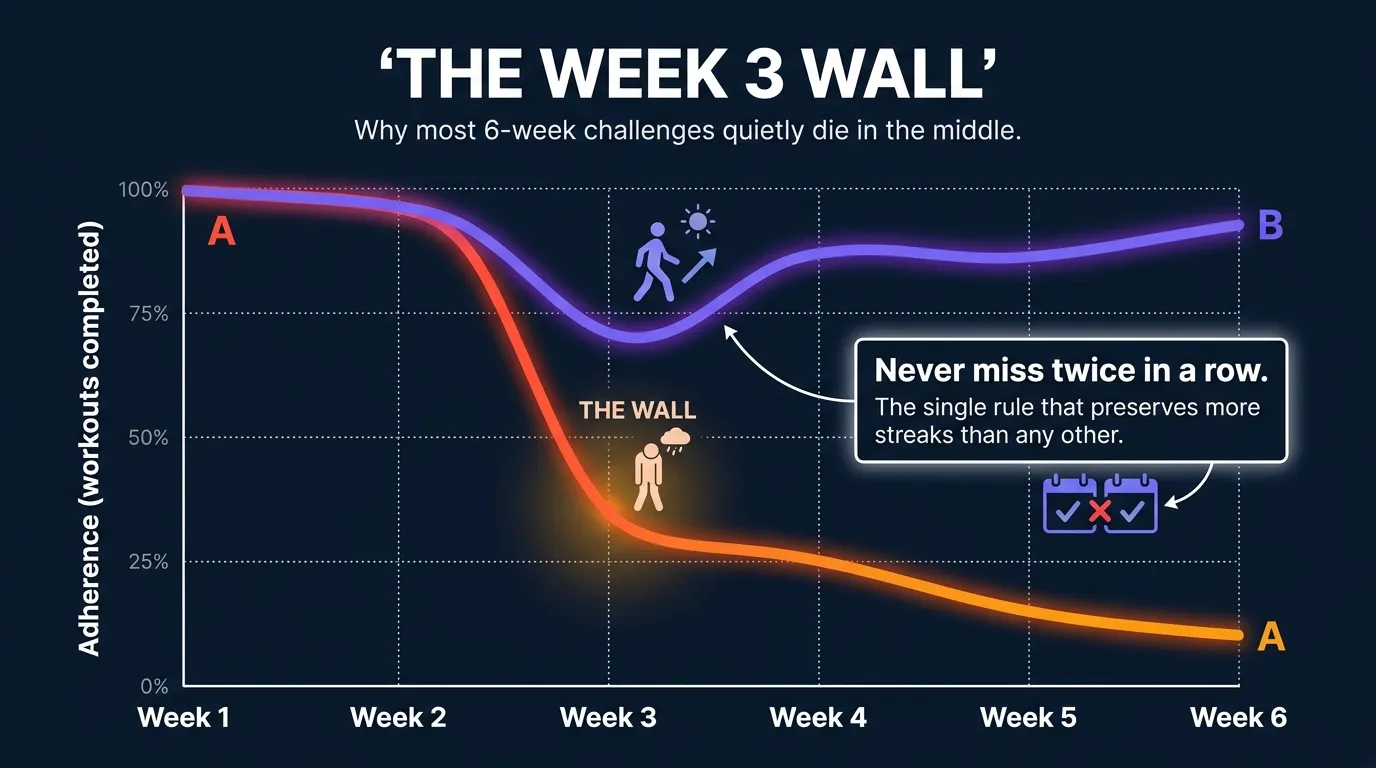
Plan for the Week 3 Wall
Most fitness habits die in week 3. The novelty has worn off. The first round of visible results hasn't fully landed yet. Life produces a busy week, you skip a day, and the streak is suddenly broken. This is the engagement-decay curve we wrote about in our research overview, and it's the part of every challenge that requires a plan, not willpower.
What works in week 3:
- Tell someone you're doing it. Public commitment makes skipping more costly.
- Track your sessions visibly. A wall calendar with an X for each day works as well as any app.
- Pre-decide your rest day. Floating it gives you 7 chances to skip; fixing it gives you 1 designed pause.
- If you miss a day, walk the next day. The rule isn't "never miss." The rule is "never miss twice in a row." That single rule preserves more streaks than any other piece of habit advice.
The behavioral mechanics here are well covered in the literature on streaks and loss aversion in fitness. We dig deeper in our piece on why streaks work.
Who 6-6-6 Is Best For (and Who Should Tweak It)
Strong Fits
- Sedentary adults restarting fitness. The protocol meets you where you are. Walking is the lowest-friction movement, and 6 weeks is short enough to feel doable.
- Office workers with low daily step counts. A focused 60-minute walk is often easier to schedule than scattering steps across a workday at a desk.
- Adults 40+ wanting low-impact cardio. Walking keeps joint stress low while delivering the cardiovascular dose that matters for healthspan.
- People returning after illness, injury, or postpartum recovery (with clearance). Brisk walking is conservative enough to layer in early, and the 6-week ramp matches typical reconditioning timelines.
Tweaks Worth Making
- Older adults or anyone deconditioned: Start at 20 to 30 minutes and build to 60 over the full 6 weeks. The endpoint is the same. The on-ramp is gentler.
- Knee, hip, or back pain: Replace 1 to 2 sessions per week with a non-impact alternative (cycling, swimming, elliptical). The cardiovascular dose stacks the same way.
- People on GLP-1 medications: Walking helps, but it doesn't preserve muscle. Add 2 short resistance sessions per week (bodyweight is fine). We cover the protocol in how to preserve muscle on Ozempic and other GLP-1 medications.
- Already-fit walkers: 60 minutes of comfortable brisk walking is maintenance, not progress. Substitute interval-style sessions, or add ankle weights or a light pack to raise intensity.
What This Means for You
The 6-6-6 walking challenge is a smart wrapper around a boring truth: most adults need more sustained moderate movement, and walking is the cheapest way to get it. The mnemonic is sticky. The 6-week finish line is psychologically clever. The 6 a.m./6 p.m. timing is mostly cosmetic, and picking the slot that fits your life will outperform picking the one the influencer told you to.
If you finish a single 6-week round, you've done two things. First, you've banked roughly 36 hours of brisk walking, which is enough to move multiple cardiovascular markers in the right direction. Second, you've built the underlying habit architecture (a defended time slot, a known cue, a tracked streak) that makes the next 6 weeks easier than the first.
The protocol isn't magic. The consistency is. And consistency is the variable most fitness apps quietly leave you to figure out on your own.
Frequently Asked Questions
What is the 6-6-6 walking challenge?
The 6-6-6 walking challenge is a structured walking protocol that went viral in 2025-2026. It prescribes a 6-minute warm-up, 60 minutes of brisk walking at either 6 a.m. or 6 p.m., a 6-minute cool-down, performed 6 days a week, for 6 weeks. The 60 minutes per session adds up to 360 weekly minutes, which more than doubles the U.S. Physical Activity Guidelines minimum of 150 weekly minutes of moderate aerobic activity.
Is the 6-6-6 walking challenge good for weight loss?
Yes, the 6-6-6 walking challenge can support weight loss for most people, though results depend on diet. A 60-minute brisk walk burns roughly 250 to 400 calories for adults between 130 and 200 pounds. Across 6 days that adds up to 1,500 to 2,400 weekly calories beyond baseline, which can produce modest fat loss without any nutrition change. People who pair the protocol with a small calorie reduction tend to see the largest changes.
Is it better to walk at 6 a.m. or 6 p.m.?
Neither time is meaningfully better for general fitness or weight loss. The biggest predictor of results is whether you actually do the walk consistently, and that depends on your schedule and chronotype, not the clock. Morning walks tend to anchor better as habits because there are fewer competing demands. Evening walks may slightly aid sleep and have shown small advantages for blood pressure in some studies. Pick the slot you can defend on a normal Tuesday.
How many calories does 60 minutes of brisk walking burn?
Roughly 250 to 400 calories for most adults. A 150-pound person walking briskly at 3.5 mph burns around 280 to 320 calories in 60 minutes. Heavier walkers burn proportionally more, lighter walkers slightly less. Adding a small incline or carrying a light pack increases the figure by 10 to 20 percent. The precise number matters less than the consistency of doing it most days.
What if I can't walk 60 minutes a day, 6 days a week?
Start where you actually live. Two 30-minute walks broken up by a few hours produce nearly identical cardiovascular benefits to one 60-minute block. Four solid sessions a week beats six attempted sessions where two get skipped. The published walking research generally finds the threshold for measurable cardiovascular and mortality benefit lands around 150 minutes a week of moderate activity, which you can hit in shorter chunks. Build to the full protocol over 4 to 6 weeks rather than trying to land it on day one.