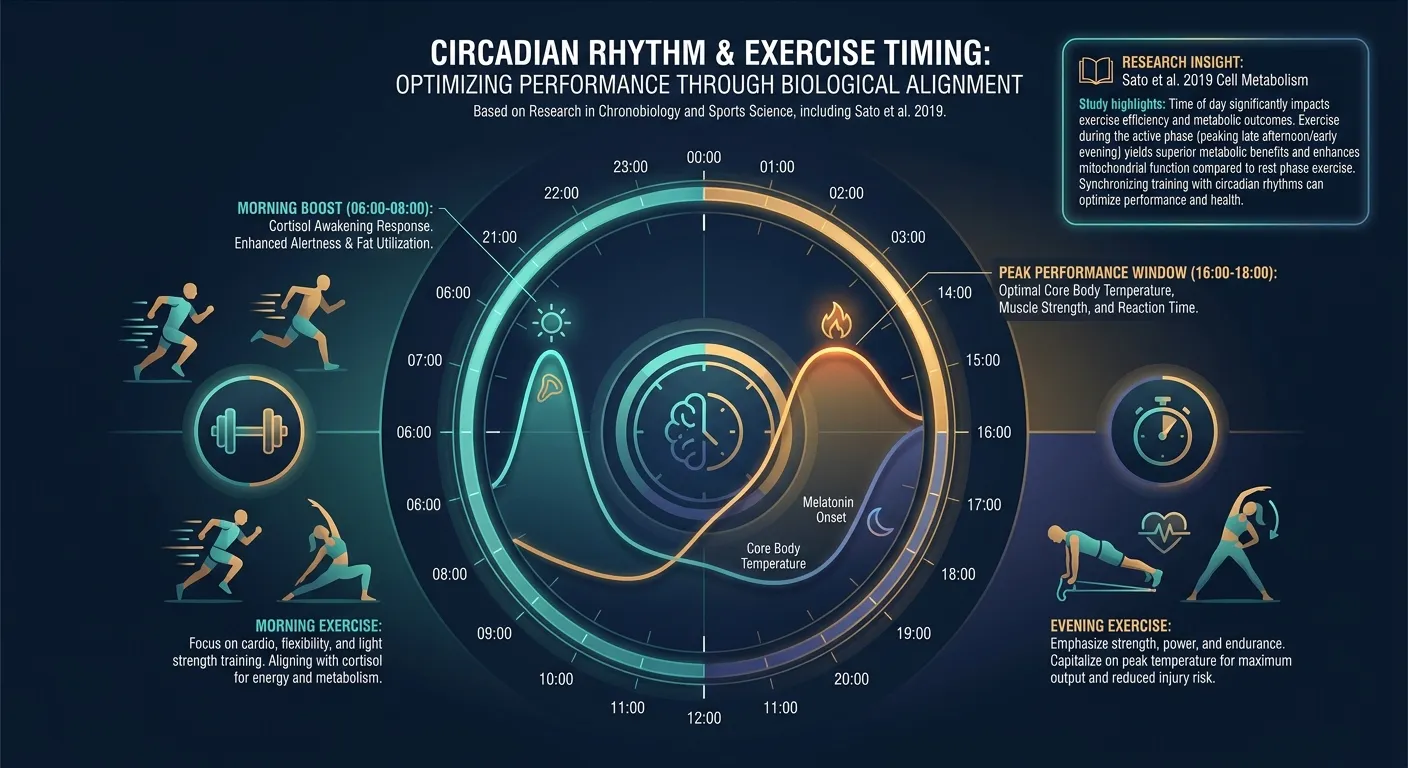
You've seen the headlines. "Science proves morning workouts burn more fat!" Right next to: "Evening exercise is actually better for you!" Both cite real studies. Both leave out the parts that don't fit the headline.
Here's what actually happened. In 2019, a team led by Shogo Sato published a study in Cell Metabolism that mapped how exercise timing changes metabolic pathways at the molecular level. It was one of the most detailed looks at exercise chronobiology ever conducted. The findings were clear, nuanced, and immediately oversimplified by every fitness blog on the internet.
Let's fix that. We'll walk through what the research actually shows, where the evidence is strong, where it's still thin, and what all of it means for someone who just wants to know when to work out. For the wider question of the best time to workout, including the sleep evidence on late sessions and the creatine and protein timing questions, we cover the whole literature on its own page.
The Landmark Study: Sato et al. (2019)
The study that kicked off the modern exercise timing debate used mice and a small human pilot cohort. Sato and colleagues used high-throughput metabolomics and transcriptomics to map exactly how exercise affects skeletal muscle metabolism at different times of day.
What They Found
Exercise during the early active phase (evening equivalent for humans) produced a significantly more robust metabolic response than exercise during the early rest phase (morning equivalent). Specifically:
- Greater lipid degradation , evening-phase exercise activated broader fat oxidation pathways in skeletal muscle
- Enhanced glycolytic activation , HIF1α, a master regulator of glycolysis, was selectively activated during active-phase exercise but not rest-phase exercise
- Higher carbohydrate utilization , evening exercise led to more complete carbohydrate exhaustion, forcing the body to tap into alternative energy sources including ketone bodies and amino acids
- Greater systemic metabolic impact. The effects weren't limited to muscle; they influenced whole-body energy homeostasis
The researchers concluded that "the time of day is a critical factor to amplify the beneficial impact of exercise." That's a strong statement from a Cell Metabolism paper, and the data backed it up.
Citation: Sato S, Basse AL, Schoenfeldt M, et al. Time of Exercise Specifies the Impact on Muscle Metabolic Pathways and Systemic Energy Homeostasis. Cell Metab. 2019;30(1):114-130.e11.
The Important Caveat
The primary data came from mice. Mice are nocturnal, so "active phase" for them is nighttime. The translation to human circadian rhythms is reasonable but not direct. The small human pilot showed consistent trends, but it wasn't a full-scale randomized trial. This study showed what happens metabolically. The human trials that followed showed whether it translates to real outcomes.
The Human Evidence: Does Evening Training Actually Produce Better Results?
The Sato study generated the hypothesis. Several human trials have since tested it.
Afternoon Training Improves Metabolic Health More Than Morning
Mancilla and colleagues at Maastricht University (2021) compared 12 weeks of morning versus afternoon exercise training in 32 metabolically compromised adults , people with conditions like type 2 diabetes risk factors, elevated fasting glucose, and excess body fat. These are exactly the people who need exercise most.
The afternoon group saw significantly greater improvements across multiple markers:
- Better peripheral insulin sensitivity , their muscles responded more effectively to insulin
- Lower fasting plasma glucose. A direct marker of metabolic health
- Greater fat mass reduction. They lost more body fat on the same training program
- Improved exercise performance. They got fitter, faster
- Better insulin-mediated suppression of adipose tissue lipolysis , their bodies regulated fat storage more effectively
Same exercises. Same program. Same duration. The only difference was when they did it. And the afternoon group came out ahead on nearly every metric.
Citation: Mancilla R, Brouwers B, Schrauwen-Hinderling VB, et al. Exercise training elicits superior metabolic effects when performed in the afternoon compared to morning in metabolically compromised humans. Physiol Rep. 2021;8(24):e14669.
Strength and Muscle Growth: The Afternoon Advantage
A 2023 systematic review with meta-analysis published in Sports Medicine - Open (Bruggisser et al.) examined whether time of day affects strength and endurance training outcomes. Pooling data from multiple trials, they found that afternoon and evening resistance training produced slightly greater gains in muscle mass compared to morning sessions.
The mechanism makes physiological sense. Core body temperature peaks in late afternoon , typically between 2 PM and 6 PM. Higher body temperature means:
- Better muscle contractile properties (your muscles literally contract more efficiently)
- Faster nerve conduction velocity (quicker reaction times)
- Greater joint flexibility (reduced injury risk)
- Higher pain tolerance (you can push harder before it feels unbearable)
Athletes have known this intuitively for years. Most world records in strength and speed events are set in the afternoon or evening. Now the meta-analyses confirm what the anecdotal evidence suggested.
Citation: Bruggisser F, Knaier R, Roth R, et al. Best Time of Day for Strength and Endurance Training to Improve Health and Performance? A Systematic Review with Meta-analysis. Sports Med Open. 2023;9:24.
The Case for Morning Workouts
Before the evening-exercise crowd starts a victory lap , morning workouts have their own research-backed advantages. And some of them are pretty compelling.
Fasted Morning Exercise and Fat Oxidation
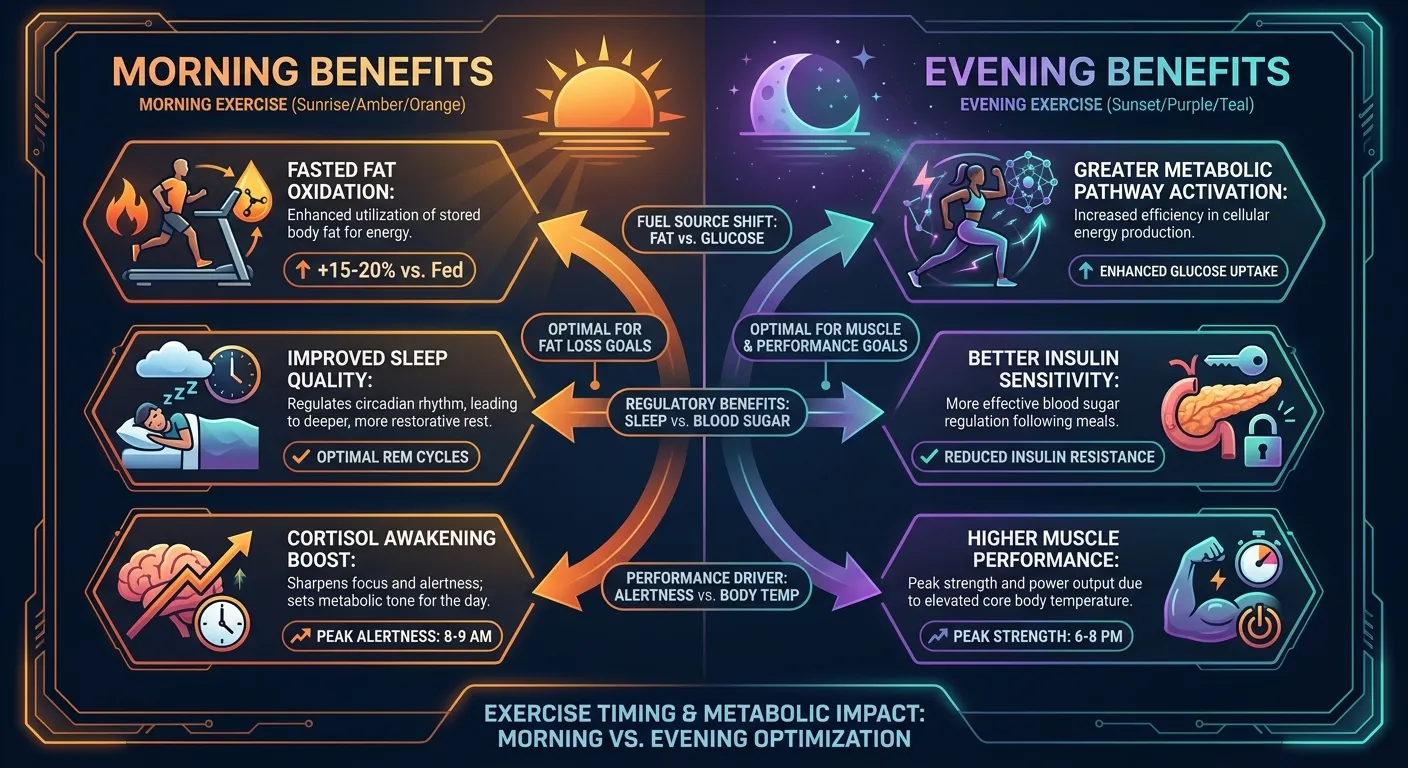
A study published in EBioMedicine (2016) found that exercise performed before breakfast increased 24-hour fat oxidation significantly compared to the same exercise performed after eating. The mechanism: after an overnight fast, glycogen stores are partially depleted. Exercise in this state forces greater reliance on fat as fuel.
Here's the nuance the headlines miss: this is a fasting effect, not strictly a morning effect. The fat oxidation boost comes from exercising in a glycogen-depleted state. Morning just happens to be when most people are naturally fasted. If you skipped lunch and worked out at 5 PM, you'd see a similar metabolic shift.
Morning Exercise and Sleep Quality
Multiple studies have found that morning exercise improves sleep onset and increases slow-wave (deep) sleep. Vigorous exercise within 1-2 hours of bedtime, on the other hand, can delay melatonin production and fragment sleep architecture. If you're someone who struggles with sleep, and poor sleep torpedoes fitness gains , morning training may offer a compounding advantage that outweighs the direct metabolic benefits of evening sessions. The active recovery research makes the sleep-recovery connection explicit: sleep is arguably the single most important recovery factor, and optimizing it matters more than any active recovery technique.
Morning Exercise and Mood
There's consistent evidence that morning exercise produces a sharper cortisol awakening response and improved mood throughout the day. For people dealing with low energy or mild depression, a morning workout can function as a natural antidepressant that colors the entire day differently. That's not a small thing when you're trying to build a fitness habit.
Enjoying the article?
Start a new fitness routine today, written by me and coached by the AI I designed.
Take the Free Assessment Free • 2 minutes • No credit cardThe Plot Twist: Consistency Beats Timing
Here's the part that should actually change your behavior.
Schumacher and colleagues (2019) published a study in Obesity that examined exercise consistency in successful weight loss maintainers , people from the National Weight Control Registry who'd lost significant weight and kept it off. They found that individuals who exercised at a consistent time of day, regardless of whether it was morning or evening, reported significantly higher levels of moderate-to-vigorous physical activity than people who varied their exercise timing.
Read that again. It wasn't morning exercisers who were most active. It wasn't evening exercisers. It was consistent exercisers , people who picked a time and stuck with it.
Citation: Schumacher LM, Thomas JG, Raynor HA, et al. Relationship of Consistency in Timing of Exercise Performance and Exercise Levels Among Successful Weight Loss Maintainers. Obesity. 2019;27(8):1285-1291.
Why Consistency Trumps Optimization
The metabolic differences between morning and evening exercise are real. But they're also relatively small. We're talking about marginal improvements in insulin sensitivity, modest differences in fat oxidation, slight edges in muscle contractile efficiency.
You know what's not small? The difference between working out four times a week versus zero times a week. Between maintaining a routine for six months versus abandoning it after three weeks.
If you're a night owl who dreads mornings, setting your alarm for 5:30 AM because some study showed a slight fat oxidation advantage is a recipe for quitting by week two. And a workout you skip is infinitely worse than a workout at a "suboptimal" time.
This is the part the fitness industry gets wrong over and over. They obsess over marginal optimization , meal timing, exercise timing, rep ranges, supplement stacks , while ignoring the one variable that actually determines outcomes: whether you show up consistently.
Your Chronotype Matters More Than You Think
There's another layer to this. Research on circadian rhythm phase shifts (Facer-Childs et al., 2018) shows that your chronotype , whether you're naturally a morning person or a night owl , affects how your body responds to exercise at different times.
- Morning chronotypes tend to feel more alert, have higher pain tolerance, and produce better performance earlier in the day
- Evening chronotypes reach peak physical capacity later , their core temperature, reaction time, and muscle function peak 2-4 hours later than morning types
- Evening exercise can worsen circadian misalignment in early chronotypes, potentially disrupting sleep
- Both morning and evening exercise can help late chronotypes advance their circadian phase, potentially improving their sleep-wake cycle
Your genetics partially determine your chronotype. Fighting it is like swimming upstream. Instead of asking "when does science say I should work out?" a better question is: "when does my body actually want to move?"

Common Misconceptions
Misconception: "Morning workouts burn more fat"
Partly true, mostly misleading. Fasted morning exercise does increase acute fat oxidation during and after the session. But the Sato et al. (2019) data shows that evening exercise activates broader metabolic pathways including lipid degradation in skeletal muscle. And the Mancilla et al. (2021) trial found that afternoon trainers lost more total fat mass over 12 weeks. Acute fat oxidation during a single session doesn't tell you much about long-term body composition changes. Total energy expenditure and dietary habits matter far more.
Misconception: "Working out at night ruins your sleep"
Moderate exercise in the evening doesn't impair sleep for most people. The research shows that only vigorous, high-intensity exercise within 1-2 hours of bedtime meaningfully disrupts sleep architecture. A moderate strength session or a 30-minute jog finishing 2-3 hours before bed? You're fine. The sleep panic around evening exercise is overblown for anyone who isn't doing all-out sprints at 10 PM.
Misconception: "There's one objectively best time to exercise"
There isn't. The research shows marginal advantages in different directions depending on what you measure. Evening wins on metabolic pathway activation and muscle performance. Morning wins on sleep quality and fasted fat oxidation. Consistency wins on every outcome that actually matters long-term , adherence, total volume, body composition, cardiovascular fitness, and mental health.
What This Means for Your Training
Let's make this practical.
If you're metabolically compromised (prediabetic, insulin resistant, carrying significant excess body fat): the evidence for afternoon/evening training is strongest here. The Mancilla et al. trial specifically showed superior outcomes in this population. If you can train in the afternoon without it wrecking your consistency, it's worth trying.
If you're training for strength and muscle: afternoon sessions (2-6 PM) align with peak core body temperature and may give you a slight performance edge. Most powerlifting and Olympic weightlifting competitions are held in the afternoon for exactly this reason.
If you struggle with sleep: morning exercise has a clearer benefit. It reinforces your circadian rhythm rather than potentially disrupting it.
If you've quit fitness apps before: forget timing optimization entirely. Pick the time slot that has the fewest competing demands in your day, and protect it. That's it. That's the entire strategy. You can optimize timing after you've built a 90-day streak. Not before. The minimum effective dose research also applies here: 15 minutes at the "wrong" time of day produces a 14% mortality reduction. Zero minutes at the "optimal" time produces nothing.
How FitCraft Handles Exercise Timing
We built FitCraft around a simple insight from this research: the best workout time is the one you'll actually do.
Ty, FitCraft's 3D AI personal trainer, doesn't lecture you about circadian rhythms. He builds your plan around when you're actually available. Morning person who has 25 minutes before the kids wake up? Ty programs for that. Night owl who only has energy after 8 PM? Ty programs for that too.
Here's what that looks like in practice:
- Schedule-adaptive programming , tell Ty when you can train, and your workouts are built for those windows. Not a generic 60-minute program crammed into 20 minutes.
- Consistency-first design , FitCraft's streak system and gamification mechanics are designed to make showing up feel rewarding, regardless of when you show up. XP, leveling, collectible cards. They work at 6 AM or 9 PM.
- AI-adaptive difficulty. If you're groggier in the morning and stronger in the evening, Ty adjusts. The AI coaching engine responds to your actual performance, not a theoretical optimal window.
- Full personalization is included. Schedule-based workout adaptation is a core FitCraft feature — not an add-on.
Programs designed by Domenic Angelino, an Ivy League-trained, NSCA-certified exercise scientist who designed FitCraft's programming around the adherence research. Not the timing research. Because he's read both, and he knows which one actually determines whether you get results.
References
- Sato S, Basse AL, Schoenfeldt M, et al. "Time of Exercise Specifies the Impact on Muscle Metabolic Pathways and Systemic Energy Homeostasis." Cell Metabolism 30.1 (2019): 114-130.e11. doi:10.1016/j.cmet.2019.03.013
- Mancilla R, Brouwers B, Schrauwen-Hinderling VB, et al. "Exercise training elicits superior metabolic effects when performed in the afternoon compared to morning in metabolically compromised humans." Physiological Reports 8.24 (2021): e14669. doi:10.14814/phy2.14669
- Sato S, Dyar KA, Treebak JT, et al. "Atlas of exercise metabolism reveals time-dependent signatures of metabolic homeostasis." Cell Metabolism 34.2 (2022): 272-287.e12. doi:10.1016/j.cmet.2021.12.016
- Schumacher LM, Thomas JG, Raynor HA, et al. "Relationship of Consistency in Timing of Exercise Performance and Exercise Levels Among Successful Weight Loss Maintainers." Obesity 27.8 (2019): 1285-1291. doi:10.1002/oby.22535
- Bruggisser F, Knaier R, Roth R, et al. "Best Time of Day for Strength and Endurance Training to Improve Health and Performance? A Systematic Review with Meta-analysis." Sports Medicine - Open 9 (2023): 24. doi:10.1186/s40798-023-00577-5
Frequently Asked Questions
Is it better to work out in the morning or evening?
Research slightly favors evening exercise for metabolic benefits and physical performance. A 2019 Cell Metabolism study found evening exercise produced greater fat oxidation and metabolic pathway activation in skeletal muscle. A 2021 study in Physiological Reports showed afternoon training improved insulin sensitivity and reduced fat mass more than morning training in metabolically compromised adults. However, adherence research consistently shows that the best time to exercise is whichever time you'll do consistently , people who exercise at a fixed time, regardless of when, are significantly more likely to maintain their routine.
Does morning exercise burn more fat than evening exercise?
It depends on fasting state and what you measure. Exercising before breakfast can increase 24-hour fat oxidation because the body taps into fat stores when glycogen is depleted overnight. However, the Sato et al. 2019 study found that evening exercise activates broader metabolic pathways in skeletal muscle, including enhanced lipid degradation. The practical difference for most people is small compared to the impact of simply exercising regularly at whatever time fits your schedule.
Does exercise timing affect muscle growth and strength?
A 2023 systematic review with meta-analysis in Sports Medicine - Open found that afternoon and evening strength training may produce slightly greater gains in muscle mass compared to morning sessions. Core body temperature peaks in the late afternoon, which improves muscle contractile properties and reduces injury risk. That said, the magnitude of difference is modest, and consistent training at any time of day produces meaningful strength and hypertrophy gains.
Does working out at night affect sleep quality?
Moderate evening exercise generally does not impair sleep quality for most people. However, vigorous high-intensity exercise within 1-2 hours of bedtime can delay melatonin production and reduce sleep quality. Research suggests finishing intense workouts at least 2-3 hours before bedtime. Morning exercise has been associated with improved sleep onset and deeper slow-wave sleep in multiple studies.
Does FitCraft adapt workouts based on when you exercise?
Yes. FitCraft's AI coach Ty builds personalized workout plans around your schedule , morning, evening, or anywhere in between. The app adapts workout intensity, duration, and structure to fit when you actually have time to train, because the research is clear that consistency at your preferred time matters far more than chasing an optimal window. FitCraft's free version includes full schedule-based personalization.