- Wall Pilates is regular Pilates done with a wall as a brace, alignment cue, or resistance point. The research that backs it is the broader Pilates research, which is substantial.
- A 2022 JOSPT network meta-analysis (Owen et al.) ranked Pilates as the most effective movement intervention for chronic low back pain among Pilates, strength, core-based, and mind-body work.
- Pilates beats general exercise on core endurance, flexibility, and dynamic balance. It's roughly equal on lower-body strength gains in untrained adults.
- The wall's real advantage is feedback. It tells your spine where neutral lives, your hips where they're rotating to, and your foot where pressure is leaving the floor.
- Wall Pilates won't replace progressive resistance training for muscle growth. Pair it with two weekly strength sessions if hypertrophy is your goal.
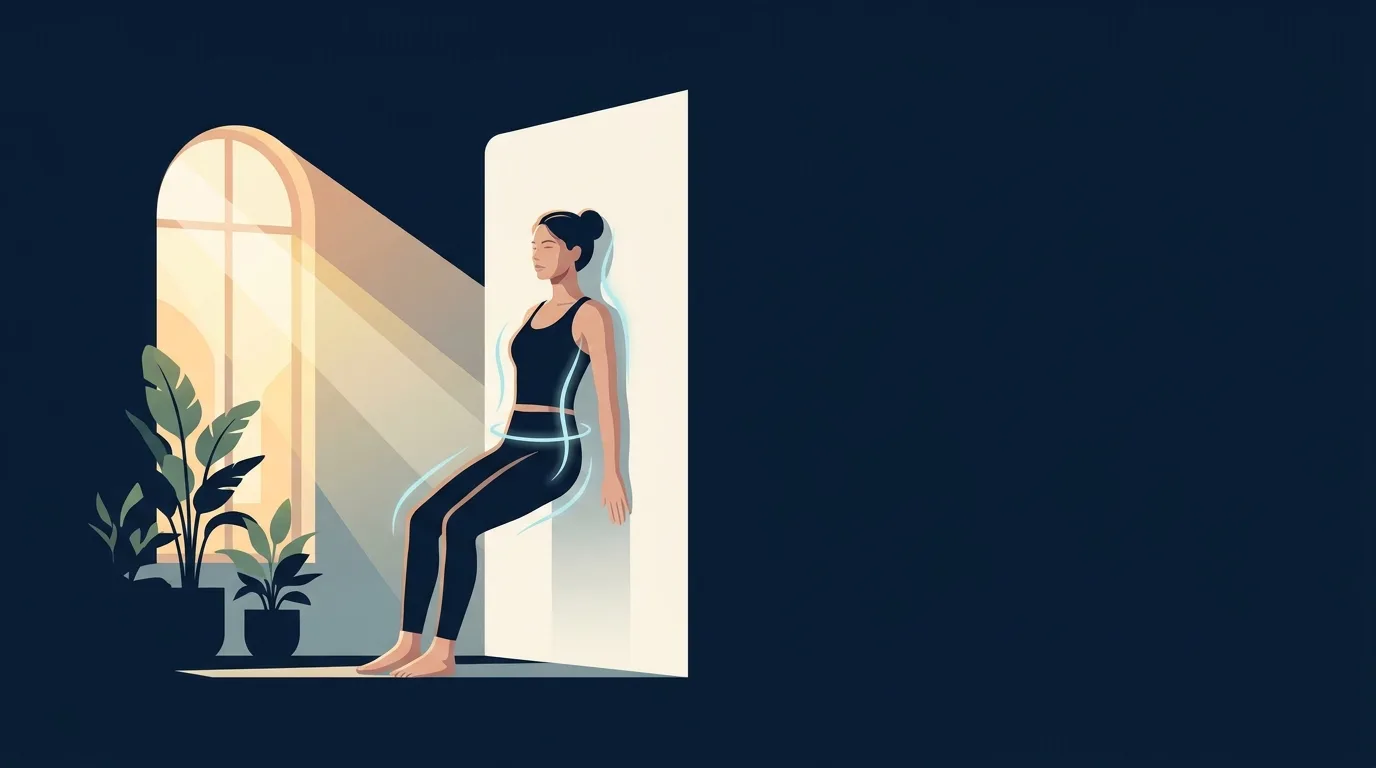
Wall Pilates blew up in 2024 and never really cooled off. Search interest stayed elevated through 2025 and into 2026, the hashtag has billions of TikTok views, and the same five-move "wall workout" carousel keeps recycling across Instagram every few weeks. Most of those videos promise the same thing. Cinch your waist, sculpt your glutes, fix your back, all from your bedroom, no equipment, twenty minutes.
Some of that's true. A surprising amount of it is real. The rest is the same fitness marketing that's always been there, dressed up in a new outfit. The point of this article is to separate the two. What does the evidence on Pilates actually show? What does the wall add (and not add) to that evidence? And how do you build a home routine that works without falling for the version that doesn't?
You'll get a 20-minute weekly plan, a clear-eyed look at where wall Pilates underperforms, and the studies that drive the recommendations. By the end you'll know exactly what to do tomorrow morning.
What Wall Pilates Actually Is
Strip the marketing away and wall Pilates is just mat Pilates with a wall in the picture. The exercises are the same Joseph Pilates moves that physiotherapists have been teaching since the 1990s. Roll-downs, bridges, hundreds, leg circles, side-lying clamshells, modified planks. The wall plays one of three roles in any given exercise.
- A brace. Pressing the lumbar spine, sacrum, or hands into the wall gives you a fixed reference for "neutral." If your back lifts off, you've lost neutral. The feedback is instant.
- An alignment cue. Hips against the wall during a single-leg stand tell you the second your pelvis rotates. Heels against the wall in a bridge make sure your knees track over your toes.
- A resistance source. Sliding down a wall into a wall sit, pressing the heel of one foot into the wall during a glute bridge, or pushing into the wall during a side plank all turn the wall into a load source you can scale up by changing angle or distance.
That's the whole concept. There's nothing magic about the wall. It's just a stable, free, always-available piece of equipment. The mat Pilates world has used it for decades. TikTok packaged the work, gave it a name, and a generation of people who wouldn't have walked into a Pilates studio started doing it on their bedroom floor. That's a good thing.
The Pilates Evidence That Backs It
Because wall Pilates is just Pilates, the research that backs it is the broader Pilates literature. Three findings matter most.
Pilates is the top-ranked exercise for chronic low back pain
The most important paper to understand here is the 2022 network meta-analysis by Owen et al. in the Journal of Orthopaedic & Sports Physical Therapy. The authors pooled 118 trials with over 9,700 adults with chronic low back pain. They compared Pilates, strength training, core-based exercise, mind-body work (yoga, tai chi), aerobic exercise, mixed exercise, and McKenzie therapy. Pilates ranked first for pain reduction and was tied with strength training for disability reduction. Sessions of less than 60 minutes, run 1 to 2 times a week for 3 to 9 weeks, were among the most effective formats.
That's a striking result. Pilates beat heavier strength training on pain at the population level. It tied it on disability. And the dose required was small. One hour or less, twice a week, for two months.
A separate 2023 meta-analysis by Yu et al. in the International Journal of Environmental Research and Public Health reached similar conclusions. Pilates produced significant improvements in pain intensity, functional disability, and quality of life in chronic low back pain populations versus controls or general exercise. The signal isn't soft. Pilates does something specific for this population that other exercise modalities don't quite match.
Pilates improves core endurance, balance, and flexibility
For healthy adults, the evidence base shifts. Pilates doesn't out-build a strength program in the squat or deadlift, but it consistently produces gains in three measures.
- Core endurance. Plank-time, side-bridge time, and trunk-flexion endurance improve in 8 to 12 weeks of consistent Pilates training across multiple RCTs.
- Dynamic balance. Functional reach, single-leg stand time, and timed up-and-go scores improve. This matters for fall prevention as you age.
- Flexibility. Hip and lower-back range of motion increase reliably across most studied populations.
An RCT in older women by Vieira et al. (2017), published in the Journal of Bodywork and Movement Therapies, ran 12 weeks of Pilates-inspired training and found significant gains in functional performance, dynamic balance, and lower-body strength versus controls. A 2019 trial in PMC by Roller et al. compared Pilates and resistance training head-to-head in older women and found Pilates produced equivalent gains in trunk strength and superior gains in balance. So if you're over 50 and your goal is to feel sturdier in everyday life, the Pilates literature is doing real work.
Pilates is mediocre at body recomposition on its own
Here's where the marketing breaks down. The most-cited "wall Pilates transformed me" videos imply huge changes in body composition from a 20-minute daily wall routine. That isn't what the research shows.
A systematic review with meta-analysis by Cavina et al. in the Journal of Physical Activity and Health pooled 10 mat Pilates trials and found the method was not more effective than traditional exercise or a control condition on body mass index, lean mass, body fat percentage, or abdominal circumference. That held in the older, adult, and overweight subgroups too. Mat Pilates is worth doing for other reasons. Driving body composition on its own is not one of them.
If your goal is body composition, Pilates is a contributor, not the whole stack. We dig into the broader picture in our piece on body recomposition with a home workout.
Why the Wall Helps
If wall Pilates is just Pilates, why does the wall version blow up while regular mat Pilates plateaus? Two reasons, and both are about how humans actually learn movement.
The wall removes the balance penalty for week one
The hardest part of mat Pilates in week one isn't the strength demand. It's the proprioception demand. Your nervous system doesn't know where your pelvis is in space yet. Your scapulae drift. Your foot pressure shifts. You spend most of your first session trying not to fall sideways, and the actual training stimulus gets lost in the wobble.
The wall fixes that. Pressing your spine into the wall in a roll-down means you can't lose neutral. Resting your heels against the wall in a bridge means your knees can't cave. The first three weeks of wall Pilates teach your body the shapes. Then you peel off the wall and do them unsupported, and they hold.
The wall is a free, silent coach
Pilates instructors are expensive (most cities run $80 to $150 a session). The cue most of them give in week one is some version of "press your back into the mat." That cue is hard to feel on a soft mat. It's instant on a wall. The wall gives you the same feedback a coach would give, every rep, for free.
This is why the home version works for people who never made it through three Pilates studio visits. The wall does the cueing for you. You don't have to wonder if you're doing it right. The wall tells you.
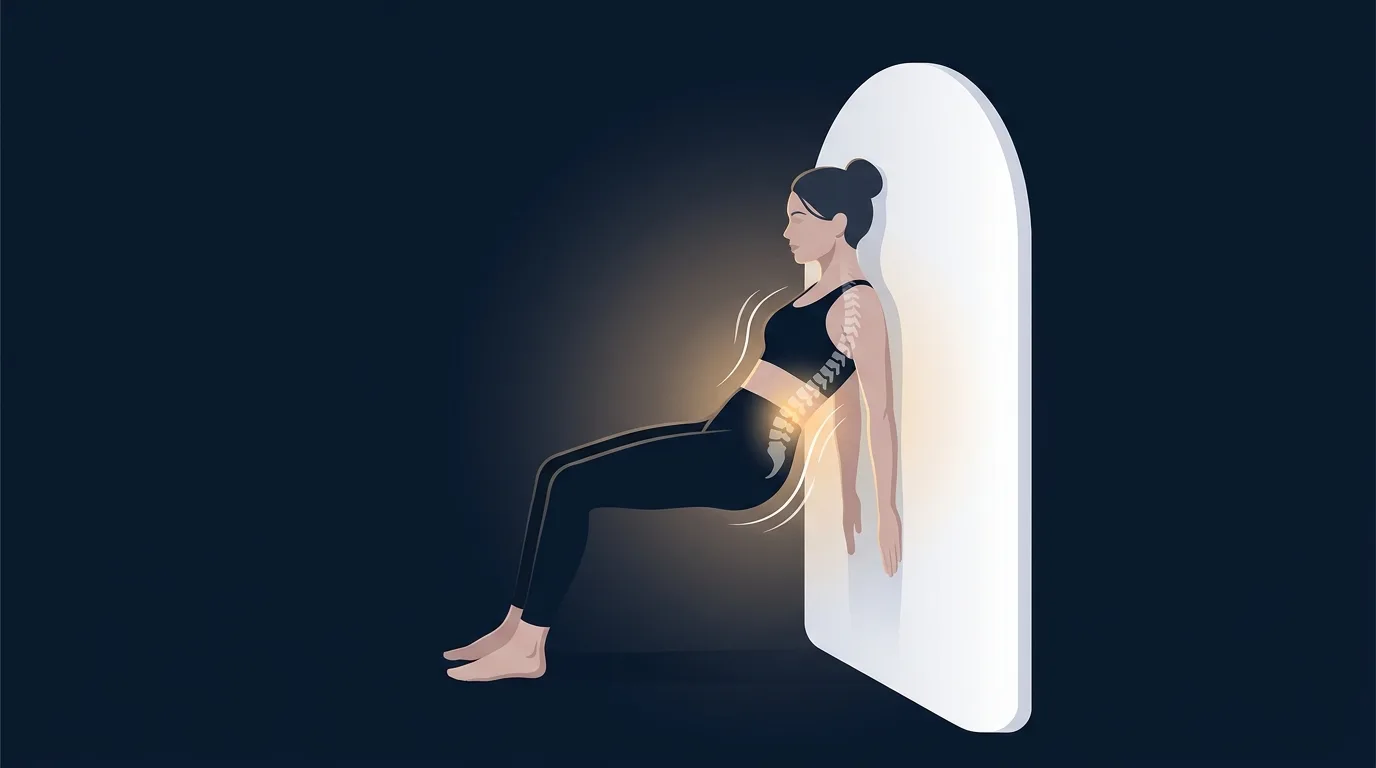
A 20-Minute Wall Pilates Plan You Can Start Tomorrow
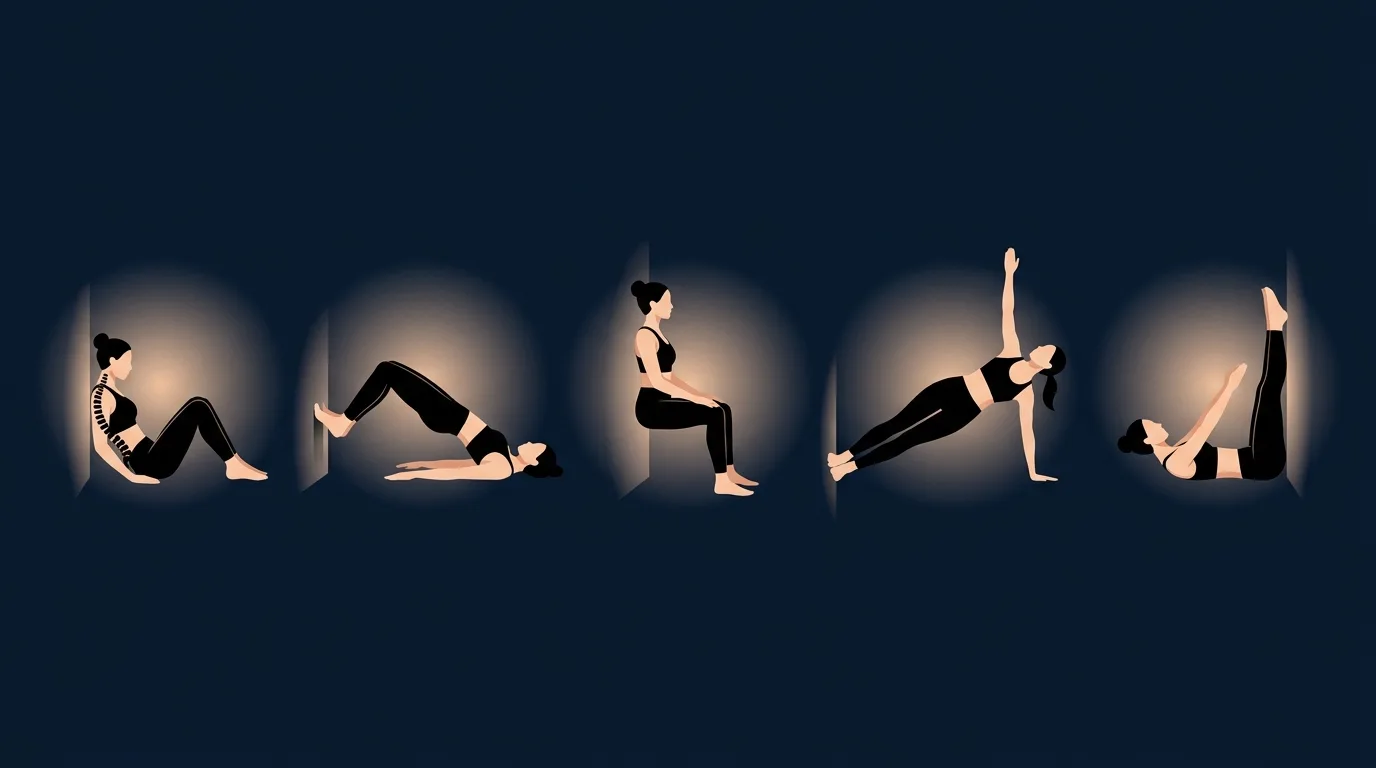
Here's the routine. Five exercises, three rounds, about 20 minutes including transitions. Run it three times a week. You only need a wall, a mat or a folded towel, and enough space to lie down with your legs up.
1. Wall roll-down (5 reps, slow)
Stand with your back against the wall, feet about a foot away, knees soft. Tuck your chin and roll down your spine one vertebra at a time, keeping your back in contact with the wall as long as you can. Reverse the movement on the way up. Trains spinal articulation, hamstring length, and the same pattern that sit-ups try to train without compressing the lumbar spine. We have a similar pattern in the cat-cow entry in our exercise library.
2. Wall bridge with heel press (8 to 12 reps)
Lie on your back with your heels pressed flat against the wall, knees at roughly 90 degrees, shins parallel to the floor. Drive your heels into the wall and lift your hips. Squeeze the glutes at the top, hold for two seconds, lower with control. The wall does what a foam roller or stability ball does in studio Pilates: it gives the heels something to push against. The glute bridge is the foundational version of this same pattern.
3. Wall sit with toe lifts (30 seconds)
Slide down the wall into a 90-degree wall sit. Hold. Then alternate lifting one foot off the ground for two seconds at a time. Loads the quads, glutes, and ankle stabilizers. The toe lifts add a balance demand without losing wall support. Wall sits on their own are an underrated isometric that builds quad endurance.
4. Wall side plank with leg lift (30 seconds per side)
Set up in a side plank with the bottom forearm on the mat and the soles of both feet pressed against the base of the wall. The wall keeps your feet stacked. Lift the top leg slowly, hold, lower. Hits the obliques, glute medius, and the deep hip stabilizers most people skip.
5. Wall hundred (1 round of 100 breaths)
Lie on your back with your legs up the wall, hips a few inches from the wall. Lift your head and shoulders into a small curl, arms long at your sides, palms down. Pump the arms in tiny pulses while breathing in for five pumps and out for five pumps, until you reach 100. The legs-up-wall position takes the lower-back load out of the standard Pilates hundred while still hammering the rectus abdominis and the deep transverse abdominis.
Three rounds. Three days a week. About 20 minutes. That's the dose.
Ready to put this into practice?
Take the free FitCraft assessment and get a personalized plan based on behavioral science, not willpower. Free version available. Ty, our 3D AI coach, demonstrates every move and adapts the plan as you progress.
Take the Free Assessment Free • 2 minutes • No credit cardWhere Wall Pilates Underperforms
It's worth being honest here. Wall Pilates is good at some things and weaker at others. Knowing the gap saves you months of disappointment.
It won't grow visible muscle on its own
Hypertrophy needs progressive mechanical tension. That means heavier loads, taken close to failure, applied across weeks and months. Wall Pilates can be hard, but it caps out. Once a movement gets easy, you can add a band or change leverage, but you'll plateau before a progressive resistance program plateaus. If you want shoulders, glutes, and quads that look bigger, add two weekly resistance sessions on top of wall Pilates. It doesn't have to be heavy gym work. Banded squats, push-up progressions, and rows do the job at home.
It's a small contribution to fat loss
The Cavina meta-analysis could not separate mat Pilates from control conditions on body composition at all. A 20-minute home routine three times a week burns about 300 to 400 calories total. That's worth doing. It's not enough to drive fat loss without nutritional changes.
It's not aerobic conditioning
Wall Pilates rarely pushes your heart rate above 65 percent of max. That's fine for the goals it does serve, but it's not zone 2 cardio and it's not VO₂ max work. If aerobic fitness matters to you, pair this routine with the kind of work we covered in our piece on zone 2 cardio at home.
It can't cure structural pain
The Pilates pain literature is strong for chronic non-specific low back pain. It's not a treatment for disc herniations, fractures, severe spinal stenosis, or any pain that comes with neurological red flags (loss of bowel control, severe leg weakness, numbness in the saddle area). If your pain is sharp, recent, or getting worse, see a clinician first.
Who Should Try Wall Pilates First
Five groups get the highest payoff per minute from wall Pilates as a starting point.
- Beginners returning after a long break. The wall removes the proprioception tax. You get back the form benefit of a personal trainer without paying for one.
- People with chronic non-specific low back pain. The evidence is strongest here. Three weeks of consistent wall Pilates often produces the first pain-free morning these readers have had in months.
- Older adults focused on balance and fall prevention. Wall Pilates trains exactly the systems that fail with age: hip stabilizers, ankle proprioception, core endurance.
- Postpartum readers cleared for exercise. Wall-supported core work re-trains the deep abdominal wall (transverse abdominis) without spiking intra-abdominal pressure the way crunches do. We touched on this in our postpartum fitness guide.
- Anyone who's been told their core is weak. Wall Pilates trains exactly the endurance pattern that core-strength tests measure. If you've ever failed the side-bridge test, this is your fix.
What This Means for You
If you've been doing wall Pilates already and wondering whether you should keep going, the answer is yes. Stay consistent. Three weeks turns into eight weeks turns into a stronger spine and a body that feels like it has a center again. The trial dose (1 to 2 sessions a week, under 60 minutes, for 3 to 9 weeks) is small enough that anyone can fit it in. Run that for two months and reassess.
If you're starting fresh, set the bar low. Three rounds of the five-move plan above, three times a week, in your living room. That's it. Don't add a daily streak, don't add an Instagram routine, don't try to do an hour of mat Pilates the first week and burn out by week three. The behavioral failure mode for almost everyone in this space is overshooting at the start. We unpacked the mechanic in our piece on streak psychology.
If your real goal is muscle growth or fat loss, treat wall Pilates as a base layer, not the whole program. Two weekly resistance sessions on top, plus the normal nutritional inputs, will take you further than tripling your wall Pilates dose. The base layer still matters: better posture, better spinal control, fewer aches when you go heavier on the strength days. It just isn't the only thing. If you want an app to program those resistance sessions, our roundup of the best fitness apps for women ranks the strength options.
And if you've tried Pilates studios before and bounced off them (the price, the lingo, the awkwardness of being new in a room of regulars), wall Pilates at home is the better entry point. The wall is the cue you would have paid for. Once you've built the base in private, the studio version is easier to walk into. Most people skip the studio entirely and never miss it.
Frequently Asked Questions
Is wall Pilates the same as regular Pilates?
Mostly, yes. Wall Pilates is mat Pilates done with a wall used as a brace, alignment cue, or resistance point. The exercises and the principles (breath, control, precision, centering) are the same Joseph Pilates work that's been studied for decades. The wall doesn't add a new training stimulus. It adds feedback, stability, and a way to scale moves up or down.
Does wall Pilates actually build strength?
It builds core endurance, postural strength, and lower-body strength in untrained or moderately trained people. A 2022 network meta-analysis in JOSPT (Owen et al.) ranked Pilates as the most effective movement intervention for chronic low back pain. But for visible muscle growth, you need progressive resistance training (heavier loads over time). Wall Pilates is a strong base. It isn't a hypertrophy program.
How often should I do wall Pilates to see results?
Most Pilates trials use 2 to 3 sessions a week of 30 to 60 minutes for 8 to 12 weeks. The 2022 JOSPT network meta-analysis found programs of 1 to 2 sessions per week, under 60 minutes each, run over 3 to 9 weeks were among the most effective for chronic low back pain. Results compound. Expect better posture and core control in 3 weeks, real strength gains by week 8.
Is wall Pilates good for beginners?
Yes. The wall removes the balance demand that often makes mat Pilates frustrating in week one. You can press into the wall to find pelvic neutral, slide down it for a controlled squat, and hold it for single-leg work without falling out of the rep. Beginners get the form benefit of one-on-one cueing without the price tag. As you get stronger, you peel away from the wall and progress to harder unsupported variations.
Can wall Pilates help with low back pain?
The evidence on Pilates for chronic non-specific low back pain is some of the strongest in the exercise-and-pain literature. The 2022 JOSPT network meta-analysis (Owen et al.) ranked Pilates first among Pilates, strength, core-based, and mind-body interventions for both pain and disability. Yu et al. (2023) confirmed similar findings in a separate meta-analysis. If you have acute pain, red-flag symptoms, or recent surgery, see a clinician before starting any home program.