The Hundred looks simple. Lie down, lift, pump, breathe. Most people gas out around pump 40 with a sore neck and a back that won't stay flat. The exercise is harder than it looks because the work is hidden: the abs hold a sustained isometric contraction while everything else moves, and the breathing pattern is non-negotiable.
Get the form right and the Hundred earns its reputation as one of the most efficient bodyweight core exercises in any program. Get it wrong and you'll feel it everywhere except your abs.
Quick Facts: The Hundred
- Equipment needed: None (mat recommended)
- Difficulty: Beginner (feet down) to Advanced (legs at 45 degrees)
- Modality: Core conditioning / Pilates
- Body region: Trunk (deep core, hip flexors, shoulder girdle)
- FitCraft quest category: Core
Muscles Worked
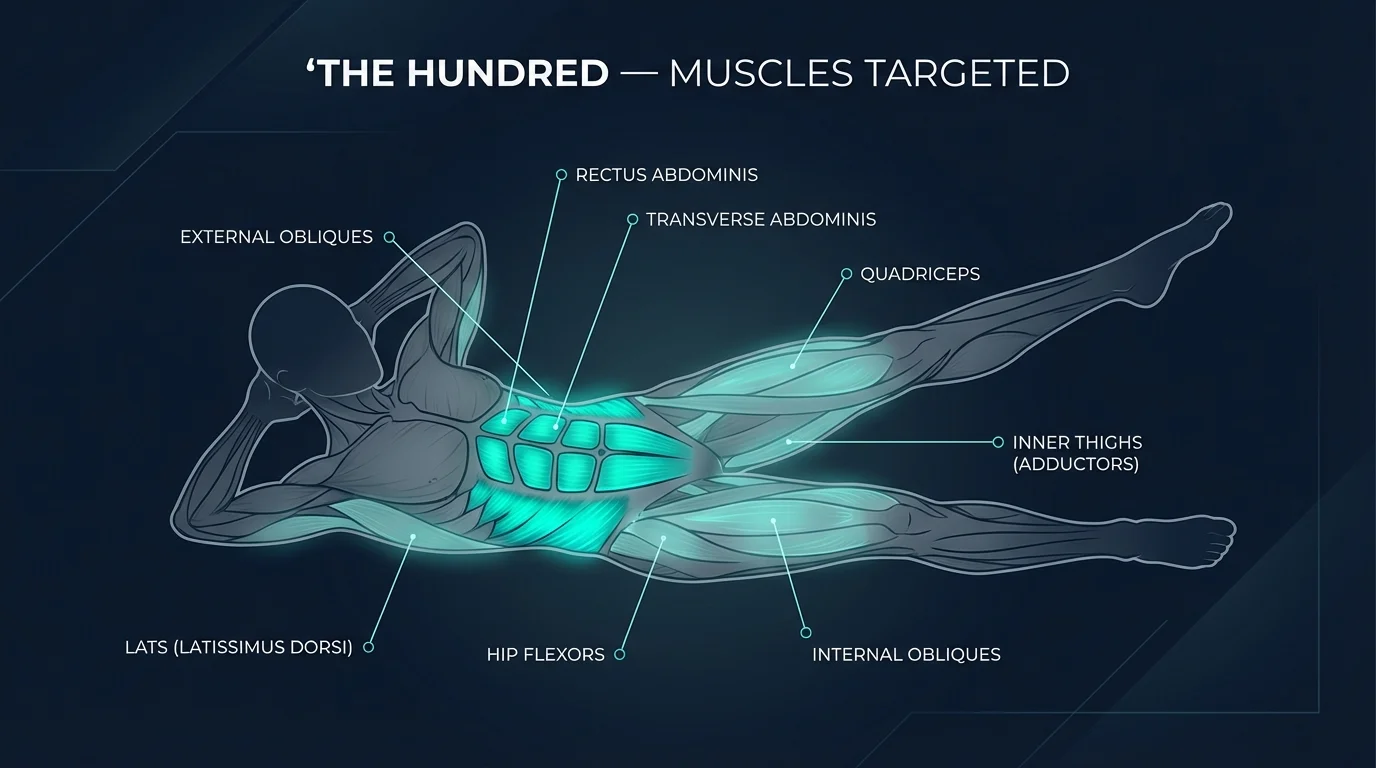
Primary movers: the rectus abdominis, transverse abdominis, and obliques. The rectus holds the head-and-shoulder curl isometrically against gravity. The transverse abdominis and obliques wrap the trunk and brace it against the long lever arm of extended (or tabletop) legs. Unlike a crunch, these muscles do not shorten and lengthen across reps. They sustain a continuous contraction for the full 100 beats.
Secondary movers: the hip flexors (psoas major and iliacus) hold the legs against gravity in tabletop or 45-degree position. The quadriceps lock the knees in the extended version. The inner thighs (adductors) squeeze a midline if you use the cue or a Pilates ring. The latissimus dorsi works through the arm-pumping motion, since the pumps come from the shoulder joint rather than the wrist, and the rhythmic shoulder extension reinforces lat engagement.
Stabilizers: the diaphragm and pelvic floor work together as the deep core canister. The 5-count inhale and 5-count exhale pattern trains these muscles to coordinate with the trunk under tension, which is the load-bearing reason the breathing pattern is not optional. The spinal erectors and posterior pelvic muscles fire isometrically to keep the lumbar spine flat on the mat. The shoulder girdle (rotator cuff and serratus anterior) stabilizes the arms through the small pumping range.
Mechanism: the Hundred's training effect comes from sustained isometric core load combined with disciplined diaphragmatic breathing. Most dynamic core exercises (crunches, bicycle crunches, leg raises) cycle the abdominals through shortening and lengthening phases, which means the working muscles get brief rest at the top or bottom of every rep. The Hundred removes that rest. The abs stay contracted from pump 1 to pump 100 while the diaphragm cycles independently underneath them. That decoupling, where the trunk braces while the breath moves, is the specific motor pattern Pilates is built around, and it transfers directly to spinal stability under load in everything from running gait to overhead pressing.
Step-by-Step: How to Perform the Hundred
The cues below apply at every level. The only thing that changes is your leg position.
Step 1: Lie on Your Back
Place your arms at your sides with palms facing down. Bend your knees and plant your feet flat on the floor, hip-width apart. Press your lower back gently into the mat to set neutral spine before you move.
Coach Ty's cue: "Lower back stays glued to the mat from the first pump to the last. If it lifts off, the rest of the exercise is built on sand."
Step 2: Curl Your Head and Shoulders Up
Engage your abdominals and lift your head, neck, and shoulders off the mat. Tuck your chin slightly. Imagine holding an egg between your chin and chest, about a fist-width gap. Lift your arms a few inches off the floor and extend them long alongside your hips with energy reaching through your fingertips.
Ty's cue: "Curl up from your ribcage, not your head. If your chin is leading, your neck is doing the work."
Step 3: Set Your Leg Position
For the intermediate version, lift your legs to tabletop with knees bent at 90 degrees and shins parallel to the floor. For the advanced version, extend your legs fully to a 45-degree angle from the floor. Keep your lower back pressed into the mat regardless of which version you choose. If the back arches, your legs are too low. Raise them until the back stays flat.
Ty's cue: "You earn the right to lower your legs. Don't lower them until your back can stay down."
Step 4: Pump Your Arms
Begin pumping your arms up and down in small, controlled movements, roughly 6 inches of range. The motion originates from your shoulders, not your wrists. Keep your fingers long and straight with wrists locked.
Ty's key cue: "Drive the pump from your shoulder joints. Imagine pressing the air down with your whole arm, not just your hand."
Step 5: Coordinate Your Breathing
Inhale through your nose for 5 arm pumps, then exhale through your mouth for 5 pumps. That completes one cycle of 10. Repeat for 10 full cycles to reach 100 total pumps. Count out loud if you need to until the rhythm becomes automatic.
Ty's reminder: "The breathing pattern is the exercise. Without the 5-in, 5-out rhythm, it's just an awkward shoulder pump."
Get this exercise in a personalized workout
FitCraft, our mobile fitness app, uses its AI coach Ty to program core stability work like this into your plan at the right volume and intensity, based on your level, goals, and equipment. Ty was designed and trained by Domenic Angelino, MPH (Brown University) and NSCA-CSCS, with research published in the Journal of Strength and Conditioning Research and Medicine & Science in Sports & Exercise.
Take the Free Assessment Free · 2 minutes · No credit card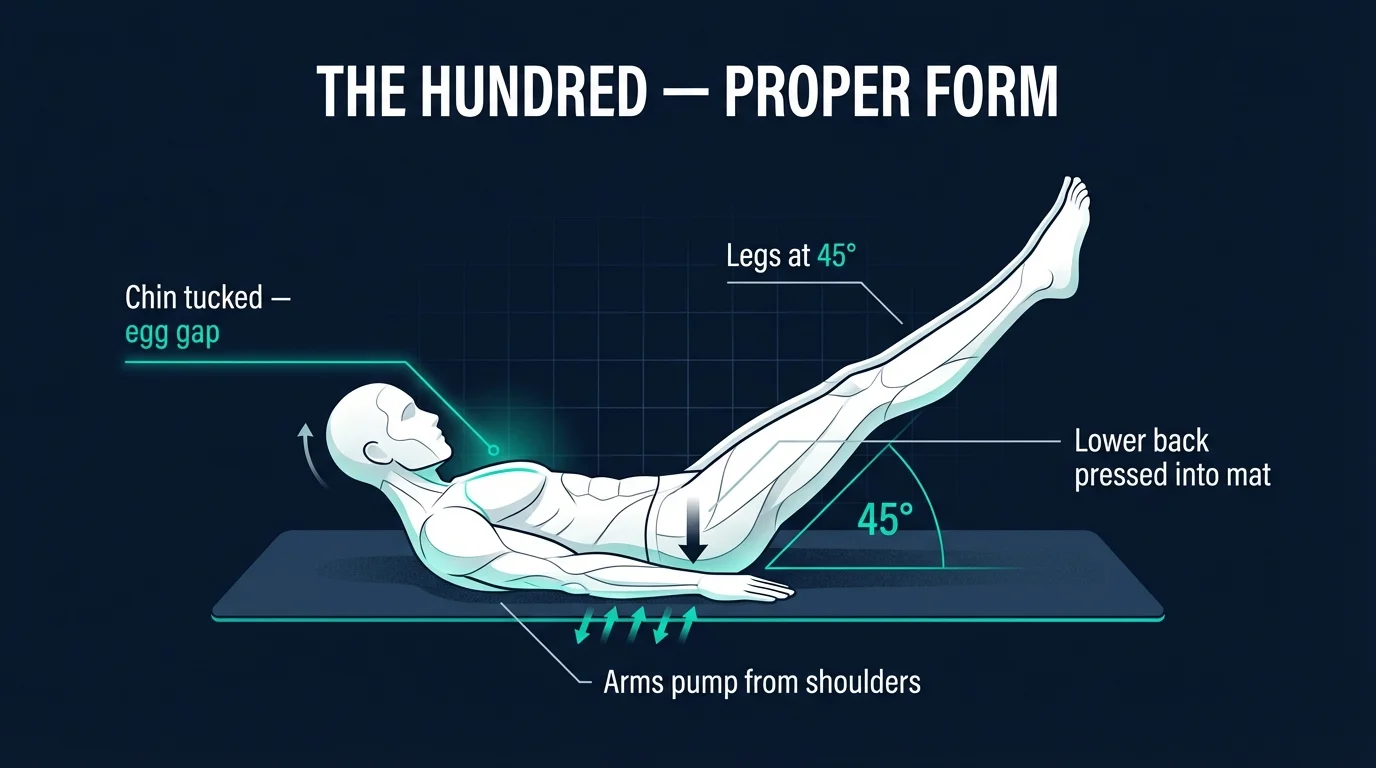
Common Mistakes (and How to Fix Them)
Here are the form breakdowns Ty corrects most often.
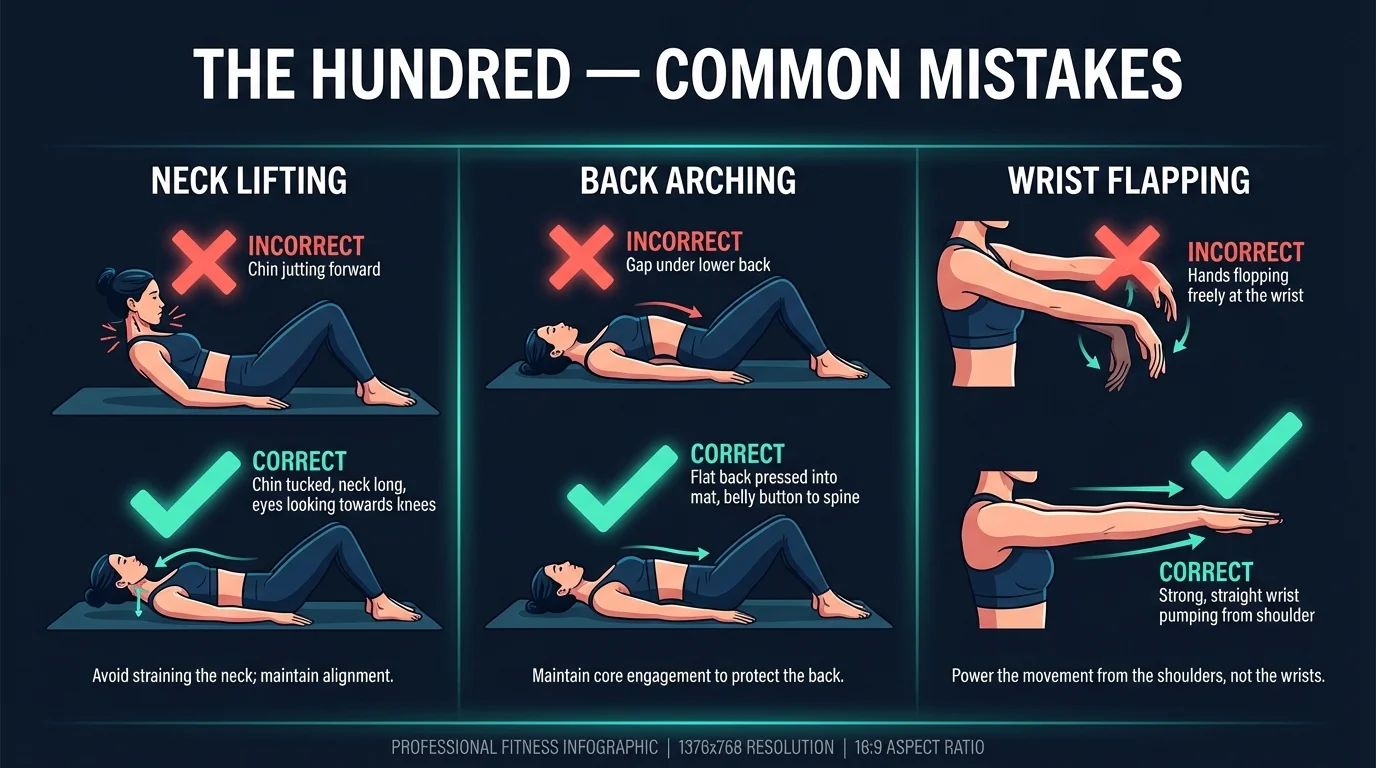
- Lifting with the neck. Chin juts forward, strain shows up in the front or sides of the neck instead of the abdominals. Fix: curl up from the ribcage, not the head. Maintain a fist-width gap between chin and chest. If neck tension persists, place one hand behind your head for support while pumping with the other arm, then switch.
- Lower back arching off the mat. A visible gap between the lower back and the floor, especially with legs extended. The hip flexors take over, the core disengages, and the lumbar spine gets stressed. Fix: raise the legs higher toward the ceiling until the lower back stays flat. If it still arches, bend the knees to tabletop. The right to lower your legs is earned by keeping your back down.
- Pumping from the wrists. The hands flap up and down while the arms stay mostly still. The lats and core stop reinforcing the position. Fix: lock the wrists straight and drive the pumping motion from the shoulder joints. Think of pressing the air down with the entire arm.
- Holding the breath. Pumps continue but the 5-in, 5-out pattern disappears. The coordinated breathing is the reason the exercise is called the Hundred. The breath pattern trains the deep core stabilizers to fire while the diaphragm moves, and holding the breath also spikes blood pressure unnecessarily. Fix: count out loud. Inhale "one-two-three-four-five," exhale "one-two-three-four-five." The rhythm becomes automatic after a few sessions.
- Pumping too large. Big arm swings replace the small controlled pumps. Momentum does the work and the lats stop firing. Fix: 6 inches of range. Small, sharp, controlled.
Hundred Variations: Regressions and Progressions
Start where you are. Progress when your form holds clean for all 100 pumps at the current level.
Feet on Floor, Head Down (Beginner Regression)
Keep your knees bent, feet flat on the mat, and head resting on the floor. Pump your arms only. This removes all neck and hip flexor demand and isolates the breathing pattern with light core activation. Good entry point if a head-up curl is too much.
Feet on Floor, Head Up (Beginner-Plus)
Same as above but curl your head and shoulders off the mat. Adds the upper abdominal contraction without the leg-hold challenge.
Tabletop Legs (Intermediate)
Lift your legs to a 90-degree bent-knee position with shins parallel to the floor. The standard intermediate version and the right starting point for most people once the head-up curl feels stable.
Legs at 45 Degrees (Advanced)
The classic full version. Extend your legs straight at a 45-degree angle from the floor. Only progress here once you can maintain a flat lower back through all 100 pumps in tabletop.
Legs Low, Six Inches Off the Floor (Expert)
The hardest bodyweight version. Lowering the legs increases the lever arm on the core. The lower back will want to arch. If it does, raise the legs higher.
With a Pilates Ring or Ball (Variation)
Squeeze a Pilates ring or small ball between your knees or ankles during the exercise. Adds inner thigh activation and increases total-body tension. Useful for finding the midline cue if your legs tend to splay.
When to Avoid or Modify the Hundred
The Hundred is safe for most healthy adults, but a few conditions call for modification or swapping the full version for a regression. None of these are permanent restrictions. They're starting points. Always consult your physician or physical therapist for personalized guidance.
- Acute lower-back pain or known disc pathology. The Hundred combines spinal flexion (the head-and-shoulder curl) with hip flexor load (the leg hold), and both can aggravate disc-related symptoms. Substitute with anti-extension and anti-rotation patterns like deadbugs, bird-dogs, and forearm planks, and clear progressions with a physical therapist.
- First 6-8 weeks postpartum or active diastasis recti. The sustained spinal flexion and intra-abdominal pressure of the Hundred can widen abdominal separation. Restore deep-core function first with diaphragmatic breathing, transverse abdominis activation, and bird-dogs or deadbugs. Progress to the feet-on-floor regression before attempting any head-up curl.
- Recent abdominal surgery (C-section, hernia repair, appendectomy). Get clearance from your surgeon. Most post-surgical protocols start with diaphragmatic breathing, then gentle bracing, then progressive loading. The full Hundred sits well past the early stages of those protocols.
- Hernia (umbilical, inguinal, ventral). The Hundred can elevate intra-abdominal pressure enough to worsen symptoms. Consult your physician about safe core options.
- Pregnancy (second and third trimesters). Avoid the long supine hold (vena cava compression in late pregnancy) and the high-flexion curl. Use upright or side-lying core alternatives, and work with a provider familiar with prenatal training.
- Pelvic-organ prolapse or pelvic-floor dysfunction. The pressure spike from the head-up curl combined with held breath (the most common form breakdown) is exactly the load pattern to avoid here. Work with a pelvic-floor PT, and rebuild with breath-first core work before introducing the Hundred.
- Persistent neck pain. If neck strain persists even after you cue from the ribcage and support behind the head, drop to the feet-on-floor head-down regression. Build sufficient deep-core endurance with deadbugs first so the abs (not the neck flexors) can hold the curl.
Related Exercises
If the Hundred is part of your routine, these movements complement or extend the same training pattern:
- Foundation for deep-core bracing: Deadbugs and Bird-Dogs are the universal foundations for trunk stability. Both train anti-extension and anti-rotation under low load, which is the bracing pattern the Hundred demands at high duration.
- Isometric anti-extension progression: Forearm Planks and Hand Planks train the same sustained-contraction quality as the Hundred in a prone position. Useful if your lower back arches during the leg-extended version.
- Advanced anterior-core challenge: Hollow Holds and the Teaser Hold push the same head-and-shoulders-up, legs-up position to higher demand and longer durations once the Hundred feels manageable.
- Same plane (spinal flexion): Crunches and Reverse Crunches train flexion through a moving range rather than the Hundred's isometric hold. Useful as a complement when you want dynamic flexion work alongside the isometric stimulus.
- Hip flexor lever progression: Leg Raises isolate the hip-flexion-dominant portion of the Hundred under a larger range of motion. A useful accessory once the bracing pattern is clean.
- Glute foundation often paired with core work: Glute Bridges train the posterior counterpart to the anterior bracing the Hundred demands, useful as a warm-up before a core block.
How to Program the Hundred
The Hundred sits at the high-duration end of dynamic core programming. The American College of Sports Medicine (ACSM) Position Stand on resistance training recommends progressive overload through controlled tempo, sufficient time-under-tension, and at least 48 hours between sessions training the same pattern at high intensity (Ratamess et al., 2009). For the Hundred specifically, the unit of work is the 10-cycle breath set rather than a rep count.
| Level | Sets × Reps | Rest between sets | Frequency |
|---|---|---|---|
| Beginner (feet on floor) | 1-2 × 50 pumps (5 breath cycles) | 45-60 seconds | 2-4 sessions/week |
| Intermediate (tabletop) | 1 × 100 pumps (10 cycles) | n/a (single set) | 3-5 sessions/week |
| Advanced (legs 45 degrees or lower) | 1-2 × 100 pumps | 60-90 seconds between sets if doubled | 4-6 sessions/week |
Where in your workout: the Hundred is traditionally placed first in a Pilates sequence because it warms up the core, oxygenates the blood, and establishes the breathing-and-bracing pattern for everything that follows. It also works well as a daily warm-up before a resistance-training session, since waking up the deep core canister before heavy compound lifts (squats, deadlifts, presses) improves spinal stability under load. Avoid putting it at the end of a session when the core is already fatigued. Form breaks down fast.
Form floor over rep targets: if your lower back lifts off the mat or your neck takes over the curl before pump 100, end the set there. Hitting the full count with the back arched or the neck doing the work trains the wrong pattern. Drop to a regression and rebuild.
How FitCraft Programs This Exercise
Knowing the form is step one. Knowing when to do the Hundred, which variation matches your current level, and when to progress is where most people get stuck.
FitCraft's AI coach Ty handles that. During your personalized diagnostic assessment, Ty maps your fitness level, goals, and available equipment. Then Ty builds a plan that slots the Hundred (or its regression) into a balanced training program at the right variation for you.
As you build core endurance, Ty adjusts the variation and volume to match your level. Feet on floor becomes tabletop. Tabletop becomes legs at 45 degrees. Volume and frequency adjust based on your recovery and consistency. Every program is designed by an Ivy League-trained exercise scientist and NSCA-certified strength coach using evidence-based periodization, then adapted to you by the AI.
Frequently Asked Questions
What muscles does the Hundred work?
The Hundred primarily targets the rectus abdominis, transverse abdominis, and obliques. It also engages the hip flexors, quadriceps, inner thighs, lats, and pelvic floor. The sustained isometric trunk hold paired with rhythmic arm pumping makes it an effective full-core conditioning exercise.
Is the Hundred good for beginners?
Yes, with modifications. Beginners should keep their feet on the floor with knees bent, or use tabletop position with knees at 90 degrees. Master each variation before progressing to extended legs. Trying the advanced version too early is the most common beginner mistake.
How many sets of the Hundred should I do?
One full set of 100 pumps (10 breath cycles of 10 pumps each) is standard. If you cannot maintain proper form for all 100, start with 50 pumps and build up over time. Quality of form matters more than reaching the full count.
Can I do the Hundred if I have lower-back pain?
The full Hundred with extended legs loads the lumbar spine through hip flexion and trunk bracing. If your lower back arches off the mat or your hip flexors light up before your abs do, the load is in the wrong place. Stay in tabletop position (knees bent at 90 degrees) or feet-on-floor regression until you can hold the position with a flat lower back. Build foundational deep-core strength with deadbugs and bird-dogs first. If pain persists or feels sharp, see a physical therapist before progressing.
Why does my neck hurt during the Hundred?
Neck pain during the Hundred usually means you are lifting with your neck muscles instead of your abdominals. Focus on curling up from your ribcage, not pulling your chin forward. Keep a fist-width gap between your chin and chest. If neck strain persists, place one hand behind your head for support, or keep your head on the mat while you build core strength.