The Teaser Hold looks simple until you try to make it clean. You sit in a V shape, reach your arms forward, lift your legs, and hold still. The hard part is keeping your spine long while your legs pull your pelvis forward and your abs fight to keep the whole shape quiet.
Use it when you already have a base of core control and want a stricter challenge than ordinary sit-ups. If your lower back rounds right away, that is useful feedback. Regress the shape, build the brace, then come back to the full hold.
Quick Facts: Teaser Hold
- Equipment needed: None; exercise mat optional
- Difficulty: Advanced
- Modality: Pilates / yoga-inspired isometric core hold
- Body region: Core and hip flexors
- FitCraft quest category: Core
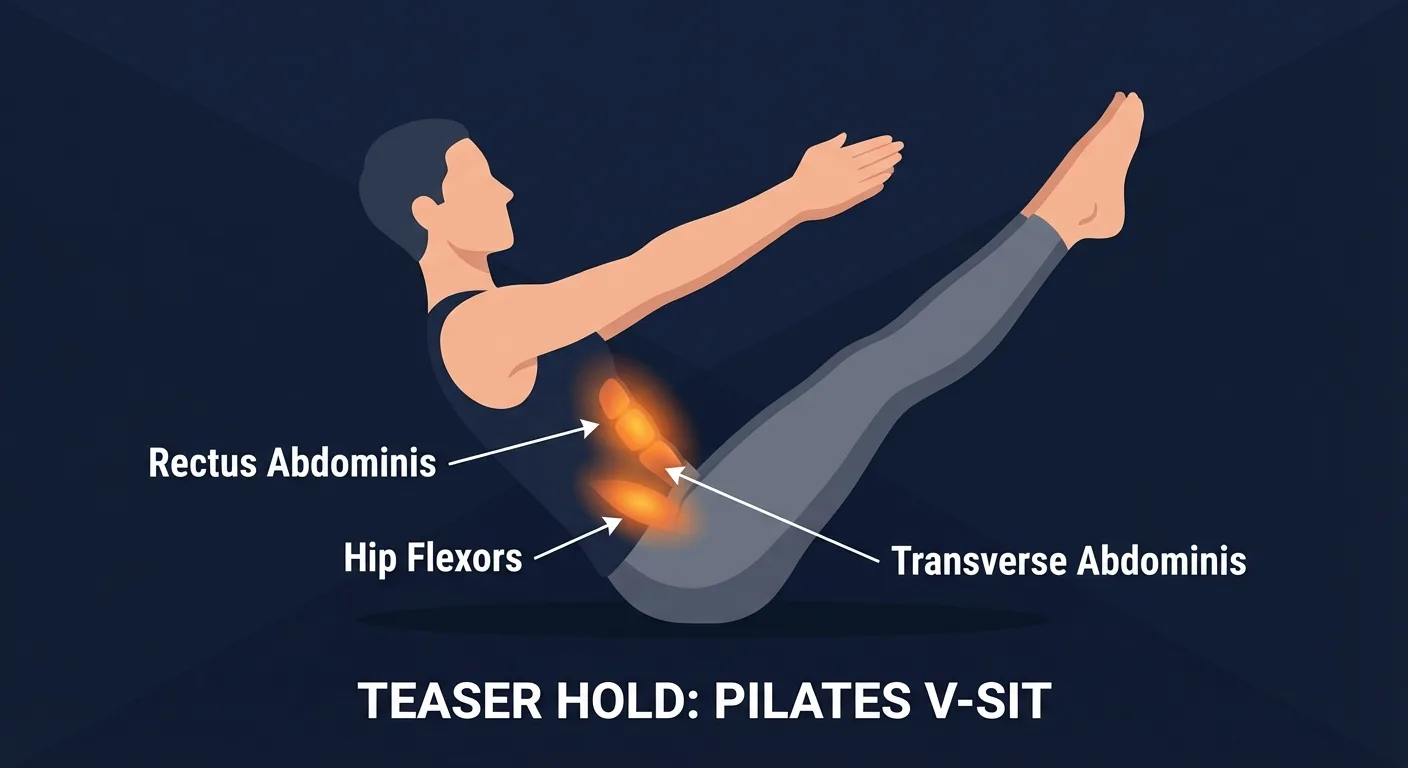
Muscles Engaged & Stretched
Primary movers: the rectus abdominis and hip flexors create and hold the V shape. In the lift into position, the hip flexors shorten to raise the legs while the abs posteriorly control the pelvis. During the hold, both groups work mostly isometrically instead of moving through full reps.
Secondary movers: the quadriceps keep the knees straight, the obliques resist side-to-side wobble, and the spinal erectors help maintain a tall torso. The shoulder flexors also work lightly because the arms stay extended forward instead of resting on the legs.
Stabilizers: the transverse abdominis, diaphragm, pelvic floor, deep hip stabilizers, and spinal erectors co-contract to keep the pelvis from tipping and the lower back from rounding. Breath matters here: slow exhales help the ribs stay down while the pose stays lifted.
Mechanism: Teaser Hold difficulty comes from lever length. Straight legs held away from the body create a long moment arm at the hips, so the abs must control pelvic position while the hip flexors keep the legs lifted. Shortening the lever by bending the knees is the safest way to scale the exercise without changing its main pattern.
Step-by-Step: How to Do a Teaser Hold
- Start seated. Sit on the floor or a mat with your knees bent and feet flat. Place your hands lightly behind you for setup and lengthen your spine. Coach Ty's cue: "Grow tall before you lift. The hold starts with posture."
- Lift into the V. Lean your torso back as you lift both legs into the air. Keep the chest broad and the spine long instead of collapsing into a rounded C shape. Coach Ty's cue: "Find the balance point on your sit bones, then freeze it."
- Reach your arms forward. Extend your arms straight out in front of you, roughly parallel to your legs. Keep the shoulders down and the neck relaxed. Coach Ty's cue: "Reach forward without shrugging. Long arms, quiet shoulders."
- Hold the shape. Press your legs together and keep the V shape steady. Shaking is normal, but low-back pain or sharp hip pinching is your stop sign. Coach Ty's cue: "If the back rounds, the set is over. Clean beats longer."
- Breathe and exit with control. Keep slow breaths moving while your eyes stay fixed on one point. Lower the legs and torso with control instead of dropping out of the hold.
Get this exercise in a personalized workout
FitCraft, our mobile fitness app, uses its AI coach Ty to program core stability work like this into your plan at the right volume and intensity, based on your level, goals, and equipment. Ty was designed and trained by Domenic Angelino, MPH (Brown University) and NSCA-CSCS, with research published in the Journal of Strength and Conditioning Research and Medicine & Science in Sports & Exercise.
Take the Free Assessment Free • 2 minutes • No credit card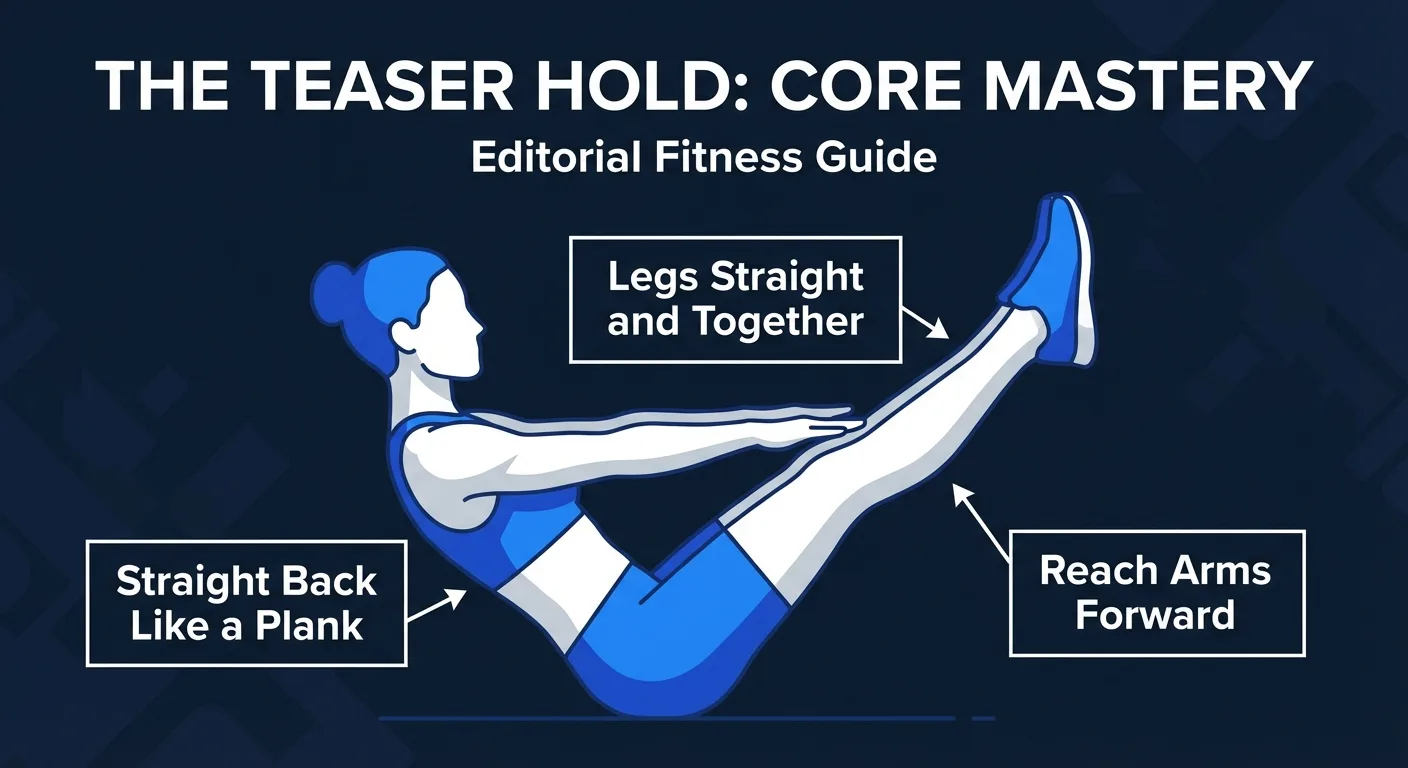
Common Mistakes and How to Fix Them
Rounding the Back
What it looks like: your spine collapses into a C shape, your chest caves in, and the shoulders roll forward.
Why it's a problem: rounding shifts stress toward the lumbar spine and turns the hold into a hip-flexor tug-of-war. You will usually feel the lower back before the abs get quality work.
The fix: shorten the lever. Bend the knees, hold boat pose, or place the fingertips lightly on the floor until you can keep the chest lifted.
Bending or Separating the Legs
What it looks like: the knees drift apart, one leg drops lower, or the legs keep bending during the hold.
Why it's a problem: the position gets easier, but the shape loses the tension that makes the Teaser Hold useful.
The fix: press the legs together and reach through the feet. If that breaks your spine position, use a bent-knee regression on purpose.
Holding Your Breath
What it looks like: your face tightens, the ribs flare, and no breath moves until you drop out of the hold.
Why it's a problem: breath-holding makes the hold feel more urgent, increases pressure, and usually shortens the set.
The fix: use slow exhales while keeping the ribs down. If you can't breathe, the version is too hard today.
Using the Arms for Balance
What it looks like: the arms swing, reach for the knees, or flap around to stop you from tipping.
Why it's a problem: the arms become a counterweight instead of part of the controlled V shape.
The fix: reach the fingertips forward and keep the shoulders quiet. Touch the floor lightly beside your hips if you need a support phase.
Teaser Hold Variations: Regressions and Progressions
Easier Regressions
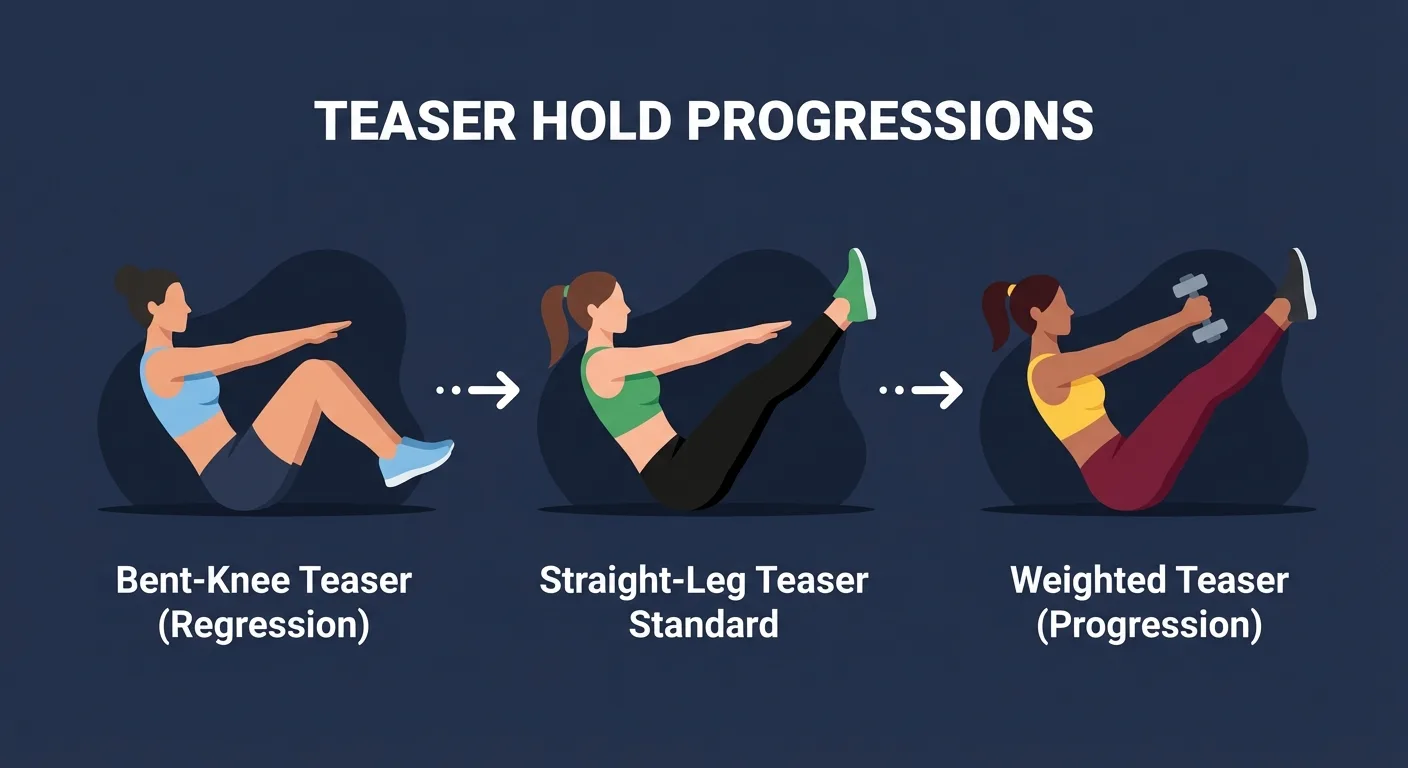
- Bent-knee Teaser Hold. Keep the same torso angle, but bend the knees so the shins are roughly parallel to the floor. This reduces leverage while preserving the balance challenge.
- Boat Pose. Use the yoga cousin of the Teaser Hold when you need a more forgiving V-sit with bent knees and a slightly shorter lever.
- Single-leg Teaser Hold. Extend one leg while keeping the other bent or lightly supported. This teaches the balance point before both legs go straight.
Harder Progressions
- Teaser with Leg Lower. From the held V position, lower the legs a few inches and lift them back up while the torso stays steady.
- Weighted Teaser Hold. Hold a very light dumbbell or medicine ball in your hands. Use this only after 30 seconds of clean unweighted form.
Alternative Exercises
- Hollow Hold. A supine core hold that trains a similar long-lever brace with less balance demand.
- Forearm Plank. A simpler isometric core foundation when the Teaser Hold overloads the hip flexors.
- Superman Hold. A posterior-chain hold that balances the flexion-heavy work of the Teaser Hold.
When to Avoid or Modify Teaser Holds
Teaser Holds are safe for many healthy adults, but the long-lever V shape can be too aggressive when the spine, hip flexors, or pelvic floor need a lower-load option. Always consult your physician or physical therapist for personalized guidance if you are training around pain, pregnancy, surgery, or a diagnosed condition.
- Lower back pain, disc symptoms, or sciatica. The Teaser Hold can pull the pelvis forward and increase lumbar stress if the abs can't hold position. Use deadbugs, bird-dogs, or forearm planks instead.
- Recent abdominal, hip, or spine surgery. Get clearance before loaded trunk-flexion holds. Start with clinician-approved breathing drills and supported core work.
- Pregnancy, early postpartum, diastasis recti, or pelvic-floor symptoms. The V-sit position can raise intra-abdominal pressure. Choose breathing-focused core regressions and avoid coning, heaviness, or pressure symptoms.
- Hip-flexor strain or sports hernia symptoms. Straight-leg holds demand sustained hip flexion. Use bent-knee boat pose or supported planks until lifting the legs is pain-free.
- Uncontrolled hypertension or cardiovascular disease. Hard isometric holds can raise blood pressure, especially if you hold your breath. Use shorter holds and medical guidance.
- Balance disorders or active vertigo. The sit-bone balance point can feel unstable. Practice near a wall, keep fingertips on the floor, or choose floor-based core work.
Related Exercises
If the Teaser Hold is part of your routine, these movements build the same core control from easier angles or balance the muscles around it:
- Same body region: Boat Pose trains the closest V-sit pattern with more scaling room.
- Easier core foundation: Deadbugs and Bird-Dogs teach deep-core control without compressing the lower back.
- Core endurance pair: Forearm Planks build anti-extension endurance before you add the Teaser Hold's balance challenge.
- Advanced long-lever peer: Hollow Holds train a similar straight-line brace while you lie on your back.
- Opposite-side balance: Superman Holds strengthen the posterior chain so core training does not stay flexion-only.
- Hip-flexor alternative: Leg Raises load the hip-flexor and lower-ab pattern without the sit-bone balance point.
How to Program Teaser Holds
Teaser Hold programming should progress by breath quality, hold time, and lever length. The broader progression model from the ACSM Position Stand on resistance training supports matching volume and frequency to training level, then increasing difficulty gradually as form holds up (Ratamess et al., 2009).
| Level | Sets x Reps | Rest between sets | Frequency |
|---|---|---|---|
| Beginner | 1-2 bent-knee holds of 10-20 seconds | 45-60 seconds | 2-3 sessions/week |
| Intermediate | 2-3 holds of 20-35 seconds | 60 seconds | 2-4 sessions/week |
| Advanced | 3-5 holds of 30-45 seconds, or shorter holds with leg lowers | 60-90 seconds | 3-5 sessions/week |
Where in your workout: use Teaser Holds late in a core block, near the end of a Pilates or yoga session, or after strength training when heavy bracing work is already done. Avoid fatiguing your core with max-effort holds before squats, deadlifts, running drills, or loaded carries.
Form floor over time targets: end the set when the lower back rounds, the breath gets trapped, the legs drop, or the arms start swinging. A clean 12-second hold is more useful than a 40-second hold held together by neck tension and hip-flexor strain.
Frequently Asked Questions
What muscles does the Teaser Hold work?
The Teaser Hold primarily trains the rectus abdominis and hip flexors. The transverse abdominis, obliques, spinal erectors, quadriceps, and deep hip stabilizers help hold the V shape without the spine collapsing.
Is the Teaser Hold the same as boat pose?
They are close, but the Teaser Hold is usually stricter. Boat pose often allows bent knees and hands near the legs, while a classic Teaser Hold asks for straighter legs, a long spine, and arms reaching forward.
How long should I hold a Teaser Hold?
Start with 10 to 20 seconds if you can keep a long spine and steady breath. Build toward 30 to 45 seconds over time. End the set as soon as the lower back rounds or the legs drop.
Can I do Teaser Holds with lower back pain?
Teaser Holds can irritate lower back pain because the long-lever V shape challenges the hip flexors and lumbar spine. Use bent-knee boat pose, deadbugs, or forearm planks instead, and get clinical guidance if pain persists.
How often should I train the Teaser Hold?
Two or three focused sessions per week is enough for most people. Short, clean holds work better than daily max-effort attempts that turn into hip-flexor strain or low-back rounding.