Medical disclaimer: This article is for informational purposes only and does not constitute medical advice. Always consult your healthcare provider before beginning any exercise program after pregnancy. Every postpartum recovery is different, and your doctor or midwife is the best source of guidance for your individual situation.
You just brought a human being into the world. Your body did something extraordinary. And now, somewhere between the 3 a.m. feedings and the mountain of laundry, a quiet thought surfaces: When can I start moving again?
Maybe it's because you miss feeling strong. Maybe it's because your energy is at rock bottom and you've heard exercise helps. Maybe it's because the mental fog of early motherhood is heavier than you expected, and you're looking for anything that might lift it.
Whatever brought you here, the good news is clear: exercise after pregnancy is one of the most powerful tools available for your recovery, your mood, and your long-term health. And recent research shows that gamification — the same mechanics that make games addictive — can help postpartum women actually stick with it.
The Research: Gamification Works for Postpartum Women
Let's start with what the science actually says — because this isn't guesswork.
In 2022, a randomized clinical trial published in JAMA Cardiology studied 127 postpartum women with hypertensive disorders of pregnancy — a population that faces elevated cardiovascular risk and has historically been underserved by exercise interventions. Approximately 55% of participants were Black and 41% were on Medicaid, making this one of the most diverse and representative postpartum fitness trials conducted.
The intervention combined team-based gamification, remote monitoring, and text-based support. The results were striking:
- +647 steps per day compared to the control group (P=.009)
- +0.11 goal-achievement days per week (P=.003)
- Remote recruitment and monitoring were shown to be fully feasible — meaning this approach works even when women can't leave the house
What makes this trial particularly noteworthy is its population. These weren't fitness enthusiasts with personal trainers. These were real postpartum women navigating the demands of new motherhood — many from communities with the fewest resources and the highest health risks. And gamification still moved the needle.
The mechanism isn't complicated: team-based accountability and game-like incentives provided the external motivation structure that new moms need when internal motivation is buried under sleep deprivation and the overwhelming demands of caring for a newborn.
Why Exercise Matters So Much Postpartum
Your body just completed a nine-month marathon. Exercise isn't about "bouncing back" or hitting a number on the scale. It's about rebuilding the foundation your body needs to carry you through the most demanding phase of your life.
Mood and Mental Health
Postpartum depression affects roughly 1 in 7 new mothers. Exercise is one of the most well-established non-pharmaceutical interventions for reducing that risk. Physical activity triggers the release of endorphins and serotonin, directly counteracting the mood disruption that comes with hormonal shifts, sleep deprivation, and the isolation of early motherhood.
Even moderate activity — a 20-minute walk with the stroller, a 15-minute bodyweight session during nap time — has been shown to significantly improve mood and reduce anxiety in postpartum women.
Energy
It sounds counterintuitive: you're already exhausted, and the advice is to exercise? But the research is consistent. Regular physical activity improves sleep quality, increases daytime energy, and reduces the perception of fatigue. New moms who exercise regularly report feeling more energized, not less — even on the same amount of sleep.
Physical Recovery
Appropriate postpartum exercise strengthens the pelvic floor, restores core stability, improves cardiovascular fitness, and supports healthy body composition changes. It also helps with common postpartum complaints like back pain, joint stiffness, and general deconditioning.
Long-Term Health
The postpartum period is a critical window for establishing long-term health habits. Women who build consistent exercise habits in the first year after delivery are significantly more likely to maintain those habits for years to come. This isn't just about the next few months — it's about the next few decades.
The Real Barriers (And Why They're Not Your Fault)
If you're struggling to exercise postpartum, it's not because you lack willpower. The barriers are real, they're structural, and they affect nearly every new mother:
Time
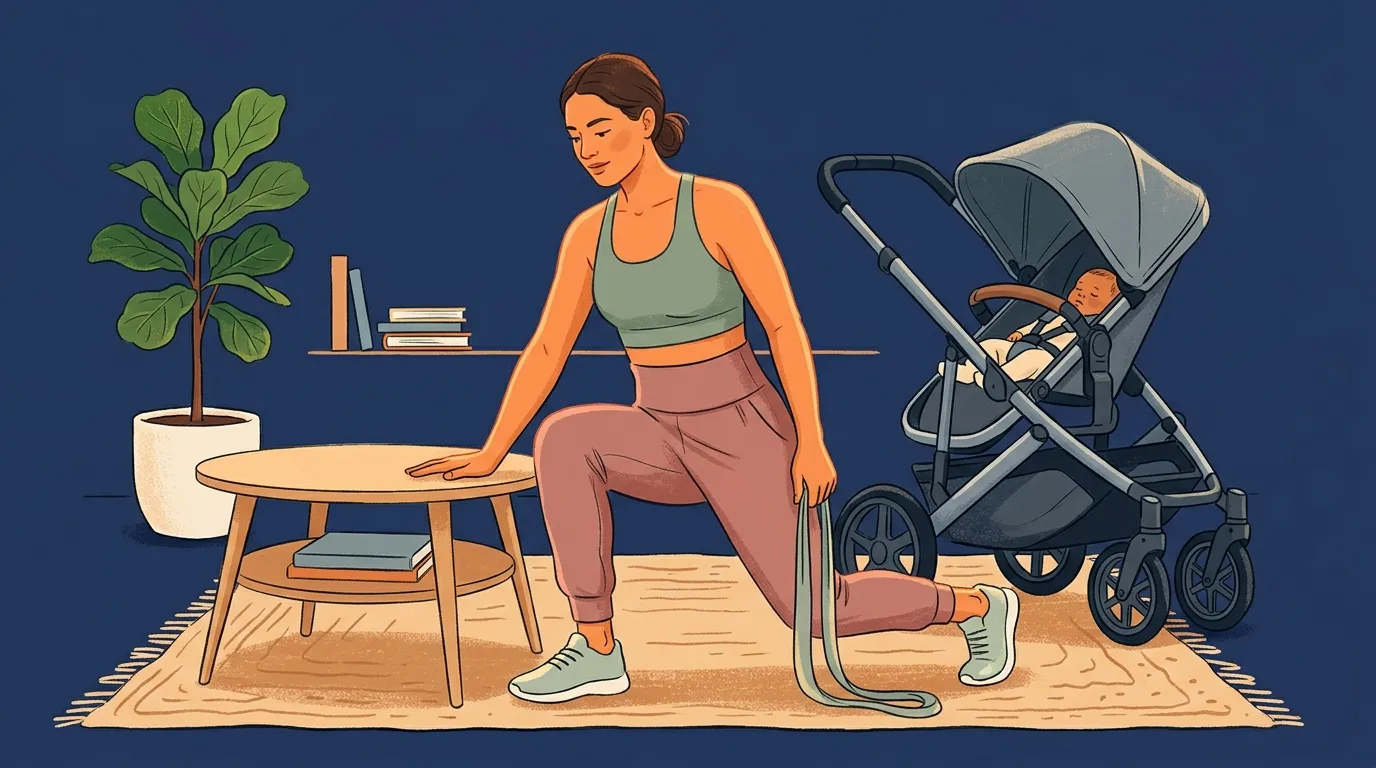
A newborn's schedule is unpredictable by nature. The 45-minute gym session you used to do? That requires childcare, a commute, and a predictable window — none of which exist in early motherhood. Traditional fitness programs weren't designed for your reality.
Sleep Deprivation
When you're running on four hours of broken sleep, the idea of a workout feels absurd. Your body is screaming for rest, not reps. Any exercise program that ignores this reality is setting you up to fail.
Body Changes
Your body is different now. Movements that were easy before pregnancy might feel unfamiliar or uncomfortable. Your core and pelvic floor need targeted rehabilitation before you jump into high-intensity work. A program that doesn't account for this isn't just ineffective — it could be counterproductive.
Mom Guilt
Taking 15 minutes for yourself can feel selfish when there's a baby who needs you, dishes in the sink, and a partner who's also running on empty. The guilt is powerful — and it's one of the most underappreciated barriers to postpartum fitness.
The answer isn't to push through these barriers with brute-force motivation. It's to choose a system that works within them.
How Gamification Helps New Moms Stay Active
The JAMA Cardiology trial didn't just show that gamification works — it showed why it works for this specific population.
When you're postpartum, your internal motivation system is depleted. Sleep deprivation impairs executive function. Hormonal shifts affect dopamine regulation. The cognitive load of caring for a newborn leaves almost nothing in the tank for self-directed behavior change.
Gamification solves this by providing external structure for motivation:
- Streaks create gentle daily accountability. Missing a day means breaking the streak — and that small psychological cost is often enough to get you moving on days when nothing else would.
- Team-based elements tap into social accountability. In the JAMA trial, women were placed in teams, which created a sense of collective progress. You're not just doing this for yourself — you're doing it with others who understand exactly what you're going through.
- Small, achievable goals combat the all-or-nothing thinking that derails most fitness plans. You don't need to complete a perfect workout. You need to hit your step goal. You need to check in. You need to show up — and that counts.
- Visible progress counteracts the feeling that nothing is changing. When you can see your streak growing, your level increasing, and your goals being met, it creates a feedback loop of competence that fuels continued effort.
This isn't a gimmick. It's applied behavioral science. And the data from the JAMA Cardiology trial confirms it works for postpartum women in real-world conditions — including those with the highest barriers to participation.
Getting Started Safely
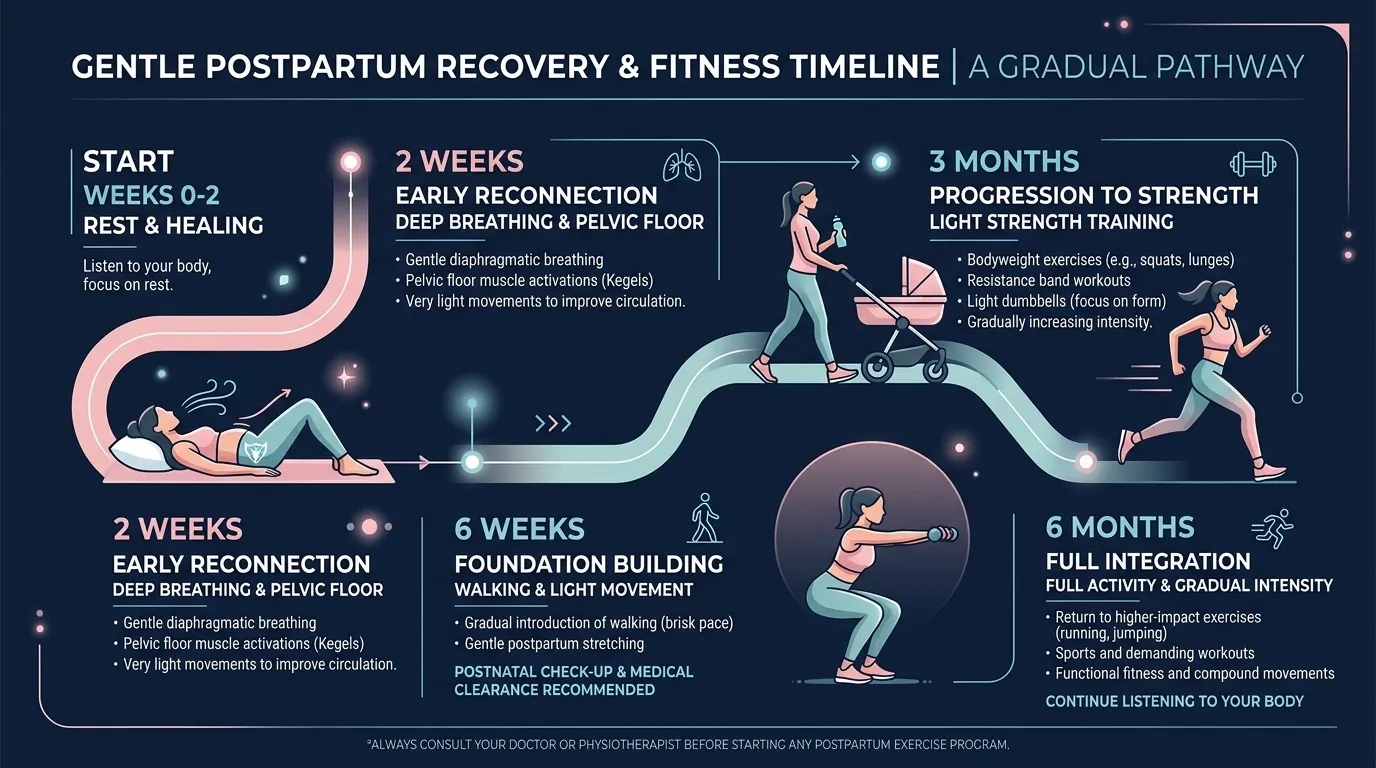
Before anything else: get medical clearance from your healthcare provider. This is non-negotiable. Every recovery is different, and your doctor or midwife needs to confirm you're ready.
Once you have the green light, here's how to return to exercise safely:
Start with the Pelvic Floor
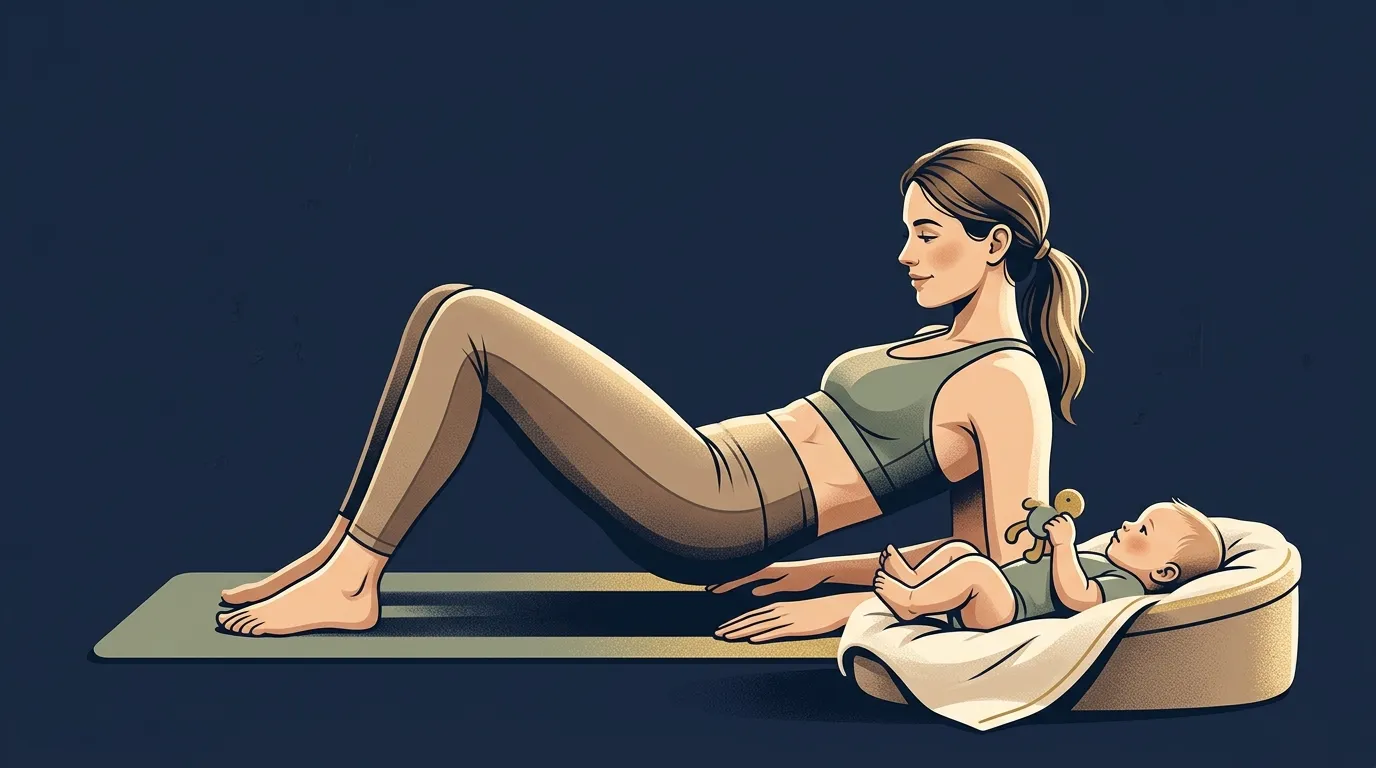
Your pelvic floor supported the weight of a growing baby for nine months, then went through the demands of delivery. Rebuilding this foundation comes first. Kegel exercises, diaphragmatic breathing, and gentle pelvic tilts are your starting point — and they can be done lying in bed while your baby sleeps next to you.
Walk Before You Run
Walking is the most underrated postpartum exercise — and you can build an effective quick workout routine around it. It's low-impact, requires no equipment, gets you outside (which improves mood independently), and can be done with your baby in a stroller or carrier. Start with 10-minute walks and gradually increase as you feel ready.
Rebuild Core Stability Gradually
Avoid jumping straight into crunches or planks. Your deep core muscles — particularly the transverse abdominis — need to be reactivated first. If you experienced diastasis recti (abdominal separation), targeted rehabilitation exercises should come before general core work. A well-designed program will sequence these correctly.
Progress Slowly and Listen to Your Body
The postpartum body gives clear signals. Pain, heaviness in the pelvic floor, increased bleeding, or excessive fatigue all mean you're doing too much too soon. A good program scales to your energy and recovery — not to an arbitrary schedule.
Give Yourself Grace
Some days, a 10-minute walk is all you have in you. That counts. Some days, you'll feel strong enough for a full bodyweight session. That's great. The goal isn't perfection. The goal is consistency over time, and consistency means showing up in whatever form your body and your day allow. When you are ready for more structure, our roundup of the best fitness apps for women compares the leading options side by side.
Your comeback starts here
Take the free 2-minute assessment. It maps your recovery stage, available time, equipment, and goals — then builds a plan that adapts to life with a newborn.
Take the Free Assessment Free · 2 minutes · No credit cardHow FitCraft Applies This Research
The JAMA Cardiology trial proved something important: postpartum women don't need more willpower. They need a system that accounts for the realities of new motherhood — limited time, unpredictable schedules, depleted energy, and the need for external motivation. FitCraft was built around these exact principles.
- 100% home-based. You never need to leave the house or arrange childcare. Every workout is designed for your living room, bedroom, or any small space. No equipment required — though FitCraft adapts to whatever you have.
- Flexible scheduling that adapts to your day. Have 10 minutes during a nap? FitCraft gives you a complete session in 10 minutes. Baby slept longer and you've got 25? It adjusts. Your program molds around your day — not the other way around.
- AI that adapts to your energy level. FitCraft's AI coach Ty doesn't just build your program — it responds to how you're feeling. Exhausted after a rough night? Your session scales down. Feeling strong? It challenges you. The program meets you where you are, every single day.
- Gamification that drives consistency. Streaks, quests, collectible cards, and avatar progression create the same external motivation structure that produced a 647-step-per-day increase in the JAMA trial. Instead of relying on willpower you don't have, FitCraft gives you a reason to show up that works even on your hardest days.
- Designed by an Ivy League-trained exercise scientist, NSCA-certified strength coach. Every program follows evidence-based principles of progressive overload and safe postpartum progression. This isn't random exercises from social media. It's real programming, designed for real bodies in real recovery.
- Streak accountability without shame. FitCraft's streak system rewards consistency without punishing imperfection. Missed a day because the baby was up all night? The system doesn't guilt you. It welcomes you back and helps you rebuild momentum.
The result is a system that mirrors what the research shows works — gamification, remote accessibility, adaptive programming, and accountability — wrapped in an experience that respects the reality of postpartum life. To see how the alternatives stack up, read our comparison of the best workout apps for moms.
The Bottom Line
You Deserve to Feel Strong Again
Returning to exercise after pregnancy isn't about "getting your body back." It's about giving your body what it needs to carry you through the most demanding and rewarding chapter of your life. The research is clear: exercise improves mood, energy, recovery, and long-term health. And gamification helps you actually do it.
You don't need a gym membership. You don't need childcare. You don't need an hour. You need a program that understands your life right now — and meets you there.
The hardest part isn't the workout. It's starting. And you're already here.
Frequently Asked Questions
When can I start exercising after giving birth?
The American College of Obstetricians and Gynecologists (ACOG) says most women can gradually resume physical activity within days of an uncomplicated vaginal delivery, once they feel ready. After a cesarean delivery, the timeline may be longer — typically 6 to 8 weeks. Always get medical clearance from your healthcare provider before starting a postpartum exercise program.
Does exercise help with postpartum depression?
Yes. Research consistently shows that regular physical activity reduces the risk of postpartum depression and improves mood, energy, and overall well-being. Even moderate activities like walking have been shown to significantly benefit mental health during the postpartum period.
How does gamification help new moms exercise consistently?
A 2022 randomized trial published in JAMA Cardiology (n=127) studied postpartum women and found that team-based gamification combined with remote monitoring increased daily steps by 647 (P=.009) and significantly improved goal achievement (P=.003). Gamification provides the external motivation structure that helps new moms stay active even when willpower is depleted by sleep deprivation and the demands of a newborn.
What exercises are safe postpartum?
Safe starting exercises include walking, pelvic floor exercises (Kegels), gentle core activation like diaphragmatic breathing and pelvic tilts, and light bodyweight movements. From there, you can gradually progress to squats, lunges, modified push-ups, and more intense exercise as your body recovers. FitCraft's AI coach Ty adapts your program to your current recovery stage and energy level.
Can I work out at home with a newborn?
Absolutely. Home-based exercise removes the biggest barrier for new moms — having to leave the house and arrange childcare. FitCraft builds personalized workouts that require no equipment and adapt to whatever time window you have, whether that's 10 minutes during a nap or 20 minutes after bedtime. You never need to leave your baby.