You know you should work out. You want to work out. But between the commute, the meetings, the kids, the errands, and the basic act of being a functioning adult, there's no 60-minute window sitting open in your calendar. So you skip it. Again. And then you feel guilty about skipping it. Again.
That guilt is the real problem. Not your schedule. Because somewhere along the way, the fitness industry convinced everyone that workouts don't "count" unless they're at least 45 minutes long. That anything shorter is a warm-up, not real training. That busy people just need to "make time" — as if time is something you manufacture out of willpower.
Here's the truth: a 15-minute workout you actually do is infinitely more valuable than a 60-minute workout you skip. That's not a motivational platitude. It's what the research shows. And once you understand the science behind short workouts, you'll stop apologizing for your schedule and start using it as an advantage. If you want an app built around that reality, see our comparison of the best workout apps for busy professionals.
The Science Behind Short Workouts
The idea that you need long sessions to get results is one of the most persistent myths in fitness. Decades of research have dismantled it.
Minimum Effective Dose: Less Than You Think
A systematic review and meta-analysis published in Sports Medicine (Androulakis-Korakakis, Fisher, and Steele, 2020) examined the minimum training dose required to increase strength. The finding: performing a single set of 6-12 repetitions at high intensity, 2-3 times per week, produced significant strength gains — even in people who were already resistance-trained. That's not 45 minutes. That's not even 20 minutes per muscle group. That's one hard set, done consistently.
A 2024 narrative review in Sports Medicine (Sabag et al.) reinforced this, finding that lower-than-typically-recommended training volumes can still improve muscle strength and endurance, particularly for beginners and people returning to exercise after a break. The researchers noted that "minimalist" approaches may actually be better for long-term adherence because they reduce the time and energy barrier that causes people to quit.
Accumulated Short Bouts Equal One Long Session
What if you can't even do 15 consecutive minutes? A meta-analysis in Sports Medicine (Wen et al., 2019) analyzed 19 studies with 1,080 total participants and found that splitting exercise into short bouts throughout the day produced the same improvements in cardiovascular fitness, blood pressure, lipid profiles, and glucose metabolism as doing the same total exercise in one continuous session. The researchers found no significant difference between the two approaches for any major health outcome.
Even more interesting: a small number of studies within that review found that body composition and LDL cholesterol actually improved more with accumulated short bouts than with one long session. The researchers hypothesized that multiple metabolic "spikes" throughout the day may offer unique benefits.
HIIT: Maximum Results in Minimum Time
High-intensity interval training has become the gold standard for time-efficient exercise. A review of 13 studies involving 424 overweight and obese adults found that HIIT reduced body fat and waist circumference at rates comparable to moderate-intensity continuous training — but required roughly 40% less exercise time. A 2021 study from the University of Huddersfield found that just 15 minutes of HIIT improved markers of cardiovascular health in previously inactive adults.
The takeaway: if you train with sufficient intensity, 15-20 minutes is not a compromise. It's a legitimate training session backed by decades of research.
What You Can Actually Achieve in 15-20 Minutes
Let's be specific. Here's what short, consistent workouts can deliver when you show up 3-5 times per week:
Strength Gains
- Significant 1RM improvements from as little as one working set per exercise at high intensity (Androulakis-Korakakis et al., 2020)
- Muscle endurance improvements from circuit-style training with minimal rest periods
- Progressive overload is absolutely achievable — you just move through harder variations faster instead of adding more time
Fat Loss
- Comparable fat reduction to longer sessions when intensity is matched (HIIT meta-analysis, 40% less time needed)
- EPOC (excess post-exercise oxygen consumption) — high-intensity short sessions elevate your metabolism for hours after you finish
- Higher adherence means more total sessions per month, which compounds into greater total calorie expenditure over time
Cardiovascular Fitness
- VO2max improvements from as little as 15 minutes of interval-style training (University of Huddersfield, 2021)
- Blood pressure reduction comparable to longer sessions (Wen et al., 2019)
- Improved insulin sensitivity and glucose metabolism — particularly relevant for people at risk of type 2 diabetes
Mental Health
- Reduced anxiety and depressive symptoms — HIIT research shows mental health benefits even from brief sessions
- Cognitive boost — a short morning workout sharpens focus and decision-making for the rest of the day
- Sense of accomplishment — completing a workout, even a short one, builds self-efficacy that carries into everything else
Find out what's really holding you back
FitCraft's AI coach Ty builds personalized plans that fit your schedule — including sessions as short as 15 minutes. Take the free assessment and get a plan that works with your life, not against it.
Take the Free Assessment Free · 2 minutes · No credit card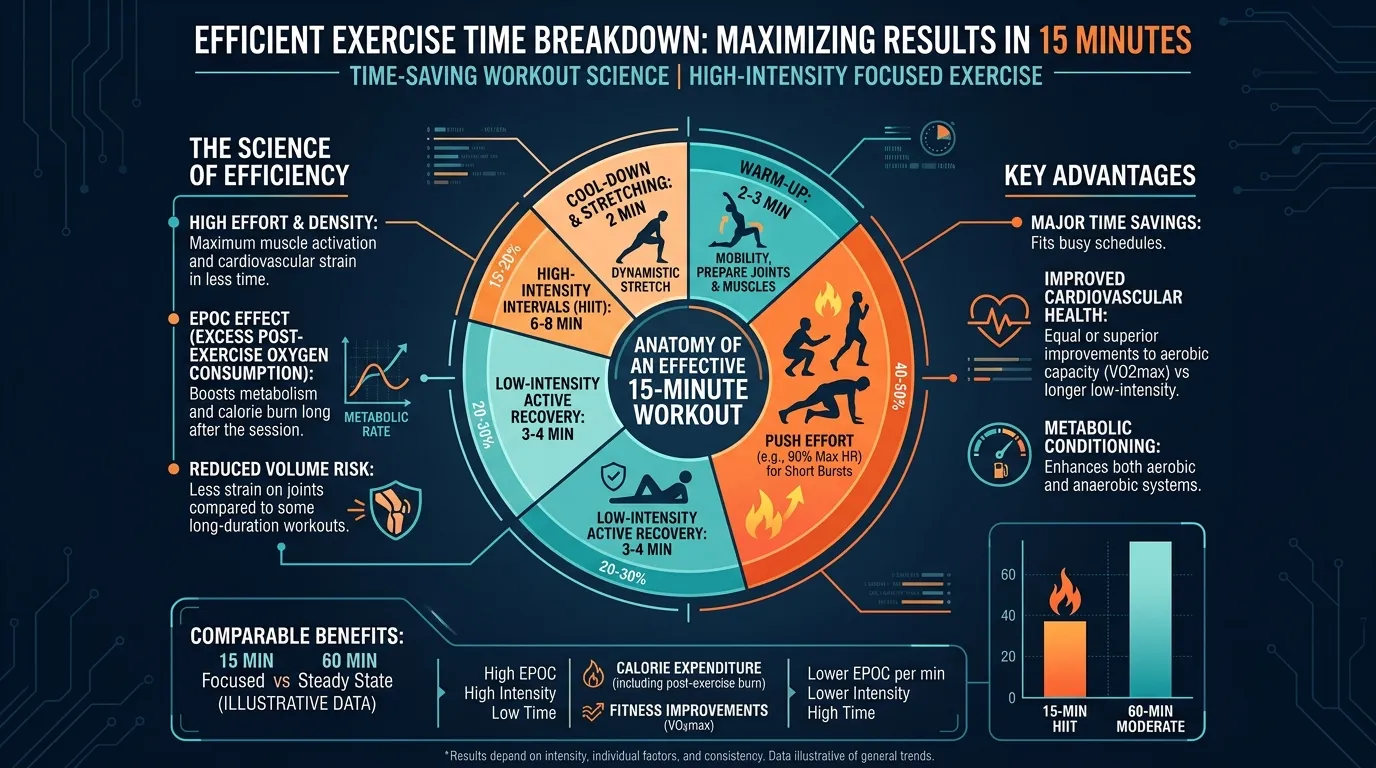
5 Sample Workout Structures (15-20 Minutes Each)
These are templates, not prescriptions. Your ideal exercises, sets, and intensity depend on your fitness level and goals. But the structures are battle-tested.
Structure 1: The Strength Circuit (15 min)
Pick 4 compound exercises. Perform each for 40 seconds of work, 20 seconds of rest. Complete 4 rounds.
- Bodyweight squats (or goblet squats with a dumbbell)
- Push-ups (at your current progression level)
- Reverse lunges (alternating)
- Plank hold
Why it works: Compound movements hit multiple muscle groups simultaneously. The circuit format keeps your heart rate elevated while building strength. Total time: 16 minutes including a brief warm-up.
Structure 2: The HIIT Burner (18 min)
30 seconds maximum effort, 30 seconds rest. 6 exercises, 3 rounds.
- Jump squats (or squat pulses if low-impact needed)
- Mountain climbers
- Burpees (or squat thrusts)
- High knees
- Lateral lunges
- Plank jacks
Why it works: True HIIT drives cardiovascular adaptation and fat loss in minimal time. The 1:1 work-to-rest ratio keeps intensity high enough to trigger EPOC.
Structure 3: The Focused Strength Session (20 min)
Pick 2 movement patterns. Perform 4 sets of 6-10 reps each with 60-90 seconds rest. Focus on quality and progressive overload.
- Upper day example: Push-ups (progressing toward archer push-ups) + Resistance band rows
- Lower day example: Bulgarian split squats + Single-leg glute bridges
Why it works: This mirrors the minimum effective dose research — fewer exercises, higher intensity, real progression week over week. Less time, same adaptation signal.
Structure 4: The Yoga/Mobility Flow (15 min)
A structured flow moving through 8-10 poses, holding each for 30-60 seconds. Focus on breath and range of motion.
- Cat-cow → Downward dog → Low lunge → Warrior II → Triangle → Half pigeon → Seated twist → Savasana
Why it works: Mobility training is training. It improves joint health, reduces injury risk, aids recovery from strength sessions, and reduces stress hormones. A 15-minute flow on rest days keeps the habit alive without taxing your muscles.
Structure 5: The Busy Parent Special (15 min, anywhere)
5 exercises, 3 sets of 10 reps each. No equipment, no setup, minimal noise. Can be done during nap time, before the school run, or in a hotel room.
- Bodyweight squats
- Push-ups (wall, incline, or standard)
- Glute bridges
- Dead bugs
- Standing calf raises
Why it works: Zero friction. No equipment to set up, no jumping to disturb downstairs neighbors, no complicated movement patterns to remember. The best workout is the one that fits your actual life.
Why Short Workouts Beat Skipped Workouts for Consistency
This is the part that changes everything. Because the real question was never "are short workouts effective?" The research answered that decades ago. The real question is: why do most people quit, and how does workout length play into that?
The Consistency Cliff
Most people quit fitness programs within the first three weeks. Not because the exercises don't work — because the program doesn't fit their life. A 60-minute workout requires finding 60 minutes. It requires commuting to a gym (or clearing space at home). It requires warming up, training, cooling down, showering, and getting back to whatever you were doing. The real time cost of an "hour workout" is often 90-120 minutes.
A 15-minute workout requires 15 minutes. You can do it in your living room before your morning coffee. You can do it in a hotel room during a work trip. You can do it during your kid's nap. The barrier to entry is so low that "I don't have time" stops being a valid excuse — and that matters, because "I don't have time" is the number one reason people skip workouts and eventually quit entirely.
Frequency Beats Duration
Research published in Sports Medicine (Murphy, Blair, and Murtagh, 2009) reviewed the evidence on accumulated versus continuous exercise and found that participants in short-bout groups exercised on more days per week and accumulated more total weekly minutes than those in long-bout groups. Let that sink in: people who did shorter workouts ended up exercising more overall.
This makes intuitive sense. If your plan calls for three 60-minute sessions and you miss one, you've lost a third of your weekly training. If your plan calls for five 15-minute sessions and you miss one, you've still completed 80% of your week. Short sessions build a higher-frequency habit that's more resilient to the chaos of real life. We ranked the best fitness apps for building consistency based on how well they support this kind of high-frequency habit.
The Identity Shift
Here's what nobody talks about: short workouts help you build identity faster. Every time you complete a workout — even 15 minutes — you cast a vote for "I'm someone who exercises." That identity accumulates. After two weeks of daily 15-minute sessions, you've cast 14 votes. After two weeks of planned 60-minute sessions where you actually showed up three times, you've cast 3 votes.
The person with 14 votes is far more likely to still be exercising in month three. Because at that point, they're not relying on motivation. They're maintaining an identity.
This is exactly why FitCraft uses gamification — XP, leveling up, collectible cards, and calendar tracking with rewards. Every completed workout, no matter how short, earns you progress. Your AI coach Ty celebrates the consistency, not the duration. The streak doesn't care if you trained for 15 minutes or 60. It cares that you showed up. And that's the mindset shift that separates people who build lasting fitness from people who burn out in January.

How to Get Started Today
You don't need a perfect plan. You need a first workout. Here's how to start this week:
- Pick a time slot that already exists. Don't create a new window — attach exercise to something you already do. Before your morning shower. During your lunch break. Right after you put the kids to bed. Habit stacking works because you're not fighting your schedule; you're working with it.
- Start with 10 minutes, not 20. You can always do more. The goal for week one is to prove to yourself that you'll show up. Set the bar embarrassingly low and clear it every day.
- Pick 3-4 exercises you already know. Squats, push-ups, planks, lunges. Don't spend 20 minutes watching tutorials for exercises you'll do for 15 minutes. Use movements you can start immediately.
- Track it. Write it down, check a box, log it in an app. The act of recording a completed workout reinforces the behavior loop. It turns an invisible effort into visible proof.
- Protect the streak, not the duration. Some days you'll have 20 minutes and crush it. Some days you'll have 8 minutes and barely get through two exercises. Both days count. The only day that doesn't count is the one where you do nothing.
What to Expect (The Reality)
Week 1: You'll feel energized and a little surprised at how doable it is. The novelty factor is high. Enjoy it.
Week 2: You'll start noticing that you're less winded and the exercises feel slightly easier. This is real adaptation happening — your neuromuscular system is learning the movements.
Week 3: This is the consistency cliff. The novelty wears off. Life gets in the way. This is where most people quit long programs. But because your sessions are 15 minutes, "I don't have time" doesn't hold up — and that matters. Show up even if you only do 10 minutes. Protect the habit.
Month 2-3: If you've stayed consistent, you'll notice real changes — clothes fitting differently, movements feeling stronger, energy levels higher throughout the day. More importantly, you'll notice that you want to work out. It's no longer something you force. It's something you do.
The Bottom Line
The fitness industry sold you the idea that results require hour-long gym sessions, expensive equipment, and monk-like discipline. The research says otherwise. Fifteen to twenty minutes of focused, consistent exercise produces measurable improvements in strength, cardiovascular fitness, body composition, and mental health. Short bouts accumulated throughout the day match the benefits of longer continuous sessions. And shorter workouts lead to higher adherence — which is the only variable that actually matters long term.
You're not cutting corners by doing a 15-minute workout. You're making the smartest possible trade: maximum results per minute invested, with the highest probability of still doing it three months from now.
Barry, 42: "-28 lbs, 4 months — Lost weight during breakfast while kids ate — worked around my life."
Katie: "I've tried everything. This is the first time I've stuck with something past two weeks."
You don't need more time. You need a system that makes the time you have count — and that keeps you coming back tomorrow. That's not a discipline problem. It's a design problem. And it's solvable.
If short and enjoyable is the combination you need, FitCraft's beginner-friendly setup is built around exactly that.
Frequently Asked Questions
Can you get fit with just 15-20 minutes of exercise per day?
Yes. A systematic review and meta-analysis published in Sports Medicine (Androulakis-Korakakis et al., 2020) found that performing a single set of 6-12 repetitions at high intensity, 2-3 times per week, produced significant strength gains. A separate meta-analysis (Wen et al., 2019) confirmed that accumulated short bouts of exercise produce comparable health benefits to longer continuous sessions, including improvements in cardiovascular fitness, blood pressure, and body composition.
What type of workout is best for 15 minutes?
Circuit-style training combining compound movements like squats, push-ups, and lunges is highly effective in 15 minutes because it maximizes muscle activation while keeping your heart rate elevated. Alternatively, focused strength sessions targeting one or two movement patterns with adequate intensity can produce meaningful gains even in short time frames.
Is a short workout better than no workout?
Absolutely. Research consistently shows that any amount of physical activity is better than none. A 2019 meta-analysis in Sports Medicine found that even short accumulated exercise bouts produced the same improvements in cardiorespiratory fitness, blood pressure, and glucose metabolism as longer continuous sessions. The biggest barrier to fitness results is not workout length — it is consistency. Short workouts you actually do will always outperform long workouts you skip.
How many days per week should I do short workouts?
Three to five days per week is the sweet spot for short workouts. Because the sessions are brief, your body recovers faster than it would from hour-long sessions, allowing higher frequency. Even 2-3 days per week of 15-20 minute sessions can produce measurable improvements in strength, cardiovascular fitness, and body composition when performed consistently over weeks and months.
How does FitCraft help with quick workouts?
FitCraft's AI coach Ty builds personalized workout plans that fit your available time, including sessions as short as 15 minutes. The app uses gamification — XP, leveling up, collectible cards, and calendar tracking with rewards — to keep you consistent even on busy days. Every program is designed by an Ivy League-trained exercise scientist, NSCA-certified strength coach, so you get the right exercises at the right intensity without wasting a single minute.