Working out inside a virtual reality headset sounds like something from a sci-fi movie — or a novelty that belongs next to your dusty Wii Balance Board. But when researchers put VR fitness through rigorous clinical trials, the results were surprisingly strong.
Not "marginally better." Not "statistically insignificant." Dramatically better than traditional exercise on multiple measures.
Here's what the research actually found — and what it means for how you train.
The VR Resistance Training Trial
In 2022, researchers published a randomized controlled trial in Frontiers in Physiology (PMC9819410) comparing VR-based resistance training to traditional resistance training. Thirty-two participants were randomly assigned to either a VR group or a conventional training group, following matched exercise protocols over the study period.
The results were not close:
- Body fat: The VR group lost 3.8% body fat vs 1.9% for the traditional group (P<.001)
- Cardiorespiratory fitness: Relative VO2max increased by 3.28 ml/kg/min in the VR group vs just 0.89 in the traditional group (P<.001)
- Body composition: The VR group showed greater gains in fat-free mass
- Strength: The VR group demonstrated superior muscular strength improvements
Same exercises. Same protocols. The only difference was the environment — and the VR group outperformed across every major outcome.
The Balance Training Evidence
VR-style fitness research didn't start with headsets. A 2016 randomized controlled trial published in BMC Geriatrics (PMC5316445) studied whether Wii Fit balance training could improve outcomes in 30 older adults.
The result: a 5.5-point improvement on the Berg Balance Scale (P<.001) — a clinically meaningful gain that translates to measurably reduced fall risk. For context, a change of 4 points on the BBS is considered a meaningful clinical difference.
An interactive game designed for living rooms outperformed conventional balance protocols in a clinical trial. That finding raised an obvious question: why?
Why VR Fitness Works (It's Not the Technology)
Here's the part most VR fitness articles get wrong. The headset isn't the active ingredient. The psychology is.
Researchers have identified two key mechanisms driving the superior outcomes:
Reduced Perceived Exertion
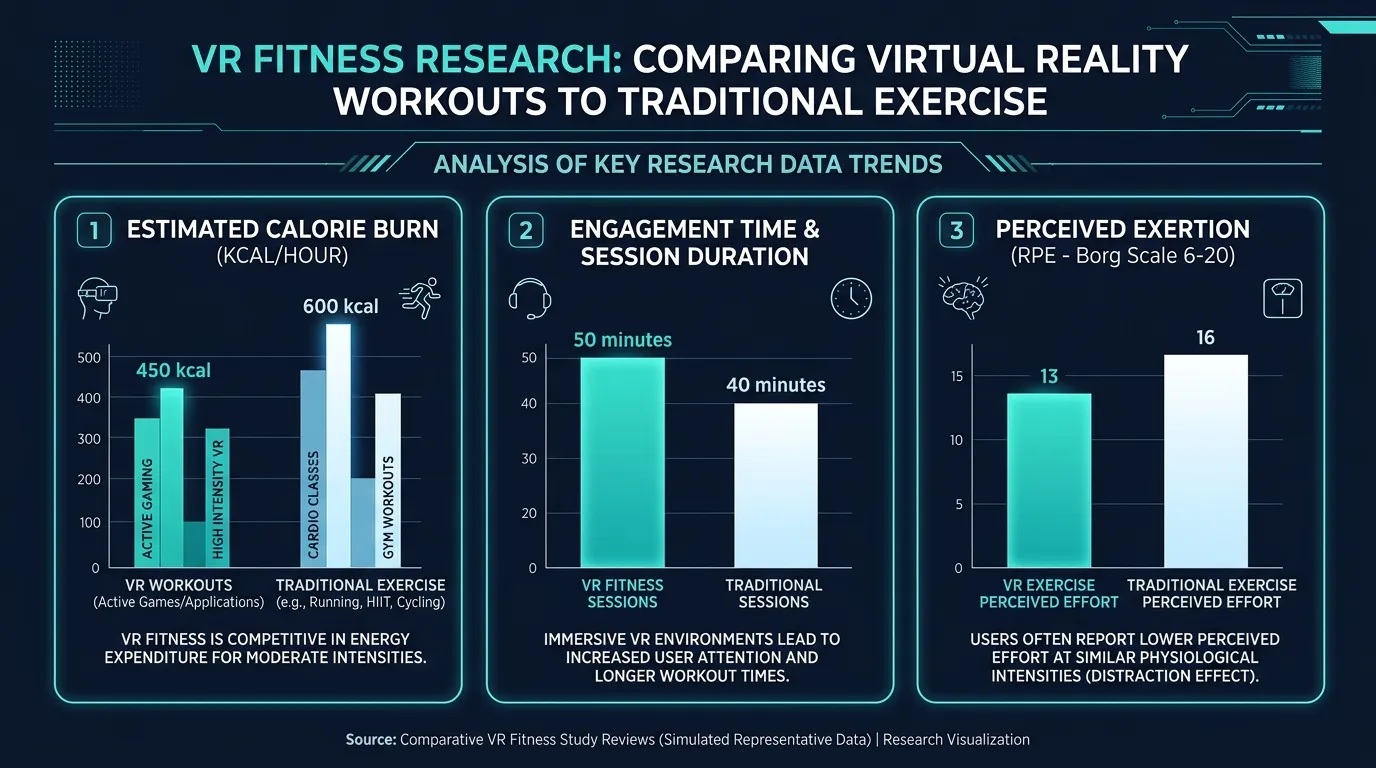
When you're immersed in an engaging environment — fighting a dragon, navigating an obstacle course, competing in a virtual challenge — your brain allocates attention to the experience rather than the discomfort. Studies consistently show that immersive exercise environments lower ratings of perceived exertion (RPE) at the same absolute workload. You're working just as hard, but it feels easier. So you push longer and harder without hitting the psychological wall that makes people quit.
Increased Enjoyment and Adherence
The second mechanism is simpler: people enjoy it more, so they do it more. Exercise adherence is the single greatest predictor of long-term fitness outcomes. The most scientifically optimized program in the world produces zero results if someone abandons it in week three. VR makes the experience engaging enough that people want to come back — and that consistency compounds over months and years.
This is the same principle behind every effective gamification system: make the process inherently rewarding, and consistency follows.
The Catch: What the Headlines Don't Mention
Before you rush out to buy a VR headset, the research comes with important caveats:
- Small sample sizes. The resistance training RCT included 32 participants. That's enough for statistical significance on the measured outcomes, but larger trials are needed to confirm the effect sizes.
- Controlled settings. These studies were conducted in supervised lab environments, not in participants' living rooms. The results may not fully translate to unsupervised home use.
- Hardware cost and friction. Quality VR headsets run $300-500+. That's a meaningful barrier. And strapping on a headset adds friction to starting a workout — friction that can erode consistency over time.
- Motion sickness. A subset of users experience nausea with VR, particularly during dynamic movements. This limits who can actually use it.
The science is genuinely promising. But VR fitness as a daily practice still has practical hurdles to clear.
You Don't Need VR to Get These Benefits
Here's what matters most about the VR research: the outcomes aren't driven by the hardware. They're driven by psychological principles that work with or without a headset.
Reduced perceived exertion through immersion. Increased enjoyment through gamification. Better adherence through progression systems that make consistency feel rewarding.
These are the same principles that FitCraft is built on. Quest-based workout progression turns each session into a challenge worth completing — not a chore to endure. Streaks and XP create the same daily engagement loop that makes VR experiences compelling. Adaptive difficulty keeps you in the zone where effort feels challenging but achievable — the sweet spot that drives both enjoyment and results.
The VR research validates what behavioral science has shown for years: when exercise feels like play, people work harder and quit less. You can deliver that experience through a $500 headset — or through an app that applies the same psychology to real-world training.
Ready to put this into practice?
FitCraft applies the same psychological principles that make VR fitness effective — without the headset. Take the free assessment.
Take the Free Assessment Free · 2 minutes · No credit cardMost of the effect survives without the hardware, and the game-like side of FitCraft is our attempt at getting there on a phone.
Frequently Asked Questions
Does VR fitness actually work for weight loss and muscle building?
Yes — clinical evidence supports it. A 2022 randomized controlled trial (PMC9819410, n=32) found that VR-based resistance training reduced body fat by 3.8% compared to 1.9% for traditional training (P<.001), while also producing greater gains in relative VO2max (+3.28 vs +0.89, P<.001), fat-free mass, and muscular strength. The key mechanism appears to be that immersive environments reduce perceived exertion and increase enjoyment, which leads to greater effort and consistency.
What are the downsides of VR fitness?
The main limitations are practical: quality VR headsets cost $300-500+, the research was conducted in controlled lab settings that may not reflect home use, some people experience motion sickness, and the hardware adds friction to starting a workout. The clinical results are impressive, but they were achieved under supervised conditions with specific protocols that aren't yet widely available as consumer products.
Can you get VR fitness benefits without a VR headset?
Yes. The underlying mechanisms that make VR fitness effective — reduced perceived exertion through immersion, gamification that increases enjoyment, and progression systems that sustain motivation — can be delivered without VR hardware. Apps like FitCraft use quest-based progression, streaks, and adaptive challenges to create the same psychological engagement that makes VR workouts outperform traditional training in clinical trials.
Is VR fitness better than traditional exercise?
The clinical data suggests VR-enhanced exercise produces superior outcomes to traditional exercise when both groups follow similar protocols — likely because the immersive environment increases effort and adherence. However, the best exercise is the one you actually do consistently. Whether that engagement comes from a VR headset, a gamified app, or a sport you love, the principle is the same: make the experience engaging enough that you keep showing up.