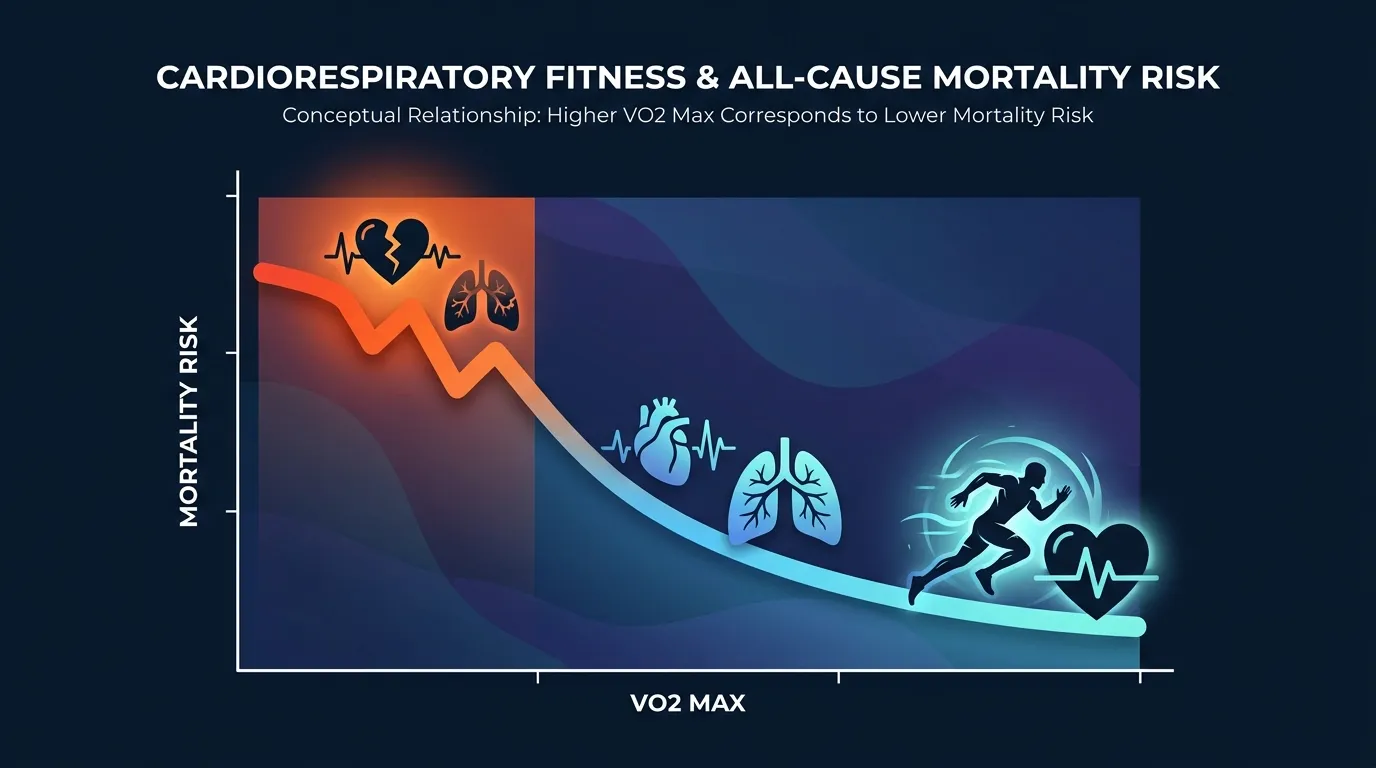
- VO2 max is the strongest single predictor of all-cause mortality. A 2018 JAMA Network Open analysis of 122,007 patients found low cardiorespiratory fitness carried a mortality risk greater than smoking, diabetes, or heart disease.
- You can train VO2 max at home with zero equipment. High knees, jump squats, mountain climbers, and burpees done as 4-minute hard intervals deliver the same stimulus as a treadmill.
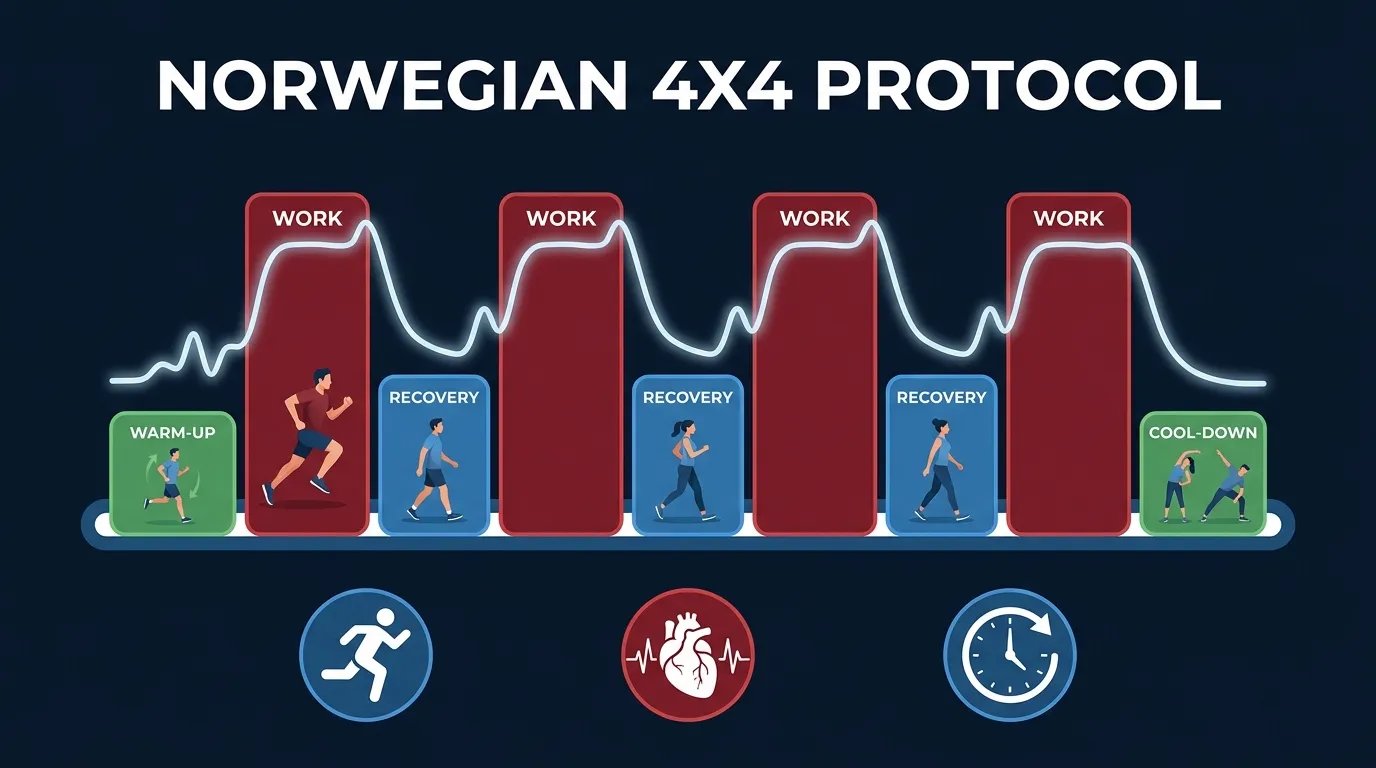
- The Norwegian 4x4 protocol (4 minutes hard, 3 minutes easy, 4 rounds) is the most studied VO2 max method. Done two to three times per week, it raises VO2 max by 7-13 percent in eight weeks.
- The hard part is not the workout. It's keeping a 90-percent-effort interval session on your calendar twice a week for three months. Most VO2 max plans fail there.
VO2 max went from a niche sports science term to a longevity headline in about three years. The bestselling longevity book Outlive put it on the cover. Andrew Huberman runs episodes about it. Apple Watch and Garmin display your number on the lock screen. And the data behind the hype is, for once, real. A higher VO2 max is one of the most powerful longevity signals modern medicine knows how to measure.
The catch: most coverage stops at "VO2 max is good, get more of it." The hard parts get glossed over. What is your number actually telling you? Can you raise it without a gym, a treadmill, or a coach? What does a session look like that genuinely moves the needle? Here's the practical version.
What VO2 Max Actually Measures
VO2 max is the maximum volume of oxygen your body can use during all-out exercise, expressed in milliliters of oxygen per kilogram of bodyweight per minute (ml/kg/min). It's a snapshot of how well your lungs pull oxygen in, your heart pumps oxygen-rich blood out, and your muscles extract that oxygen for fuel.
The number reflects three systems working together:
- Pulmonary capacity: how much oxygen your lungs can transfer into blood per breath
- Cardiac output: how much oxygen-rich blood your heart can move per minute (stroke volume × heart rate)
- Mitochondrial density: how efficiently muscle cells convert that oxygen into ATP
Train any one of these and your VO2 max creeps up. Train all three at once with hard intervals and it climbs faster.
What Is a Good VO2 Max?
Reference values vary by age and sex. A rough guide using Cooper Institute percentile data:
- Men, age 30-39: Below 33 = poor. 34-41 = average. 42-46 = good. 47+ = excellent.
- Men, age 40-49: Below 30 = poor. 31-37 = average. 38-43 = good. 44+ = excellent.
- Women, age 30-39: Below 27 = poor. 28-32 = average. 33-37 = good. 38+ = excellent.
- Women, age 40-49: Below 24 = poor. 25-29 = average. 30-35 = good. 36+ = excellent.
If you're an Apple Watch or Garmin user, your watch gives you a number based on heart rate and pace data during runs and walks. Research validating these wearable estimates shows roughly 5-10 percent error compared to lab-grade metabolic carts. Close enough for trend tracking, not precise enough for elite-athlete benchmarking.
Why VO2 Max Is the Most Important Number You're Not Tracking
Here's the headline finding. Mandsager et al. (2018), in JAMA Network Open, ran 122,007 patients through treadmill exercise testing at the Cleveland Clinic and tracked them for an average of 8.4 years. The finding that broke through to mainstream coverage: people in the lowest quintile of cardiorespiratory fitness had a mortality risk five times higher than the elite-fitness group, and roughly twice the mortality risk of smokers.
That's not a typo. Being in the bottom 20 percent for VO2 max was a more powerful predictor of dying within a decade than smoking, diabetes, or end-stage renal disease. The authors concluded that "cardiorespiratory fitness is inversely associated with long-term mortality with no observed upper limit of benefit."
This wasn't an outlier study. Kodama et al. (2009) published a meta-analysis in JAMA pooling 33 studies and 102,980 healthy adults. Every one-MET increase in cardiorespiratory fitness (about 3.5 ml/kg/min of VO2 max) was associated with a 13 percent reduction in all-cause mortality and a 15 percent reduction in cardiovascular events.
So the American Heart Association made it official. Ross et al. (2016), writing the AHA scientific statement, called for cardiorespiratory fitness to be treated as "a clinical vital sign" alongside blood pressure, cholesterol, and BMI. We've covered the same body of evidence in our piece on why being unfit is worse than smoking.
Why Trainers Care About the "Trainable" Window
VO2 max is partly genetic. Twin studies put the heritable ceiling somewhere around 50 percent of an individual's max value. The other half is open territory. Most untrained adults can raise their VO2 max by 15-25 percent in three to six months of consistent interval training. People starting from a sedentary baseline often see even larger gains because there's more room to climb. The trials behind that range, including the four-arm study that matched every group for total work, are collected in our review of how to increase VO2 max.
That's the trainable window. And the cheapest way through it is hard, short, repeated efforts.
How to Test VO2 Max at Home (No Lab Required)
You don't need a metabolic cart and a treadmill. Three field tests give you a usable estimate within roughly 5-10 percent of the gold standard.
1. Cooper 12-Minute Run
The classic. Find a flat track, park, or measured path. Warm up for 10 minutes at an easy pace. Then run as far as you can in 12 minutes. Plug the distance into the formula:
VO2max (ml/kg/min) = (distance in meters – 504.9) / 44.73
So if you cover 2,400 meters (about 1.5 miles) in 12 minutes, your estimated VO2 max is (2,400 – 504.9) / 44.73 = roughly 42.4 ml/kg/min. Repeat the test every 6-8 weeks to track progress. The Cooper test calculator has a 12-minute timer with a lap counter and rates your distance for your age and sex.
2. Rockport 1-Mile Walk Test
Better for older adults, deconditioned beginners, or anyone with joint issues. Walk one mile as fast as possible without running. Record the time and your immediate post-walk heart rate. The Rockport equation factors in age, sex, weight, walk time, and ending heart rate. Multiple online calculators will run the math for you. Our free VO2 max calculator runs the Rockport equation for you and rates the result against lab-measured adults of your age and sex.
3. Beep Test (20-Meter Shuttle Run)
Used by militaries and pro sports leagues. Run 20-meter shuttles in time with audio beeps that get progressively faster. Record the level you reached when you couldn't keep pace. Free apps (UFE Beep Test, Bleep Test) play the audio. The beep test is the most accurate of the three for younger, fit individuals. Our free beep test player plays every level on time in your browser and turns your score into an estimated VO2 max.
4. Wearable Estimates
Apple Watch, Garmin, and Whoop all estimate VO2 max from heart rate and pace data during outdoor walks and runs. They need a few weeks of data to stabilize. Treat these as a useful tracking tool, not a precision instrument. The trend over months matters far more than the absolute number.
The Norwegian 4x4: The Most Studied VO2 Max Protocol
If you do one thing for VO2 max, do this. Helgerud et al. (2007), working at the Norwegian University of Science and Technology, ran a head-to-head comparison of four training methods over eight weeks: long slow distance, threshold pace, 15-second intervals, and 4-minute intervals. The 4-minute interval group (now called the Norwegian 4x4) raised VO2 max by 7.2 percent. The long slow distance group barely moved.
The structure:
- Warm-up: 10 minutes easy
- Interval 1: 4 minutes hard at 85-95 percent of max heart rate
- Recovery 1: 3 minutes easy
- Repeat: 3 more interval/recovery rounds (4 total)
- Cool-down: 5 minutes easy
Total time: about 38 minutes. Frequency: two to three times per week. The "hard" pace is whatever puts you at 85-95 percent of max heart rate (220 minus your age, roughly). On a wearable, that's the top of Zone 4 and into Zone 5. By the third round, you'll be questioning your decisions. That's the point.
Milanovic et al. (2015) ran a meta-analysis of 28 studies pooling HIIT and continuous endurance training. The conclusion: HIIT produced a 4.0 percent greater VO2 max improvement than continuous moderate exercise, in less than half the total weekly training time. For people with limited hours per week, intervals win on efficiency.
For the bigger picture on intervals vs. steady-state, our deeper write-up on HIIT vs. steady-state cardio covers when each modality earns its slot in your week.
Five No-Equipment Exercises That Drive VO2 Max
The Norwegian 4x4 was originally tested on uphill running and treadmills, but the variable that matters is heart rate, not the movement. Any exercise that drives your pulse to 85-95 percent of max for four minutes does the job. Bodyweight movements work fine if you go hard enough.
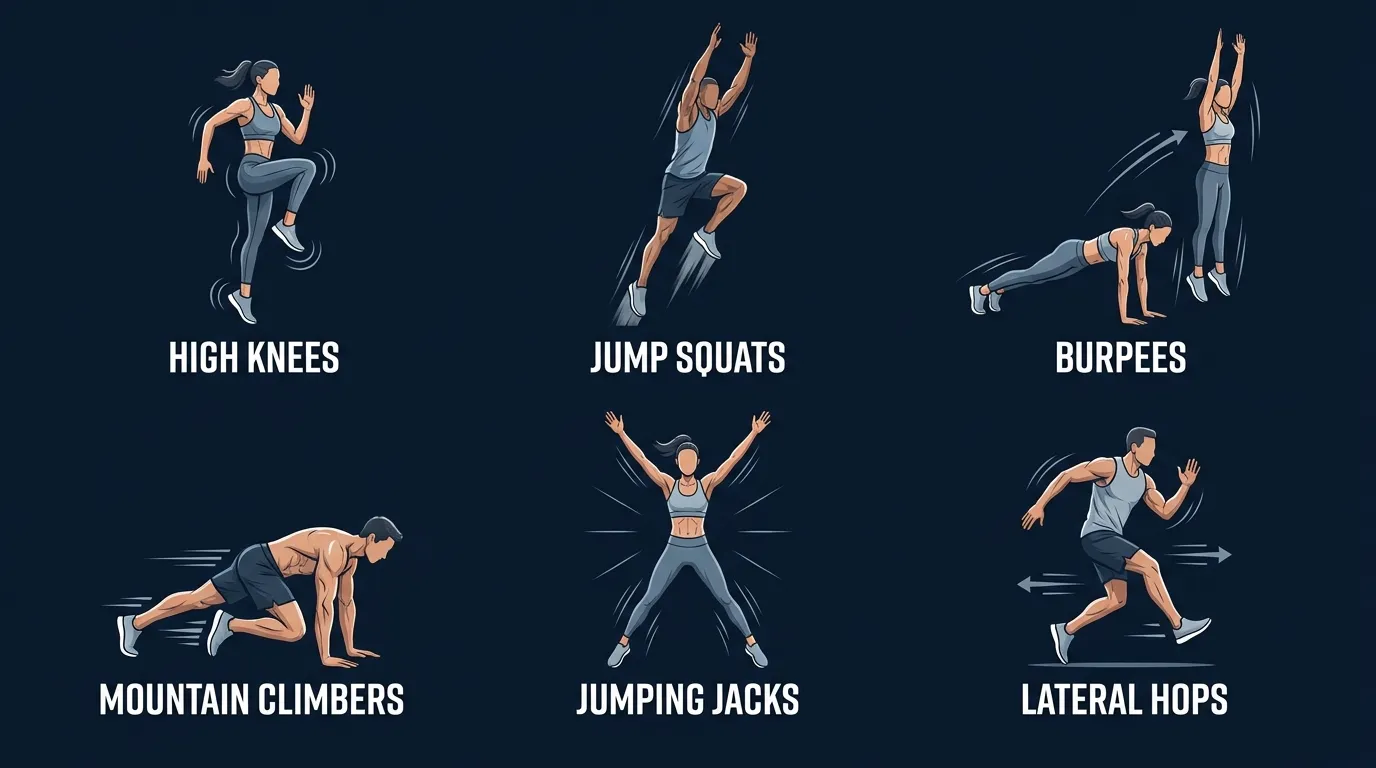
1. High Knees
Run in place, drive your knees up to hip height, pump your arms. Do this for four straight minutes and your heart rate will be wherever you need it. Drop the pace if you can't sustain four minutes. Form guide for high knees.
2. Jump Squats
Squat down, explode up into a jump, land soft, repeat. Continuous reps for four minutes is brutal. Use them for the first two intervals when you have the most pop. Substitute regular squats at fast tempo if your knees object.
3. Mountain Climbers
From a high plank position, drive knees toward chest at a fast tempo. The combination of plyometric demand and full-body engagement makes mountain climbers one of the most efficient ways to spike heart rate fast. Pace yourself or you'll redline in 90 seconds.
4. Burpees
The classic VO2 max bodyweight move. Squat, kick back to plank, push-up, jump back up, vertical jump. Continuous burpees for four minutes will hit anyone's max heart rate. Modify by removing the push-up or the jump if needed.
5. Jumping Jacks (Fast Tempo)
The "easier" option, but only if done at a serious clip. Slow jumping jacks live in Zone 2. Fast jumping jacks for four minutes straight will get you into the right zone. Use these as the third and fourth interval when fatigue from earlier rounds means you can't sustain the explosive moves.
You can mix these inside a single 4x4 session: round 1 high knees, round 2 burpees, round 3 jump squats, round 4 mountain climbers. Or pick one movement and stick with it for simpler tracking.
Want a VO2 max plan that actually fits your week?
Take the free FitCraft assessment and Ty, your 3D AI coach, builds a program around your goals, schedule, and current fitness level. No guessing about pace or rounds.
Take the Free Assessment Free • 2 minutes • No credit cardAn 8-Week VO2 Max Plan You Can Run From Your Living Room
Here's a starting structure. Adjust based on your current fitness, but the shape stays the same: a polarized week with most volume easy, a small slice very hard, and almost nothing in the moderate middle.
Weeks 1-2: Build the Base
- 2 sessions per week of 3x3-minute hard intervals (instead of 4x4, to ease in)
- 3-minute easy recovery between intervals
- Pick one movement per session: high knees, jump squats, or jumping jacks at a hard tempo
- 2 sessions per week of easy Zone 2 cardio (30-45 minutes of brisk walking or low-intensity movement)
Weeks 3-4: Hit the Norwegian 4x4
- 2 sessions per week of full 4x4 protocol (4 minutes hard, 3 minutes easy, 4 rounds)
- 2-3 sessions of Zone 2 cardio
- Test yourself with the Cooper 12-minute run at the end of week 4 to set a baseline
Weeks 5-8: Push the Stimulus
- 2 sessions of 4x4 plus 1 shorter "topping" session of 6 x 60-second all-out intervals
- 2 sessions of Zone 2 cardio
- 2-3 resistance training sessions (resistance training preserves muscle mass and supports VO2 max recovery)
- Re-test in week 8. Most people see a 7-15 percent improvement.
Skip a session if you're sick, sleep-deprived, or recovering from a hard week. Buchheit and Laursen (2013) showed that the dose-response curve for HIIT plateaus quickly. Doing more than three high-intensity sessions per week rarely produces extra adaptation, and often produces extra overtraining.
Why Most VO2 Max Plans Quietly Fail
The science is clear. The protocols are simple. So why does almost everyone start a VO2 max program and ghost it by week three?
Because hard intervals demand something most fitness apps don't help you build: the willingness to redline twice a week, on schedule, when nothing about your day says you should. The workouts hurt. They're short, but they're miserable mid-interval. There's no podcast you can listen to while gasping. No Netflix episode that distracts you through round three. Just a four-minute clock and your own breath.
So people skip a session. Then another. Then they tell themselves they'll restart Monday. Inconsistency steals the adaptation. By the time anyone retests their VO2 max, the number's flat and they assume their genetics are bad.
The fix is the same as everywhere else in fitness: a system that makes showing up for the unpleasant session feel like progress, not punishment. Streaks. A coach who knows your history. A plan that adjusts when you're tired. Research on gamification shows that game mechanics raise exercise adherence by 20-40 percent in randomized trials, and the effect is strongest for the high-effort sessions people most want to skip.
FitCraft's Ty, the 3D AI coach inside the app, runs you through interval workouts in real time. He counts down rounds, adjusts pace if your heart rate spikes too fast, and keeps your weekly schedule polarized so you actually recover. The free version covers the assessment and your first program, with a subscription available to unlock the full library and all program variations.
What This Means for You
If you're 40 or older, raising your VO2 max may be the highest-leverage thing you can do for your healthspan. Period. The mortality data is robust, the protocols are well-validated, and the equipment list is exactly zero items long. You need a flat patch of floor, eight weeks, and the discipline to push through twelve hard sessions.
The hard part won't be the workouts. It'll be the calendar. Twelve sessions over eight weeks sounds trivial when you read it. It feels like nothing. The moment you've finished a 4x4 and your watch buzzes that your VO2 max ticked up another point, you'll wonder why nobody told you sooner.
"I went from 32 to 41 in four months. The weird part isn't the number. It's that I now actually look forward to interval days." (Matt, FitCraft user)
Frequently Asked Questions
What is a good VO2 max for my age?
An average VO2 max for a sedentary adult is roughly 35-40 ml/kg/min for men and 27-31 for women in their 30s. Reference values from the Cooper Institute place "good" at the 60th-80th percentile for your age and sex, and "excellent" above the 80th percentile. A VO2 max in the bottom quintile carries a mortality risk that the JAMA Network Open analysis by Mandsager et al. (2018) found exceeded the risk associated with smoking.
Can I improve VO2 max at home without equipment?
Yes. Bodyweight intervals that drive heart rate to roughly 90 percent of max (high knees, jump squats, mountain climbers, burpees, jumping jacks done at speed) deliver the same VO2 max stimulus as treadmill or bike intervals. The variable that matters is intensity, not modality. A 2015 meta-analysis in Sports Medicine found HIIT produces a larger VO2 max improvement than continuous moderate exercise across populations.
What is the Norwegian 4x4 protocol?
The Norwegian 4x4 is the most cited VO2 max training protocol, popularized by Helgerud et al. (2007) at the Norwegian University of Science and Technology. It calls for four-minute hard intervals at 85-95 percent of max heart rate, separated by three-minute active recovery periods, repeated four times. Total session length is about 38 minutes including warm-up and cool-down. Run two to three times per week, the protocol produces a 7-13 percent VO2 max improvement in eight weeks.
How fast does VO2 max improve with training?
Most studies show measurable VO2 max gains within four to six weeks of consistent interval training. Beginners improve fastest (10-25 percent in 8-12 weeks), while trained individuals see smaller relative gains (3-7 percent over the same period). The first 30 percent of progress comes quickly. The rest is the long tail. Consistency over 90 days matters far more than which specific protocol you pick.
How can I estimate VO2 max without a lab?
The simplest field test is the Cooper 12-minute run. Cover as much distance as possible in 12 minutes, then plug the meters covered into the formula VO2max = (distance in meters - 504.9) / 44.73. The 1.5-mile run, the Rockport one-mile walk, and the 20-meter beep test are equally validated alternatives. Modern wearables (Garmin, Apple Watch, Whoop) estimate VO2 max from heart rate and pace data with roughly 5-10 percent error vs. lab metabolic carts.