The HIIT-versus-steady-state debate has been one of the loudest arguments in fitness for at least a decade. Scroll through any fitness forum or Instagram comment section and you'll find people swearing that one is clearly superior to the other. But what does the actual research say when you strip away the opinions and look at the data?
Quite a bit, actually. And the answer is more nuanced than either side wants to admit.
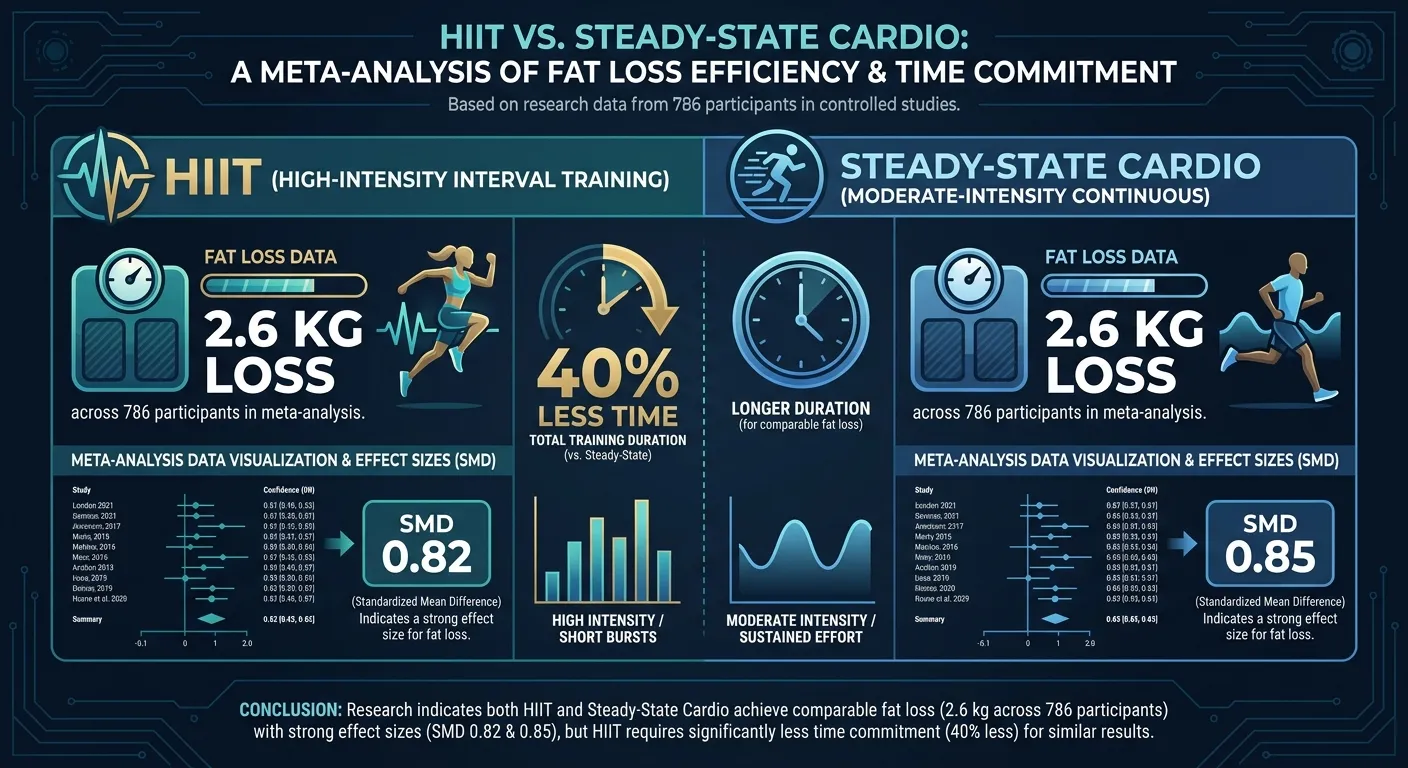
In 2017, a team of researchers at the University of New South Wales published what remains one of the most cited meta-analyses on this topic. They sifted through 1,334 studies, narrowed it down to 13 that met rigorous inclusion criteria, and pooled data from 786 overweight and obese adults who'd been randomized to either HIIT or moderate-intensity continuous training (MICT, the technical term for what most people call "steady-state cardio").
Their findings changed how a lot of exercise scientists think about cardio prescriptions. Here's the full breakdown.
The Wewege Meta-Analysis: What They Did and What They Found
Let's start with what this study actually was, because "meta-analysis" gets thrown around a lot without people understanding why it matters.
A meta-analysis pools results from multiple randomized controlled trials (RCTs, the gold standard of evidence) and analyzes them together. Instead of one study with 50 people, you get the combined statistical power of thousands of participants across different labs, countries, and protocols. It's the closest thing exercise science has to a definitive answer.
Study Design
Wewege and colleagues screened 1,334 articles and included 13 RCTs that directly compared HIIT to MICT in overweight or obese adults (BMI ≥ 25). They looked at every body composition measure they could find: total body fat mass, waist circumference, body fat percentage, body weight, and BMI. The combined sample was 786 participants.
Importantly, these weren't cherry-picked studies. The researchers used strict inclusion criteria: only randomized trials, only direct head-to-head comparisons, only peer-reviewed publications. This wasn't a blog post citing three favorable studies. It was systematic.
The Fat Loss Results
Here's what surprised a lot of people in the fitness world: HIIT and MICT produced virtually identical fat loss.
Both groups lost approximately 2.6 kg of fat mass. The standardized mean differences were 0.82 for HIIT and 0.85 for MICT, both classified as "large" effects. There were no statistically significant differences between the two for any body composition measure. Not fat mass, not waist circumference, not body weight, not BMI.
Read that again. Across 786 participants and 13 separate trials, neither approach was meaningfully better for fat loss.
The Time Difference
But here's where things get interesting. HIIT required approximately 40% less total training time than MICT to produce those same results.
That's not a minor detail. If you're getting the same fat loss in 20 minutes that someone else is getting in 45, the practical implications are enormous. Especially for people whose biggest barrier to exercise is time. And that's a lot of people.
One Important Nuance: Running vs. Cycling
The meta-analysis found that exercise modality mattered. Running-based protocols showed large effects on fat mass for both HIIT and MICT (SMD of -0.82 and -0.85, respectively). But cycling-based protocols didn't produce significant fat loss for either group.
This doesn't mean cycling is useless. It means the specific protocols tested in these trials, at those durations and intensities, didn't move the needle on fat mass. Running involves more total muscle mass, which may partially explain the difference. But it's a reminder that not all cardio is interchangeable, even within the same intensity category.
Citation: Wewege M, van den Berg R, Ward RE, Keech A. The effects of high-intensity interval training vs. moderate-intensity continuous training on body composition in overweight and obese adults: a systematic review and meta-analysis. Obesity Reviews. 2017;18(6):635-646.
Beyond Fat Loss: HIIT and Cardiovascular Fitness
Fat loss isn't the only reason people do cardio. Cardiovascular fitness, meaning your heart's ability to pump blood and your muscles' ability to use oxygen, is arguably more important for long-term health. And this is where HIIT starts to pull ahead.
The Weston et al. Meta-Analysis (2014)
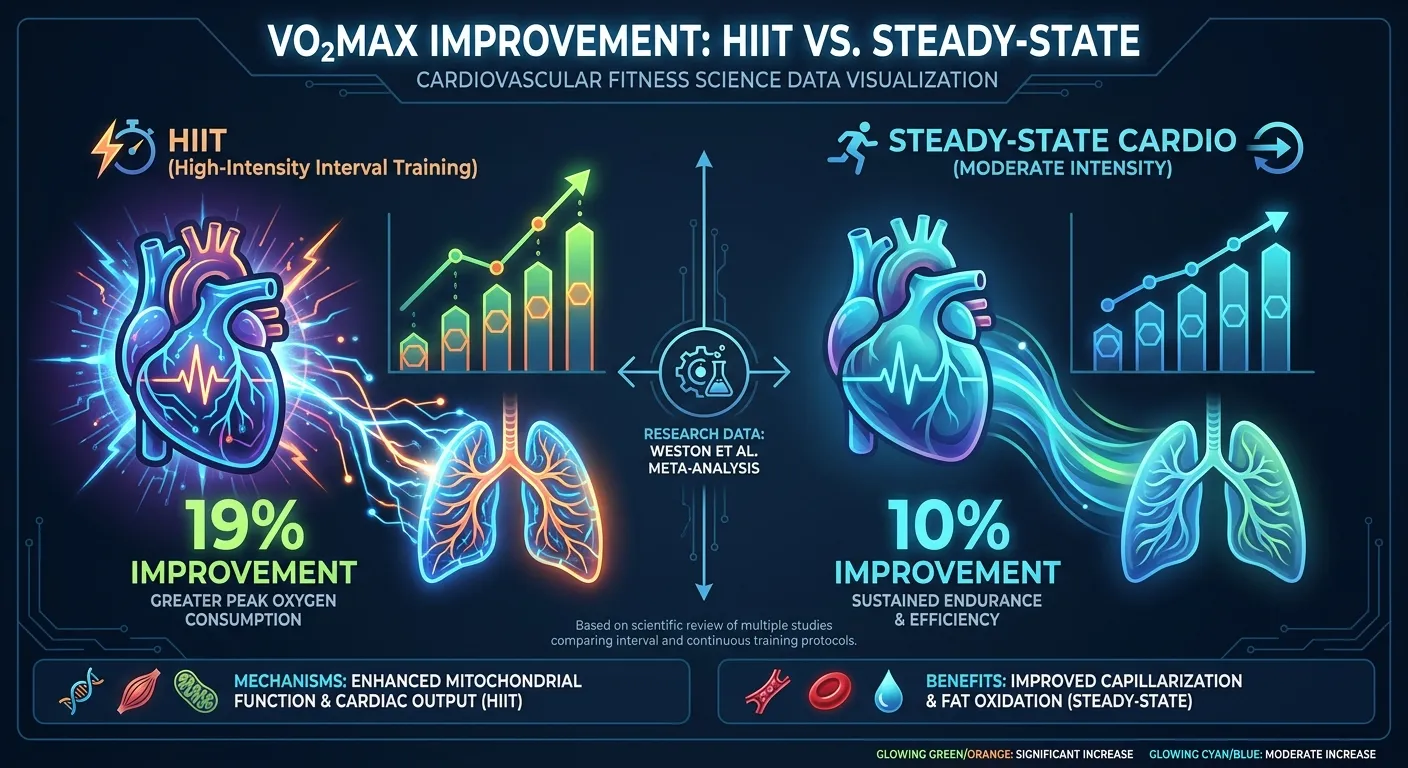
Three years before the Wewege study, Weston, Wisløff, and Coombes published a meta-analysis in the British Journal of Sports Medicine examining HIIT in patients with lifestyle-induced cardiometabolic diseases, including conditions like high blood pressure, obesity, heart failure, coronary artery disease, and metabolic syndrome.
The headline finding: HIIT improved VO2max by approximately 19%, compared to 10% for MICT. Nearly double. VO2max is your maximal oxygen uptake, the single best predictor of cardiovascular health and all-cause mortality. An improvement that large isn't just statistically significant. It's clinically meaningful.
For context, every 1 mL/kg/min increase in VO2max is associated with roughly a 10-15% reduction in cardiovascular mortality risk. A 19% improvement could translate to several extra mL/kg/min depending on your starting point. That's not trivial.
Citation: Weston KS, Wisløff U, Coombes JS. High-intensity interval training in patients with lifestyle-induced cardiometabolic disease: a systematic review and meta-analysis. Br J Sports Med. 2014;48(16):1227-1234.
The Milanović Meta-Analysis (2015): Healthy Adults Too
You might wonder: does the VO2max advantage hold up in healthy people, not just patients with heart disease? Milanović, Sporiš, and Weston addressed exactly this question in their 2015 meta-analysis of 28 controlled trials involving 723 healthy, young-to-middle-aged adults.
Both HIIT and continuous endurance training produced large improvements in VO2max compared to no-exercise controls. But HIIT produced greater gains. The mean VO2max improvement with endurance training was 4.9 mL/kg/min, while HIIT produced even larger effects.
The practical takeaway: whether you're a sedentary beginner or a reasonably fit adult, HIIT appears to build cardiovascular fitness faster than moderate-intensity steady-state work.
Citation: Milanović Z, Sporiš G, Weston M. Effectiveness of High-Intensity Interval Training (HIT) and Continuous Endurance Training for VO2max Improvements: A Systematic Review and Meta-Analysis of Controlled Trials. Sports Med. 2015;45(10):1469-1481.
The Metabolic Syndrome Angle
Tjønna and colleagues published a striking pilot study in Circulation in 2008. They randomized 32 patients with metabolic syndrome to either aerobic interval training (4x4 minutes at 90% of max heart rate) or continuous moderate exercise (70% of max heart rate) three times a week for 16 weeks.
The interval training group improved their VO2max by 35%. The moderate group improved by 16%. Both significant, but the HIIT group's improvement was more than double.
The interval group also removed more of the risk factors that constitute metabolic syndrome. Given that metabolic syndrome triples your risk of dying from heart disease, that's a finding with real stakes.
Citation: Tjønna AE, Lee SJ, Rognmo Ø, et al. Aerobic Interval Training Versus Continuous Moderate Exercise as a Treatment for the Metabolic Syndrome. Circulation. 2008;118(4):346-354.
Why This Matters for Your Training
Here's what all this data actually means when you're standing in your living room trying to decide what workout to do today.
If your primary goal is fat loss: Pick whichever style you'll actually do consistently. The Wewege meta-analysis is clear: HIIT and steady-state produce the same fat loss results. The "best" cardio for fat loss is the one that fits your schedule and doesn't make you dread tomorrow's session. Research on the minimum effective exercise dose confirms that even modest consistent activity outperforms occasional intense bursts.
If you're short on time: HIIT wins. Getting equivalent results in 40% less time isn't a gimmick. It's replicated across 13 randomized trials. A 20-minute HIIT session is genuinely as effective for fat loss as a 40-minute steady-state jog. And if jogging is off the table entirely, our guide to the best cardio app for home workouts without running shows how to get the same stimulus indoors.
If you want to improve cardiovascular fitness: The evidence leans toward HIIT, especially if you're starting with lower fitness or have cardiometabolic risk factors. The nearly 2:1 advantage in VO2max improvement (Weston et al.) is hard to ignore.
If you're a beginner: Don't let the word "high-intensity" scare you. Intensity is relative to your fitness level. Walking briskly up a hill can be "high intensity" for a deconditioned beginner. The key is reaching 80-95% of your max heart rate during work intervals. What gets you there depends entirely on where you're starting from.
Enjoying the article?
Start a new fitness routine today, written by me and coached by the AI I designed.
Take the Free Assessment Free • 2 minutes • No credit cardCommon Misconceptions
The HIIT-versus-steady-state conversation is plagued by oversimplifications. Let's clear a few up.
Misconception: "HIIT burns more fat than steady-state"
This is the most common myth, and the Wewege meta-analysis directly contradicts it. Both methods produce statistically equivalent fat loss. The "afterburn effect" (excess post-exercise oxygen consumption, or EPOC) from HIIT is real but small, typically adding 50-80 extra calories over 24 hours. That's not enough to create a meaningful fat loss advantage over weeks and months.
The reason this myth persists: HIIT produces the same fat loss in less time, so the per-minute fat loss rate is higher. But the total result is the same. If you do 45 minutes of steady-state, you'll match the fat loss of a 25-minute HIIT session.
Misconception: "Steady-state cardio is useless"
Some HIIT enthusiasts dismiss steady-state entirely. That's wrong, and the research doesn't support it. Moderate-intensity continuous training is still effective for fat loss (the same 2.6 kg in the Wewege analysis), it's easier to recover from, it carries lower injury risk, and it's more accessible for people with joint issues, heart conditions, or very low baseline fitness.
Steady-state also builds aerobic base — the foundation of cardiovascular endurance. Elite endurance athletes do 80% of their training at low-to-moderate intensity for good reason. Dismissing it entirely is throwing away a useful tool.
Misconception: "You should only do one or the other"
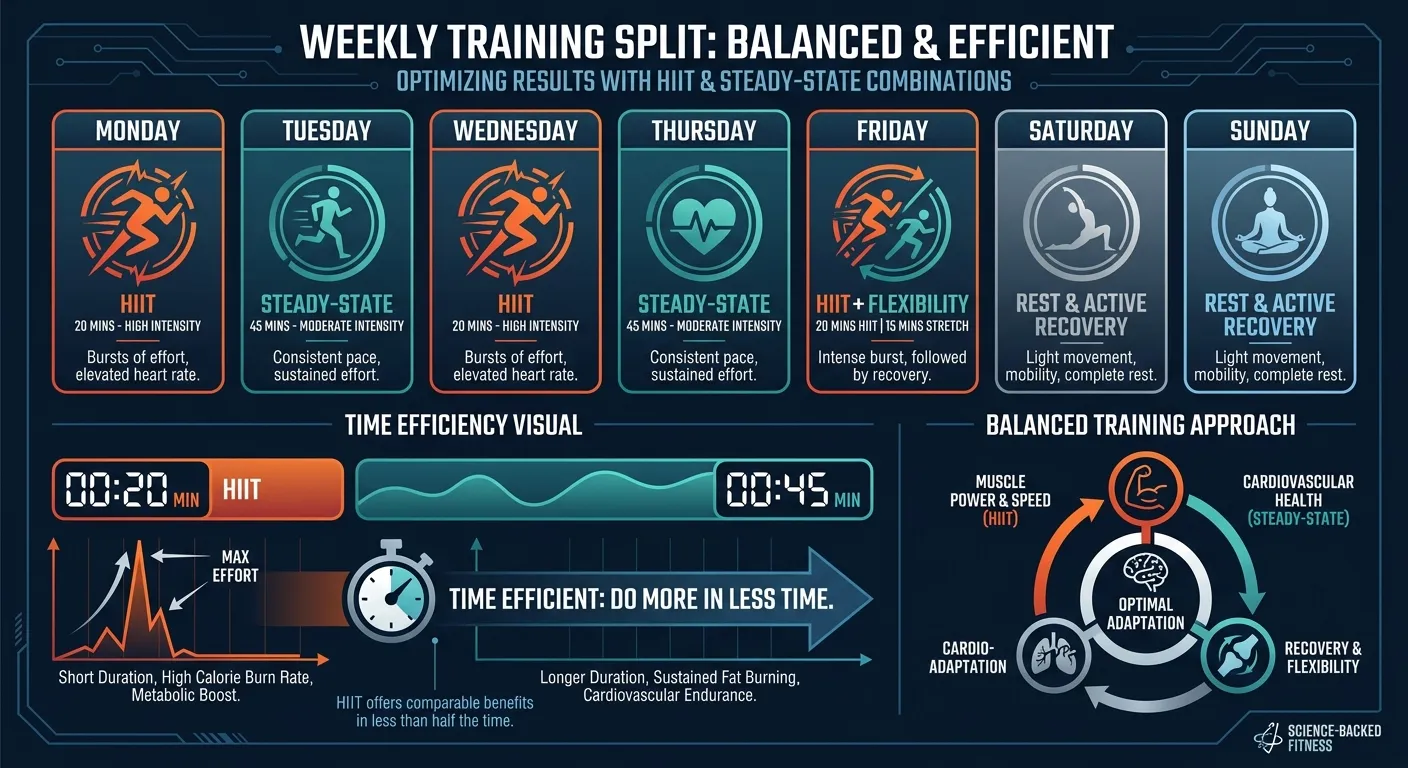
Nothing in the research suggests exclusivity. Most exercise guidelines, including the WHO's 2020 Physical Activity Guidelines, recommend 150-300 minutes of moderate-intensity or 75-150 minutes of vigorous-intensity aerobic activity per week. That "or" is important. A mix of both counts. In practice, combining 2-3 HIIT sessions with 1-2 longer steady-state sessions per week gives you the time efficiency of HIIT plus the recovery benefits and aerobic base of lower-intensity work.
Honest Limitations of This Research
Good science means being upfront about what we don't know. Here's what the research leaves unresolved.
Most Studies Are Short-Term
The trials in the Wewege meta-analysis ranged from a few weeks to several months. We don't have strong randomized evidence on HIIT versus steady-state beyond one year. Long-term adherence patterns may differ. Some people can sustain HIIT indefinitely, while others burn out. The reverse is also true for steady-state. Real-world sustainability matters more than any 12-week trial.
Participants Are Not Average App Users
People who volunteer for exercise studies are inherently more motivated than someone downloading an app at midnight after seeing a TikTok. Selection bias inflates the results of every exercise trial. The actual fat loss and fitness improvements for the general population are likely smaller than what these studies report.
The Protocols Varied Widely
The 13 studies in the Wewege analysis used different HIIT protocols — some used 30-second sprints, others used 4-minute intervals. Work-to-rest ratios varied. Equipment varied. When a meta-analysis pools these together, it tells you about the general category (HIIT) rather than any specific protocol. The "optimal" HIIT prescription for fat loss remains unknown.
Body Composition Isn't Everything
These studies primarily measured fat mass, waist circumference, and body weight. They tell us less about how each approach affects muscle mass, bone density, mental health, sleep quality, or long-term joint health. Fat loss is one piece of a much larger puzzle. For the muscle side of that question, our look at whether HIIT builds muscle pools the lean-mass trials and compares intervals with lifting.
How FitCraft Applies This Research
If the science says both HIIT and steady-state work, and that the best approach depends on your goals, fitness level, and schedule, then the real question becomes: who's adapting the programming to you?
That's what FitCraft's 3D AI coach Ty is built to do. Ty doesn't prescribe one-size-fits-all HIIT templates or generic jogging plans. The app assesses your current fitness level, your goals, your available equipment, and how much time you have, then builds a program that incorporates the right mix of intensities.
- Adaptive intensity scaling: Ty adjusts interval work and recovery periods based on how you're actually performing, not a static formula. This keeps HIIT sessions appropriately challenging without pushing you past recovery capacity.
- Smart programming variety: Your week might include HIIT cardio, steady-state mobility work, strength training, and yoga, all programmed together based on the research showing that mixed-modality approaches produce better adherence than rigid single-style programs.
- Bodyweight-first approach: Since the Wewege analysis found that running protocols outperformed cycling for fat loss, FitCraft emphasizes full-body movements that engage more muscle mass, no gym equipment required. Studies on bodyweight workout effectiveness confirm these movements produce meaningful adaptations without any equipment.
- Gamification that sustains effort: The hardest part of any cardio program isn't the first session. It's session 30. FitCraft's XP system, streaks, and collectible rewards use variable reinforcement schedules to keep you showing up past the initial motivation window.
Programs are designed by Domenic Angelino, an Ivy League-trained, NSCA-certified exercise scientist with publications in the Journal of Strength and Conditioning Research and Medicine & Science in Sports & Exercise. The science above isn't just referenced. It's built into the product.
FitCraft is free to start. No credit card, no commitment. Just a 2-minute assessment and your first personalized workout.
What the Research Suggests Going Forward
The HIIT-versus-steady-state debate is mostly settled for fat loss: they're equivalent, and HIIT saves time. For cardiovascular fitness, HIIT has an edge. For overall health, the WHO and ACSM both recommend a combination.
What we still need are longer trials (12+ months), head-to-head comparisons in diverse populations, and studies measuring outcomes beyond body composition: mental health, sleep, injury rates, long-term joint health.
In the meantime, the most evidence-based advice is also the simplest: do cardio you'll actually stick with. If you've got 20 minutes and enjoy intensity, do HIIT. If you prefer a longer walk or a 40-minute jog, that works just as well for fat loss. If you can fit in both, even better.
The worst cardio program is the one you quit after two weeks. That's not the research talking. That's just math.
References
- Wewege M, van den Berg R, Ward RE, Keech A. "The effects of high-intensity interval training vs. moderate-intensity continuous training on body composition in overweight and obese adults: a systematic review and meta-analysis." Obesity Reviews 18.6 (2017): 635-646. doi:10.1111/obr.12532
- Weston KS, Wisløff U, Coombes JS. "High-intensity interval training in patients with lifestyle-induced cardiometabolic disease: a systematic review and meta-analysis." British Journal of Sports Medicine 48.16 (2014): 1227-1234. doi:10.1136/bjsports-2013-092576
- Milanović Z, Sporiš G, Weston M. "Effectiveness of High-Intensity Interval Training (HIT) and Continuous Endurance Training for VO2max Improvements: A Systematic Review and Meta-Analysis of Controlled Trials." Sports Medicine 45.10 (2015): 1469-1481. doi:10.1007/s40279-015-0365-0
- Tjønna AE, Lee SJ, Rognmo Ø, et al. "Aerobic Interval Training Versus Continuous Moderate Exercise as a Treatment for the Metabolic Syndrome: A Pilot Study." Circulation 118.4 (2008): 346-354. doi:10.1161/CIRCULATIONAHA.108.772822
- World Health Organization. "WHO Guidelines on Physical Activity and Sedentary Behaviour." Geneva: WHO, 2020. NCBI Bookshelf
Frequently Asked Questions
Is HIIT better than steady-state cardio for fat loss?
According to the Wewege et al. 2017 meta-analysis of 13 studies and 786 participants published in Obesity Reviews, HIIT and moderate-intensity continuous training produce virtually identical fat loss results. Both groups lost approximately 2.6 kg of fat mass. The key difference is time: HIIT required about 40% less training time to achieve comparable results.
How much time does HIIT save compared to steady-state cardio?
Research shows HIIT requires approximately 40% less total training time than moderate-intensity continuous training for equivalent fat loss outcomes. A typical HIIT session runs 15-25 minutes including warm-up and cool-down, compared to 40-60 minutes for a steady-state session targeting similar caloric expenditure.
Does HIIT improve cardiovascular fitness more than steady-state cardio?
Yes, for certain populations. The Weston et al. 2014 meta-analysis in the British Journal of Sports Medicine found that HIIT improved VO2max by approximately 19% compared to 10% for moderate-intensity continuous training in patients with cardiometabolic disease. The Milanović et al. 2015 meta-analysis of 28 studies confirmed larger VO2max gains with HIIT in healthy adults as well.
Is HIIT safe for beginners?
HIIT can be safe for beginners when properly scaled. "High intensity" is relative to the individual. What matters is reaching 80-95% of your maximum heart rate during work intervals, not performing advanced movements. Starting with longer rest periods and shorter work intervals allows beginners to build tolerance gradually. FitCraft's AI coach Ty automatically scales intensity based on your fitness level.
Does FitCraft use HIIT in its workout programs?
Yes. FitCraft's AI coach Ty builds personalized programs that incorporate both HIIT and steady-state cardio based on your goals, fitness level, and schedule. The app adjusts interval timing and intensity in real time, applying the research showing that individualized HIIT programming produces better adherence and results than generic protocols.