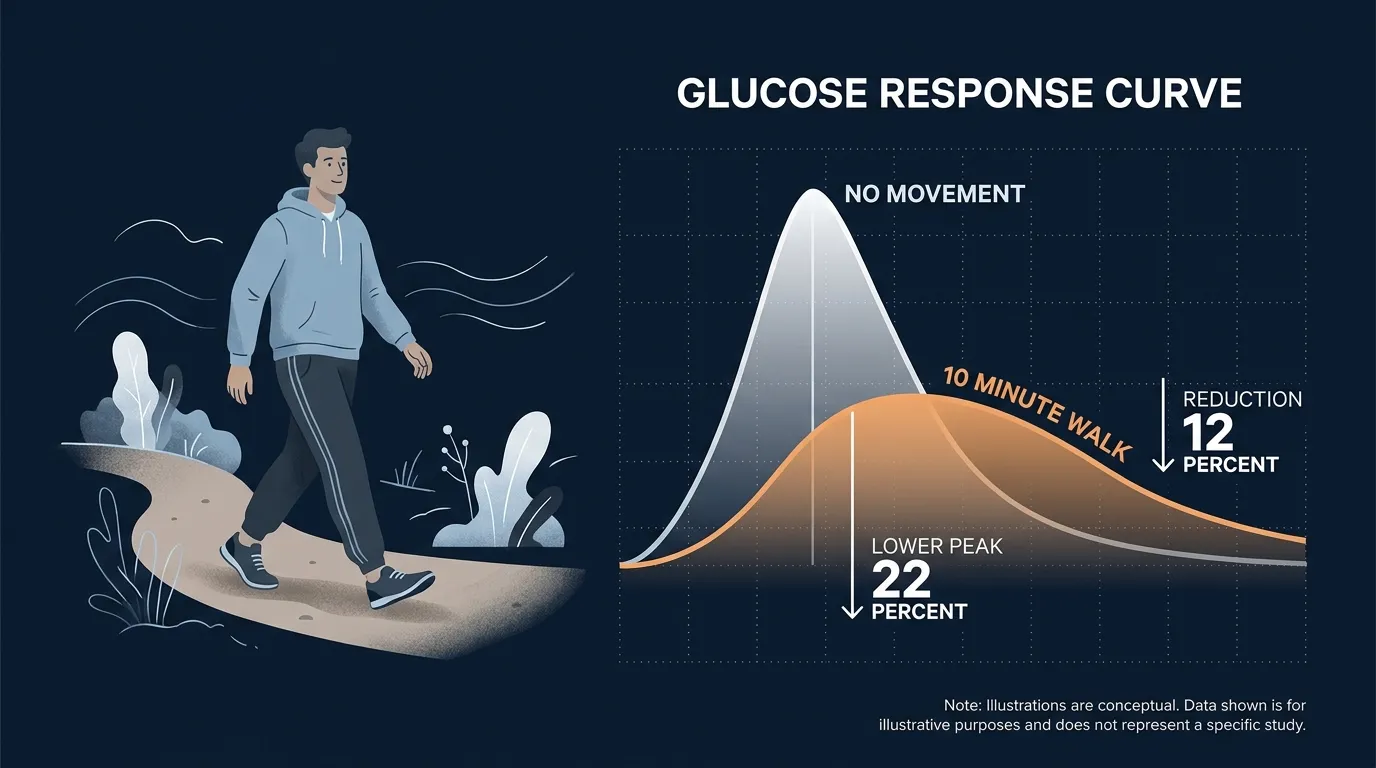
- Ten minutes of light walking right after a meal lowers postprandial blood glucose by roughly 12 to 17 percent on average, with the after-dinner walk often showing a 22 percent drop. (Reynolds 2016, Buffey 2022)
- Timing matters more than total minutes. A 10-minute post-meal walk beats a 30-minute walk done at a random time of day for glucose control. (Reynolds 2016, Diabetologia)
- The pace doesn't have to be brisk. The studied speed averaged about 3.8 km/h, roughly a comfortable stroll. Slow still works.
- Walking after eating also reduces bloating, gas, and belching, with effects similar to a prokinetic medication in a 2021 randomised clinical trial.
- Start within 15 to 30 minutes of finishing your meal. Aim for 10 minutes. Repeat after the next meal. That's the entire protocol.
You finish dinner. The plate is empty. The couch is calling. Your phone is right there.
Most people sit. And inside that sitting body, blood sugar is climbing fast. Carbs from the meal break down into glucose, glucose hits the bloodstream, insulin scrambles to clear it. The peak usually lands somewhere between 30 and 90 minutes after the first bite. If you're sedentary while it climbs, the curve is steep and tall. If you're moving, even gently, the curve is shorter and flatter.
That's the whole pitch for walking after meals. It's a small habit with a big payoff, and the research is unusually clean. So let's walk through what's actually been shown, why timing beats total time, and how to make this stick when your couch is more comfortable than your sneakers.
What Happens to Blood Sugar After You Eat
Every meal with carbs creates a glucose curve. Bigger meal, bigger curve. Higher-carb meal, sharper peak. The body's response, mostly insulin, pulls glucose out of the blood and into muscles, liver, and fat cells where it's used or stored. A healthy body handles this well. A body with insulin resistance or type 2 diabetes handles it less well, and the curve stays high longer.
That post-meal spike isn't just a diabetes problem. Even in healthy adults, repeated big spikes are linked to higher cardiovascular risk, more inflammation, and worse long-term metabolic health. So flattening the curve is useful whether you have a diagnosis or not.
Why muscles change the math
Walking muscles pull glucose out of the blood directly. They do it without insulin, through a transporter called GLUT4 that opens up when muscles contract. So light activity right after eating gives the body a second clearance pathway. Insulin still does its job. The walking adds a parallel one. The result is a smaller, gentler curve.
And here's the thing. The window where this matters is short. Glucose rises fast and peaks within 60 to 90 minutes. If you start moving while the curve is climbing, you blunt the peak. If you wait two hours, you've missed it. The same number of walking minutes after the peak does much less.
The 10-Minute Walk That Beat the 30-Minute Walk
The cleanest evidence comes from a 2016 study in Diabetologia. Reynolds and colleagues ran a randomised crossover trial in 41 adults with type 2 diabetes. For two weeks at a time, participants either walked 30 minutes once a day at any time, or walked 10 minutes after each of their three main meals. Same total walking. Different schedule.
Postprandial glucose dropped 12 percent more on the post-meal-walk schedule. The biggest effect, a 22 percent drop, came after dinner, the meal that's usually highest in carbs and most often followed by sitting still. Same person. Same daily walking total. Just better timing.
What a meta-analysis adds
The Reynolds study isn't alone. A 2022 systematic review and meta-analysis by Buffey et al. in Sports Medicine pooled seven randomised crossover trials in mostly overweight or obese adults. Light-intensity walking breaks during the day cut postprandial glucose by roughly 17 percent compared to staying seated. Standing alone helped too, dropping glucose by about 9.5 percent, but walking nearly doubled the effect.
Want even more recent data? A 2023 Sports Medicine systematic review by Engeroff and colleagues looked specifically at the timing question across healthy subjects and people with impaired glucose tolerance. Their conclusion was direct: for blunting the post-meal glucose peak, exercise after the meal beats exercise before it. The clinical guidance line they pulled out: "after dinner, walk a mile."
The pace that actually works
Easy. That's the answer. In Bellini et al. 2022 in Nutrients, participants self-selected a comfortable walking speed and still got the glucose benefit. The average pace landed at about 3.8 km/h (2.4 mph). That's a casual stroll, not power-walking. No need for a fitness tracker, no need to hit a step rate. The mechanism isn't cardio. It's muscle contraction nudging glucose out of the bloodstream, and even slow contractions do that.
Ready to put this into practice?
Take the free FitCraft assessment and get a personalized plan based on behavioral science, not willpower.
Take the Free Assessment Free • 2 minutes • No credit cardThe Other Reason People Walk After Eating: Their Gut
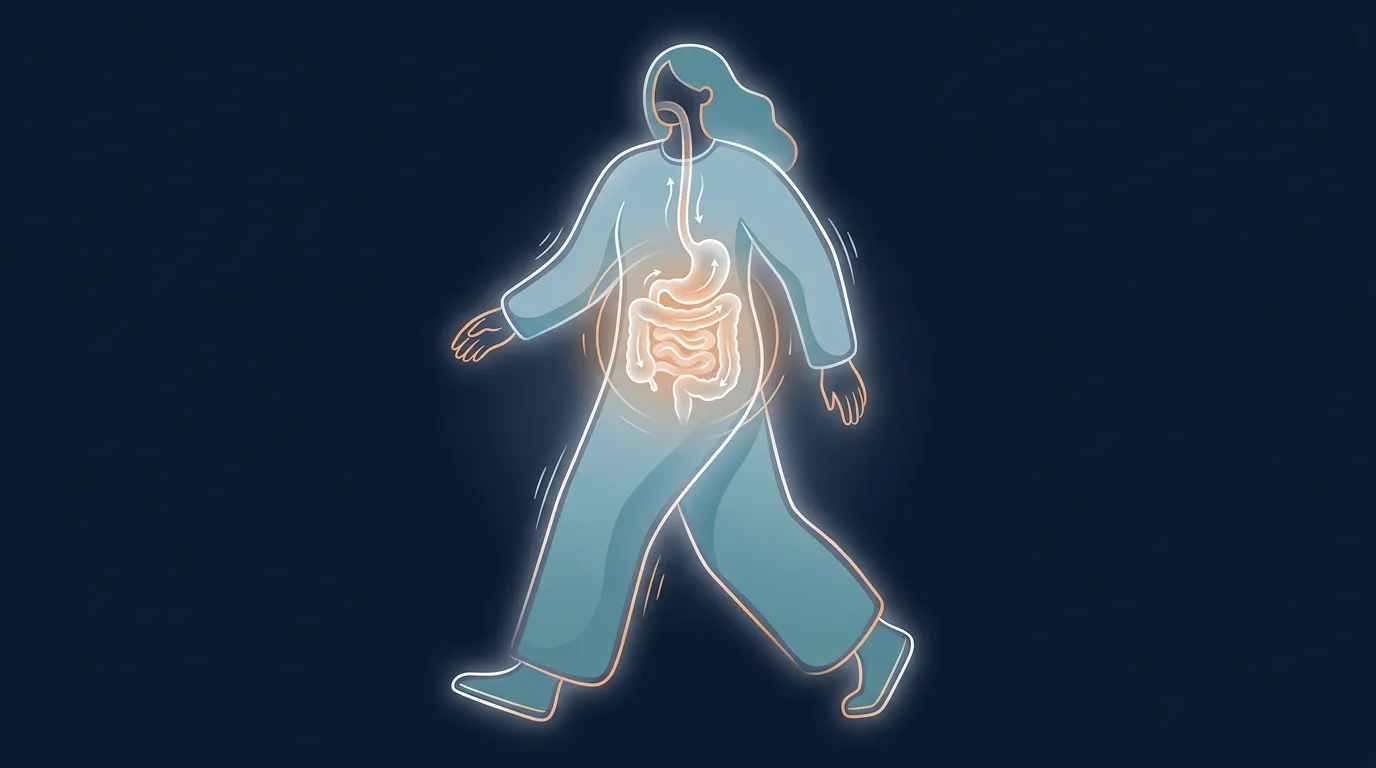
If you've ever heard the phrase "fart walk," you know where this is going. The TikTok trend isn't wrong. Light walking after a meal really does help with bloating, gas, and that heavy "I shouldn't have eaten that much" feeling.
The clearest evidence is a 2021 randomised clinical trial by Hosseini-Asl and colleagues in Gastroenterology and Hepatology From Bed to Bench. They compared a 10 to 15 minute post-meal walk to a prokinetic medication in adults with functional bloating. Both reduced symptoms across the board: less bloating, less belching, less gas, less postprandial fullness, less abdominal discomfort. The walking group came out ahead on the bloating score specifically.
The mechanism is simple. Walking increases gut motility, the rhythmic muscular contractions that push food and gas along the digestive tract. Standing alone helps. Walking helps more. Sitting compresses the abdomen and slows things down, which is the worst possible position right after a meal. Ten minutes after dinner is a habit rather than a training plan, and our post on whether walking counts as exercise covers the pace at which it starts counting.
How to Actually Make This a Habit
The science is clean. The problem isn't knowing what to do. The problem is doing it after eight different things in your day already used up your willpower budget.
So here's how to set this up so it doesn't depend on motivation.
Anchor the walk to the meal, not the clock
Don't schedule "walk at 7:15." Schedule "walk after dinner." The trigger is the empty plate. The action is sneakers on. Habit researchers call this implementation intention, and it's one of the few behavior-change tricks that survives contact with real life. If you tie a new behavior to an existing one (the meal), the existing one does the remembering for you.
Start at five minutes, not ten
Five minutes feels stupid easy. That's the point. Easy gets done. Easy survives bad days, rainy days, "I'm tired" days. Once five minutes is automatic, ten happens on its own. Most people who try to start at thirty quit by week two. We've covered this exact dynamic in our guide to consistency over intensity, and the pattern is remarkably consistent: small commitment, sustained, beats big commitment, abandoned.
Pick the meal that's easiest to walk after
For most people, that's dinner. Lower stakes, less time pressure, often the highest-carb meal of the day. So you get the biggest glucose effect from the easiest insertion point. Lunch is the second-easiest if you work somewhere with a sidewalk. Breakfast is hardest because mornings already run on rails. Don't fight the calendar. Pick the meal where the walk fits and let the others be bonus.
Make it boring
Don't try to make this a "real workout." Don't track pace. Don't plan a route. Boring is the feature, not the bug. The whole point of the post-meal walk is that it's such a low ask that you'll actually do it. Light music, a podcast, a phone call with a friend. Or nothing. Just movement.
When the Post-Meal Walk Doesn't Apply
A few honest caveats.
If your meal was tiny (a snack, a piece of fruit), the glucose effect is tiny too. You'll still get a small benefit, but the protocol is built around real meals with real carb loads. Don't beat yourself up for skipping a walk after an apple.
If you have GERD or reflux, lying down right after eating is the worst posture and walking is one of the best. Gravity helps keep stomach contents where they belong, and gentle movement supports that. So this is a high-value habit specifically for reflux-prone folks, not a problem.
If you're on a GLP-1 medication or have any condition that affects gastric emptying, the post-meal glucose curve looks different and the walk's effect can be smaller in absolute terms. It still tends to help. Talk to your provider about specifics, especially if you're tracking with a continuous glucose monitor. Our deeper take on the GLP-1 question lives in our Ozempic and exercise piece.
And if you've got mobility limits, marching in place at the kitchen counter or pacing the hallway counts. The benefit comes from muscle contraction, not from going anywhere specific.
What This Means for You
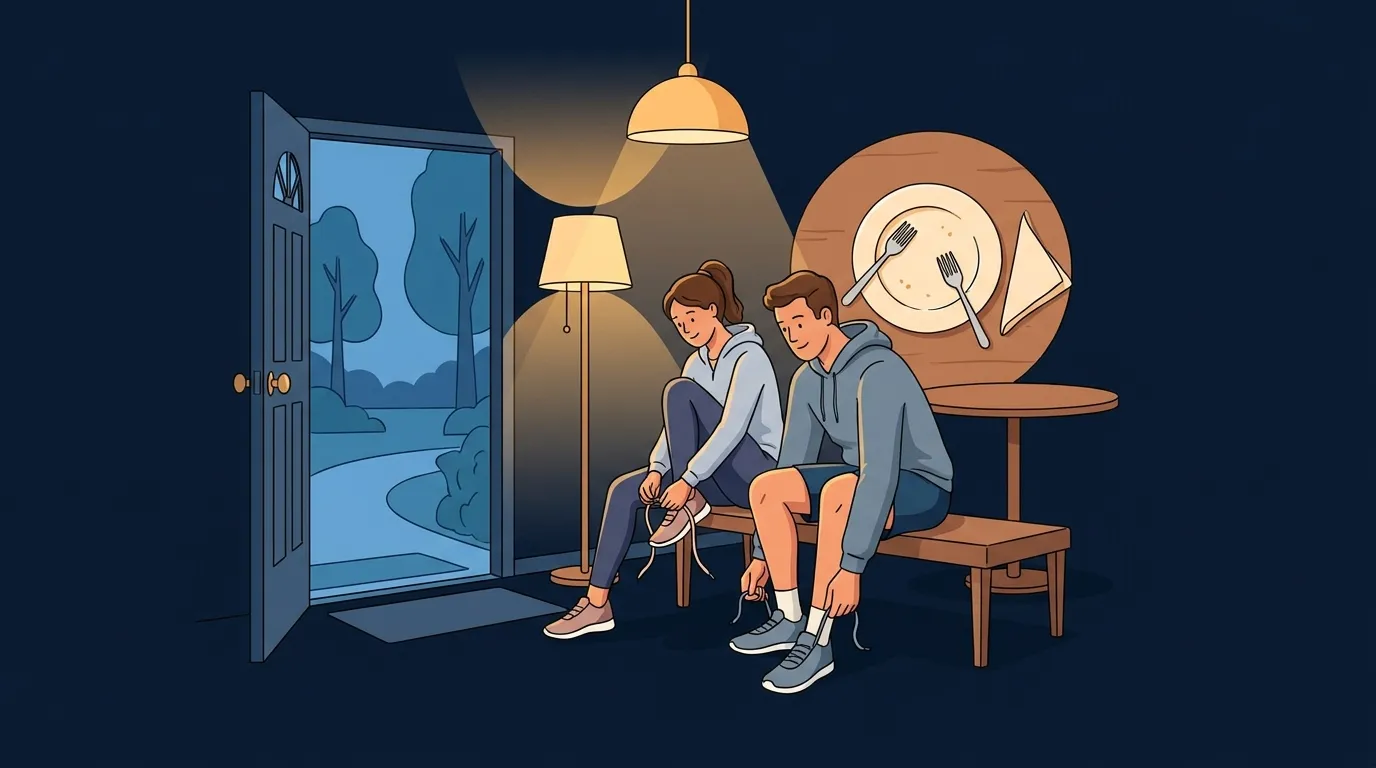
Picture the next month. After dinner, instead of the couch, you're outside. Ten minutes. The light is fading. Your stomach feels less heavy than it usually does at this point in the night. Your sleep is a little better, because elevated blood sugar near bedtime tends to mess with sleep quality, and you've blunted that. By week three, you don't think about it anymore. You stand up when the plate is clear. The shoes are by the door.
The thing about this habit is that it pays you back fast. The glucose effect happens the first night. The bloating effect, the same night. The sleep effect, within a week. Most healthy habits ask you to wait months for results. This one delivers within hours. That's why it sticks when other "shoulds" don't.
And it pairs well with the rest of a basic fitness practice. The post-meal walk isn't a substitute for strength training or higher-intensity cardio. Think of it as the floor. The minimum dose of movement that protects your metabolic health and your gut. On top of that, you still want resistance work two to three days a week, which is where FitCraft's 3D AI coach Ty comes in. Ty walks you into a workout that fits your day, demonstrates each exercise from any angle in interactive 3D, and uses streaks and programs to make consistency feel like a game rather than a chore. The post-meal walk handles glucose. The training handles muscle. Both stack.
Most people who quit fitness apps quit because the ask is too big. Sixty-minute workouts, six-day splits, perfect macros. We built FitCraft for the opposite assumption: that the people who win at fitness are the ones who make tiny, repeatable, almost-too-easy moves part of their day. A 10-minute post-meal walk is exactly that kind of move. So is a 12-minute mobility flow with Ty in your living room. So is hitting your protein floor at breakfast. None of it looks heroic. All of it compounds.
Frequently Asked Questions
How long should I walk after eating?
Ten minutes is the sweet spot supported by the strongest research. A 2016 randomised crossover study in Diabetologia found that 10-minute walks after each main meal lowered postprandial glucose by an average of 12% in adults with type 2 diabetes, with a 22% drop after the evening meal. Even shorter bouts of two to five minutes still beat sitting still, according to a 2022 Sports Medicine meta-analysis.
When is the best time to walk after a meal?
Start walking within 15 to 30 minutes of finishing your meal. That window catches the rising glucose curve before it peaks. Waiting an hour or more lets the spike already happen, so the walk has less to flatten. Earlier is better than later, and any walking is better than none.
Does a 10-minute walk really lower blood sugar?
Yes. Light-intensity walking after meals reduced postprandial glucose by roughly 17% on average compared to continued sitting in a 2022 Sports Medicine meta-analysis of seven randomised crossover trials. The effect is larger when the meal is carbohydrate-heavy, which is why the after-dinner walk usually shows the biggest drop.
Can walking after eating help with bloating and digestion?
It can. A 2021 randomised clinical trial in Gastroenterology and Hepatology From Bed to Bench found that a 10 to 15 minute walk after each meal reduced bloating, gas, belching, and abdominal discomfort, with effects comparable to or better than a prokinetic medication. Light movement nudges the gut to push gas and food along.
Do I need to walk fast to get the benefit?
No. The studied pace was light. Participants self-selected a comfortable speed averaging about 3.8 km/h (2.4 mph), roughly a leisurely stroll. The point is gentle muscular activity, not cardio. A relaxed walk after dinner counts. Pushing the pace gives a slightly bigger glucose effect, but the consistency of doing it daily matters more than speed.