Open any fitness app. Within minutes, it will tell you what to do: hit 10,000 steps, work out 3 times per week, burn 500 calories a day. The numbers vary. The approach doesn't. The app assigns the goal. You're expected to follow it.
This feels reasonable. Surely the experts know better than you do. Surely a data-driven recommendation beats a gut feeling. And yet the dropout numbers tell a different story. The average fitness app loses 90% of its users within 90 days — a pattern we analyze in the Week 20 problem. People don't fail because the goals are wrong. They fail because the goals aren't theirs.
That's not a motivational platitude. It's a testable hypothesis — and a team of researchers at the University of Pennsylvania tested it in one of the most rigorous physical activity trials ever conducted.
The ENGAGE Trial: The Definitive Study on Goal Setting and Physical Activity
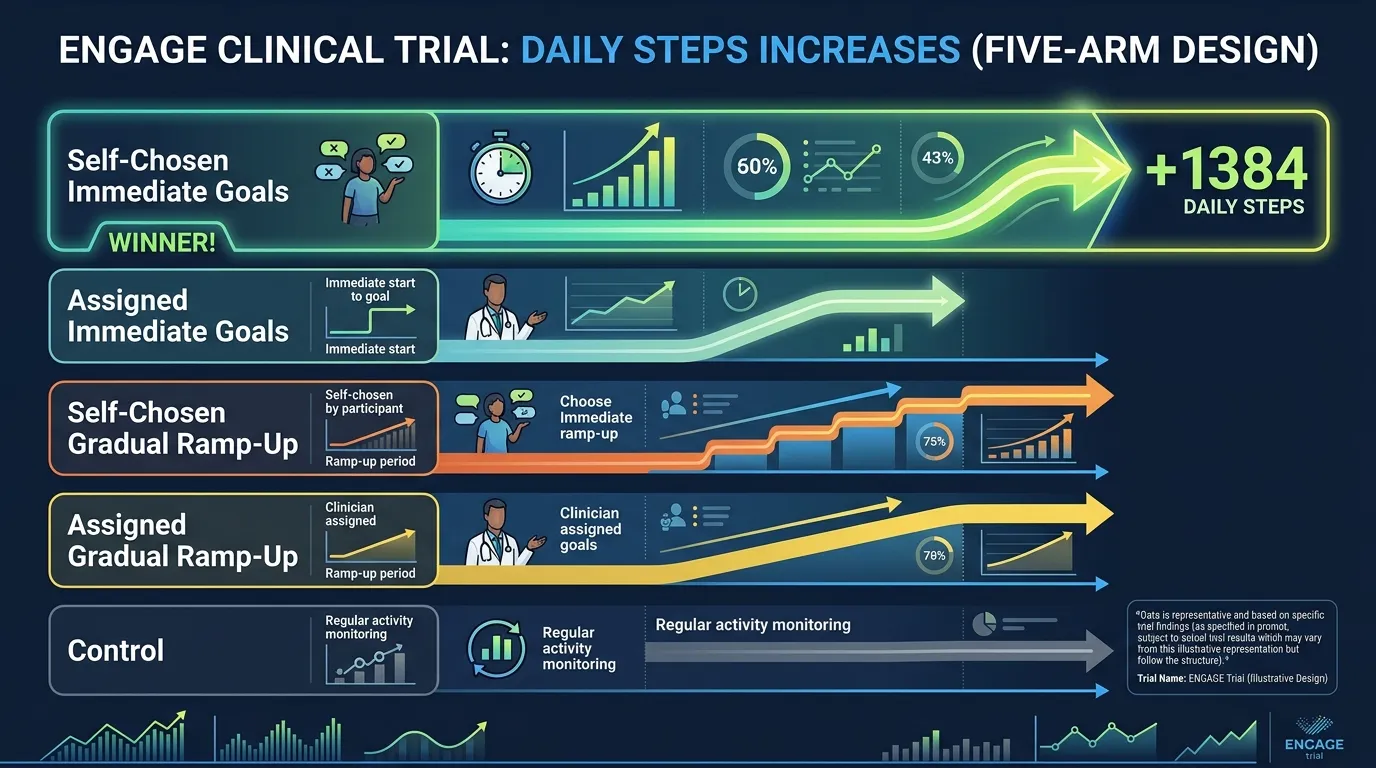
The ENGAGE trial was a 5-arm randomized controlled trial published in JAMA Cardiology in 2021 (PMC8411363). It was designed to answer a specific question: does it matter whether fitness goals are self-chosen or assigned — and does it matter whether you ramp up gradually or start immediately?
The study enrolled 500 adults from lower-income neighborhoods in Philadelphia. The population was approximately 66% Black, roughly 70% women, with a mean age of 58.5 years. This wasn't a study of already-motivated gym-goers. These were real people, many of whom faced significant barriers to physical activity.
Here's what made the trial design so powerful: gamification was held constant across all five arms. Every participant received the same gamification package — points, levels, social incentives. The only thing that varied was the goal-setting approach. This allowed the researchers to isolate the effect of goal type with unusual precision.
The five arms were:
- Control — standard monitoring only
- Self-chosen + immediate — participants picked their own step goal and started at that level immediately
- Self-chosen + gradual — participants picked their own step goal but ramped up to it over several weeks
- Assigned + immediate — researchers set the goal based on baseline data; participants started immediately
- Assigned + gradual — researchers set the goal; participants ramped up gradually
The Results Were Stark
Only one condition produced significant and sustained results: self-chosen goals with an immediate target.
Participants in the self-chosen + immediate arm increased their daily steps by 1,384 compared to control (P<.001). They increased their moderate-to-vigorous physical activity (MVPA) by 4.1 minutes per day (P<.001). And these weren't temporary effects that faded once the intervention ended — at follow-up, the gains held: +1,391 steps/day (P<.001) and +3.5 min/day MVPA (P=.004).
Now look at the other three intervention arms:
- Self-chosen + gradual: did NOT reach consistent significance
- Assigned + immediate: did NOT reach consistent significance
- Assigned + gradual: did NOT reach consistent significance
Read that again. Three out of four goal-setting strategies — including the approaches used by most fitness apps — failed to produce reliable results. Only the combination of personal choice and immediate commitment worked.
This is not a marginal finding. In a 500-person RCT published in one of cardiology's most respected journals, three of four experimental conditions were statistically indistinguishable from doing nothing. One condition produced a large, durable effect. The difference was autonomy.
Why "Gradual Ramp-Up" Failed
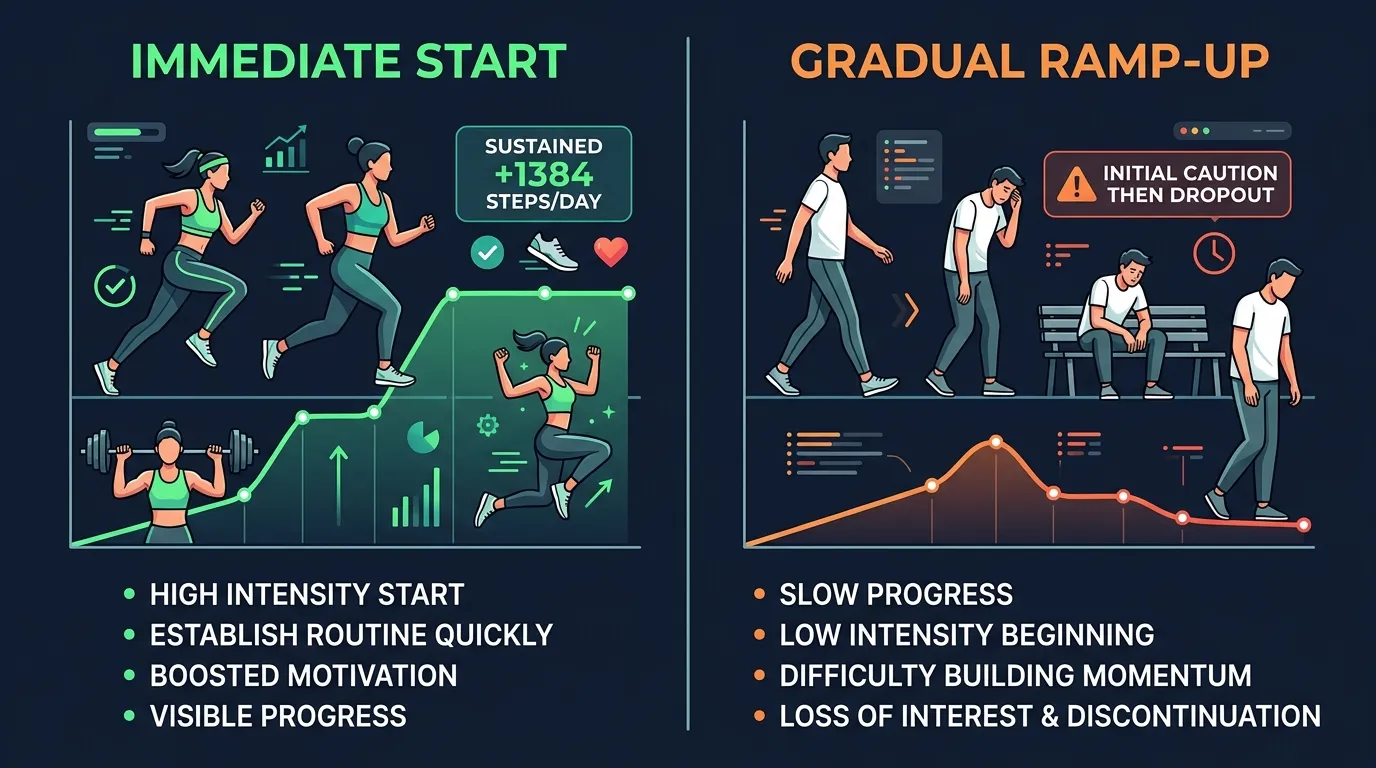
This is the finding that surprises people most. Conventional wisdom says you should ease into fitness — start small, build slowly, avoid overwhelming yourself. It sounds logical. It sounds safe. And in this trial, it didn't work.
Even when participants chose their own goals, the gradual ramp-up condition failed to produce consistent significant effects. Why?
The researchers didn't speculate extensively on mechanism, but the behavioral psychology literature offers a compelling explanation. When you choose a goal and start pursuing it right now, the goal feels real. It's yours, and you're doing it. There's a psychological commitment that forms in the act of immediate engagement.
When you choose a goal but are told "we'll ease you into it over the next few weeks," something subtle happens: the pacing becomes externally controlled. You chose the destination, but someone else is driving. The gradual trajectory reintroduces an element of external regulation — and that's enough to undermine the autonomy benefit that made self-chosen goals effective in the first place. This mirrors the broader finding that externally controlled systems deplete motivation.
There's another factor at play. Immediate goals create immediate feedback. You know today whether you hit your target. Gradual ramp-up goals create ambiguity — you're always in a transitional phase, never quite at the "real" goal, and the feedback signal is muddied. That ambiguity erodes the sense of competence (another core need identified by Self-Determination Theory) and makes it harder to build the identity of someone who hits their goals.
The practical implication is clear: pick your goal, then start. Don't let a system pace you. The data says the gradual on-ramp doesn't help — it actually strips away the autonomy that makes your goal worth pursuing.
The Psychology: Self-Determination Theory and the Power of Autonomy
The ENGAGE trial's results align precisely with one of the most extensively validated frameworks in motivational psychology: Self-Determination Theory (SDT), developed by Edward Deci and Richard Ryan.
SDT identifies three core psychological needs that drive intrinsic motivation:
- Autonomy — the feeling that your actions are self-chosen, not imposed
- Competence — the feeling that you're effective and growing
- Relatedness — the feeling of connection to others
When these needs are satisfied, people experience intrinsic motivation — the kind that sustains behavior without external pressure, rewards, or accountability tricks. When these needs are thwarted, motivation becomes extrinsic (doing something because you "should"), which is fragile and short-lived.
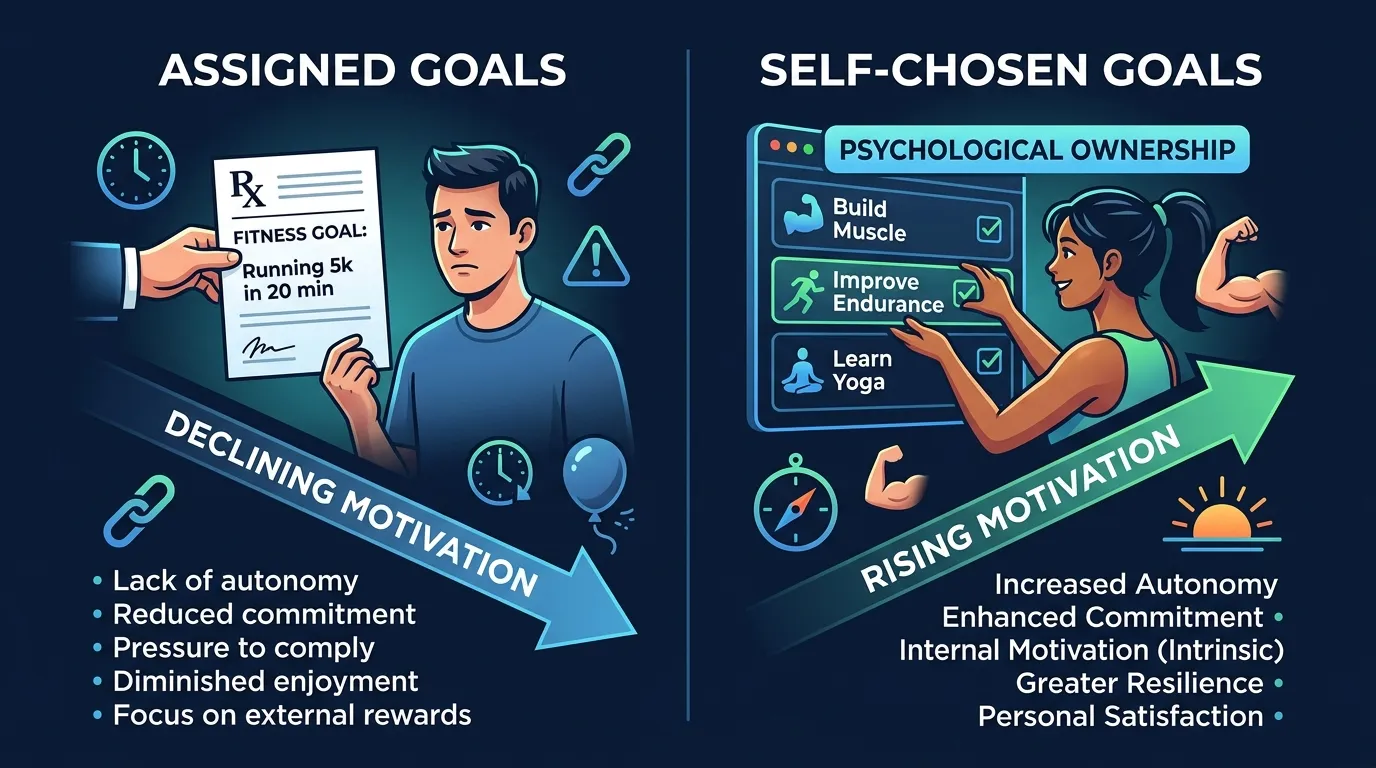
Assigned goals directly thwart autonomy. As the gamification research confirms, SDT explains why well-designed game mechanics keep people exercising. Even if the goal is perfectly calibrated to your fitness level, the fact that someone else chose it shifts the locus of control. The goal becomes something you're complying with rather than something you're pursuing. And compliance, as decades of SDT research have shown, does not sustain behavior.
Self-chosen goals do the opposite. When you select a target — even if it's imperfect, even if an expert might have picked a different number — the act of choosing activates ownership. The goal becomes an expression of your intentions, not someone else's prescription. That psychological ownership is what the ENGAGE trial captured: it's the difference between +1,384 steps/day and statistical insignificance.
Your goals. Your plan. Backed by research.
FitCraft's diagnostic asks what matters to you — then builds a program around your choices, not someone else's prescription.
Take the Free Assessment Free · 2 minutes · No credit cardSupporting Evidence: The BE FIT Trial
The ENGAGE trial isn't an isolated result. The BE FIT trial — a randomized clinical trial published in JAMA Internal Medicine in 2017 (PMC5710273) — tested a gamified physical activity intervention with 200 participants from 94 families. A key design feature: participants selected individualized step goal increases rather than being assigned a universal target.
The results reinforced the same principle. Participants who chose their own goals achieved them on 53% of days, compared to just 32% for controls — a highly significant 21-percentage-point difference. They also increased daily steps by 1,661 compared to 636 for controls.
BE FIT didn't directly compare self-chosen vs assigned goals the way ENGAGE did (see the full trial statistics), but its design implicitly validated the approach: letting participants drive goal selection produced strong adherence and sustained behavior change. The trial's success with individualized, participant-selected goals foreshadowed what ENGAGE would later confirm experimentally.
What About "Unrealistic" Goals?
The most common objection to self-chosen goals is predictable: "But what if people set unrealistic goals and then fail? Isn't it better to have an expert guide them?"
It's a reasonable concern. And the data addresses it directly.
In the ENGAGE trial, the assigned goals were set by researchers based on each participant's baseline activity data. These were, by any standard, well-calibrated goals set by experts. They were probably more "realistic" than what many participants chose for themselves. And they didn't work. The assigned goal conditions — both immediate and gradual — failed to reach consistent statistical significance.
Meanwhile, the self-chosen goals — which were presumably a mix of ambitious, conservative, and everything in between — produced the trial's only significant results. The implication is striking: the "quality" of the goal matters less than the ownership of it.
This doesn't mean goal selection should be random or uninformed. It means the person doing the choosing matters more than the precision of the choice. A slightly imperfect goal that you own will outperform a perfectly calibrated goal that was handed to you. Every time.
The practical takeaway for app design is not "let users do whatever they want with no guidance." It's "give users the information they need, then let them decide." There's a difference between informing a choice and making it for someone.
How FitCraft Applies This Research
FitCraft was built on a specific premise: the user drives the goals, and the system adapts around them. Here's how that works in practice.
When you start FitCraft, the diagnostic assessment doesn't tell you what your goals should be. It asks what matters to you. Do you want to build strength? Lose weight? Feel more energetic? Exercise consistently for the first time? The answers are yours. The AI coach Ty then builds a program around your stated priorities — not a generic template, and not a researcher's best guess at what you "should" want.
As you train, Ty adapts. If you're crushing your goals, the program evolves. If you're struggling, it adjusts. But the direction is always yours. Ty handles the exercise science — the sets, reps, progression, periodization — while you maintain ownership of where you're headed. This is exactly the model that the ENGAGE trial validated: self-chosen direction with immediate engagement, supported by intelligent systems that handle the technical details.
This approach also addresses the "unrealistic goal" concern without stripping autonomy. The diagnostic provides context. Ty provides feedback. But the choice stays with you — because the research is clear that the moment someone else takes the wheel, the motivation advantage disappears.
Frequently Asked Questions
Should I set my own fitness goals or follow what an app tells me?
Research strongly favors self-chosen goals. The ENGAGE trial (2021, JAMA Cardiology, n=500) found that participants who chose their own step goals increased daily steps by 1,384 — a highly significant result (P<.001). Participants given assigned goals did not achieve statistically significant improvements. Self-Determination Theory explains why: when goals feel self-chosen, intrinsic motivation increases because your need for autonomy is satisfied.
Is it better to start with small gradual goals or jump to your target immediately?
Counterintuitively, the ENGAGE trial found that gradual ramp-up goals did not produce significant results — even when they were self-chosen. Only the self-chosen immediate goal condition (jumping straight to your target) produced significant and sustained increases in physical activity (+1,384 steps/day during intervention, +1,391 at follow-up). The gradual approach may undermine motivation by making the goal feel externally paced rather than personally owned.
What is the ENGAGE trial?
The ENGAGE trial was a 5-arm randomized controlled trial published in JAMA Cardiology in 2021 (PMC8411363). It enrolled 500 adults from lower-income neighborhoods — approximately 66% Black, 70% women, mean age 58.5 — and tested different combinations of goal types (self-chosen vs assigned) and goal trajectories (immediate vs gradual). Gamification was held constant across all arms. It is one of the most rigorous studies ever conducted on goal setting and physical activity.
What if I set an unrealistic fitness goal for myself?
The research suggests that the act of choosing matters more than choosing perfectly. In the ENGAGE trial, assigned goals were set by researchers based on baseline data — well-calibrated by experts — and they still failed to reach consistent significance. Self-chosen goals, which were presumably a mix of ambitious and conservative, produced the only significant results. A well-designed app helps you make informed choices rather than prescribing goals for you.
How does FitCraft let me set my own fitness goals?
FitCraft's diagnostic assessment asks what matters to you — your goals, your schedule, your preferences. The AI coach Ty then builds a program around your choices. You drive the direction; Ty handles the programming details. This approach is directly informed by the ENGAGE trial's finding that self-chosen goals are the only type that produce sustained physical activity increases, and by Self-Determination Theory's emphasis on autonomy as a core psychological need.