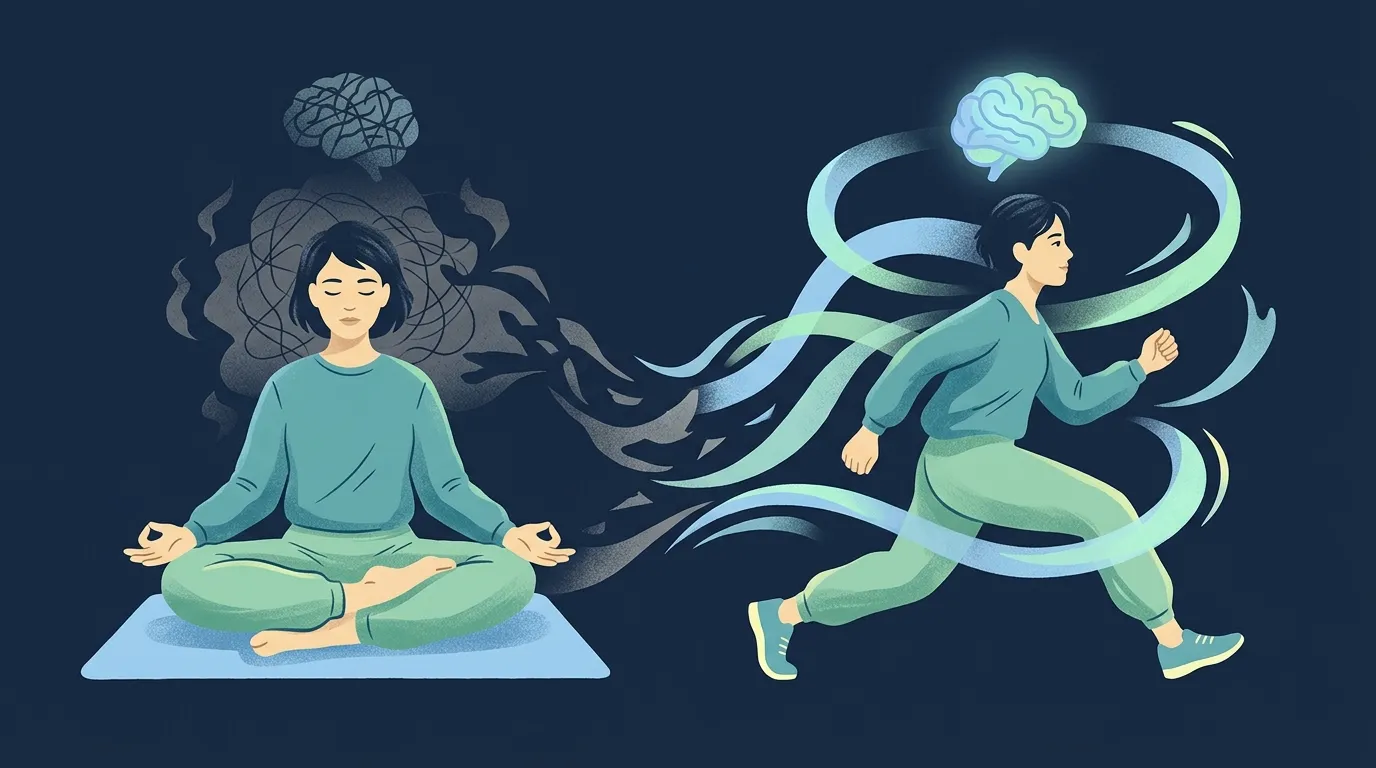
If you're reading this while dealing with anxiety or depression, something important first: this article is not going to tell you to "just exercise more" and expect that to fix everything. Depression and anxiety are real medical conditions. They deserve real treatment — therapy, medication if appropriate, professional support.
But there is something the research is remarkably clear about: exercise is one of the most effective interventions we have for both conditions. Not as a replacement for professional care. As a complement to it. And for many people, the biggest obstacle isn't knowing that exercise helps — it's finding a way to actually do it when your brain is working against you.
That's where the right tool matters.
The Research: Exercise as a Mental Health Intervention
This isn't wellness-influencer speculation. The evidence base for exercise as a treatment for anxiety and depression is enormous and growing.
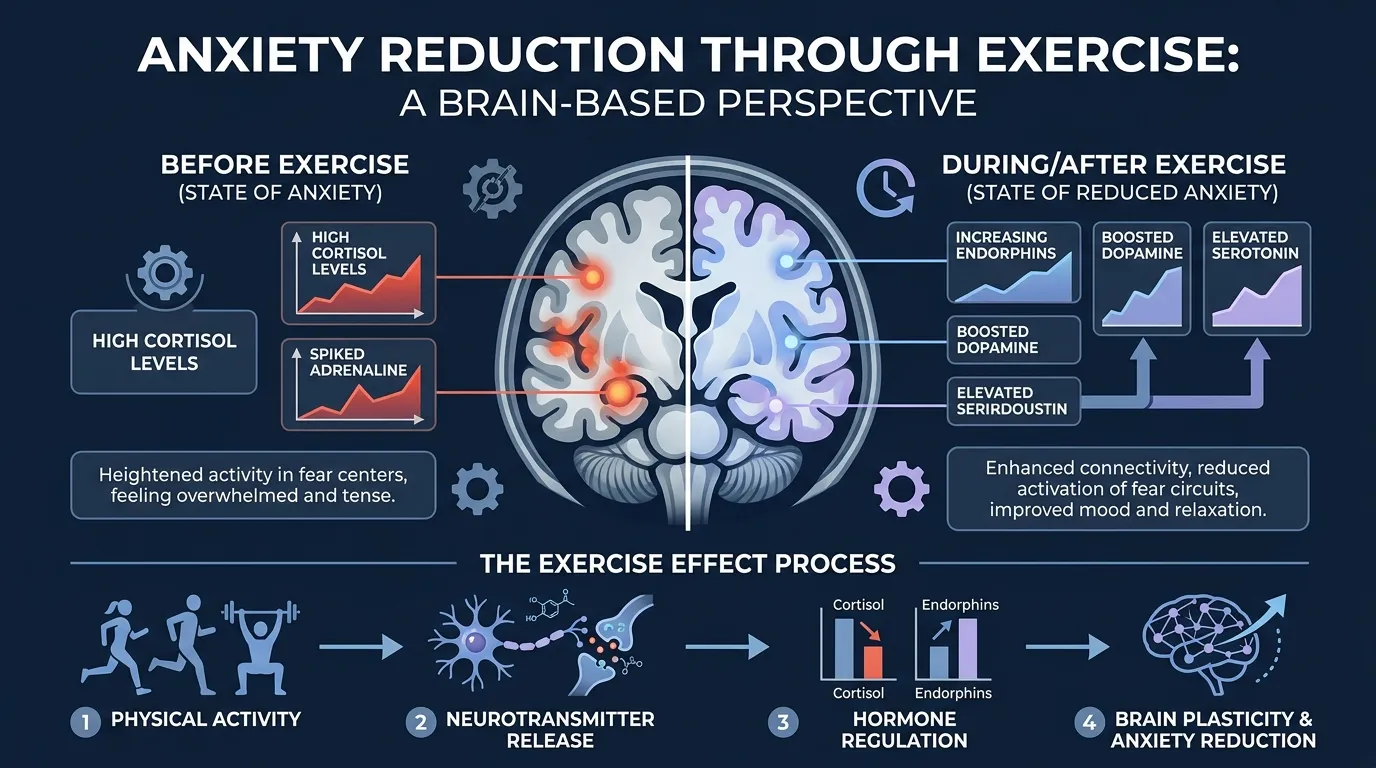
In 2023, Singh et al. published an umbrella review in the British Journal of Sports Medicine — essentially a review of reviews — that synthesized 97 systematic reviews covering more than 128,000 participants (Singh et al., 2023). Their conclusion was striking: physical activity was as effective as psychotherapy and more effective than many pharmacological interventions for reducing symptoms of depression, anxiety, and psychological distress.
This wasn't a marginal finding. The effect sizes were large, clinically meaningful, and consistent across diverse populations — men and women, young and old, people with and without pre-existing health conditions.
Earlier research supports the same conclusion. A landmark 2018 meta-analysis in the American Journal of Psychiatry by Schuch et al. pooled 49 prospective studies covering 266,939 people and found that those with high physical activity had 17% lower odds of developing depression than those with low activity (adjusted odds ratio 0.83). The protective effect held in youths, adults, and older people, and across every region studied (Schuch et al., 2018).
How Much Exercise? The Dose-Response Curve
One of the most important findings in this literature is that the dose-response curve for exercise and mental health is steepest at the low end. In plain language: the biggest improvement comes from going from nothing to something.
Choi et al. (2019), also publishing in JAMA Psychiatry, used Mendelian randomization — a method that helps establish causation, not just correlation — and found that as little as 15 minutes of vigorous activity per day (or roughly one hour of moderate activity) was associated with a 26% reduction in depression risk (Choi et al., 2019).
This matters enormously for people with depression, because depression makes ambitious exercise plans feel impossible. You don't need to train for a marathon. You don't need an hour in the gym. You need to move your body for a few minutes, consistently. That's the threshold where the mental health benefits begin.
A 2022 prospective study by Pearce et al. in JAMA Psychiatry reinforced this, finding that adults who performed even half the recommended amount of physical activity (about 75 minutes of moderate activity per week — roughly 11 minutes per day) had an 18% lower risk of depression (Pearce et al., 2022).
The takeaway: perfection is not required. Any movement counts. And shorter sessions are not "less than" — for mental health purposes, they may be exactly right.
Which Types of Exercise Help Most?
If you're hoping for a single "best" exercise type for depression or anxiety, the honest answer is: the best type is the one you'll actually do. But the research does reveal some patterns worth knowing.
Strength Training
A 2018 meta-analysis by Gordon et al. in JAMA Psychiatry examined 33 randomized controlled trials and found that resistance exercise training significantly reduced depressive symptoms regardless of health status, total prescribed volume of training, or degree of strength improvement (Gordon et al., 2018). The antidepressant effect was not dependent on getting stronger — the act of resistance training itself was beneficial.
This is relevant because strength training provides a unique psychological benefit: tangible, visible progress. Adding a rep, increasing weight, completing a harder movement — these small wins create a sense of mastery and self-efficacy that directly counteracts the helplessness depression instills.
Yoga and Mindful Movement
Yoga has particularly strong evidence for anxiety reduction. A 2018 systematic review by Cramer et al. found that yoga significantly reduced anxiety symptoms compared to no treatment, with effects comparable to other active interventions (Cramer et al., 2018). The combination of controlled breathing, body awareness, and gentle movement appears to directly modulate the stress response system.
Mobility work and dynamic movement share similar benefits. Any practice that combines physical movement with present-moment body awareness seems to help quiet the rumination loops that characterize both anxiety and depression.
Aerobic Exercise
Cardio remains the most-studied modality for depression. The mechanisms are well-established: aerobic exercise increases brain-derived neurotrophic factor (BDNF), boosts dopamine, reduces inflammation, normalizes cortisol rhythms, and stimulates neurogenesis in the hippocampus — a brain region that physically shrinks during chronic depression (Schuch et al., 2016).
The key insight across all three modalities: variety may matter more than optimization. Depression thrives on monotony. Having access to different workout types — strength, yoga, mobility, cardio, dynamic movement — means you can match your exercise to your energy on any given day instead of forcing yourself into a rigid template that depression will eventually make you abandon.
The Activation Energy Problem
Here's the cruelest paradox of exercise and depression: the people who would benefit most from exercise are the people for whom starting is hardest.
Depression doesn't just make you sad. It impairs executive function — your brain's ability to plan, initiate, and sustain effortful behavior. It causes fatigue that has nothing to do with how much sleep you got. It creates anhedonia — the inability to feel pleasure — which removes the reward signal that normally motivates action. And it generates a relentless internal narrative that you're too tired, it won't help, and you'll just fail again anyway.
Psychologists call this an "activation energy" problem. In chemistry, activation energy is the minimum energy required to start a reaction. Depression dramatically raises the activation energy for everything — getting out of bed, making a meal, answering a text. Exercise, which requires multiple decisions (what to do, when, where, how long, what to wear), has an especially high activation energy.
This is why "just exercise" is such useless advice for someone with depression. It's like telling someone with a broken leg to "just walk." The prescription is correct. The implementation is impossible without the right support structure.
Start where you are, not where you think you should be
Take the free 2-minute assessment. It maps your current state, available equipment, and schedule constraints — then builds an adaptive plan designed for consistency, not perfection.
Take the Free Assessment Free · 2 minutes · No credit cardWhat to Look for in a Fitness App If Mental Health Is Your Priority
Not every fitness app is built for someone whose primary motivation is managing anxiety or depression. Most apps are designed for people who are already motivated — they assume you'll show up and just need programming. When depression is part of the picture, the requirements are fundamentally different.
Here's what to look for:
1. Low Decision Load
Every decision is a potential exit point. An app that asks you to browse a library of workouts and pick one is asking a depressed brain to do the thing it's worst at: initiate complex choices under low motivation. The right app should tell you exactly what to do today — no browsing, no choosing, no decision fatigue.
Look for adaptive workout plans that adjust automatically based on your progress, rather than requiring you to constantly reassess and select.
2. External Motivation Structures
When internal motivation is impaired — which is literally what depression does — you need external scaffolding. This is where gamification becomes more than a gimmick.
Research on self-determination theory (Deci & Ryan, 2000) shows that competence, autonomy, and relatedness drive sustained behavior — the same framework that explains why gamification works in fitness. Well-designed gamification directly targets competence: you see your XP accumulate, your level increase, your progress made tangible and visible. This creates an external motivation loop that doesn't depend on feeling good — it just requires showing up.
Features like earning XP, leveling up, unlocking collectible cards, and tracking calendar streaks with rewards create what behavioral scientists call "commitment devices" — structures that make the cost of skipping feel real, even when depression is telling you it doesn't matter.
3. Adaptive Difficulty
Depression has good days and bad days. An app that prescribes the same intensity regardless of how you're doing will eventually hit a day when the workout feels impossible — and that single missed session can spiral into a week, then a month, then quitting.
Adaptive workouts that adjust based on your actual progress — not a fixed 12-week plan — can meet you where you are on any given day. This is critical for sustainability.
4. Multiple Workout Types
On a high-energy day, you might want to push through a strength session with dumbbells or resistance bands. On a low day, a gentle yoga or mobility flow might be all you can manage — and that's enough. Having access to yoga, mobility, strength, cardio, and dynamic movement within one app means you always have an option that matches your capacity.
This flexibility prevents the all-or-nothing thinking that depression weaponizes: "I can't do a full workout, so I won't do anything." When a 10-minute mobility session counts, the bar is low enough to step over even on the hardest days.
5. Encouraging, Not Punishing
A fitness app that shames you for missing a workout is the last thing a depressed person needs. Look for an AI trainer that provides adaptive encouragement — acknowledging where you are without judgment and helping you build back momentum after gaps, rather than making you feel guilty about them.
6. Home-First Design
Getting to a gym requires a chain of decisions: pack a bag, drive there, find parking, navigate the space, deal with other people. For someone managing anxiety or depression, each link in that chain is an opportunity for the brain to say "not today." An app that works in your living room with bodyweight, dumbbells, or resistance bands removes the entire chain. You go from couch to workout in under a minute.
How Gamification Reduces the Activation Energy Barrier
This deserves its own section because it's the mechanism most people underestimate.
Gamification in fitness gets a bad reputation because most implementations are shallow — meaningless badges, generic "great job!" messages, progress bars that don't connect to anything real. But well-designed gamification directly addresses the specific psychological barriers that depression creates.
It Replaces Internal Motivation with External Structure
Depression impairs the brain's reward circuitry. Activities that used to feel rewarding — exercise included — stop generating the dopamine response that motivates behavior. Gamification creates an alternative reward pathway. You might not feel the runner's high, but you can see your XP bar filling up. You might not feel proud of yourself (anhedonia makes that hard), but you can see your level number increase. The reward isn't internal and emotional — it's external and visible.
It Creates Micro-Commitments
Calendar tracking with rewards transforms a vague goal ("I should exercise more") into a concrete, daily commitment with tangible consequences. Missing a day isn't abstract — you can see the gap in your calendar streak. This isn't about guilt. It's about making consistency visible, which gives you something concrete to protect.
It Provides a Sense of Progress When Depression Says Nothing Is Changing
One of depression's most insidious lies is "nothing is getting better." Collectible cards, XP accumulation, and level progression provide objective, undeniable evidence that something is changing. You have more cards than you did last week. Your level is higher. Your calendar has more filled days. Depression can argue with feelings. It can't argue with numbers.
It Makes the First Step Smaller
When your AI trainer tells you exactly what to do, when your workout is already queued up, when starting is one tap away — the activation energy drops dramatically. You don't need to plan. You don't need to decide. You don't need to be motivated. You just need to tap "Start" and do what the screen shows you, one exercise at a time, with interactive 3D demos showing you exactly how each movement works.
A Note on What Exercise Can and Cannot Do
It would be irresponsible to write this article without being direct about the limitations.
Exercise is not a cure for clinical depression or anxiety disorders. It is a powerful, evidence-based intervention that can significantly reduce symptoms, improve quality of life, and complement other treatments. But it is not a substitute for professional care.
If you are experiencing depression or anxiety:
- Talk to a healthcare provider. A therapist, psychiatrist, or your primary care doctor can help you develop a comprehensive treatment plan.
- If you're in crisis, contact the 988 Suicide & Crisis Lifeline (call or text 988 in the US), or the Crisis Text Line (text HOME to 741741).
- Exercise can be part of your plan — but let it be part, not the whole thing.
The goal of the right fitness app isn't to replace your therapist. It's to make the exercise component of your recovery as frictionless as possible — so that on the days when everything feels hard, at least this one thing is easy to start.
Why FitCraft Was Built for This
FitCraft wasn't originally designed as a "mental health app." It was designed by an Ivy League-trained exercise scientist, NSCA-certified strength coach to solve a specific problem: why do most people quit exercise programs within three weeks?
The answer, it turns out, overlaps heavily with the challenges depression creates. People quit because:
- Programs require too many decisions
- There's no external motivation structure when internal motivation fails
- The all-or-nothing framing makes missed days feel catastrophic
- Programs don't adapt to real-life fluctuations in energy and capacity
FitCraft addresses each of these:
- Your AI trainer Ty builds your personalized plan from a 32-step assessment and adjusts it as you progress — no decisions required.
- Gamification — XP, leveling up, collectible cards, calendar streaks with rewards — creates external motivation that works even when you don't "feel like it."
- Multiple workout types — yoga, mobility, strength (bodyweight, dumbbells, resistance bands), cardio, dynamic movement — mean there's always something that matches your energy level.
- Interactive 3D exercise demos with pinch-and-zoom camera control show you exactly how to perform every movement, so you never feel lost or unsure.
- Adaptive workouts adjust based on your actual progress, not a rigid calendar that breaks the moment life gets hard.
It works at home. It works in under 15 minutes. And it's designed for the person who has tried everything and keeps quitting — not the person who was going to exercise anyway.
Frequently Asked Questions
Does exercise really help with anxiety and depression?
Yes. A 2023 umbrella review in the British Journal of Sports Medicine analyzed 97 systematic reviews covering more than 128,000 participants and found that physical activity is as effective as psychotherapy and more effective than many pharmacological interventions for reducing symptoms of depression, anxiety, and psychological distress. The effect sizes were clinically significant across all populations studied.
How much exercise do you need to reduce anxiety and depression symptoms?
Research consistently shows that even small amounts of exercise produce meaningful mental health benefits. A 2018 meta-analysis in JAMA Psychiatry found that just 15 minutes of vigorous activity or about 60 minutes of moderate activity per day was associated with a 26% lower risk of developing depression. Importantly, any amount of exercise is better than none, and the greatest gains come from moving from zero activity to some activity.
What type of exercise is best for depression?
Multiple types of exercise have been shown to reduce depression symptoms. Strength training, yoga, and aerobic exercise all demonstrate significant antidepressant effects. A 2018 meta-analysis in JAMA Psychiatry found that resistance training significantly reduced depressive symptoms regardless of health status. Yoga has particularly strong evidence for anxiety reduction. The best type is whichever type you will actually do consistently.
Can a fitness app replace therapy or medication for depression?
No. A fitness app is a complement to professional mental health care, not a replacement. Exercise is a powerful evidence-based intervention, but depression and anxiety are complex conditions that often benefit from a combination of approaches including therapy, medication, social support, and lifestyle changes. Always consult a healthcare provider for a comprehensive treatment plan.
Why is it so hard to exercise when you're depressed?
Depression creates what researchers call an "activation energy" problem. Symptoms like fatigue, low motivation, anhedonia (inability to feel pleasure), and impaired executive function make it extremely difficult to initiate effortful activities — even ones you know will help. This is not laziness; it is a neurobiological consequence of the condition. Tools that reduce the number of decisions required and provide external motivation structures can help bridge this gap.