You've downloaded a fitness app before. Maybe several. You were excited for the first few days — new workouts, fresh motivation, a sense of momentum. And then, somewhere around week two or three, you stopped opening it. The notifications piled up. The guilt crept in. You deleted it and told yourself you'd find a better one later.
If that pattern sounds familiar, you're in good company. Over 45% of fitness app users stop using their app once the novelty wears off, and a study of 5,240 gym members found that 63% of new exercisers quit within the first three months (Sperandei et al., 2016). That's not because people are lazy. It's because most people choose the wrong app for how they're actually built.
Here's what nobody tells you: the best fitness app in the world is worthless if it doesn't match your goals, your schedule, your equipment, and your motivation style. Choosing a fitness app isn't like choosing a restaurant — it's more like choosing a coach. Get the match wrong and you won't stick around long enough to see results. Get it right and exercise stops feeling like a battle.
Why Most People Choose the Wrong Fitness App
Before we get into how to choose well, it helps to understand why most people choose poorly. The mistakes are predictable — and almost universal.
Mistake 1: Following the Crowd
The most popular app isn't necessarily the right app for you. An app with 50 million downloads was designed for the broadest possible audience — which means it probably wasn't designed for your specific situation. A 2021 study published in the Journal of Medical Internet Research found that generic fitness apps without personalization had significantly lower impact on physical activity intentions than apps that adapted to individual users (Litman et al., 2021).
Mistake 2: Choosing Based on Features You Won't Use
An app might offer 500 workout videos, meal planning, sleep tracking, hydration reminders, and social feeds. That sounds impressive in the App Store. But if you only need guided strength workouts with dumbbells three times a week, those extra features aren't value — they're noise. Complexity kills consistency.
Mistake 3: Ignoring Your Motivation Style
This is the biggest one. Some people are motivated by competition. Some by visible progress. Some by game-like rewards. Some by a coach who knows their name. Research from Frontiers in Psychology identified that intrinsic motivations — self-development, self-control, and enjoyment — are the strongest drivers of long-term fitness app use (Wang et al., 2023). If your app doesn't tap into what actually drives you, willpower alone won't bridge the gap.
Mistake 4: Going Free When You Need Structure
Free apps serve a purpose — they're great for exploring. But data shows a striking difference in retention: users on paid subscription plans stayed active for an average of 154 days compared to just 81 days for free-plan users (Kern et al., 2026). Paid apps tend to offer better personalization, adaptive programming, and engagement systems. And the financial commitment itself creates accountability.
Mistake 5: Not Testing Before Committing
Signing up for an annual plan on day one — before you know whether the app's approach works for you — is a recipe for wasted money and frustration. Always use a free assessment or trial period to evaluate the experience before committing financially.
The 6 Factors That Actually Matter
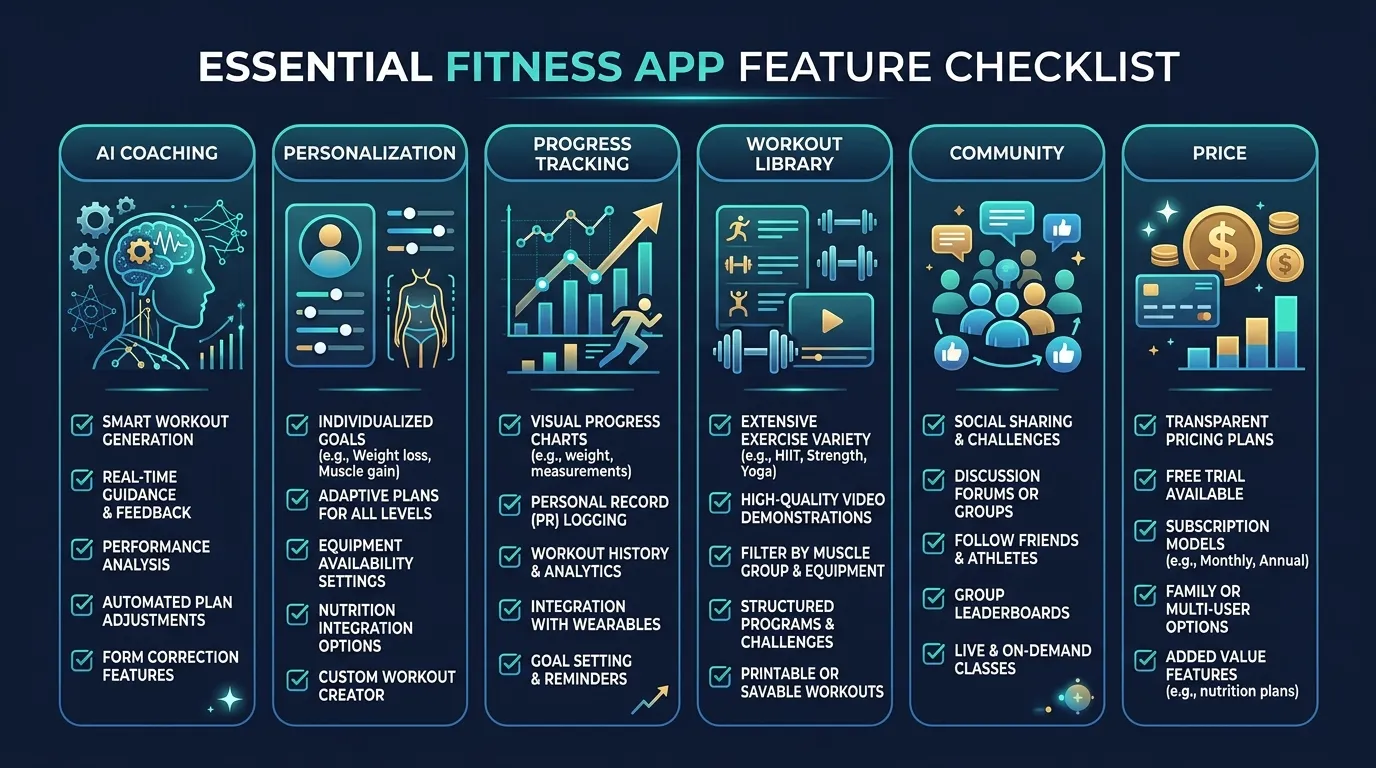
When you strip away the marketing, choosing a fitness app comes down to six factors. Get these right and you dramatically increase your odds of finding something you'll actually stick with.
1. Goal Alignment
What are you actually trying to accomplish? This seems obvious, but most people never get specific. "Get in shape" is a wish, not a goal. Narrow it down:
- Lose weight — You need an app with structured progressive programming and calorie-aware workout design.
- Build strength — Look for apps that support resistance training with dumbbells, bands, or bodyweight and offer progressive overload.
- Improve mobility and flexibility — Yoga and mobility-focused apps, or general apps that include these as workout categories.
- Build a consistent habit — If your core problem is quitting, not capability, prioritize apps built around adherence and behavioral science over raw workout volume.
- General fitness and energy — Look for variety: cardio, strength, dynamic movement, and flexibility in one place.
The right app covers your primary goal without forcing you into a one-size-fits-all program.
2. Workout Preferences
Do you enjoy structured strength training? Yoga flows? High-energy cardio? A mix of everything? The app you choose should offer workout types you'll actually enjoy doing — not just the ones that sound impressive.
Key workout categories to look for:
- Strength training — bodyweight, dumbbells, resistance bands
- Cardio — structured cardio sessions, not just "go run"
- Yoga and mobility — guided flexibility and recovery work
- Dynamic movement — functional, full-body movement patterns
If an app only offers one workout style, you'll plateau — both physically and motivationally. Look for variety within structure.
3. Equipment Compatibility
This is a deal-breaker that people overlook constantly. You download a highly rated app, open it up, and every workout requires a barbell, a squat rack, and a cable machine. Meanwhile, you have a pair of dumbbells and a yoga mat in your living room.
Before committing, verify:
- Does the app work with no equipment (bodyweight only)?
- Does it support basic home equipment (dumbbells, resistance bands)?
- Does it adapt workouts based on what you actually have?
The best apps ask what equipment you have during onboarding and build every workout around your answer — so you never see an exercise you can't do.
4. Motivation Style
This is where most people go wrong. They pick an app that sounds effective without asking: will this keep me coming back?
Different apps use different motivation systems:
- Gamification — XP, leveling up, streaks, collectible rewards, and progress visualization. Best for people who respond to visible progress and game-like feedback loops. In a 2022 randomized comparison, people given the gamified version of a physical activity app kept using it for 113 days on average versus 81 days for the non-gamified version, about 40% longer, though goal adherence itself did not differ between the groups (Maher et al., 2022).
- AI coaching — A personalized coach that adapts encouragement and programming to your behavior and progress. Best for people who want to feel guided rather than left alone with a workout list.
- Community and social — Group challenges, shared feeds, friend accountability. Best for people who are motivated by social connection.
- Data and tracking — Detailed analytics, progress charts, calendar tracking. Best for people who are motivated by numbers and trends.
Be honest with yourself about which category you fall into. If you've quit apps that relied on willpower and self-scheduling, maybe you need gamification or AI coaching — systems that do the motivating for you. Our comparison of the best gamified fitness apps breaks down which apps use these mechanics well.
Not sure which motivation style fits you?
FitCraft's free 2-minute assessment identifies your motivation patterns, goals, and constraints — then matches you with a plan built for how you're actually wired.
Take the Free Assessment Free · 2 minutes · No credit card5. Budget and Value
Fitness apps range from completely free to paid subscriptions. Here's how to think about it:
- Free apps — Good for basic workouts and exploration. Limited personalization and engagement features. Higher dropout rates.
- Mid-range subscriptions — The sweet spot for most people. Expect personalization, adaptive programming, and some form of engagement system (gamification, coaching, or both).
- Higher-end subscriptions — Often includes live classes, extensive libraries, or specialized coaching. Worth it only if you'll use those features regularly.
Context matters: even a mid-range fitness app is dramatically cheaper than a personal trainer or most gym memberships. The question isn't "is it free?" — it's "will I actually use it long enough to see results?"
Always look for a way to try an app before committing. And check whether annual plans offer savings — many apps discount significantly for yearly subscriptions.
6. Personalization Quality
This is the factor that separates apps you'll use for two weeks from apps you'll use for two years. Personalization means the app adapts to you — not the other way around.
Strong personalization includes:
- An initial assessment that evaluates your goals, fitness level, available equipment, and schedule
- Adaptive workouts that adjust based on your progress over time
- Exercise instruction that meets your experience level — whether that's interactive 3D demos you can examine from every angle or detailed text cues
- Scheduling flexibility — the program works around your life, not the other way around
If an app gives every user the same Day 1 workout regardless of their goals, equipment, or fitness level — that's a red flag. The research is clear: personalization is one of the strongest predictors of continued fitness app use (Litman et al., 2021).
A Simple Framework for Choosing
You don't need a spreadsheet. You need five minutes of honesty. Use this framework to narrow your choices quickly.
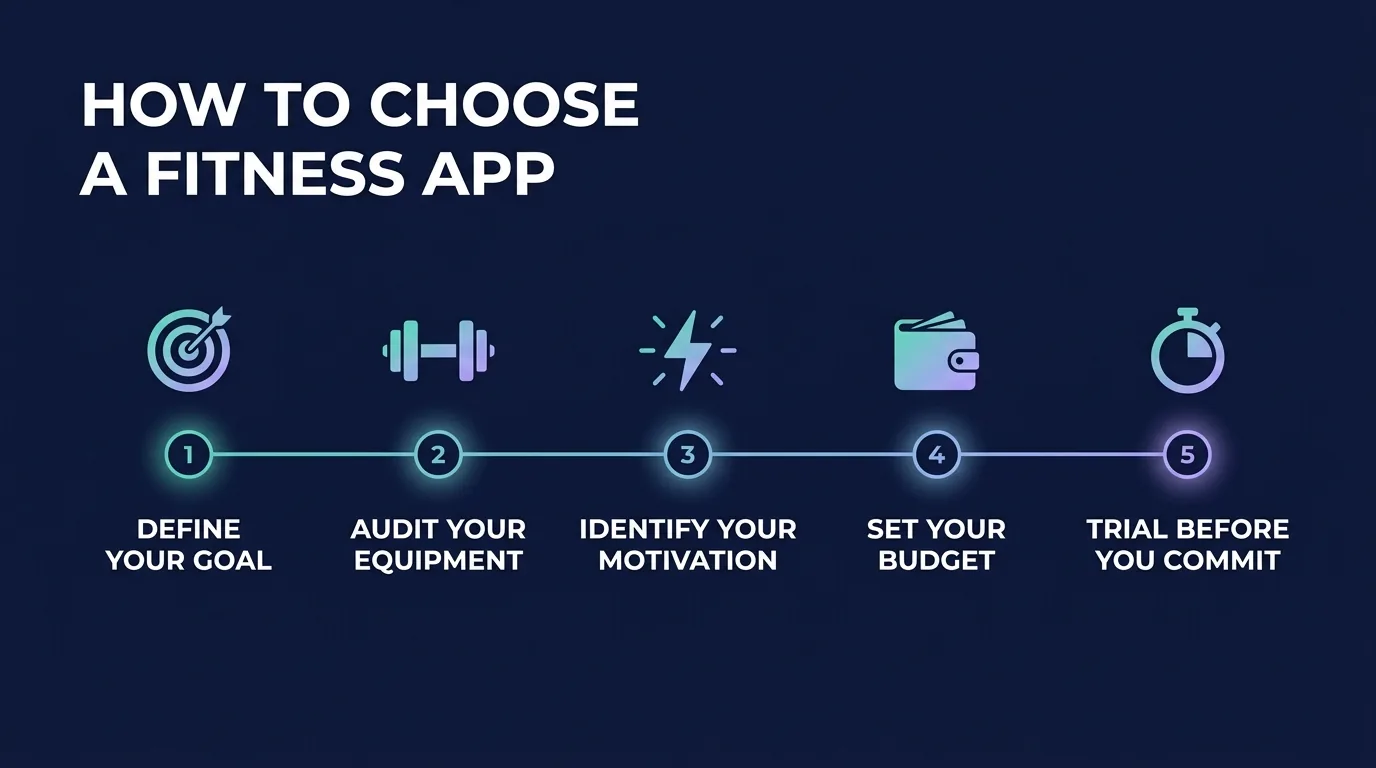
Step 1: Define Your Primary Goal
Pick one. Not three. What is the single most important outcome you want from a fitness app right now? Lose weight? Build strength? Stop quitting? Improve flexibility? Write it down.
Step 2: Audit Your Equipment
Look around your space. What do you actually have access to? No equipment? A set of dumbbells? Resistance bands? A full gym? Be honest — choose an app that works with what you have today, not what you plan to buy someday.
Step 3: Identify Your Motivation Pattern
Think about the last time you stuck with something — a game, a hobby, a habit. What kept you coming back? Was it visible progress? Rewards? A sense of challenge? Social pressure? A guide telling you what to do next? That's your motivation pattern. Find an app that mirrors it.
Step 4: Set Your Budget
Decide what you're willing to spend per month. Remember: the cheapest option is rarely the best value if it doesn't keep you engaged. A paid app you use consistently for a year delivers far more value than a free app you abandon in two weeks.
Step 5: Trial Before You Commit
Try the app before you commit. Most serious fitness apps offer a free assessment or introductory period. During that time, ask yourself three questions:
- Did I enjoy the workouts? (Not "were they effective?" — did I actually enjoy them?)
- Did the app adapt to me, or did I have to adapt to it?
- After three sessions, do I want to open the app again?
If the answer to that third question is yes — you've found your app. If it's no, move on without guilt. The problem wasn't you. It was the match.
What to Expect When You Find the Right Fit
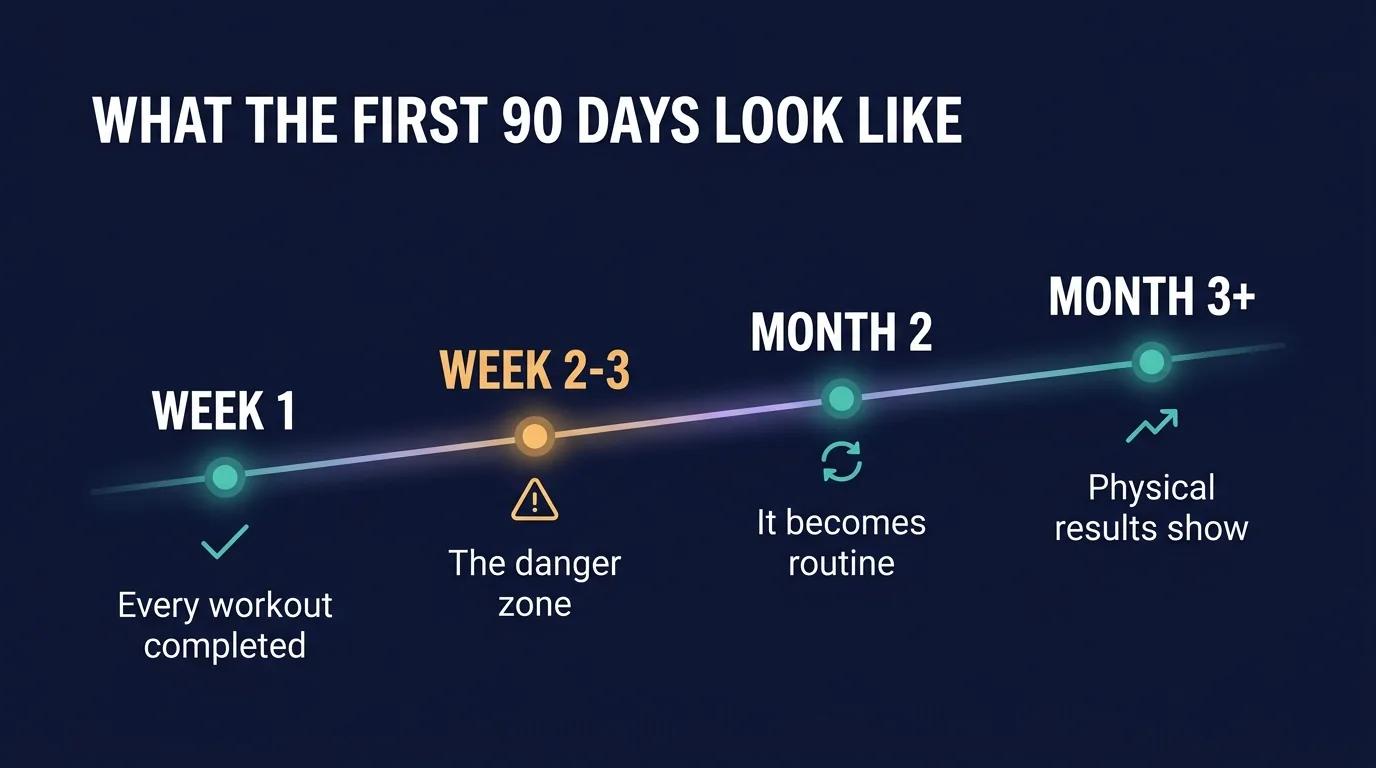
When the app actually matches how you're wired, something shifts. Exercise stops being a negotiation with yourself every morning. Here's what that looks like:
- Week 1: You complete every workout — not because you forced yourself, but because the app made it easy to start.
- Week 2-3: The danger zone. This is where most people quit. But with the right app, there's something pulling you back — a streak you don't want to break, a level you want to reach, a coach that noticed you showed up.
- Month 2: You stop thinking about whether you'll work out. It's just something you do. The app has become part of your routine, not an interruption to it.
- Month 3+: You see physical results. But the bigger win is the identity shift — you're someone who exercises. That's new. And it happened not because you found more willpower, but because you found a better system.
As Matt, a FitCraft user, put it: "The real win is I actually want to work out now. That's never happened before."
How FitCraft Approaches This Problem
FitCraft was built specifically for people who have tried and quit other fitness apps. The approach is different in a few key ways:
- It starts with a diagnostic assessment. A 2-minute quiz that maps your goals, equipment, schedule, fitness level, and motivation patterns — before you ever see a workout. Programs are designed by an Ivy League-trained exercise scientist, NSCA-certified strength coach and adapted to your specific profile.
- Gamification is the core engagement system. XP for every workout. Leveling up as you progress. Collectible cards you earn through consistency. Calendar tracking with rewards for streaks. These aren't gimmicks — they're behavioral science applied to exercise adherence.
- AI coaching through Ty. A personalized AI trainer that provides adaptive encouragement and adjusts your programming based on your progress. Not a chatbot with canned responses — a coach that knows where you are in your journey.
- Interactive 3D exercise demos. Instead of flat videos, FitCraft uses interactive 3D models you can pinch, zoom, and rotate to see every exercise from any angle. You understand the movement before you attempt it.
- Every workout type in one place. Yoga, mobility, strength (bodyweight, dumbbells, resistance bands), cardio, and dynamic movement — all adapted to your equipment and level.
FitCraft isn't the right app for everyone. If you want live classes, a social feed, or a meal-planning tool, it's not built for that. But if your core problem is quitting — if you've started and stopped more times than you can count — it's designed for exactly that pattern.
The Bottom Line
The fitness app market is enormous and growing. That's both good news and bad news. Good: there's almost certainly an app that fits your life. Bad: finding it requires more thought than scrolling the "Top Charts" section of the App Store.
The people who stick with fitness apps long enough to see results aren't more disciplined than you. They found a better match. They chose an app that aligned with their goals, worked with their equipment, matched their motivation style, and adapted as they progressed. If you're brand new to exercise, we ranked the best fitness apps for complete beginners using the same six factors from this guide.
Katie, a FitCraft user, said it simply: "I've tried everything. This is the first time I've stuck with something past two weeks."
You're not broken for quitting before. You just haven't found the right fit yet.
For how FitCraft measures up against that checklist, see our page for first-time app users.
Frequently Asked Questions
What should I look for when choosing a fitness app?
The most important factors when choosing a fitness app are goal alignment, workout variety for your preferences, equipment compatibility, motivation style (whether you respond better to gamification, coaching, or community), budget relative to value, and the quality of personalization. Research shows that perceived enjoyment is the strongest predictor of continued app use, ahead of even perceived usefulness.
Why do most people quit fitness apps?
Over 45% of fitness app users quit after the initial novelty wears off, and more than 50% of new exercisers quit within three months. The most common reasons are lack of personalization (generic programs that do not adapt), boredom from repetitive routines, and choosing an app based on popularity rather than fit for their specific goals, schedule, and motivation style.
Are free fitness apps as good as paid ones?
Free fitness apps can be effective for basic workouts, but they typically lack personalization, adaptive programming, and engagement features that drive long-term consistency. Research shows that users on paid subscription plans retained for an average of 154 days compared to 81 days for free plan users, suggesting that the investment in a paid app may increase commitment and that paid apps tend to offer features that better support adherence.
Do gamified fitness apps actually work better?
Yes, according to multiple studies. A 2022 study in Translational Behavioral Medicine found that users of gamified fitness apps logged more days of usage (113 days vs. 81 days) compared to non-gamified versions. Gamification features like XP, streaks, and collectible rewards tap into intrinsic motivation, making exercise feel less like a chore and more like a challenge worth returning to.
How do I know if a fitness app is right for my fitness level?
Look for apps that include an initial assessment or onboarding quiz that evaluates your current fitness level, goals, available equipment, and schedule. Apps that adapt workouts based on your progress are better suited for long-term use than apps that offer static programs. The best fitness apps meet you where you are and adjust as you improve.